# Blake Harris Law
> The Offshore Asset Protection Law Firm. Experienced attorneys and staff helping high-net-worth individuals protect assets from lawsuits using Cook Islands Trusts.
Site: https://blakeharrislaw.com/
Contact: https://blakeharrislaw.com/contact
## Services
### Cook Islands Trust
URL: https://blakeharrislaw.com/asset-protection/cook-islands-trust
How a Cook Islands Trust protects assets from U.S. creditors — the structure, statutory framework, what it costs, and when it's the right fit.
A Cook Islands Trust is an offshore asset protection trust established under the laws of the Cook Islands, a self-governing nation in free association with New Zealand. It is governed by the International Trusts Act, first enacted in 1984 and strengthened through amendments — most significantly in 1989. What makes it different from every domestic alternative is not its basic structure but the legal environment governing it: a system that does not recognize U.S. court judgments, holds creditors to the standard of proof used in criminal prosecutions, and requires any legal attack to start from scratch under Cook Islands law.
Cook Islands trusts are not about secrecy. They are about jurisdictional strength.
- **Jurisdictional separation.** Cook Islands courts do not recognize or enforce U.S. judgments. A U.S. judgment against you carries no legal weight inside the Cook Islands.
- **Beyond-a-reasonable-doubt evidentiary standard.** A creditor claiming a transfer was fraudulent has to prove it beyond a reasonable doubt — the same standard a prosecutor must meet to convict someone of a crime. In a U.S. civil court, the creditor only has to show the claim is more likely than not.
- **Short statute of limitations.** Most fraudulent-transfer claims must be filed within one to two years. The window closes before most claims can be brought.
- **Duress-clause trustee.** The licensed Cook Islands trustee is contractually required to refuse repatriation instructions given under duress, including U.S. court orders.
- **Tax-neutral.** A Cook Islands Trust does not reduce or increase your U.S. tax obligations. Anyone telling you otherwise is either mistaken or selling something illegal.
- **40-year track record.** No creditor has successfully recovered assets from a properly funded Cook Islands Trust through Cook Islands court proceedings.
### How a Trust Works
A trust is a legal arrangement, not a company or a separate legal person. One party (the settlor) transfers legal ownership of assets to another (the trustee), who manages them for designated beneficiaries. The settlor no longer legally owns the assets, so creditors cannot reach them as if they were the settlor's property.
That division between legal ownership and beneficial enjoyment is the foundational principle of trust law. In an asset-protection context, it is also the mechanism that creates the protection. For the complete step-by-step mechanics, see [How a Cook Islands Trust Works](/articles/how-a-cook-islands-trust-works).
**A statute purpose-built in 1984. Forty-plus years of adverse case law. Zero successful creditor recoveries through Cook Islands courts.**
The Cook Islands did not become the world's most-trusted asset-protection jurisdiction by accident. In the early 1980s, policymakers chose a single objective: build the strongest statutory protection framework available, and defend it. The jurisdiction's courts have applied its laws as intended, its legislature has updated its statutes while preserving the core protections, and its regulatory framework meets international standards for anti-money laundering and transparency — which means the Cook Islands retains access to global banking that more opaque jurisdictions lose.
Its free association with New Zealand, established in 1965, grants the Cook Islands full authority over its legal system while signaling that it operates within a recognized international framework. New Zealand does not govern the Cook Islands — a New Zealand judgment is no more automatically enforceable there than a U.S. one — but the constitutional link provides the credibility and banking relationships that more isolated offshore centers lose. That combination of independence and stability is why experienced asset-protection attorneys direct clients facing serious exposure to the Cook Islands.
### The International Trusts Act
The Cook Islands International Trusts Act is the legal foundation that separates a Cook Islands Trust from every other asset-protection structure. Five features do the work:
- **No foreign-judgment enforcement.** U.S. judgments are not recognized. A creditor must start a new case in Cook Islands courts from scratch.
- **Beyond-a-reasonable-doubt evidentiary standard.** A creditor must prove a fraudulent transfer to the standard a prosecutor needs for a conviction, not merely show it was more likely than not. No other asset-protection jurisdiction imposes a higher burden on creditors.
- **Short statute of limitations.** Generally one to two years from the date of transfer. Once the window closes, Cook Islands courts will not hear the claim.
- **The duress clause.** When a U.S. court orders repatriation, the duress clause activates and the trustee — bound by Cook Islands law, not U.S. orders — is required to refuse. See [Duress Clauses Explained](/articles/duress-clauses-cook-islands-trust).
- **Licensed-trustee oversight.** Trustees must be licensed by the Cook Islands Financial Services Authority, which enforces professional and operational standards.
For a deeper plain-English walk-through of the statute, see [The Cook Islands International Trusts Act 1984](/articles/cook-islands-international-trusts-act-1984).
- **The settlor** creates the trust and transfers assets into it. After transfer the settlor no longer holds legal title and cannot demand distributions. This relinquishment of control is the design feature that makes the structure work.
- **The trustee** holds legal title and manages the assets under fiduciary obligation and Cook Islands law. The trustee must be licensed in the Cook Islands and must exercise genuine independent discretion — not reflexive compliance with the settlor's wishes.
- **The protector** is an optional but common role that provides oversight of the trustee, with limited powers to veto specific decisions or replace the trustee. The protector must be genuinely independent to serve their intended purpose.
- **The beneficiaries** are typically the settlor and family, holding discretionary rather than fixed interests. If a beneficiary cannot compel a distribution, neither can their creditor.
Most structures pair the trust with a Cook Islands LLC: the trust owns the LLC, and the settlor manages the LLC's day-to-day operations until a legal threat activates the duress clause. For the full breakdown, see [Trustee, Protector, and Settlor](/articles/cook-islands-trust-trustee-protector-settlor) and [Cook Islands Trust vs. Offshore LLC](/articles/cook-islands-trust-vs-offshore-llc).
### Funding the Trust
Once a trust is established, its effectiveness depends almost entirely on how it is funded. Cash and securities move into accounts held in the trustee's name. Operating businesses are typically held through a holding entity placed into the trust. Real estate is held indirectly via an LLC. Cryptocurrency requires secure offshore custody and clear ownership documentation.
The single biggest funding variable is timing. The statute of limitations begins running from the date of transfer, so a trust funded today becomes more defensible with every year that passes without challenge. For the full step-by-step, see [Funding a Cook Islands Trust](/articles/funding-a-cook-islands-trust).
Malpractice insurance is a critical first layer, but coverage limits get exceeded and some liabilities fall outside policy coverage entirely. A Cook Islands Trust creates the backstop.
Personal guarantees, piercing the corporate veil, and operational missteps can extend liability past the business entity — into everything you own personally.
Wealth creates a target. The perception of resources alone shapes how aggressively claims get pursued.
Property ownership generates ongoing exposure to tenant disputes, premises liability, and contractual conflicts across every asset in a portfolio.
Concentrated digital-asset wealth is just as vulnerable to civil judgments as a brokerage account — and presents specific custody and reporting questions.
Exposure profiles vary. If you carry meaningful personal liability — professional, contractual, or reputational — the analysis is the same: what would a determined creditor reach?
A Cook Islands Trust is not appropriate for individuals currently facing active criminal charges or government enforcement actions, those attempting to shield assets from an ongoing legal proceeding, or those whose asset base does not justify the cost. If any of those apply, we will tell you directly and recommend an alternative.
Domestic asset-protection trusts (DAPTs) set up in Nevada, Delaware, Alaska, or other DAPT-friendly states are often marketed as a simpler, cheaper alternative to offshore planning. They are not equivalent. A domestic trust exists within the same legal system a U.S. creditor will use to pursue you. U.S. courts can issue orders directly to a domestic trustee, freeze accounts, and override state-level protections under federal bankruptcy law.
| Dimension | Cook Islands Trust | Domestic APT (Nevada, Delaware, Alaska, etc.) |
| ---------------------------------------------------- | --------------------------------------------------- | -------------------------------------------------------------------------- |
| Governing jurisdiction | Cook Islands law; outside the reach of U.S. courts | U.S. state law; fully within the reach of U.S. courts |
| Statute of limitations on fraudulent-transfer claims | 1–2 years from the date of transfer | Up to 10 years under federal bankruptcy law (11 U.S.C. § 548(e)) |
| Evidentiary standard for creditors | Beyond a reasonable doubt | Preponderance of the evidence (some states clear and convincing) |
| Foreign judgment enforcement | Cook Islands courts do not recognize U.S. judgments | Full Faith and Credit applies — any state's judgment is enforceable |
| Federal bankruptcy override | None — trust property sits outside U.S. court reach | Trust assets remain reachable in U.S. bankruptcy proceedings |
| Trustee subject to U.S. court orders | No — licensed Cook Islands fiduciary | Yes — domestic trustee is fully within U.S. jurisdiction |
| Track record under contested litigation | 40+ years of adverse case law; structure has held | Mixed; multiple structural defeats (e.g. _In re Huber_, _In re Mortensen_) |
| Engagement cost at Blake Harris Law | $25,000 setup · $7,000/year | Varies; typically lower upfront with greater downstream exposure |
The same jurisdictional problem applies to **Hybrid DAPTs** and the **Bridge Trust®** model. Both remain fully within U.S. court reach until a creditor event triggers an attempted offshore transition — at the worst possible moment, when fraudulent-transfer scrutiny is most intense. For the full comparison, see [Cook Islands Trust vs. Domestic Asset Protection Trust](/articles/cook-islands-trust-vs-dapt), [The Hybrid DAPT](/articles/hybrid-dapt), and [The Bridge Trust® Analysis](/articles/bridge-trust).
### Cook Islands vs. Other Offshore Jurisdictions
Nevis, Belize, and the Cayman Islands are frequently discussed as alternatives, and each has a genuine niche — Nevis for LLC charging-order strategies at moderate exposure, Belize for cost-sensitive structures, the Caymans for institutional fund vehicles. None combines the Cook Islands' beyond-a-reasonable-doubt creditor standard, categorical non-recognition of foreign judgments, and forty years of adversarial case law.
For head-to-head deep dives, see [Cook Islands Trust vs. Nevis Trust](/articles/cook-islands-trust-vs-nevis-trust) and [Cook Islands Trust vs. Belize Trust](/articles/cook-islands-trust-vs-belize-trust).
CPA filings for the required annual reporting (Form 3520, 3520-A, FBAR, Form 8938) typically run $2,000–$3,000 per year and are filed by your CPA, not by Blake Harris Law. Non-standard structures (multiple entities, operating businesses, unusual assets) may be quoted higher, in writing, before any work begins. For the full pricing breakdown see [Cook Islands Trust Cost Breakdown](/articles/cook-islands-trust-cost-breakdown).
### How to Establish a Cook Islands Trust
The process follows a clear sequence: define objectives, select a licensed Cook Islands trustee, draft the trust deed (including the duress clause and governing-law provisions), complete AML/KYC due diligence, execute the deed and transfer legal title, establish offshore banking, and begin ongoing administration.
For more on selecting who administers the trust, see [Choosing a Cook Islands Trustee Company](/articles/choosing-cook-islands-trustee).
### Tax Reporting for U.S. Clients
A Cook Islands Trust is tax-neutral. The IRS treats it as a grantor trust, which means all income, gains, and deductions flow through to your personal return as if the trust did not exist. The Cook Islands itself imposes no local income, capital-gains, or estate tax on qualifying structures — but your U.S. obligations remain identical.
Annual filings are required: Form 3520, Form 3520-A, FBAR (FinCEN 114), and Form 8938. Filed correctly, these forms do not increase audit risk. For grantor-trust treatment in depth see [Tax Treatment of a Cook Islands Trust](/articles/cook-islands-trust-tax-treatment); for the filing mechanics see [Reporting Requirements: FBAR, Form 3520, Form 8938](/articles/cook-islands-trust-reporting-requirements).
### Confidentiality and Privacy
Cook Islands trusts are not subject to public registration. There is no publicly accessible registry disclosing settlors, beneficiaries, or trust assets, and trustees are bound by strict fiduciary confidentiality obligations. But this confidentiality is not absolute: the Cook Islands participates in the Common Reporting Standard (CRS) and FATCA, so certain financial information is reported to tax authorities through regulated channels. That information is not available to private creditors, civil litigants, or the public.
The result is controlled confidentiality, not anonymity — and secrecy is not the main benefit of a Cook Islands Trust. Structures built on legal strength remain effective even when the trust's existence is known. A creditor can know the trust exists. Reaching the assets is still a separate, very difficult undertaking.
**Step 1 — The creditor wins a U.S. judgment.** They trace your assets and discover the trust — and hit a structural wall: that judgment has no automatic legal force in the Cook Islands. There is nothing to register, and nothing to collect against.
**Step 2 — Their options narrow.** They can ask the U.S. court to pressure you personally — but with a duress clause in place, you no longer have the legal authority to comply; the trustee is required to refuse. Or they can start a new case in Cook Islands courts from scratch: local counsel, the beyond-a-reasonable-doubt standard, and a one-to-two-year statute of limitations. Most creditors never take that step.
**Step 3 — The economics force a resolution.** Asset protection does not need to make recovery impossible; it needs to make it expensive, uncertain, and slow. When a creditor's attorney runs the numbers on Cook Islands litigation against a negotiated settlement, the math almost always favors settlement — most cases end there, before any Cook Islands court is ever engaged.
### Real Case Law
The cases critics cite to argue Cook Islands Trusts do not work — most commonly **FTC v. Affordable Media** (the Anderson case) and **In re Lawrence** — actually demonstrate the structure's strength. In both cases the U.S. court held the settlor personally in contempt for failing to repatriate. But the Cook Islands trustee refused to comply. The assets remained offshore. The structure held.
What failed in those cases was the settlor's ability to demonstrate genuine trustee independence — the court found enough retained practical control to disbelieve the claim of powerlessness. The pattern across every adversarial Cook Islands Trust case is consistent: early establishment, proper funding, genuine trustee independence, and clean documentation produce structures that protect assets. Trusts that cut corners on any of those create personal exposure for the settlor — even when the assets themselves remain offshore and untouched.
For the case-by-case record and the contempt analysis, see [Cook Islands Trust Contempt of Court Cases](/articles/cook-islands-trust-contempt-cases) and [What If a U.S. Court Orders You to Repatriate Trust Assets?](/articles/cook-islands-trust-repatriation-court-order).
### The Three Questions Courts Ask
When a Cook Islands Trust is challenged, courts focus on three things. The last one is usually decisive.
A trust created before a legal problem arises is viewed as legitimate planning. A trust created after a problem appears is viewed through the lens of intent: _why was it done, and what was the settlor trying to avoid?_ These are credibility questions, and credibility is difficult to reconstruct after the fact.
Blake Harris Law does not establish trusts for clients with imminent or pending claims. See [Pre-Litigation Timing and Fraudulent Transfer Concerns](/articles/pre-litigation-fraudulent-transfer-cook-islands-trust).
In asset protection, timing is almost always the hidden variable. The statute of limitations begins running from the date of transfer, so every year that passes without challenge makes the structure more defensible.
Asset protection is not something that happens during a lawsuit. It is something that should exist before one begins. The best time to establish a Cook Islands Trust is when you do not need it. The second best time is now.
The most common failure in asset protection is not a bad jurisdiction or a poorly drafted deed — it is retained control: moving assets out of reach while quietly maintaining authority over them. Courts look for this directly and use it to unravel structures that are otherwise legally sound.
A settlor may remain involved — communicating preferences, articulating investment philosophy, requesting distributions. But that input must leave room for genuine independent judgment by the trustee. Settlors who accept this tradeoff benefit from a structure that has withstood four decades of legal pressure. Those who attempt to preserve both full control and full protection consistently achieve neither.
### What Winning Actually Looks Like
In practice, winning rarely takes the form of a definitive courtroom victory. It is far more often reflected in what does not happen: opposing counsel, on evaluating the structure, confronts recovery that is jurisdictionally complex, procedurally burdensome, and economically inefficient. In many cases this results in quiet abandonment, narrowed claims, or a decision to pursue more accessible defendants.
Asset protection does not eliminate liability; it complicates recovery. And in doing so, it often produces materially better settlement terms. The most effective structures do not produce dramatic courtroom victories. They produce quieter results: cases not filed, claims not pursued, settlements reached on terms that reflect constraint rather than capitulation.
Blake Harris is an asset-protection attorney focused entirely on offshore structures, with a primary concentration in Cook Islands Trusts. Blake maintains a global network of licensed trustees, banking relationships, and international advisors, and has co-founded Atlas Trust Company, a licensed Cook Islands trust company.
Every engagement begins with a direct, honest consultation. We assess your risk profile, explain exactly how a Cook Islands Trust would apply to your situation, and give you a clear answer about whether this structure makes sense for you. If it does not, we will tell you that too, and recommend what does.
_Bridge Trust® is a registered trademark of its owner. The structure was pioneered and popularized by the law firm of Lodmell & Lodmell, and is referenced here for purposes of comparison and commentary._
---
## Team
### Blake Harris — Managing Attorney
URL: https://blakeharrislaw.com/about/blake-harris
Blake Harris is the Managing Attorney at Blake Harris Law, where he assists clients throughout the world with offshore asset protection. Having traveled to over 40 countries, Blake has built an extensive global network by meeting with trust companies, protectors, and bankers worldwide.
Blake is an accomplished author and international speaker. He wrote [_Don't Let a Lawsuit Take Away Everything_](/docs/dont-let-a-lawsuit-take-away-everything.pdf), and his continuing legal education lectures on asset protection and offshore planning have educated countless professionals. He has been quoted in numerous national publications, including Bloomberg, Forbes, The Epoch Times, ABC, NBC, CBS, Fox News, MarketWatch, USA Today, Fortune, Law.com, Law360, Business Insider, Investor's Business Daily, WealthManagement, Financial Planning, GOBankingRates, Authority Magazine, and The Street. He also has a significant social media presence, with hundreds of thousands of followers.
Blake's background is in wealth management. He previously worked with one of America's premier wealth management firms, advising high- and ultra-high-net-worth clients on strategies to safeguard their assets. His passion for helping families cultivate and preserve their legacy inspired him to establish Blake Harris Law. The firm is deeply committed to providing tailored solutions and peace of mind for its clients.
Blake was mentored by the late [Barry Engel](/blog/barry-engel-cook-islands-statute), the Denver attorney widely regarded as the father of offshore asset protection. Engel was one of three co-authors of the 1989 amendments to the Cook Islands International Trusts Act 1984 — the first asset-protection-specific trust statute of its kind, and the model later followed by more than twenty offshore jurisdictions. Every Cook Islands trust this firm establishes today operates inside the statute he helped write.
Blake's commitment to the field doesn't stop at his firm. He has consistently been recognized as a "Rising Star" by Super Lawyers Magazine and holds Martindale-Hubbell's AV® Preeminent™ rating — its highest peer rating for legal ability and ethical standards. He also serves as an industry watchdog helping to identify and prevent fraud in the asset protection field.
Blake is a proud alumnus of the University of Florida, where he earned a degree in finance in 2007. He went on to earn his Juris Doctorate in 2010 from the University of Florida Levin College of Law.
Blake is an active member of the American Bar Association, International Bar Association, the Florida Bar since 2010 (Florida Bar number: 86486), and the Colorado Bar since 2013 (Colorado Bar number: 45942). Blake resides in Miami Beach. In his limited free time, he enjoys traveling internationally, swimming in the ocean, and Muay Thai training.
## Publications
| Book | Year |
| ----------------------------------------------------------------------------- | ---- |
| Don't Let a Lawsuit Take Away Everything | 2023 |
| Asset Protection: How to Protect Your Property from Lawsuits | 2022 |
| The Ultimate Guide to Estate Planning and Asset Protection | 2021 |
| Money Matters: World's Leading Entrepreneurs Reveal their Top Tips to Success | 2020 |
## Speaking Engagements
| Title & Event | Year |
| ------------------------------------------------------------------------------------------------------------------------------------------------------------------------------------------------------------------------ | ---- |
| Offshore Asset Protection: Strategies for Success — Cerifi LegalEdge | 2026 |
| [I'm a Financial Planner: 4 Things You Must Do To Retire a Millionaire](https://www.gobankingrates.com/money/wealth/financial-planner-shares-things-you-must-do-to-retire-millionaire/) | 2026 |
| [Mastering Offshore Asset Protection Strategies — National Academy of Continuing Legal Education](https://www.nacle.com/Media/CourseNotes/CN-INT4300.pdf) | 2026 |
| Asset Protection Strategies for Doctors | 2026 |
| [5 Overlooked Vulnerabilities That Can Jeopardize Your Business Assets](https://www.forbes.com/councils/forbesfinancecouncil/2025/10/02/5-overlooked-vulnerabilities-that-can-jeopardize-your-business-assets/) — Forbes | 2025 |
| [15 Finance Experts Reflect On Early Money Lessons Learned](https://www.forbes.com/councils/forbesfinancecouncil/2025/08/07/15-finance-experts-reflect-on-early-money-lessons-learned/) — Forbes | 2025 |
| Offshore Trusts and Banking: Navigating Compliance Challenges and High-Risk Financial Strategies — Law Practice CLE | 2025 |
| Rewriting the Rulebook for Offshore Asset Protection — USA Today | 2025 |
| Offshore Trusts, Banks, and High-Stakes Compliance Risks — myLawCLE | 2025 |
| Podcast VIP with Joel Evan | 2025 |
| 1% Podcast with Shane Riggs | 2025 |
| 10 Mistakes to Avoid When Working with Asset Protection Trusts — National Academy of Continuing Legal Education | 2025 |
| Offshore Asset Protection — Coffee is for Closures Podcast with Joseph Shalaby | 2025 |
| Outbound Investment Summit, Hong Kong — International Asset Protection Conference | 2025 |
| Utilizing Offshore Trusts and Banks for Keeping Your Client's Assets Protected from Lawsuits — myLawCLE | 2025 |
| The Cook Islands Asset Protection Trust Advantage — Cook Islands Trust Law & Estate Planning Forum | 2024 |
| 10 Mistakes to Avoid When Working with Offshore Trusts — LawPracticeCLE | 2024 |
| Protecting Assets through Trusts and Estates — Rossdale CLE | 2024 |
| Mastering Offshore Trusts: Origins, Mechanics, Mistake Prevention, and Asset Protection Strategies — myLawCLE | 2024 |
| Utilizing Offshore Trusts and Banks for Keeping Your Client's Assets Protected from Lawsuits — Celesq | 2024 |
| Offshore vs. Domestic Asset Protection: What You Need to Know — myLawCLE | 2024 |
| Offshore vs. Domestic Asset Protection: What You Need to Know — LawPracticeCLE | 2024 |
| Offshore vs. Domestic Asset Protection: What You Need to Know — National Academy of CLE | 2024 |
| Offshore vs. Domestic Asset Protection: What You Need to Know — LexVid CLE | 2024 |
| Utilizing Offshore Trusts and Banks for Keeping Your Client's Assets Protected from Lawsuits — Lawline | 2024 |
| Alternative Investments — South Florida Commercial Real Estate Finance Conference | 2023 |
| Offshore Asset Protection — Intrepid Capital | 2023 |
| Exploring Offshore Jurisdiction Choices for Latin America — Private Wealth Latin America & the Caribbean | 2023 |
| Fraudulent Conveyances Uncovered — myLawCLE | 2023 |
| Trust Planning and Asset Protection — Choreo Advisors | 2023 |
| The Investment Landscape — GlobeSt. Multifamily Fall | 2023 |
| International Asset Protection: Using Offshore Trusts and Offshore Banking to Safeguard Assets — National Academy of Continuing Legal Education | 2023 |
| Asset Protection for Cryptocurrency — CO Bar Association TEPS | 2023 |
| Offshore Asset Protection: Exploring the Various Jurisdictions for Protecting Your Client's Assets — LexVid | 2023 |
| Offshore Asset Protection: Exploring the Various Jurisdictions for Protecting Your Client's Assets — myLawCLE | 2023 |
## Media Appearances
| Topic | Outlet |
| -------------------------------------------------------------------------------------------------------------------------------------------------------------------------------------------------------------------------------------------- | ---------------------------------------------- |
| [National Campaign Corrects the Record About the Lawful Use of Foreign Asset Protection Trusts](https://www.prweb.com/releases/national-campaign-corrects-the-record-about-the-lawful-use-of-foreign-asset-protection-trusts-302880415.html) | PRWeb · EIN Presswire (press release) |
| [5 habits rich retirees use to stay wealthy](https://moneywise.com/managing-money/retirement-planning/rich-retirees-habits-successful-retirement) | Moneywise |
| [How Jurisdictional Diversification Can Strengthen An Asset Protection Strategy](https://www.forbes.com/councils/forbesfinancecouncil/2026/09/03/how-jurisdictional-diversification-can-strengthen-an-asset-protection-strategy/) | Forbes |
| [What Entrepreneurs Often Overlook When Structuring Asset Protection Plans](https://www.forbes.com/councils/forbesfinancecouncil/2026/07/08/what-entrepreneurs-often-overlook-when-structuring-asset-protection-plans/) | Forbes |
| [Why Offshore Asset Protection Case Law Is Often Misunderstood](https://www.forbes.com/councils/forbesfinancecouncil/2026/06/05/why-offshore-asset-protection-case-law-is-often-misunderstood/) | Forbes |
| [The Offshore Asset Protection Conversation Every Physician Should Have](https://www.warnerwealthct.com/blog/physician-wealth-meds-are-your-assets-protected-from-a-lawsuit) | Physician Wealth Meds Podcast |
| [Choosing And Changing Your Trustee](https://www.forbes.com/councils/forbesfinancecouncil/2026/03/17/choosing-and-changing-your-trustee-how-to-vet-pay-and-replace-the-key-gatekeeper-in-your-trust/) | Forbes |
| [2025 LexVid Faculty Award Recipient](https://lexvid.com/blog/2025-faculty-awards) | LexVid |
| [Miami Firm Files Suit to Rid 'Rotten Apple' From Asset Protection Industry](https://www.law.com/dailybusinessreview/2025/12/12/miami-firm-files-suit-to-rid-rotten-apple-from-asset-protection-industry/) | Law.com |
| [Florida Asset Protection Law Firm Sues 'Non-Lawyer Competitor' Kevin Wessell for 'False Advertising'](https://www.offshorealert.com/florida-asset-protection-law-firm-sues-non-lawyer-kevin-wessell-for-false-advertising/) | OffshoreAlert |
| [The 8 Life Events Financial Advisers Say Clients Are Least Prepared For](https://www.marketwatch.com/picks/death-disability-lawsuits-the-8-life-events-financial-advisers-say-clients-are-least-prepared-for-f856b605) | MarketWatch |
| [The First 90 Days With An Offshore Trust](https://www.forbes.com/councils/forbesfinancecouncil/2025/12/26/the-first-90-days-with-an-offshore-trust-what-to-do-after-the-ink-dries/) | Forbes |
| [Beyond Insurance: How To Defend Your Business Against Lawsuits](https://www.forbes.com/councils/forbesfinancecouncil/2025/08/05/beyond-insurance-how-to-defend-your-business-against-lawsuits/) | Forbes |
| [Don't Let a Lawsuit Take Away Everything — with Tom Hegna](https://www.prlog.org/13087509) | Financial Freedom with Tom Hegna |
| [The Rhonda Swan Show](https://creators.spotify.com/pod/profile/the-rhonda-swan-show/episodes/The-Rhonda-Swan-Show-Blake-Harris---S10-EP10-e34pvoh/a-ac16239) | Spotify |
| Rewriting the Rulebook for Offshore Asset Protection | USA Today |
| Rhonda Swan Kicks off NYC Media Tour | Business Insider |
| [16 Strategies To Keep Your Retirement Portfolio Growing And Balanced](https://www.forbes.com/councils/forbesfinancecouncil/2025/06/23/16-strategies-to-keep-your-retirement-portfolio-growing-and-balanced/) | Forbes |
| [How To Balance Personalized Financial Advice With Digital Automation](https://www.forbes.com/councils/forbesfinancecouncil/2025/06/13/how-to-balance-personalized-financial-advice-with-digital-automation/) | Forbes |
| The Get Shit Done Experience — Making Millions Cool: Keeping Them | Simplecast |
| [20 Methods to Organize Your Business Finances And Improve Cash Flow](https://www.forbes.com/councils/forbesfinancecouncil/2025/06/05/20-methods-to-organize-your-business-finances-and-improve-cash-flow/) | Forbes |
| [Top 5 Questions To Ask When Considering Offshore Banking](https://www.forbes.com/councils/forbesfinancecouncil/2025/06/10/top-5-questions-to-ask-when-considering-offshore-banking/) | Forbes |
| [The Millionaire Mindset: Fortifying Wealth With Offshore Asset Protection](https://www.forbes.com/councils/forbesfinancecouncil/2025/05/07/the-millionaire-mindset-fortifying-wealth-with-offshore-asset-protection/) | Forbes |
| [Digital Social Hour with Sean Mike Kelly](https://youtu.be/tD65DNOp2hg?si=moLsYtnaI3WHBSdm) | Podcast |
| Dropping Bombs Podcast with Brad Lea | Podcast |
| [Commerce Powers Key In Battle Over Corp. Transparency Law](https://www.law360.com/articles/2292422/commerce-powers-key-in-battle-over-corp-transparency-law) | Law360 |
| [Navigating Domestic And International Regulations For Asset Protection](https://www.forbes.com/councils/forbesfinancecouncil/2025/03/25/navigating-domestic-and-international-regulations-for-asset-protection/) | Forbes |
| Offshore Trusts Explained: A Guide to Asset Protection | The Street |
| [20 Ways Financial Teams Can Communicate More Effectively With Clients](https://www.forbes.com/councils/forbesfinancecouncil/2025/03/21/20-ways-financial-teams-can-communicate-more-effectively-with-clients/) | Forbes |
| [Keeping the Kids: An Advisor's Guide to Retaining Next-Gen Clients](https://www.financial-planning.com/news/keeping-the-kids-an-advisors-guide-to-retaining-next-gen-clients) | Financial Planning |
| [How To Protect Your Real Estate And Hard Assets](https://www.forbes.com/councils/forbesfinancecouncil/2025/02/18/how-to-protect-your-real-estate-and-hard-assets/) | Forbes |
| [Should You Give Your Heirs Their Inheritance With Trump In Office?](https://www.investors.com/etfs-and-funds/personal-finance/inheritance-should-you-give-your-heirs-their-with-trump-in-office/) | Investor's Business Daily |
| [Offshore Asset Protection Strategies Amid Corporate Transparency Act Uncertainty](https://www.wealthmanagement.com/asset-protection/offshore-asset-protection-strategies-amid-corporate-transparency-act-uncertainty) | WealthManagement |
| 10 Mistakes to Avoid When Working with Asset Protection Trusts | National Academy of Continuing Legal Education |
| [The Trump Economy Begins: 3 Money Moves the Upper-Middle Class Should Make](https://www.gobankingrates.com/money/wealth/trump-economy-beginsmoney-moves-the-upper-middle-class-smake-before-inauguration-day/) | GOBankingRates |
| 3 Ways Mark Cuban and Other Millionaires Protect Their Wealth | GOBankingRates |
| Offshore Assets: Americans Create a 'Plan B' | Retirement Daily on The Street |
| [More Rich People Are Using 'Secret' Trusts and LLCs to Hide Money From Their Spouses](https://fortune.com/2024/10/08/ultra-rich-secret-trusts-llcs-hide-money-from-spouses/) | Fortune |
| [Asset Protection Checklist: 5 Must-Haves](https://www.forbes.com/councils/forbesfinancecouncil/2024/09/30/asset-protection-checklist-5-must-haves/) | Forbes |
| [Structuring Trusts in Emerging Markets vs the First World](https://youtu.be/wkvbw9a96IA?si=eGn5sLH-pDP97Cbc) | Offshore Tax with HTJ Tax |
| [Crypto and the Tax Implications of Asset Protection Trusts](https://www.youtube.com/watch?v=Cc1a7LoU7Uo) | Offshore Tax with HTJ Tax |
| [97% Of My Clients I Never Meet In Person](https://open.spotify.com/episode/4BK8aTfGbJfxIMUE8tIpKZ?si=b441bb6284bc499f) | What The Hell Is My Job?! |
| Gen Z Wants an Inheritance. Good Luck With That, Say Their Boomer Parents | USA Today |
| [Personal Banking Vs. Private Banking: What Are The Differences](https://www.supermoney.com/personal-banking-vs-private-banking-what-are-the-differences) | SuperMoney |
| [4 of the Best Polynesian Islands to Visit](https://www.luxurytravelmagazine.com/news-articles/best-polynesian-islands-to-visit) | Luxury Travel Magazine |
| [Great Wealth Transfer: How Boomers Are Passing on Fortunes to Their Heirs](https://www.gobankingrates.com/money/wealth/the-great-wealth-transfer-how-baby-boomers-are-passing-on-fortunes-to-heirs/) | GOBankingRates |
| [How Financial Advisors Help You Avoid Potential Wealth Management Pitfalls](https://financialtechtimes.com/financial-advisors-help-avoid-pitfalls/) | Financial Tech Times |
| [On the Top 5 Mistakes Businesses Make Without Legal Counsel](https://medium.com/authority-magazine/blake-harris-of-blake-harris-law-on-the-top-5-mistakes-businesses-make-without-legal-counsel-7e0db3712616) | Authority Magazine |
| [Integrating Asset Protection Strategies Into Retirement Planning](https://www.forbes.com/sites/forbesfinancecouncil/2024/05/17/integrating-asset-protection-strategies-into-retirement-planning/) | Forbes |
| [What Non-Celebrities Can Learn From Celebrity Lawsuits](https://www.forbes.com/sites/forbesfinancecouncil/2024/03/18/what-non-celebrities-can-learn-from-celebrity-lawsuits/) | Forbes |
| [How To Protect Assets Like A Millionaire](https://www.forbes.com/sites/forbesfinancecouncil/2024/02/13/how-to-protect-assets-like-a-millionaire/) | Forbes |
| [What Is A Cook Islands Trust And How To Use It Properly](https://www.forbes.com/sites/forbesfinancecouncil/2023/04/14/what-is-a-cook-islands-trust-and-how-to-use-it-properly/) | Forbes |
---
### Ali El-Haj — Attorney
URL: https://blakeharrislaw.com/about/ali-el-haj
Ali El-Haj is an asset protection attorney at Blake Harris Law who focuses his practice on wealth preservation for entrepreneurs, high-net-worth families, and international clients. He works on structuring offshore asset protection trusts, including [Cook Islands](/asset-protection/cook-islands-trust) and Nevis trusts, designed to legally protect and preserve wealth across borders.
Ali brings a deeply analytical, global perspective to the firm. His approach focuses on listening closely to each client's needs and goals to design tailored structures that provide lasting security and peace of mind.
## Background & Experience
Prior to joining Blake Harris Law, Ali built an extensive foundation in academic research and complex global legal frameworks. He served as a research fellow at the Max Planck Institute for Comparative Public Law and International Law in Heidelberg, Germany, and lectured in law at Humboldt University of Berlin. He also practiced at various international law firms, including in international arbitration.
## Education & Honors
Ali holds an LL.M. from the University of Cambridge and an LL.B. from University College London (UCL), where he graduated with First Class Honours. He was awarded the John Frederic Whitehouse Essay Award for the best LL.B. dissertation of his graduating class. Ali is licensed to practice law in New York State.
## Speaking Engagements
| Title | Event | Date |
| ------------------------------------------------------------------------------------------------ | ------------------------------------------------------ | -------------- |
| Designing Effective Offshore Trust Structures | Cerifi LegalEdge | May 13, 2026 |
| Offshore Asset Protection: Strategies for Success | Cerifi LegalEdge | April 3, 2026 |
| Mastering Offshore Asset Protection | National Academy of Continuing Legal Education (NACLE) | March 4, 2026 |
| Offshore Trusts and Banking: Navigating Compliance Challenges and High-Risk Financial Strategies | LawPractice CLE | August 4, 2025 |
| Offshore Trusts, Banks, and High-Stakes Compliance Risks | myLawCLE | June 24, 2025 |
---
### Fidel Morales — Attorney
URL: https://blakeharrislaw.com/about/fidel-morales
Fidel Morales is an Attorney at Blake Harris Law who has helped individuals, families, and business owners safeguard their wealth, preserve their legacy, and plan confidently for the future since joining the firm in 2015. Over more than a decade of practice, he has built a reputation for guiding clients through intricate planning decisions with clarity and confidence.
Fidel takes a comprehensive approach to each client relationship, developing customized legal strategies that align with long-term personal and financial goals. He believes that real asset protection is not reactive — it is built on a foundation of thoughtful, forward-looking legal strategy implemented well before a threat arises.
## Practice Areas
Fidel's practice encompasses [international asset protection planning](/asset-protection/cook-islands-trust), trust and estate planning, business entity structuring, and the proactive implementation of offshore protection solutions designed to shield wealth. He has advised high-net-worth clients, entrepreneurs, and professionals across a wide range of industries — from real estate and finance to healthcare and technology.
## Background & Experience
Fidel is known for his ability to simplify complex legal concepts and walk clients through difficult planning decisions step by step. He is fully fluent in English and Spanish, allowing him to serve a diverse clientele and communicate complex legal concepts effectively across language and cultural barriers.
## Education
Fidel holds a Juris Doctorate from the University of California, Berkeley School of Law and an undergraduate degree from the University of Southern California.
## Bar Admissions
Fidel is an active member of both the Arizona and Colorado Bar Associations, staying current on evolving laws and regulations that impact his clients' planning strategies.
---
### Christine Newbrough — Paralegal
URL: https://blakeharrislaw.com/about/christine-newbrough
Christine is a dedicated Paralegal at Blake Harris Law, where she has continued to develop both professionally and personally throughout her years with the firm. Since joining the BHL team in 2019, Christine has become an integral part of the practice, contributing to the firm's commitment to providing high-quality legal services and exceptional client support. Her strong work ethic, attention to detail, and client-focused approach have allowed her to grow into a trusted member of the legal team and an important resource for the clients she serves each day.
In her role as a paralegal, Christine works closely with clients to assist them with a variety of legal matters related to asset protection planning, trust documentation, and ongoing compliance needs. She understands that navigating legal and financial planning can often feel overwhelming for individuals and families, which is why she takes pride in helping clients feel informed, supported, and confident throughout the process. Her ability to communicate clearly and compassionately allows her to build strong relationships with clients while ensuring that every detail of their legal documentation is handled carefully and accurately.
Christine's experience in asset protection planning has enabled her to assist clients in organizing and safeguarding their assets for the future. She plays an important role in preparing and reviewing trust documentation, helping clients establish plans that align with their long-term goals and personal circumstances. In addition, she assists with ongoing compliance matters, helping ensure that clients remain organized and up to date with the requirements related to their legal structures and planning strategies. Her thoroughness and reliability help contribute to the seamless operation of the firm and the positive experiences of the clients she supports.
Since becoming part of the firm in 2019, Christine has embraced opportunities to learn and expand her legal knowledge. Over the years, she has demonstrated a strong commitment to professional growth and continuous improvement. Her willingness to take on new challenges and responsibilities has allowed her to become a valuable contributor within the firm's collaborative environment. Colleagues appreciate her positive attitude, strong organizational skills, and dedication to helping both clients and team members succeed.
Christine earned her Bachelor of Arts degree in Criminology from the University of Northern Iowa in 2018. Her educational background provided her with a strong foundation in critical thinking, communication, and the legal system, all of which continue to support her work as a paralegal today. Her studies in criminology helped her develop an understanding of legal processes, research methods, and analytical problem-solving skills that translate effectively into her daily responsibilities within the legal field.
Outside of the office, Christine enjoys maintaining a balanced and fulfilling personal life centered around family, friendships, and hobbies she genuinely loves. One of her favorite pastimes is cooking and baking new recipes. She enjoys experimenting in the kitchen, trying different cuisines, and creating meals and desserts that she can share with loved ones.
Her warm personality, professionalism, and dedication to helping others make Christine an important part of the Blake Harris Law team. She approaches every task with care and integrity, always striving to provide excellent support to both clients and colleagues.
---
### Connor Hunter — Paralegal
URL: https://blakeharrislaw.com/about/connor-hunter
Originally from Chicago, IL and now based in Miami Beach, Florida, Connor Hunter combines technical prowess with a client-focused approach, honed through diverse experiences in technology and customer service. With a background in Computer Science, Connor brings a unique analytical perspective to the firm.
Connor builds and maintains the firm's digital presence, including the Blake Harris Law website and the [Asset Protection Conference website](https://assetprotectionconference.com). His work spans content, SEO, performance, and integrations, from the article library and the Cook Islands Trust resource pages to the contact-form pipeline that connects inquiries to the firm's CRM. Being responsible for both properties gives him a working understanding of how the firm's online education, lead intake, and event marketing fit together, which translates into faster turnaround when the legal team needs new pages, articles, or campaigns deployed.
Beyond the digital work, Connor has invested in firsthand exposure to the jurisdictions and counterparties the firm works with. He has traveled to the Cook Islands to meet with the trustees, protectors, and local counsel who administer the offshore structures BHL establishes for clients. These face-to-face relationships matter. Much of offshore asset protection comes down to trust, and the firm's ability to introduce clients to people we have met personally is a meaningful part of what we offer. Connor has also met with a number of Swiss private bankers. Switzerland remains one of the most important offshore banking jurisdictions for U.S. clients, and these relationships make it easier for the firm to coordinate banking arrangements that complement the trust structures we draft.
Connor is currently pursuing a Bachelor of Science in Accounting, with the intent to attend law school. The accounting background is deliberate: asset protection, trust administration, and offshore tax reporting all sit at the intersection of law and accounting, and the firm's clients are often best served by attorneys who can read a balance sheet and a Form 3520 with equal fluency.
Outside of work, Connor is a Muay Thai fighter with a 2–0 record, a motorcycle enthusiast, and manages his own servers at home to keep up to date on all things tech.
---
### Eli Johnson — Paralegal
URL: https://blakeharrislaw.com/about/eli-johnson
Eli Johnson joined Blake Harris Law in September 2025 as a paralegal, where he quickly took on a wide range of responsibilities across client services and digital marketing.
On the legal side, Eli manages initial consultation calls, handles client intake, assists with document preparation, and supports attorneys throughout the client onboarding process — gaining direct, hands-on experience in offshore asset protection law from day one.
On the digital front, Eli owns the firm's social media strategy end to end — recording, editing, and publishing content across Instagram, TikTok, Threads, and YouTube to grow Blake Harris Law's online presence and generate leads among high-net-worth professionals.
Currently enrolled at Santa Fe College pursuing a business foundation, Eli is on a deliberate academic track: transferring to the University of Florida to complete a Finance degree, followed by UF Levin College of Law. His path is intentional: build the business acumen, earn the legal credentials, and become the kind of attorney who understands both the law and the wealth it protects.
Eli brings a rare combination of real-world legal experience and modern marketing instincts to the firm — and he's just getting started.
---
### Zach Nord — Fractional CFO
URL: https://blakeharrislaw.com/about/zach-nord
Zach Nord is a Fractional CFO at Blake Harris Law, where he focuses on the firm's internal financial operations — strategic planning, budgeting, forecasting, and financial analysis. He has a strong interest in [offshore asset protection structures](/asset-protection/cook-islands-trust) and the long-term financial security they can provide when properly implemented.
A Swedish native, Zach relocated to the United States to pursue higher education and a career in finance. Raised in Sweden, he moved to Miami to attend the University of Miami, where he earned a degree in Quantitative Economics.
## Background & Experience
After graduation, Zach worked in finance at a Fortune 500 company, gaining experience across corporate finance, financial analysis, budgeting, forecasting, and operational strategy. He brings that same analytical, forward-looking approach to his work at Blake Harris Law.
## Beyond the Office
Outside of his professional career, Zach is deeply involved in martial arts and fitness. After participating in a variety of sports throughout his life, he developed a passion for Muay Thai and has trained consistently for nearly a decade. Alongside his own training, he dedicates time to coaching and mentoring others — helping students build discipline, confidence, and technical skill.
In his personal time, Zach maintains a strong interest in global economics, financial markets, geopolitics, and international business, continuously expanding his understanding of the forces shaping the modern economy.
## Education
Zach holds a degree in Quantitative Economics from the University of Miami.
---
### Jennifer Dela Cerna — Paralegal
URL: https://blakeharrislaw.com/about/jennifer-dela-cerna
Jennifer Dela Cerna is a paralegal at Blake Harris Law who assists clients throughout the onboarding and trust establishment process, facilitating communication and support for offshore asset protection structures. She works closely with clients to help ensure a smooth experience while navigating due diligence requirements, documentation, and trust-related matters.
## Background & Experience
Prior to joining Blake Harris Law, Jennifer built a diverse legal background through litigation, legal aid, and private practice in the Philippines. As a licensed attorney, she gained experience handling a wide range of legal matters and developed a strong foundation in client advocacy and legal support.
In addition to private practice, Jennifer has remained active in legal service and community involvement. From 2024 to 2025, she served as Legal Aid Deputy Director and IBP Board Director with the Integrated Bar of the Philippines – Misamis Oriental Chapter, where she participated in legal outreach initiatives and pro bono efforts focused on expanding access to legal services. For the 2025–2027 term, she currently serves as an IBP Board Director for the Integrated Bar of the Philippines – Misamis Oriental Chapter. She also serves as Secretary of the Xavier Ateneo Law Alumni Association Incorporated (XALAAI).
## Education & Interests
Jennifer earned her Juris Doctor from Xavier University – Ateneo de Cagayan School of Law. Before pursuing law, she earned a Bachelor's Degree in Music Education, major in Voice, Cum Laude, from the University of Santo Tomas Conservatory of Music.
Outside of work, Jennifer enjoys traveling, singing karaoke, and playing pickleball. A fun fact about her journey: before entering the legal profession, she spent years studying music and voice performance, making law her second stage.
---
## Articles
### Understanding IRA Protections: Federal and State Rules
URL: https://blakeharrislaw.com/blog/understanding-ira-protections
Published: 2026-10-21T00:00:00.000Z
Updated: 2026-10-21T00:00:00.000Z
How IRA creditor protection actually works - ERISA vs. IRAs, the federal bankruptcy cap, state opt-outs, rollover tracing, and the inherited-IRA trap.
---
### Judgment-Proof: What It Means and How People Get There Legally
URL: https://blakeharrislaw.com/blog/judgment-proof
Published: 2026-10-19T00:00:00.000Z
Updated: 2026-10-19T00:00:00.000Z
A judgment gives a creditor the right to seize your assets. Being judgment-proof means they cannot collect. How exemptions, LLCs and trusts get people there.
---
### What Is Equity Stripping?
URL: https://blakeharrislaw.com/blog/equity-stripping-asset-protection
Published: 2026-10-19T00:00:00.000Z
Updated: 2026-10-19T00:00:00.000Z
Equity stripping attaches legitimate debt to an asset so little equity is left for a creditor, then moves the loan proceeds somewhere protected. How it works.
---
### Is Umbrella Insurance Enough?
URL: https://blakeharrislaw.com/blog/is-umbrella-insurance-enough
Published: 2026-10-15T00:00:00.000Z
Updated: 2026-10-15T00:00:00.000Z
Umbrella insurance adds coverage above your home, car and boat policies, but it does not protect the assets themselves. How it works and where it falls short.
---
### Does the 10-Year Bankruptcy Lookback Reach a Hybrid DAPT?
URL: https://blakeharrislaw.com/blog/hybrid-dapt-10-year-lookback
Published: 2026-10-13T00:00:00.000Z
Updated: 2026-10-13T00:00:00.000Z
A Hybrid DAPT is built to sit outside the Bankruptcy Code's 10-year rule for self-settled trusts. Whether it does depends on one word in the statute.
---
### What the $7,000 Annual Fee for a Cook Islands Trust Pays For
URL: https://blakeharrislaw.com/blog/cook-islands-trust-annual-fee
Published: 2026-10-10T00:00:00.000Z
Updated: 2026-10-10T00:00:00.000Z
Blake Harris Law's Cook Islands Trust annual fee is a flat $7,000. Here is where each dollar goes, what it includes, what it does not, and how it compares.
---
### Why I Co-Founded Atlas Trust Company
URL: https://blakeharrislaw.com/blog/why-i-co-founded-atlas-trust-company
Published: 2026-10-08T00:00:00.000Z
Updated: 2026-10-12T00:00:00.000Z
A Cook Islands Trust is only as good as its trustee. Blake Harris on the experience that led him to co-found Atlas Trust Company, and what it was built to do.
---
### What Is Asset Protection?
URL: https://blakeharrislaw.com/blog/what-is-asset-protection
Published: 2026-10-08T00:00:00.000Z
Updated: 2026-10-12T00:00:00.000Z
Asset protection is arranging your financial affairs so your home, business and other assets are harder to seize in a lawsuit. The main strategies and timing.
---
### Exemption Planning: What State Law Already Protects
URL: https://blakeharrislaw.com/articles/exemption-planning
Published: 2026-10-08T00:00:00.000Z
Updated: 2026-10-08T00:00:00.000Z
Exemption planning starts with what the law already protects from creditors: a qualifying home, retirement accounts, and smaller exemptions most people miss.
Exemption planning is the use of protections that state and federal law already provide, before any trust or entity is considered. Every state exempts some property from the claims of most creditors, and the first step in any [asset protection plan](/blog/what-is-asset-protection) is to find out how much of a person's wealth those exemptions may already cover.
This page explains the two largest exemptions, homestead and retirement accounts, the smaller ones that are often overlooked, and where exemption planning stops.
- **Exemptions come first:** State and federal law already put some property beyond the reach of most creditors, at no cost and with no new structure.
- **Homestead and retirement accounts carry most of the value:** A qualifying home and qualifying retirement accounts are often the largest protected assets, though the amounts vary widely by state.
- **The smaller exemptions are modest but real:** Vehicles, household goods, and jewelry are often protected only up to a few thousand dollars, while a few items, such as a wedding ring or a family Bible in some states, have no dollar limit.
- **Converting assets to dodge a creditor can be undone:** Florida, for example, lets a creditor reverse a conversion into exempt property made with intent to hinder, delay, or defraud.
- **An asset protection trust has real costs and real tradeoffs:** It is irrevocable, requires independent trustee involvement, carries ongoing costs, and cannot properly be used to defeat a known creditor.
## What is exemption planning?
It is planning around the property the law already protects. A creditor who wins a judgment can generally collect from a debtor's non-exempt property, while exempt property is generally off the table. Exemption planning asks two questions. Which assets already qualify, and could more of a person's wealth qualify, legitimately and in advance?
Consider a hypothetical. A surgeon in Florida owns a $2 million home on a quarter-acre lot, holds $1.5 million in a 401(k), drives a $60,000 car, and keeps $3 million in a brokerage account. Under [Florida law](/articles/florida-asset-protection), the home's equity and the 401(k) are generally protected. Only $5,000 of the car is, and none of the brokerage account. About half of the surgeon's wealth sits inside an exemption.
Now change one fact. The same surgeon lives in Pennsylvania, which has no homestead exemption beyond a $300 general exemption. Unless the home is held in a form that protects it some other way, its $2 million of equity may be reachable, and the protected share falls by more than half. The assets are identical. The state is not.
The state you live in decides most of the answer. That is the first rule of exemption planning.
## Homestead: usually the largest exemption
For most people, the home is the largest exempt asset. Florida and Texas protect a qualifying primary residence without a dollar cap, within acreage limits. Most other states cap the exemption, and the caps vary widely, from $5,000 in Kentucky to $1,000,000 for a declared homestead in Massachusetts. Some states also require a recorded declaration before the protection attaches.
Bankruptcy adds a federal limit. Under [11 U.S.C. § 522(p)](https://www.law.cornell.edu/uscode/text/11/522), equity acquired within 1,215 days before filing is generally capped at $214,000, whatever the state allows. Our [homestead guide](/articles/homestead-asset-protection) lists every state's figure, checked against each statute in October 2026.
## Retirement accounts: usually the second
Retirement accounts are often the next-largest exemption. Employer plans covered by ERISA, such as most 401(k)s, are generally protected by federal law. IRAs depend more on state law outside bankruptcy, and that protection ranges from unlimited, to a dollar cap, to amounts reasonably necessary for support.
In bankruptcy, federal law protects traditional and Roth IRAs up to $1,711,975 for cases filed on or after April 1, 2025, and SEP, SIMPLE, and rollover funds without that cap. Our [retirement asset protection guide](/articles/retirement-asset-protection) covers each state's rules.
## The smaller exemptions
Beyond the home and retirement accounts, most exemptions are small. They exist to leave a debtor the basics of daily life, not to shelter wealth. They are still worth knowing, because they apply without any planning and cost nothing.
These examples were checked against each statute in October 2026:
| Asset | Where | Protected amount |
| --------------------------------------- | --------------------------------------------------------------------------------------------------------------- | ---------------------------------------------------- |
| Motor vehicle | [Florida](https://www.leg.state.fl.us/statutes/index.cfm?App_mode=Display_Statute&URL=0200-0299/0222/0222.html) | $5,000, one vehicle |
| Motor vehicle | [Kansas](https://www.ksrevisor.gov/statutes/chapters/ch60/060_023_0004.html) | $20,000, one vehicle |
| Motor vehicle | New York | $5,500 |
| Motor vehicle | Federal bankruptcy exemptions | $5,025 |
| Personal property | Florida | $1,000, plus $4,000 if no homestead is claimed |
| Wedding and engagement rings | [Virginia](https://law.lis.virginia.gov/vacode/title34/chapter3/section34-26/); New York (wedding ring) | No dollar limit (in New York, outside bankruptcy) |
| Family Bible | Virginia; Texas (religious texts) | No dollar limit |
| Jewelry | Federal bankruptcy exemptions | $2,125 |
| Household goods | Federal bankruptcy exemptions | $800 per item, $16,850 in total |
| Life insurance cash value and annuities | Florida | No dollar limit |
| 529 plans and health savings accounts | Florida | No dollar limit |
| Head-of-family wages | Florida | Generally exempt up to $750 a week of disposable pay |
Three federal protections apply in every state. Social Security benefits are exempt under [42 U.S.C. § 407](https://www.law.cornell.edu/uscode/text/42/407). Veterans' benefits are exempt under 38 U.S.C. § 5301, except from claims of the United States. And for ordinary debts, federal law generally caps wage garnishment at 25% of disposable earnings ([15 U.S.C. § 1673](https://www.law.cornell.edu/uscode/text/15/1673)), with higher limits for support orders. Our page on [public benefits exemptions](/articles/public-benefits-exemptions) covers these in more detail.
## Can someone simply move wealth into exempt assets?
It is tempting to conclude that the answer is to move everything into exempt property, by paying down the mortgage, funding an annuity or buying a larger home. The idea has three limitations.
First, most exemptions have caps, and the smaller ones are small. Second, many of the most valuable assets people own, such as brokerage accounts, business interests, and second homes, generally have no exemption at all. Third, and more importantly, a conversion made to defeat a creditor can be undone.
Florida's statute on [fraudulent asset conversions](https://www.leg.state.fl.us/statutes/index.cfm?App_mode=Display_Statute&URL=0200-0299/0222/0222.html) lets a creditor reverse a conversion into exempt property if the debtor made it "with the intent to hinder, delay, or defraud the creditor," even when the creditor's claim arose after the conversion.
This is significant because timing, again, decides the outcome. In other words, the same move can be ordinary planning years before any dispute and a reversible conversion after a demand letter.
## Where exemption planning stops
Exemptions protect a floor, not a fortune. For someone whose wealth is mostly a qualifying home and qualifying retirement accounts, state law may already do most of the work, and a trust may add cost without adding much protection. That is a real advantage of living in a strong-exemption state.
However, for someone with significant assets outside those categories, such as liquid investments or the proceeds of a business sale, the exemptions may leave most of that wealth exposed. That is where an offshore trust such as a [Cook Islands Trust](/asset-protection/cook-islands-trust) may address what the exemptions leave.
It is irrevocable, requires independent trustee involvement, carries ongoing costs, and cannot properly be used to defeat a known creditor. We decline engagements structured to defeat a known creditor.
Exemption planning, then, is less a strategy than an inventory of which assets the law already protects, in which state, and up to what amount. It costs nothing to take, and it is worth taking before any claim exists.
---
### Offshore Broker: What Its Own Terms Say
URL: https://blakeharrislaw.com/blog/offshore-broker-terms-of-use
Published: 2026-10-06T00:00:00.000Z
Updated: 2026-10-06T00:00:00.000Z
Offshore Broker sells Cook Islands Trusts from $10,000. What its own Terms of Use say about legal advice, oversight, liability and where disputes go.
---
### Offshore Trust Cases, Category by Category
URL: https://blakeharrislaw.com/articles/offshore-trust-cases
Published: 2026-10-06T00:00:00.000Z
Updated: 2026-10-06T00:00:00.000Z
Every case on the circulating 45-case list, what actually happened, and why it is not a failure of a properly formed offshore asset protection trust.
The 45-case list organizes its entries into the categories below. Here is every case, what actually happened, and why it is not a failure of a properly formed offshore asset protection trust.
## TICC in the Cases Themselves
[TICC](/blog/four-rules-of-offshore-trusts) is Timing, Illegal, Comply, Control - the four things that decide these cases. Read together, the cited decisions are a catalog of TICC conduct. Each is an execution or conduct failure, not a failure of offshore trust law:
- **T, timing.** Funding a trust after a judgment (_Legendre_, _Solow_), during litigation (_Allen_, _Weese_), or amid an investigation (_AmeriDebt_) invites ordinary fraudulent-transfer law, offshore or not.
- **I, illegal conduct.** Tax evasion and fraud prosecutions (_Thompson_, _Butselaar_, _Schneider_) involve crimes, not asset protection.
- **C, comply.** Bankruptcy fraud and non-disclosure (_Brennan_, _Portnoy_, _Colburn_) are failures to comply with an obligation under oath, and are the opposite of how legitimate planning works, in the open. Where a settlor was jailed rather than sanctioned, it was for refusing an order he could have obeyed.
- **C, control.** Settlors who kept protector powers with repatriation authority (_Affordable Media_), trustee-appointment and beneficiary powers (_Lawrence_), or de facto direction of distributions (_Rogan_, _Grant_) gave courts the very handle used against them.
## Contempt of Court
The pattern in this category: a U.S. court orders repatriation, the settlor's own conduct (retained control, concealment, non-credible impossibility claims) leads to a contempt finding, and the trust assets stay offshore.
| Case | What happened | Why it is not a trust failure |
| ----------------------------------------------------------------------------------------------------------------------------------- | ------------------------------------------------------------------------------------------------------------------------------------------------------------------------------------------------------------------------------------------------------------------- | --------------------------------------------------------------------------------------------------------------------------------------------------------------------------------------------------------------------------------------------------------------------------------------------------------------------------------------------------------------------- |
| _[FTC v. Affordable Media](https://law.justia.com/cases/federal/appellate-courts/ca9/98-16378/98-16378.html)_ (the _Anderson_ case) | Telemarketing-scheme defendants were held in contempt after refusing to repatriate; they were the trust's protectors with power to force repatriation, had pulled over $1M from the trust, and tried to resign as protectors only after the FTC exposed their role. | A properly structured trust would never leave the settlors holding protector powers that let them force repatriation. Retained control, not structural failure. |
| _[In re Lawrence](https://law.justia.com/cases/federal/appellate-courts/F3/279/1294/505921/)_ | Trust funded two months before a $20.4M arbitration award the settlor plainly anticipated; he kept the power to appoint trustees and exclude or reinstate beneficiaries; held in contempt. | A fraudulent, settlor-controlled trust, funded on the eve of a known award with retained powers the court used to reject his impossibility defense. |
| _[SEC v. Bilzerian](https://law.justia.com/cases/federal/district-courts/FSupp2/112/12/2521435/)_ | Contempt turned on his refusal to provide a sworn accounting after a $62M judgment; the court froze proceeds of his U.S. mansion. | The court never reached the offshore corpus. The one reachable asset was U.S.-situs real estate, a vulnerability of holding domestic property, not a defect in the trust. |
| _BankFirst v. Legendre_ | Nassau trust created shortly after a $650k judgment; the trust paid his personal bills; jailed five days for withholding information. | A textbook fraudulent conveyance, post-judgment funding, retained beneficial use, and the assets and key players never left U.S. reach. |
| _Barbee v. Goldstein_ | Colorado RICO case; the settlor was jailed for non-compliance and secured release by paying ~$586k; his trustee and protector then consented to winding up the trust. | The offshore barrier was never tested on its own terms: the trustee _consented_ to liquidation. A structural failure of that trust, not one inherent to a correctly implemented offshore trust. |
| _Chadwick v. Green_ | Fourteen years of confinement for refusing to return ~$2.5M to a divorce court. | No trust was involved at all: the money sat in offshore annuities and a Panamanian bank account he controlled and simply refused to repatriate. |
| _[SEC v. Solow](https://law.justia.com/cases/federal/appellate-courts/ca11/08-13014/200813014-2011-02-28.html)_ | After a securities verdict, assets moved to his wife, who settled a Cook Islands trust; he was held in contempt for making no reasonable effort to recover what he had transferred to her. | No order ran against the Cook Islands trustee and Cook Islands law was never applied. The transfers that funded the trust were attacked directly, though: the SEC brought a separate fraudulent-transfer and equitable-lien action against Mrs. Solow. A timing failure, not a jurisdiction failure. |
| _Morris v. Morris_ | Post-nuptial forfeiture dispute; by her own account she was jailed for indirect criminal contempt, failing to appear in court. | The contempt was for failing to appear, not for the trust, which (administered by Southpac) was never set aside. The parties settled. |
| _Morris v. Wroble_ | Not a separate chart entry. | The chart lists it with _Morris v. Morris_ as one entry. The HTJ Tax list splits the pair. |
| _Eulich v. U.S._ | IRS document-production fight over a Bahamian trust; escalating fines until he produced the documents. | He was ultimately able to obtain and produce every requested document, exactly what a properly structured trust allows, while the underlying assets stayed protected. |
| _FTC v. AmeriDebt_ | Trusts in Delaware, Nevis, and the Cook Islands created within two months of FTC Civil Investigative Demands; the defendant was later jailed for concealing _other_ assets. | Trusts created in the teeth of an investigation, and the contempt turned on concealment of other assets, not any failure to repatriate the Nevis or Cook Islands trusts. |
## Fraudulent Conveyance
| Case | What happened | Why it is not a trust failure |
| ------------------------------------------------------------------------------------------- | ------------------------------------------------------------------------------------------------------------------------------------------------------------------------------- | ----------------------------------------------------------------------------------------------------------------------------------------------------------------------------------------------------------------------------------------------------- |
| _Brown v. Higashi_ | Belize trusts found property of the bankruptcy estate; transfers fraudulent and self-settled; the settlor retained complete control while the foreign trustee was a figurehead. | A properly structured trust vests assets in an independent foreign trustee holding them offshore. Here the settlor controlled U.S.-based accounts himself. |
| _Fortney v. Kuipers_ | Post-accident transfers to family and friends, then bankruptcy. | Domestic transfers only, no offshore trust is involved. |
| _Advanced Telecommunications Network v. Allen_ | Funds wired into two self-settled Cook Islands trusts after suit was filed and while a freeze motion was pending; contempt followed. | Fraudulent-transfer timing, not advance planning. And despite years of repatriation orders, the creditor never recovered the trust funds, the corpus went undisturbed. |
| _Rush University v. Sessions_ | Illinois court held a self-settled trust reachable for a $1.5M pledge. | The trust's assets were all U.S.-situs, Illinois real estate and a Colorado partnership interest, reachable regardless of the Cook Islands governing-law clause. Offshore in name only, and the opinion reflects no actual invasion of the principal. |
| _[BB&T v. Hamilton Greens (Bellinger)](/blog/bbt-hamilton-greens-bellinger-offshore-trust)_ | Creditor moved for contempt after the debtor funded a Cook Islands trust mid-litigation; the court held a hearing and **denied** the motion. | Actually a win for the offshore trust: the court credited that the debtor could not compel the trustee, and the creditor offered no evidence of retained control. |
## Bankruptcy
| Case | What happened | Why it is not a trust failure |
| ------------------------------------------------------------- | ------------------------------------------------------------------------------------------------------------------------------------------------------------------------------- | --------------------------------------------------------------------------------------------------------------------------------------------------------------------------------------------------------------------------------------- |
| _[In re Portnoy](http://www.uniset.ca/lloydata/201BR685.htm)_ | Channel Islands trust funded as his loan guarantee was about to be called; he made himself primary beneficiary, kept sweeping control, and failed to disclose it in bankruptcy. | Retained control plus non-disclosure: the two things a properly structured, properly disclosed trust never involves. |
| _SEC v. Brennan_ | Gibraltar trust funded with ~$4M in bearer bonds near the end of his SEC trial; omitted from his bankruptcy petition; he was convicted of bankruptcy fraud. | Intentional concealment on bankruptcy schedules is a crime. It says nothing about lawful, disclosed planning. |
| _In re Colburn_ | Discharge denied for false oaths and concealment regarding a Bermuda trust. | The court found the trust's assets were **not** proven to be property of the estate, he lost his discharge for concealment, not because the trust failed. |
| _In re Brooks_ | Counted as a separate failure. | A duplicate of _Sattin v. Brooks_ below. |
| _In re Rensin_ | Florida-law ruling that a self-settled discretionary trust's assets were reachable in principle. | The corpus remained undisturbed, the court dismissed the declaratory claim because the trustee, an indispensable party, had never been joined. |
| _In re Cyr_ | Bankruptcy trustee's fraudulent-transfer claims allowed to proceed against a Texas family trust. | A domestic Texas trust created by the debtor's in-laws, and the ruling was a motion to dismiss; nothing was decided on the merits. |
| _Sattin v. Brooks_ | Stock certificates held property of the estate on a choice-of-law ground (Connecticut public policy vs. Bermuda/Jersey law). | The trust corpus remained undisturbed notwithstanding the order, and a properly formed offshore trust would not have left the settlor with such broad beneficiary rights. |
| _In re Smith_ | Cook Islands trust formed three days before a judgment was finalized for appeal; involuntary bankruptcy followed. | The settlor was pushed into involuntary bankruptcy, but no facts suggest the trust corpus was disturbed. (The list cites this entry as "In re Schmidt", no case by that name could be located; this appears to be the matter intended.) |
## Divorce
| Case | What happened | Why it is not a trust failure |
| ------------------------------------------------------------------------------------------------------------------------------------------------ | ----------------------------------------------------------------------------------------------------------------------------------------------------------- | ------------------------------------------------------------------------------------------------------------------------------------------------------------------------------------------------------------------------------------------------------------------------ |
| _[Riechers v. Riechers](https://caselaw.findlaw.com/court/ny-supreme-court/1125069.html)_ | Cook Islands trust funded almost entirely with marital assets; the divorce court awarded the wife half their value. | The court accepted the trust as legitimate, disclaimed jurisdiction over its corpus, and entered a $2M in personam equitable-distribution award against the husband personally, without invading or setting aside the trust. |
| _Westrate v. Westrate_ | Husband secretly moved 90% of marital assets (~$11M) into a Cook Islands trust that did not name his wife as beneficiary; she learned of it in the divorce. | The case settled and the trust assets remained untouched. A drafting and disclosure failure toward a spouse, not a piercing. |
| _Breitenstine v. Breitenstine_ | Bahamas trust funded with marital assets; Wyoming courts found fraudulent conveyance and awarded the wife half the marital estate. | The Wyoming court could not, and did not, directly alter title to the Bahamian res or bind the foreign trustee, it reached the corpus only indirectly through coercive orders against the husband, and recovery still depended on his compliance. |
| _[Marriage of Harnack](https://law.justia.com/cases/illinois/court-of-appeals-first-appellate-district/2022/1-21-0143.html)_ (the _Fanady_ case) | Divorce court awarded shares locked in a Belize trust; the husband was jailed until he transferred the stock or its value. | The court never reached the Belize corpus, the trustee invoked the trust's duress clause and refused. The court coerced the husband personally, finding he had the means and had never claimed poverty. |
## Tax Evasion
| Case | What happened | Why it is not a trust failure |
| ----------------------- | -------------------------------------------------------------------------------------------------------------------------------------------------------------------------- | -------------------------------------------------------------------------------------------------------------------------------------------------------------------------- |
| _U.S. v. Thompson_ | The treasure-hunter defendant moved disputed gold coins into a Belize trust, absconded, pleaded guilty to criminal contempt, then broke his plea agreement and was jailed. | Not an offshore-trust-on-the-merits case at all: the trust's validity was never litigated, and he was jailed for refusing to honor his plea agreement. |
| _U.S. v. Butselaar_ | Criminal prosecution of a tax advisor who built offshore structures to conceal over $100M of client income from the IRS. | Not an asset protection case, a criminal tax-fraud prosecution of the _advisor_ for concealment structures, with no creditor or trustee ever trying to reach trust assets. |
| _Jerome Schneider case_ | Criminal prosecution of a promoter who sold sham offshore banks with a "decontrol" process designed to conceal ownership and evade tax. | No offshore asset protection trusts were involved, the structures were sham banks and corporations, and the case is a fraud prosecution of their promoter. |
## Regulatory Enforcement
| Case | What happened | Why it is not a trust failure |
| ------------------------- | --------------------------------------------------------------------------------------------------------------------------------------------------------------------------------------- | ------------------------------------------------------------------------------------------------------------------------------------------------------ |
| _FTC v. Fortuna Alliance_ | Pyramid-scheme funds moved to an Antiguan bank; repatriated under a settlement. | There was no trust at all, corporate funds in an offshore bank account in the company's own name. |
| _SEC v. Greenberg_ | Unpaid SEC judgment; evidence showed he was living lavishly through a Gibraltar trust he treated as his personal account; his impossibility defense failed and he was held in contempt. | Not a failure of an offshore asset protection trust, the sanction ran against Mr. Greenberg personally, and recovery still depended on his compliance. |
| _SEC v. Cook_ | Fraudulent-investment-scheme defendant jailed for failing to repatriate ~$46M from offshore accounts. | Money sitting in offshore bank accounts and entities he personally controlled, not a trust with an independent trustee. |
## Piercing Offshore Trusts / Court Orders
| Case | What happened | Why it is not a trust failure |
| -------------------------------------------------------------------------------------------------------- | ------------------------------------------------------------------------------------------------------------------------------------------------------------------------------------------------------------------------------------------------ | ---------------------------------------------------------------------------------------------------------------------------------------------------------------------------------------------------------------------------------------------------------------------- |
| _[U.S. v. Grant](/blog/us-v-grant-arline-grant-offshore-trust)_ | $36M tax judgment; the surviving spouse was held in contempt after transfers from the offshore trusts to herself (through her children's accounts) showed she retained the power to reach the assets. | A personal-conduct failure on the settlor's side, her own transfers revealed apparent control, and valid federal tax liens had already attached. Not a structural defeat of the offshore jurisdiction. |
| _U.S. v. Plath_ | Contempt for failing to comply with IRS summonses about offshore accounts. | Offshore _credit-card accounts_ with a Bahamas trust company, no offshore asset protection trust involved. |
| _U.S. v. Rogan_ | $64M Medicare-fraud judgment; Bahamian trusts found to be the debtor's alter ego. | The FBI documented that he directly or indirectly directed ~$8.15M of distributions to himself, retained substantial control, the defining opposite of proper structuring. |
| _Indiana Investors (Hammon-Whiting; Fink)_ | Domestic trusts designed to shift control offshore upon "duress"; restraining orders froze everything before the shift occurred. | The trusts were domestic until triggered, control never left the United States, so U.S. courts retained full authority. An argument against trigger-style structures, not against trusts already offshore. |
| _[Gilmore Bank v. AsiaTrust](https://law.justia.com/cases/california/court-of-appeal/2014/g048053.html)_ | California appellate court held the New Zealand trustee subject to California personal jurisdiction based on its extensive California business contacts. | A jurisdictional holding only, a court finding it has jurisdiction over a foreign trustee does not mean the trust corpus was reached in any way. |
| _Bank of America v. Weese_ | Cook Islands trust funded (~$25M) starting the day arbitration notice was sent; after a $17.6M award, litigation in Maryland and the Cook Islands settled for ~$13M. | The trust corpus remained undisturbed, and the matter concluded with a consensual settlement, which does not alter that conclusion. |
| _Netsphere v. Baron_ | In a bankruptcy fight, the sole beneficiary of a Cook Islands trust (trustee: SouthPac) directed a $330k distribution to a court officer as security; the Fifth Circuit later reversed the receivership and ordered ~$1.6M released back to him. | The $330k was a voluntary beneficiary distribution, precisely what a properly formed trust permits, not a coerced extraction. No other trust asset was reached, and on appeal the corpus and trust-owned entities remained beyond the court's grasp. |
## Other Notable Outcomes
| Case | What happened | Why it is not a trust failure |
| -------------------------- | --------------------------------------------------------------------------------------------------------------------------------------------------------------------------------------- | --------------------------------------------------------------------------------------------------------------------- |
| _In re Omegas Group_ | A bankruptcy court imposed a constructive trust over $302k from a commercial deal; the Sixth Circuit reversed. | No offshore asset protection trust exists in this case, it is a constructive-trust dispute. |
| _FDIC v. Lewis_ | $66M in judgments; creditors traced a St. Vincent trust and Isle of Man company and moved for repatriation, which the court **denied**, directing them to exhaust other remedies first. | The court left the trust intact. And the structure was post-claim fraud on creditors, not bona fide advance planning. |
| _In re Steering Committee_ | Counted among the 45. | The case could not be located despite extensive research; the search is ongoing. |
| _In re Tinsley_ | Counted among the 45. | The case could not be located despite extensive research; the search is ongoing. |
---
### The Cook Islands Trust Bond Requirement: What the Law Actually Says
URL: https://blakeharrislaw.com/articles/cook-islands-trust-bond-requirement
Published: 2026-10-04T00:00:00.000Z
Updated: 2026-10-04T00:00:00.000Z
Is there a $100,000 bond to sue a Cook Islands Trust? No - that figure comes from Nevis law. What the Act actually requires is security set by the court.
A claim circulates in asset-protection marketing that a creditor must post a $100,000 bond before suing a Cook Islands Trust. The number is real - but it belongs to a different statute, on a different island.
- **There is no fixed statutory bond in the Cook Islands.** Nothing in the International Trusts Act 1984 or any of its amendments specifies a dollar amount. The widely repeated $100,000 figure comes from Nevis legislation and has been misattributed to the Cook Islands in marketing material.
- **Security is still required - the court sets it.** Under section 13K, a challenging creditor's affidavit must address the security to be paid, and the High Court of the Cook Islands fixes the amount on the facts of each case.
- **Rulings are sealed, so there is no published "going rate."** Practitioners involved in these proceedings report orders in the range of USD 20,000 to 40,000, assessed against the size and complexity of the claim.
- **The bond was never the real barrier.** Before quantum even matters, a creditor must sue in the Cook Islands within strict time limits, prove intent to defraud beyond reasonable doubt, and clear threshold tests before obtaining discovery or any interim order.
- **A discretionary bond is not a weaker one.** A fixed bond is a known price a well-funded creditor can budget for. The Cook Islands regime cannot be bought past, because its strength lies in the substantive tests, not the entry fee.
## Where the $100,000 Figure Actually Comes From
The $100,000 bond is a feature of **Nevis** law, not Cook Islands law. Section 61 of the Nevis International Exempt Trust Ordinance requires a creditor to post a bond of EC$270,000 - US$100,000 at the pegged rate - before bringing any action or proceeding against **Nevis trust property**.
It is a genuine and deliberate deterrent, and we set out the statutory text alongside the Cook Islands position in our comparison of [Cook Islands Trusts and Nevis trusts](/articles/cook-islands-trust-vs-nevis-trust).
Be precise about the structure. This is a **trust** provision. The Nevis Limited Liability Company Ordinance fixes no bond amount at all - its section 62 leaves the sum to the High Court, and applies at enforcement rather than at the start of an action. Quoting $100,000 against a Nevis LLC is wrong on both the amount and the trigger.
At some point, commercial marketing material began attaching that Nevis number to the Cook Islands, and the claim has been repeated enough to read like settled fact. It is not. We reviewed the [International Trusts Act 1984](/articles/cook-islands-international-trusts-act-1984) and every amending Act - 1989 (twice), 1991, 1995–96, 1999, 2004, and 2013 - and no provision anywhere in that body of law fixes a bond amount.
This article exists because precision about case law and statutes is the standard we hold others to, and it applies equally to claims that flatter our own jurisdiction of choice.
## What the Act Actually Requires
The relevant provision is **section 13K**, inserted by the International Trusts Amendment Act 1991. It works like this:
1. **Any action to set aside a transfer to a Cook Islands international trust must be brought in the High Court of the Cook Islands**, within two years of the settlement or disposition. Foreign judgments carry no force; the creditor starts over, in Rarotonga.
2. **Before the Court will make any order at all** - including interim remedies such as freezing (Mareva) injunctions or search (Anton Piller) orders - it must first be satisfied, [beyond reasonable doubt](https://www.law.cornell.edu/wex/beyond_a_reasonable_doubt), on the creditor's own affidavit, that the action is not precluded by the Act.
3. **That affidavit must address "the quantum of security to be paid by the plaintiff"** under section 13K(4)(c). The amount is left entirely to the discretion of the High Court, fixed on the facts of each case - the size of the claim, the complexity of the proceedings, and the anticipated costs exposure of the trustee and settlor.
So the accurate statement is this: a creditor challenging a Cook Islands Trust should expect to post security, in an amount the court sets, before the case proceeds. What no one can accurately say is that the statute prices it at $100,000 - or at any other figure.
## What Security Orders Look Like in Practice
Because proceedings under sections 13B and 13K are sealed and confidential, there is no published body of quantum decisions and no verifiable "going rate." Offshore counsel involved in these cases report security orders in the range of **USD 20,000 to 40,000** - meaningful, but anecdotal, and dependent on the facts of each matter.
Any source quoting a precise universal figure for Cook Islands security is describing something the sealed record cannot support.
## The Bond Was Never the Real Barrier
Focusing on the bond misunderstands why creditors so rarely pursue Cook Islands Trusts. Security for costs is the smallest of the hurdles. Before or alongside it, a challenging creditor faces the Act's substantive tests:
- **A criminal-law standard of proof in a civil case.** Under section 13B, the creditor must prove _beyond reasonable doubt_ that the transfer was made with the settlor's principal intent to defraud _that specific creditor_, and that it left the settlor unable to meet the claim. The [burden of proof](https://www.law.cornell.edu/wex/burden_of_proof) rests on the creditor throughout.
- **Short, hard time limits.** A transfer cannot be challenged as fraudulent if it occurred more than two years after the creditor's cause of action accrued - and even inside that window, the creditor must file within one year of the transfer. We cover how this interacts with U.S. fraudulent-transfer doctrine in [our fraudulent-transfer analysis](/articles/pre-litigation-fraudulent-transfer-cook-islands-trust).
- **No fishing expeditions.** Discovery and other interlocutory remedies are unavailable until the creditor's affidavit clears the section 13B thresholds - the Act is expressly designed to prevent a creditor from suing first and searching for evidence second.
- **A foreign forum at the creditor's expense.** All of this happens in the Cook Islands, with Cook Islands counsel, against a trustee with no U.S. presence.
Each of these operates independently. A creditor who can comfortably fund any bond still has to win under that standard, inside those windows, without discovery to build the case.
## Why a Discretionary Bond Is Not a Weaker One
It is tempting to read "Nevis: $100,000 bond" against "Cook Islands: amount discretionary" and score the round for Nevis. That reading gets the economics backwards.
A fixed statutory bond is a **known price**. A creditor with a large claim and deep pockets can budget it on day one; it deters small claims and does little else. Discretionary security under section 13K scales with the case in front of the court - and it sits on top of a substantive regime that money cannot buy past.
The Cook Islands' four-decade record against creditor challenges rests on the beyond-reasonable-doubt standard, the limitation periods, and the non-recognition of foreign judgments - the architecture examined across [our review of the case law](/articles/case-law-cit) - not on the size of the entry fee.
Both jurisdictions are credible. But choosing between them on the bond alone is like choosing a safe by the price of the parking space in front of it. For how the full structures compare - trustee ecosystems, statute maturity, charging-order rules - see [Cook Islands Trust vs. Nevis Trust](/articles/cook-islands-trust-vs-nevis-trust), or start with [the Cook Islands Trust overview](/asset-protection/cook-islands-trust).
## The Bottom Line
There is no $100,000 bond to sue a Cook Islands Trust - that figure is Nevis law, misattributed. What the Cook Islands requires is security in an amount its High Court sets case by case, layered beneath statutory tests that are far more consequential than any bond: proof of fraud beyond reasonable doubt, one-to-two-year limitation windows, no discovery without threshold proof, and no recognition of the judgment the creditor already holds.
Getting the statute right matters - and it leaves the Cook Islands' position stronger, not weaker.
---
### Why the Cook Islands Is Considered the Asset Protection Gold Standard
URL: https://blakeharrislaw.com/blog/cook-islands-gold-standard
Published: 2026-10-02T00:00:00.000Z
Updated: 2026-10-02T00:00:00.000Z
The Cook Islands is often called the gold standard for offshore asset protection trusts. The statute, the case record and the limits behind that reputation.
---
### The Magic Pink Pony Trust Has Never Failed (Because It Doesn't Exist)
URL: https://blakeharrislaw.com/blog/magic-pink-pony-trust
Published: 2026-10-01T00:00:00.000Z
Updated: 2026-10-01T00:00:00.000Z
A trust that has never failed may simply never have been tested. A fictional trust shows why to judge the structure, not the name.
---
### Three Asset Protection Trust Claims, Fact-Checked
URL: https://blakeharrislaw.com/blog/three-asset-protection-trust-claims-fact-checked
Published: 2026-09-29T00:00:00.000Z
Updated: 2026-09-30T00:00:00.000Z
A Massachusetts firm's article makes three claims about offshore trusts and DAPTs. What the courts and the DAPT statutes actually say about each.
---
### Bridge Trust® vs. Cook Islands Trust: Full Offshore vs. On Standby
URL: https://blakeharrislaw.com/blog/bridge-trust-versus-cook-islands-trust
Published: 2026-09-29T00:00:00.000Z
Updated: 2026-09-30T00:00:00.000Z
A Bridge Trust stays domestic until a trigger fires. Why a Cook Islands Trust, offshore from day one, avoids the conversion window a court can freeze.
---
### Why Focus Matters in Foreign Asset Protection
URL: https://blakeharrislaw.com/blog/why-focus-matters-foreign-asset-protection
Published: 2026-09-27T00:00:00.000Z
Updated: 2026-09-27T00:00:00.000Z
A response to Jay Adkisson on where asset protection fits. Why a firm that does one thing may serve a client better than one that offers everything.
---
### Why a Cook Islands Trust Beats a Hybrid DAPT
URL: https://blakeharrislaw.com/blog/cook-islands-trust-vs-hybrid-dapt
Published: 2026-09-26T00:00:00.000Z
Updated: 2026-09-30T00:00:00.000Z
A Hybrid DAPT keeps the settlor out of the trust to stay protected. What that costs in access and gift tax exemption, and how a Cook Islands Trust differs.
---
### Asset Protection Marketing That Doesn't Hold Up
URL: https://blakeharrislaw.com/blog/asset-protection-marketing-claims
Published: 2026-09-25T00:00:00.000Z
Updated: 2026-09-29T00:00:00.000Z
Claims we have checked against the decisions and the source documents, what we found, and the questions worth asking any provider before you hire one.
---
### The Risks of a 541 Trust
URL: https://blakeharrislaw.com/blog/risks-of-a-541-trust
Published: 2026-09-23T00:00:00.000Z
Updated: 2026-09-23T00:00:00.000Z
A 541 Trust is a branded irrevocable trust built on Section 541(b)(1) of the Bankruptcy Code. What it is, and the risks to weigh before you commit.
---
### Tribal LLC vs. Offshore Trust
URL: https://blakeharrislaw.com/blog/tribal-llc-vs-offshore-trust
Published: 2026-09-22T00:00:00.000Z
Updated: 2026-09-22T00:00:00.000Z
Tribal LLCs and offshore trusts are sold with the same language. What tribal sovereign immunity actually covers, and why an offshore trust works differently.
---
### Has a Foreign Trust Ever Failed?
URL: https://blakeharrislaw.com/blog/has-a-foreign-trust-ever-failed
Published: 2026-09-22T00:00:00.000Z
Updated: 2026-09-22T00:00:00.000Z
The cases critics cite against offshore trusts, from FTC v. Affordable Media to In re Rensin, and what they actually show about timing and control.
---
### Cook Islands Trust Registrations Hit a Record. What We Have Built
URL: https://blakeharrislaw.com/blog/cook-islands-trust-registrations-record
Published: 2026-09-22T00:00:00.000Z
Updated: 2026-09-22T00:00:00.000Z
New Cook Islands international trust registrations rose 42 percent to a record 433. What the figures show, what they do not show, and what our firm has built.
---
### Offshore Trusts Have a Mixed Reputation. What's True and What Isn't
URL: https://blakeharrislaw.com/blog/offshore-trusts-reputation
Published: 2026-09-18T00:00:00.000Z
Updated: 2026-09-18T00:00:00.000Z
Panama Papers, Hollywood, and the contempt cases. What the offshore trust reputation gets right, what it gets wrong, and where the industry earns it.
---
### Asset Protection for Licensed Professionals
URL: https://blakeharrislaw.com/articles/asset-protection-for-licensed-professionals
Published: 2026-09-18T00:00:00.000Z
Updated: 2026-09-23T00:00:00.000Z
A professional entity does not cover a professional's own conduct. Where that leaves personal wealth, and guides for four professions.
Licensed professionals often have risks that follow them personally. Insurance can cover many claims, and a PLLC, PC, or other entity can protect against certain obligations of the practice. Neither necessarily keeps a professional's personal assets out of reach when the professional is individually liable.
For someone who has accumulated significant wealth, that can leave a meaningful amount exposed even with a well-structured practice. State exemption laws may protect some of it. Other assets may need additional protection before a claim ever arises.
The guides below explain how those concerns apply to different professions and when an offshore trust may be worth considering.
## The One Thing Every Licensed Professional Shares
A business entity can separate many practice liabilities from personal assets, but it does not eliminate a licensed professional's personal responsibility for the professional's own negligence or wrongful conduct.
A PLLC, PC, or other professional entity still has an important role. It can keep many ordinary obligations of the practice separate from the owners and provide a structure for ownership and management.
What it cannot generally do is insulate a professional from liability for that person's own work. The exact protection also varies by state and by the type of professional entity involved.
The first priority is reducing the risk itself. That means carrying appropriate insurance, keeping the practice or business entity in good standing, using sound contracts, and identifying property that state law already protects.
An offshore trust becomes relevant when a professional has substantial personal wealth left exposed after those steps. It needs to be established while the concern is still about future risks rather than a creditor claim that has already developed.
## What Asset Protection Generally Looks Like for Professionals
Insurance and the business or professional entity usually do most of the work at the beginning. From there, it makes sense to identify assets that state law already protects.
Depending on the state, that may include some [home equity](/articles/homestead-asset-protection), [retirement savings](/articles/retirement-asset-protection), wages, life insurance, annuities, or jointly owned property. Assets that already have strong protection may not need to be moved into a trust - benefits under an [ERISA-qualified plan](https://www.law.cornell.edu/uscode/text/29/1056), for instance, generally may not be assigned or alienated.
An offshore asset protection trust enters the discussion when substantial assets remain exposed after those protections are applied.
We work with offshore structures in the [Cook Islands](/asset-protection/cook-islands-trust), Nevis, and Belize, with the Cook Islands serving as the firm's primary jurisdiction for asset protection trusts. The economics generally make sense for people with roughly $500,000 or more in personal assets at meaningful creditor risk.
A standard Cook Islands Trust costs $25,000 to establish, plus $7,000 in annual trustee, legal, and Protector fees and typically $2,000 to $3,000 annually for [CPA reporting](/articles/cook-islands-trust-cost-breakdown).
An offshore trust is not appropriate when the exposed assets do not justify those costs or when someone is trying to move assets beyond the reach of a known creditor. We decline engagements structured to defeat a known creditor.
## Asset Protection by Profession
### Dentists
Dentists combine personal malpractice exposure with the risks of owning a healthcare business. Practice debt, personal guarantees, associates, employees, premises liability, and DSO transactions can create risks separate from clinical care.
Read: [Asset Protection for Dentists](/articles/asset-protection-for-dentists)
### Contractors
Contractors face long-tail construction defect claims and personally guaranteed surety obligations in addition to ordinary business risk. Bond indemnity can create direct personal exposure that survives the contractor's LLC or corporation.
Read: [Asset Protection for Contractors](/articles/asset-protection-for-contractors)
### Tech Professionals
Tech professionals may hold much of their wealth in restricted stock units (RSUs), stock options, concentrated employer stock, and cryptocurrency. Equity-plan transfer restrictions, securities rules, taxes, and crypto custody make these assets different from ordinary cash or brokerage investments.
Read: [Asset Protection for Tech Professionals](/articles/asset-protection-for-tech-professionals)
### Business Owners
Business owners can face personal guarantees, employment claims, partner disputes, personal-side judgments, and potential veil-piercing claims. An LLC provides important protection, but it does not insulate an owner from every source of personal liability.
Read: [Asset Protection for Business Owners](/articles/asset-protection-for-business-owners)
---
### Will an Offshore Trust Get You Audited?
URL: https://blakeharrislaw.com/blog/will-an-offshore-trust-get-you-audited
Published: 2026-09-17T00:00:00.000Z
Updated: 2026-09-17T00:00:00.000Z
The IRS knows about your offshore trust because you tell them. What it prosecutes is evasion - and the red flags that mean you are being sold something else.
---
### Questions for Anderson Business Advisors
URL: https://blakeharrislaw.com/blog/anderson-business-advisors-questions
Published: 2026-09-17T00:00:00.000Z
Updated: 2026-09-22T00:00:00.000Z
Anderson's Terms say it is not in the business of providing Legal Services, while its marketing calls it a legal and tax firm. Questions worth asking first.
---
### Why Offshore Trust Reporting Works in Your Favor
URL: https://blakeharrislaw.com/blog/offshore-trust-reporting-works-in-your-favor
Published: 2026-09-16T00:00:00.000Z
Updated: 2026-09-17T00:00:00.000Z
Most people treat foreign-trust filings as the price of going offshore. They are closer to part of the product - the paper trail that makes a plan defensible.
---
### New York Asset Protection
URL: https://blakeharrislaw.com/articles/new-york-asset-protection
Published: 2026-09-16T00:00:00.000Z
Updated: 2026-09-16T00:00:00.000Z
New York's exemptions are narrow and EPTL 7-3.1 voids self-settled trusts. What state law protects, and where an offshore trust fits.
New York gives residents some protection against creditors, but those protections are relatively limited, and the state does not allow someone to place their own assets into a self-settled trust and keep them protected from creditors. For people with significant wealth outside the state's exemptions, that can make an offshore asset protection trust worth considering.
The tradeoff is that offshore planning has to be done before a specific creditor problem develops. It also comes with meaningful setup and annual costs, federal reporting requirements, and a transfer of legal ownership to an independent trustee.
New York does protect part of a primary residence, certain personal property, and a portion of wages. Those protections are generally narrower than what residents may have in states such as [Florida](/articles/florida-asset-protection) or Texas. This page explains what New York law protects, where the gaps remain, and when an offshore trust may make sense.
- **New York exemptions leave substantial assets exposed:** homestead, personal-property, and wage protections are limited by statutory dollar amounts and other restrictions.
- **New York rejects self-settled creditor protection:** EPTL §7-3.1 makes a trust created for the settlor's own use void against the settlor's existing and future creditors.
- **Third-party trusts are different:** New York provides protections for certain trust interests when the beneficiary did not create the trust for himself or herself.
- **Offshore trusts can address the remaining exposure:** substantial non-exempt wealth may warrant protection beyond the domestic options available to New York residents.
- **An asset protection trust has real costs and real tradeoffs:** it is irrevocable, requires independent trustee involvement, carries ongoing costs, and cannot properly be used to defeat a known creditor.
## What New York Law Already Protects, and What It Doesn't
New York protects some property from judgment creditors, but its exemptions are generally narrower than those available in states such as Florida and Texas.
| Protection | Scope |
| ------------------------------- | ------------------------------------------------------------------------------------------------------------------------------------------------------------------------------------------------------------------------ |
| Homestead | $204,825 in Kings, Queens, New York, Bronx, Richmond, Nassau, Suffolk, Rockland, Westchester, and Putnam counties; $170,700 in Dutchess, Albany, Columbia, Orange, Saratoga, and Ulster; $102,400 elsewhere. CPLR §5206. |
| Motor vehicle | $5,500, or up to $13,625 for a vehicle equipped for use by a person with a disability. CPLR §5205. |
| Tools of trade | Up to $4,075 in necessary working tools, implements, professional instruments, furniture, and library. CPLR §5205. |
| Household and other property | Certain household goods are exempt without a specific dollar limit; specified categories such as domestic animals and jewelry have a $1,325 limit. CPLR §5205. |
| Cash if no homestead is claimed | Up to $6,825 under the alternative bankruptcy exemption, subject to the requirements of Debtor and Creditor Law §283. |
| Wages | Income executions generally cannot exceed 10% of gross income and are also subject to limits based on disposable earnings and applicable minimum-wage thresholds. CPLR §5231. |
| Tenancy by the entirety | Available for qualifying real property and cooperative apartments owned by married spouses, but not ordinary bank accounts. EPTL §6-2.2. |
New York does not allow married couples to hold ordinary bank or investment accounts as [tenants by the entirety](https://www.law.cornell.edu/wex/tenancy_by_the_entirety). That form of ownership is generally limited to real estate and certain cooperative interests. Even then, a creditor of one spouse may be able to reach that spouse's interest while the other spouse keeps their own rights in the property.
## Does New York Allow an Asset Protection Trust?
No. New York does not authorize a [domestic self-settled asset protection trust](/articles/domestic-asset-protection-trusts) (DAPT), and its statute is unusually direct about trusts created for the settlor's own benefit.
EPTL §7-3.1(a) provides: "A disposition in trust for the use of the creator is void as against the existing or subsequent creditors of the creator." A New York resident therefore cannot transfer assets to a trust, remain the person for whose use the trust was created, and rely on the trust to prevent personal creditors from reaching those assets.
That rule is different from New York's treatment of a trust created by someone else for a beneficiary. Under EPTL §7-1.5, the beneficiary's right to receive income from an express trust generally cannot be transferred unless the trust instrument gives the beneficiary that power - the mechanism a [spendthrift trust](https://www.law.cornell.edu/wex/spendthrift_trust) relies on.
Those protections can apply because the beneficiary is not trying to protect assets that he or she placed into a trust for personal use.
The distinction substantially narrows the domestic options for New Yorkers protecting their own wealth. Creating a self-settled trust under another state's law does not erase the potential conflict with New York's express statutory rule - a [choice-of-law clause](/blog/choice-of-law-clause-offshore-trust) does not settle the question by itself.
For a New York resident with significant non-exempt assets, that exposure is one reason the asset protection discussion may move offshore rather than depend on another state's domestic asset protection trust statute.
## What New York Residents Actually Use
New York residents generally begin with the exemptions and liability-separating structures available under state law, but those protections leave more exposed wealth than the corresponding rules in Florida or Texas.
The homestead exemption protects only a specified amount of equity rather than an unlimited value. Even in New York City and the other counties receiving the highest exemption, the current amount is $204,825. Equity above the applicable exemption can remain available to creditors.
New York also protects certain personal property, but many exemptions have relatively modest dollar limits. Wages can be subject to an income execution, although CPLR §5231 limits how much can be withheld and protects earnings below specified thresholds.
Married couples have some protection through tenancy by the entirety, but it applies to real property and qualifying cooperative apartments rather than ordinary financial accounts. An individual creditor can also reach the debtor spouse's interest subject to the other spouse's rights.
[LLCs and other business entities](/articles/llc-asset-protection) can separate liabilities associated with investment property or business operations from assets held elsewhere, but they do not exempt an owner's personal assets from a personal judgment.
## Where an Offshore Trust Fits
An offshore asset protection trust can address substantial non-exempt wealth that New York's exemptions, insurance, and domestic entities do not cover. It does so by placing legal ownership of trust assets with an independent trustee in a foreign jurisdiction rather than relying on another U.S. state's self-settled trust statute - which, given EPTL §7-3.1, is a particularly uncertain route for a New York resident.
Blake Harris Law works with offshore structures in the [Cook Islands](/asset-protection/cook-islands-trust), Nevis, and Belize, with the Cook Islands serving as the firm's primary jurisdiction for asset protection trusts.
The structure is not appropriate for everyone. The economics generally make sense for individuals with roughly $500,000 or more in personal assets at meaningful creditor risk; below that level, the setup and annual costs may outweigh the benefit.
Timing is equally important. If a known creditor claim already exists, an offshore trust should not be used to move assets beyond that creditor's reach.
## What Is the Major Disadvantage of an Asset Protection Trust?
A major disadvantage of an offshore asset protection trust is the loss of direct legal ownership that comes with an irrevocable structure, along with substantial setup, maintenance, and reporting costs.
An independent trustee holds legal title to the trust assets. The settlor can remain a beneficiary and retain certain rights, but someone who wants unrestricted personal control over every asset may not be comfortable with the arrangement.
We charge $25,000 to establish a standard Cook Islands Trust and $7,000 annually for trustee administration, ongoing legal counsel, and the Protector.
Foreign trusts also create federal reporting obligations. Depending on the structure and accounts, required filings can include Forms 3520 and 3520-A, FBAR, and [Form 8938](https://www.irs.gov/forms-pubs/about-form-8938). CPA preparation typically adds approximately $2,000 to $3,000 per year. The trust does not reduce U.S. income taxes; a standard U.S.-settlor structure remains taxable to the settlor.
Timing creates another limitation. Funding a trust after a claim develops can lead to fraudulent-transfer challenges, court orders, and potential contempt exposure for violating those orders. Anyone seeking to hide assets from an existing creditor, avoid taxes, or retain unrestricted direct ownership should not use an offshore asset protection trust.
## Cost and Timeline
| Item | Amount | Notes |
| -------------------- | -------------------- | ----------------------------------------------------------------------------------------------------- |
| Setup, flat | $25,000 | Legal drafting, licensed-trustee onboarding, reporting setup, and offshore bank-account establishment |
| Annual trustee | $5,000 | Trustee administration |
| Annual legal counsel | $1,500 | Ongoing legal counsel |
| Annual Protector | $500 | Protector |
| Annual CPA reporting | $2,000–$3,000 | Paid to the client's own CPA |
| Timeline to funded | Typically 30–40 days | Deed, trustee onboarding, offshore account, and funding |
The [full cost breakdown](/articles/cook-islands-trust-cost-breakdown) sets out what each figure covers.
## Timing: Why This Only Works Before a Claim
Asset protection works best when it is done before a specific creditor problem exists. Once a lawsuit, demand, or other claim has developed, transferring assets into a trust can raise [fraudulent-transfer](/blog/guide-to-understanding-fraudulent-conveyances) concerns instead of creating legitimate protection for future risks.
New York, like most states, looks at the circumstances surrounding the transfer. A court may consider whether the person had already been sued or threatened with suit, continued using or controlling the property, concealed the transfer, moved most of their assets, or made the transfer around the time substantial debt was incurred.
Those factors come from the [Uniform Voidable Transactions Act](https://www.uniformlaws.org/committees/community-home?CommunityKey=64ee1ccc-a3ae-4a5e-a18f-a5ba8206bf49) framework as adopted state by state, and New York's version appears in the Debtor and Creditor Law.
A shorter limitations period under foreign law does not make an improper transfer valid or override U.S. law that still applies. We decline engagements structured to defeat a known creditor. If a claim has already developed, we look instead at the lawful options that are still available - and the [four rules](/blog/four-rules-of-offshore-trusts) that decide how courts treat these structures are the place to start.
## How Blake Harris Law Works with New York Residents
We focus exclusively on offshore asset protection and work with structures in the Cook Islands, Nevis, and Belize. [Blake Harris](/about/blake-harris) is admitted to practice in Florida and Colorado, and the firm works with New York residents on offshore planning governed by foreign trust law and U.S. federal reporting rules.
For new Cook Islands Trust engagements, Blake Harris Law recommends [Atlas Trust Company](/articles/introducing-atlas-trust-company), a licensed Cook Islands trustee co-founded by Blake Harris. That relationship is disclosed, and clients may select another licensed Cook Islands trustee.
We also review existing exemptions, non-exempt assets, potential exposure, timing, and cost before recommending an offshore structure. If New York law already provides sufficient protection, the assets at risk do not justify the expense, or the proposed planning is directed at a known creditor, we will say that an offshore trust is not appropriate.
---
### Asset Protection for Tech Professionals
URL: https://blakeharrislaw.com/articles/asset-protection-for-tech-professionals
Published: 2026-09-16T00:00:00.000Z
Updated: 2026-09-23T00:00:00.000Z
Vested stock can often be protected. Unvested RSUs and options usually cannot. What the plan documents decide, and where a trust fits.
Tech professionals whose wealth is concentrated in company stock, restricted stock units (RSUs), stock options, cryptocurrency, or consulting income can use asset protection planning to reduce the amount of personal wealth exposed to future lawsuits, with an offshore trust potentially protecting substantial vested assets that can legally be transferred.
The limitation is that unvested equity compensation and stock options are often subject to company-plan transfer restrictions, and no trust overrides securities laws, tax rules, blackout policies, or a known creditor claim.
Tech professionals may also face personal liability from consulting or contracting work, concentrated single-stock risk, crypto custody issues, and non-compete or trade-secret disputes. This page explains how those exposures differ from ordinary investment wealth, how equity compensation must be handled, which protections should come first, and when an offshore asset protection trust may fit.
- **Tech wealth is often unusually concentrated:** RSUs, options, and vested employer stock can leave a large percentage of personal net worth tied to one company.
- **Equity compensation is not automatically transferable:** RSU and option plan documents determine whether an award can be assigned or transferred before settlement or exercise.
- **Vested stock and unvested awards require different planning:** shares already owned are generally easier to structure than contractual rights that remain subject to company restrictions.
- **Crypto requires both legal and custody planning:** moving digital assets into a trust requires a custody structure in which the trustee genuinely participates in control.
- **An asset protection trust has real costs and real tradeoffs:** it is irrevocable, requires independent trustee involvement, creates ongoing reporting costs, and cannot properly be used to defeat a known creditor.
## What Tech Professionals Are Actually Exposed To
Tech professionals can accumulate substantial wealth quickly while holding much of it in assets that are concentrated, restricted, or unusually difficult to custody.
A tech professional may have a large portion of net worth tied to one company. For a founder, executive, engineer, or longtime employee, vested employer stock can create both investment concentration and personal creditor exposure.
RSUs and options are different. They can be worth a great deal, but until they vest the employee does not yet own shares that can simply be moved into a trust. What can be done with them is set by the award agreement and the equity plan. Vesting, exercise rules, transfer restrictions, and taxes all have to be reviewed before the asset is included in a protection strategy.
Cryptocurrency creates a different practical problem. Moving coins to another wallet is not enough by itself. The custody arrangement has to reflect the trust structure, including who controls the keys and whether the trustee has a real role in holding or directing the assets.
Outside employment, engineers, developers, executives, and founders may perform consulting or contracting work, creating personal or business liability depending on how the work is structured.
Finally, disputes involving non-compete provisions, confidentiality obligations, intellectual property, or alleged trade-secret misuse can create significant [litigation exposure](/articles/lawsuit-asset-protection), particularly when someone leaves one company for a competitor or starts a new venture.
## Protecting Equity Compensation and Concentrated Stock
Equity compensation must be divided into what the tech professional already owns and what remains subject to an employer's compensation plan.
Vested shares that have already been issued are generally easier to incorporate into asset protection planning because the employee owns the stock, subject to applicable securities restrictions and company policies. A large vested position may also present an investment concentration problem, so asset protection should be coordinated with diversification, tax, and investment planning rather than treated in isolation.
Unvested RSUs are different. An RSU is a promise to deliver stock or cash if the award conditions are met. Whether that right can be transferred depends on the employer's plan and the individual award agreement. Some plans prohibit lifetime transfers entirely. Others allow narrow exceptions, such as certain transfers to family members or trusts.
The same caution applies to stock options. [Incentive stock options](https://www.law.cornell.edu/uscode/text/26/422) generally need to remain nontransferable during the employee's lifetime to preserve their statutory tax treatment. Nonstatutory options may allow more flexibility, but the plan and the tax consequences still have to be reviewed.
Even after shares vest or options are exercised, transactions may be constrained by insider-trading law, company blackout periods, preclearance requirements, or a [Rule 10b5-1](https://www.law.cornell.edu/cfr/text/17/240.10b5-1) trading plan.
For that reason, equity transfers should be coordinated with the employer's plan administrator, securities counsel where necessary, and tax counsel or the client's CPA before assets are moved.
## What Actually Works, in Order of Strength
For tech professionals, asset protection should begin by identifying which assets are actually transferable and which risks can be reduced without a trust.
1. **Reduce avoidable liability and concentration risk.** Consulting or contracting work should generally be conducted through an appropriate [entity](/articles/llc-asset-protection) with suitable liability insurance and clean separation between personal and business activity. Large single-stock positions should also be reviewed with investment and tax advisers because creditor protection does not solve the financial risk of excessive concentration.
2. **Use existing state and federal protections.** [Retirement accounts](/articles/retirement-asset-protection), [homestead equity](/articles/homestead-asset-protection), jointly owned property, life insurance, annuities, and other exempt assets may already receive significant creditor protection depending on the state. Assets that are already strongly exempt may not need to be moved.
3. **Review equity-compensation documents before planning around them.** Unvested RSUs and options should not be treated like ordinary brokerage assets. The plan, award agreement, vesting schedule, transfer restrictions, tax treatment, blackout policy, and any Rule 10b5-1 plan need to be identified first.
4. **Address crypto custody deliberately.** A trust holding cryptocurrency needs a custody arrangement that gives the offshore trustee genuine participation rather than leaving unrestricted control solely with the settlor.
Only after those issues are addressed should an offshore trust be considered for substantial vested stock, taxable investments, cryptocurrency, cash, or other non-exempt wealth that remains exposed.
## Where an Offshore Trust Fits
The better candidates for an offshore trust are usually assets the tech professional already owns and can legally transfer. That may include vested company stock, a brokerage portfolio, cash, cryptocurrency, or an interest in a privately held company.
Unvested awards and options subject to transfer restrictions are a different issue. A trust cannot make those restrictions disappear, so they should not be treated the same way as freely transferable investments.
Blake Harris Law works with offshore structures in the [Cook Islands](/asset-protection/cook-islands-trust), Nevis, and Belize, with the Cook Islands serving as the firm's primary jurisdiction for asset protection trusts.
Cryptocurrency can also be held through a Cook Islands structure, but custody must be designed correctly. The trust needs a custody arrangement that gives the trustee meaningful control over the assets. That may involve a regulated offshore custodian or an entity owned by the trust. Simply keeping the crypto in a wallet controlled only by the settlor does not provide the same separation.
The structure is not appropriate for everyone. The economics generally make sense at roughly $500,000 or more in personal assets at meaningful creditor risk. Below that level, the costs may outweigh the benefit. It is also too late to use the trust to defeat a creditor once a specific claim has developed.
## What Is the Major Disadvantage of an Asset Protection Trust?
A major disadvantage of an offshore asset protection trust is the loss of direct legal ownership that comes with an irrevocable structure, together with substantial setup, maintenance, and federal reporting costs.
Putting assets into an offshore trust means giving up direct legal ownership of them. An independent trustee holds the assets instead. The tech professional can remain a beneficiary, but the structure is not a good fit for someone who wants complete control over every investment decision or every account.
We charge $25,000 to establish a standard Cook Islands Trust. The trustee, Protector, and ongoing legal work cost $7,000 per year. Clients typically pay their CPA another $2,000 to $3,000 annually.
There is also additional federal reporting. [Forms 3520 and 3520-A](https://www.irs.gov/forms-pubs/about-form-3520) are commonly required, and [FBAR](https://www.irs.gov/businesses/small-businesses-self-employed/report-of-foreign-bank-and-financial-accounts-fbar) or Form 8938 filings may apply depending on the accounts and assets involved. The trust does not reduce the settlor's U.S. income taxes.
If a trade-secret claim, consulting dispute, or other creditor problem has already developed, moving assets can be challenged. We use offshore trusts for future risk, not to hide property from an existing claimant or to get around equity-plan restrictions.
A person seeking to hide assets from an existing claimant, obtain a tax benefit, transfer equity contrary to plan restrictions, or retain unrestricted direct ownership should not use an offshore asset protection trust.
## Cost and Timeline
| Item | Amount | Notes |
| -------------------- | -------------------- | -------------------------------------------------------------------------------------------------------------------- |
| Setup, flat | $25,000 | Legal drafting, licensed-trustee onboarding, IRS and FinCEN reporting setup, and offshore bank-account establishment |
| Annual trustee | $5,000 | Trustee administration |
| Annual legal counsel | $1,500 | Ongoing legal counsel |
| Annual Protector | $500 | Protector |
| Annual CPA reporting | $2,000–$3,000 | Paid to the client's own CPA |
| Timeline to funded | Typically 30–40 days | Deed, trustee onboarding, offshore account, and funding |
The trust deed is generally prepared within five to seven business days, while establishment of the offshore bank account generally takes 30 days or less. Non-standard structures involving unusual assets or additional entities may be quoted differently. The [full cost breakdown](/articles/cook-islands-trust-cost-breakdown) sets out what each figure covers.
## Timing: Why This Only Works Before a Claim
The best time to plan is while the risk is still general.
For a tech professional, that might mean while vested stock or crypto wealth is growing, before starting a side consulting business, or before changing employers when no dispute has surfaced. Once a lawsuit, demand, or other specific claim appears, later transfers can be examined much more closely.
A court may look at what the person knew at the time, how much property was moved, whether the transfer was concealed, and whether the person continued controlling the assets afterward - the same considerations behind the [four rules](/blog/four-rules-of-offshore-trusts) that decide how courts treat these structures.
The time limit for challenging a transfer depends on the state and the type of claim. Bankruptcy has separate [rules for voiding transfers](/blog/guide-to-understanding-fraudulent-conveyances) as well. A shorter period under offshore law does not wipe out a remedy that is still available under applicable U.S. law.
We decline engagements structured to defeat a known creditor. If a claim already exists, the firm evaluates what lawful prospective planning remains.
## How Blake Harris Law Works with Tech Professionals
We do offshore asset protection and nothing else. The tech professionals we work with have usually already used the domestic protections available to them, and still have vested stock, cryptocurrency and other personal wealth exposed beyond them. The engagement we offer is the Cook Islands Trust.
For new Cook Islands Trust engagements, Blake Harris Law recommends [Atlas Trust Company](/articles/introducing-atlas-trust-company), a licensed Cook Islands trustee co-founded by [Blake Harris](/about/blake-harris). That relationship is disclosed, and clients may select another licensed Cook Islands trustee.
Before recommending a trust, we look at what the client actually owns and what can legally be transferred. That includes state exemptions, equity-plan restrictions, crypto custody, current creditor exposure, and the amount of wealth still at risk.
Sometimes the answer is that an offshore trust is unnecessary. It may also be impractical if the main assets are already protected, subject to transfer restrictions, or too small to justify the expense.
---
### Asset Protection for Dentists
URL: https://blakeharrislaw.com/articles/asset-protection-for-dentists
Published: 2026-09-16T00:00:00.000Z
Updated: 2026-09-23T00:00:00.000Z
Dentists carry malpractice exposure and business exposure at once. What a practice entity does not cover, and where an offshore trust fits.
Dentists can have personal exposure from two directions at once: the care they provide and the business they own. Malpractice insurance and a properly structured practice entity are important, but neither one protects every asset from every kind of claim.
A dentist can still be personally responsible for the dentist's own clinical negligence. Practice ownership also brings risks tied to employees, leases, contracts, equipment financing, and business disputes. If substantial personal wealth remains exposed after insurance, entity planning, and state exemptions are in place, an offshore trust may be worth considering.
The planning has to be done before a specific creditor problem develops. This page looks at the risks dentists face inside and outside the treatment room and where an offshore trust may fit.
- **Dentists have both clinical and business exposure:** malpractice claims arise from patient care, while practice ownership adds employment, premises, debt, and contractual risks.
- **A practice entity does not eliminate personal malpractice liability:** an LLC or professional entity can separate many practice obligations from personal assets but does not erase liability for the dentist's own conduct.
- **Insurance and entity discipline should come first:** professional liability coverage, business insurance, clean entity practices, and state exemptions form the first layers of protection.
- **A DSO transaction can create new financial exposure:** sale documents may include representations, warranties, restrictive covenants, continuing employment terms, and post-closing obligations.
- **An asset protection trust has real costs and real tradeoffs:** it is irrevocable, requires independent trustee involvement, creates ongoing compliance costs, and cannot properly be funded to defeat a known creditor.
## What Dentists Are Actually Exposed To
Dentists face liability from both patient care and the operation of a valuable small business.
The most obvious risk is a malpractice claim alleging injury caused by diagnosis, treatment, medication, surgical procedures, anesthesia, or other professional care. Professional liability insurance is the first line of defense, but coverage is governed by the policy's terms and limits.
A dental practice can create liability even when the dentist's treatment is not at issue. An employee may bring a workplace claim. A patient or visitor can be injured at the office. A vendor, landlord, or other business partner may have a contract dispute with the practice.
Financing can create a more direct risk for the dentist. Equipment purchases, office build-outs, practice acquisitions, and commercial leases often require a personal guarantee. If the practice falls behind, the lender or landlord may be able to pursue the dentist individually for the unpaid amount.
Owners practicing with associates or partners can also face disputes involving compensation, ownership, departure terms, restrictive covenants, or the value of the practice.
A future DSO transaction adds another layer. Dental practice sales commonly involve extensive due diligence and negotiated terms addressing liabilities, representations and warranties, employment arrangements, restrictive covenants, patient care, equipment, leases, and other obligations that can survive or affect the sale.
These exposures are why protecting the practice itself is not the same as protecting the dentist's accumulated personal wealth.
## Why a Dental Practice Owner Has Two Separate Risk Profiles
A dental practice owner is usually both a licensed clinician and a business owner, and those roles create two separate channels of liability: clinical and business.
Clinical liability starts with the treatment the dentist personally provides. If a patient brings a malpractice claim based on that treatment, forming an [LLC](/articles/llc-asset-protection) or professional corporation does not make the dentist personally immune from the claim. The entity can organize the practice and help contain other liabilities, but it cannot separate the dentist from the dentist's own professional conduct.
The business side works differently. The practice may owe money under a lease, employ staff, buy equipment, contract with vendors, or become involved in a dispute that has nothing to do with patient care. A properly structured entity can help keep many of those obligations with the practice rather than with the dentist individually.
The problem is that entity structure addresses only part of the overall risk. It may contain an ordinary business obligation while doing nothing about a malpractice judgment against the dentist personally, a personal guarantee signed by the dentist, or another personal-side claim.
That is why a dental practice needs more than one layer of protection. The entity can address many business liabilities, but it does not solve the dentist's personal malpractice exposure. Personal asset planning has to account for both.
## What Actually Works for Dental Practice Owners, in Order of Strength
For most dental practice owners, effective asset protection begins with conventional risk management before any trust is considered.
1. **Maintain adequate insurance.** Professional liability coverage should reflect the dentist's procedures, specialty, patient volume, and actual malpractice exposure. The practice may also need commercial general liability, employment-practices, cyber, property, workers' compensation, umbrella, and other coverage appropriate to its operations.
2. **Maintain the practice entity correctly.** Keep business and personal accounts separate, document transactions, execute contracts through the proper entity, maintain required professional-entity formalities, and avoid unnecessary personal guarantees where counterparties will accept another arrangement.
3. **Use existing state-law protections.** Depending on where the dentist lives, [homestead exemptions](/articles/homestead-asset-protection), [retirement-account protections](/articles/retirement-asset-protection), jointly owned property, life insurance, annuities, and other exempt assets may already place substantial wealth beyond ordinary creditor collection.
Those steps should come before a trust. A trust is not a substitute for malpractice insurance or good business practices.
For a dentist whose wealth extends beyond those protections, the remaining exposure may include taxable investment accounts, cash, investment property, proceeds from a practice sale, or valuable business interests. An offshore trust can then become an additional layer designed to protect substantial personal assets rather than simply reorganize the dental practice.
## Where an Offshore Trust Fits
The assets that need attention are often the dentist's accumulated personal wealth rather than the equipment or receivables inside the practice. Brokerage accounts, cash, investment property, sale proceeds, and valuable ownership interests may all sit outside the protection provided by malpractice coverage or the practice entity.
An offshore trust may make sense when a substantial amount of that wealth remains exposed to a personal judgment, such as a malpractice award, an enforced personal guarantee, or another claim against the dentist individually.
We work with offshore structures in the [Cook Islands](/asset-protection/cook-islands-trust), Nevis, and Belize, with the Cook Islands serving as the firm's primary jurisdiction for asset protection trusts.
The dental practice itself does not necessarily need to be transferred offshore. Depending on the structure, interests in domestic entities may be held through the trust while the operating practice continues to function under applicable state professional-ownership and licensing rules.
The structure is not appropriate for every dentist. The economics generally make sense for people with roughly $500,000 or more in personal assets at meaningful creditor risk. Below that level, the cost may not be justified. It is also not appropriate after a known malpractice claim, transaction dispute, or other creditor problem has already developed.
## What Is the Major Disadvantage of an Asset Protection Trust?
A major disadvantage of an offshore asset protection trust is the loss of direct legal ownership that comes with an irrevocable structure, together with significant setup, maintenance, and federal reporting costs.
Putting assets into an offshore trust means they are no longer legally owned by the dentist. An independent trustee holds them instead. The dentist can remain a beneficiary and keep the rights provided by the trust, but the arrangement is not a good fit for someone who wants complete control over every asset transferred.
We charge $25,000 to establish a standard Cook Islands Trust. The trustee, Protector, and ongoing legal work cost $7,000 per year. Clients typically pay their CPA another $2,000 to $3,000 annually.
The trust also comes with foreign reporting. [Forms 3520 and 3520-A](https://www.irs.gov/forms-pubs/about-form-3520) are commonly required, and [FBAR](https://www.irs.gov/businesses/small-businesses-self-employed/report-of-foreign-bank-and-financial-accounts-fbar) or Form 8938 filings may apply depending on the accounts and assets involved. The trust does not reduce the U.S. income tax owed by the settlor.
A dentist who already has a malpractice claim, DSO dispute, or other developed creditor problem is in a different position. Transfers made after that point may be challenged. We use offshore trusts for future risks, not to move assets away from someone who already has a claim.
## Cost and Timeline
| Item | Amount | Notes |
| -------------------- | -------------------- | -------------------------------------------------------------------------------------------------------------------- |
| Setup, flat | $25,000 | Legal drafting, licensed-trustee onboarding, IRS and FinCEN reporting setup, and offshore bank-account establishment |
| Annual trustee | $5,000 | Trustee administration |
| Annual legal counsel | $1,500 | Ongoing legal counsel |
| Annual Protector | $500 | Protector |
| Annual CPA reporting | $2,000–$3,000 | Paid to the client's own CPA |
| Timeline to funded | Typically 30–40 days | Deed, trustee onboarding, offshore account, and funding |
The trust deed is generally prepared within five to seven business days, and the offshore bank account generally takes 30 days or less to establish. The [full cost breakdown](/articles/cook-islands-trust-cost-breakdown) sets out what each figure covers.
## Timing: Why This Only Works Before a Claim
The best time to deal with personal exposure is before a patient complaint, business dispute, or transaction problem turns into a creditor claim.
Once a dentist knows that a serious claim is developing, moving assets can be examined very differently. Courts may look at when the transfer happened, what the dentist knew at the time, how much property was moved, and whether the dentist continued controlling it afterward. Those are the same considerations behind the [four rules](/blog/four-rules-of-offshore-trusts) that decide how courts treat these structures.
The rules and time limits for challenging a transfer depend on the state and the type of claim. Bankruptcy has separate [rules for voiding transfers](/blog/guide-to-understanding-fraudulent-conveyances) as well. A shorter limitation period under offshore law does not cancel rights that still exist under applicable U.S. law.
The correct time to plan is therefore when malpractice and business exposure remain prospective. That can include a dentist acquiring a practice, increasing personal wealth, adding associates, taking on personally guaranteed debt, or considering a future DSO sale.
We do not take on engagements designed to put assets beyond the reach of a known creditor. If a claim has already developed, we look at what lawful planning, if any, is still available instead of using a trust to frustrate that claimant.
## How Blake Harris Law Works with Dentists
We do offshore asset protection and nothing else. The dentists we work with have usually already put malpractice cover, a practice entity and their state exemptions in place, and still have personal wealth exposed beyond them. The engagement we offer is the Cook Islands Trust.
For new Cook Islands Trust engagements, Blake Harris Law recommends [Atlas Trust Company](/articles/introducing-atlas-trust-company), a licensed Cook Islands trustee co-founded by [Blake Harris](/about/blake-harris). The relationship is disclosed, and clients may select another licensed Cook Islands trustee.
We also review your malpractice exposure, practice ownership, personal guarantees, non-exempt personal assets, transaction plans, and timing before recommending an offshore trust. If existing protections are sufficient or the exposed assets do not justify the cost, the firm will say that an offshore trust is not appropriate.
Retirement plans are a useful illustration of why the review matters: benefits under an [ERISA-qualified plan](https://www.law.cornell.edu/uscode/text/29/1056) generally may not be assigned or alienated, so those assets often need no further protection at all.
---
### Asset Protection for Contractors
URL: https://blakeharrislaw.com/articles/asset-protection-for-contractors
Published: 2026-09-16T00:00:00.000Z
Updated: 2026-09-23T00:00:00.000Z
Why surety indemnity reaches past a construction LLC, how long defect claims can follow a completed job, and where an offshore trust fits.
Contractors can have personal exposure even when the work is performed through a company. Surety agreements may be signed individually, construction defects can surface long after a project is finished, and some claims can reach beyond the protection of an LLC or corporation.
Insurance, proper entity practices, and state exemptions should do as much of the work as possible first. If substantial personal wealth is still exposed after those protections are in place, an offshore trust may be worth considering.
The key is to plan before a specific claim develops. This page explains where contractor liability tends to come from, why bonding can create personal obligations, and when an offshore trust may be useful for assets that remain at risk.
- **Construction liability can continue after a project is finished:** state statutes of repose establish different deadlines for construction defect claims, creating a long tail of potential exposure.
- **Surety indemnity can create direct personal liability:** owners who personally sign a general indemnity agreement may owe the surety for losses and expenses even when the construction company is an LLC or corporation.
- **A construction entity is only one layer of protection:** it can separate many company obligations from personal assets but does not eliminate personal guarantees, personal conduct, or other direct obligations.
- **Insurance, entity discipline, and contract review come first:** these protections should address routine construction risk before a trust is considered.
- **An asset protection trust has real costs and real tradeoffs:** it is irrevocable, requires independent trustee involvement, creates ongoing compliance costs, and cannot properly be used to defeat an existing surety or other known creditor.
## What Contractors Are Actually Exposed To
Contractors face liabilities that can arise during construction and continue for years after the work is complete.
Construction defect claims create the most distinctive long-term exposure. A latent water-intrusion, structural, electrical, roofing, or other defect may not become apparent when the project closes. Many states use [statutes of repose](https://www.law.cornell.edu/wex/statute_of_repose) to establish an outside deadline for certain construction claims, often measured from substantial completion, but the periods, triggering events, exceptions, and covered parties vary substantially by state.
Bonded contractors have another source of risk: surety indemnity. Sureties commonly require company owners and sometimes spouses or affiliated entities to sign general indemnity agreements before extending bonding capacity. Those agreements can create obligations outside the construction entity.
Contractors may also face mechanics lien disputes involving owners, subcontractors, suppliers, or payment issues. Worksite accidents can produce claims involving employees, subcontractors, visitors, or third parties, while disputes with subcontractors can generate contractual and indemnification claims.
Licensing adds another channel. State contractor licensing boards can investigate complaints and impose administrative consequences independently of a civil lawsuit.
Insurance and the construction entity address important portions of these risks, but neither necessarily protects the contractor from personal guarantees, personal indemnity obligations, personal wrongdoing, or liabilities that exceed available coverage.
## Why Bond Indemnity Agreements Undo Most Entity Planning
A general indemnity agreement can give the surety a direct contractual claim against the people who personally signed it, which means the contractor's [LLC or corporation](/articles/llc-asset-protection) may not separate those individuals from the bonded obligation.
A surety bond is not the same thing as liability insurance. The contractor remains responsible for the bonded work. The surety steps in financially if the contractor does not perform or pay as required, and it usually expects to be reimbursed for losses connected to the bond.
That is why indemnity agreements are so important. If the owner signs one individually, the obligation belongs to the owner as well as the company. Forming an LLC does not cancel a contract the owner signed personally, and it does not prevent a court from [piercing the corporate veil](https://www.law.cornell.edu/wex/piercing_the_corporate_veil) where state law allows it.
Depending on the agreement, the surety may also have the right to demand collateral before its final loss has been calculated. That can put pressure on the owner well before the dispute is finished.
Asset protection cannot erase an indemnity agreement that already exists. The better opportunity is to protect unrelated personal wealth before a particular bond claim or demand develops. Once a project has defaulted, the surety has asked for collateral, or a bond claim is underway, moving assets can create a very different legal problem.
## What Actually Works for Contractors, in Order of Strength
For contractors, asset protection should begin with the risks created by active projects rather than with a trust.
1. **Maintain adequate insurance.** Coverage may include commercial general liability, builders risk, commercial auto, workers' compensation, professional or errors-and-omissions coverage where appropriate, umbrella coverage, and other policies based on the contractor's operations. Completed-operations exposure deserves particular attention because claims can arise after a project is finished.
2. **Maintain clean entity and contract practices.** Keep personal and company finances separate, contract through the correct entity, document intercompany transactions, maintain required licenses, and avoid unnecessary personal guarantees when commercially possible. Bond and indemnity documents should be reviewed with the understanding that a personal signature can create direct exposure.
3. **Use available state exemptions and domestic structures.** [Homestead laws](/articles/homestead-asset-protection), [retirement-account exemptions](/articles/retirement-asset-protection), jointly owned property, insurance protections, and other exemptions vary by state and may already protect substantial personal wealth.
Those layers should come before a trust. An offshore trust is not a replacement for liability insurance, proper contracts, or a well-maintained construction entity.
For contractors with substantial wealth beyond those protections, the remaining exposure may include taxable investments, cash, [investment real estate](/articles/real-estate-asset-protection), business interests, or other non-exempt property. An offshore trust can then serve as an additional layer for assets that are not already implicated in a developed creditor claim.
## Where an Offshore Trust Fits
For many contractors, the assets that need additional protection are outside the construction company. That may include brokerage accounts, cash, investment property, or valuable ownership interests.
An offshore trust may make sense when a substantial amount of that personal wealth remains exposed after insurance, the operating entity, and available state exemptions have been taken into account.
Blake Harris Law works with offshore structures in the [Cook Islands](/asset-protection/cook-islands-trust), Nevis, and Belize, with the Cook Islands serving as the firm's primary jurisdiction for asset protection trusts.
The construction company does not ordinarily need to move offshore. Depending on the circumstances, interests in domestic entities may be held through a trust while the contractor continues operating and bonding projects through U.S. entities.
The cost needs to make sense for the amount at risk. As a general guideline, we usually look at offshore planning when someone has roughly $500,000 or more in personal assets that are meaningfully exposed to creditors.
It also has to be done early enough. A contractor who already has a developed bond claim, surety demand, defect claim, or other known creditor problem cannot properly use an offshore trust to move assets away from that claimant.
## What Is the Major Disadvantage of an Asset Protection Trust?
A major disadvantage of an offshore asset protection trust is the loss of direct legal ownership that comes with an irrevocable structure, together with substantial setup, maintenance, and federal reporting costs.
Putting assets into an offshore trust means the contractor no longer owns them directly. An independent trustee holds legal title. The contractor can still be a beneficiary, but the arrangement is not a good fit for someone who wants complete control over everything transferred.
We charge $25,000 to establish a standard Cook Islands Trust. The trustee, Protector, and ongoing legal work cost $7,000 per year. Clients typically pay their CPA another $2,000 to $3,000 annually.
There is additional federal reporting as well. [Forms 3520 and 3520-A](https://www.irs.gov/forms-pubs/about-form-3520) are commonly required, and [FBAR](https://www.irs.gov/businesses/small-businesses-self-employed/report-of-foreign-bank-and-financial-accounts-fbar) or Form 8938 filings may apply depending on the accounts and assets involved. The trust does not lower the settlor's U.S. income taxes.
A contractor who already has a surety demand, defect claim, lawsuit, or other developed creditor issue is in a different position. Transfers made after that point may be challenged. We use offshore trusts to plan for future risks, not to escape obligations that have already become a problem.
## Cost and Timeline
| Item | Amount | Notes |
| -------------------- | -------------------- | -------------------------------------------------------------------------------------------------------------------- |
| Setup, flat | $25,000 | Legal drafting, licensed-trustee onboarding, IRS and FinCEN reporting setup, and offshore bank-account establishment |
| Annual trustee | $5,000 | Trustee administration |
| Annual legal counsel | $1,500 | Ongoing legal counsel |
| Annual Protector | $500 | Protector |
| Annual CPA reporting | $2,000–$3,000 | Paid to the client's own CPA |
| Timeline to funded | Typically 30–40 days | Deed, trustee onboarding, offshore account, and funding |
The trust deed is generally prepared within five to seven business days, and the offshore bank account generally takes 30 days or less to establish. The [full cost breakdown](/articles/cook-islands-trust-cost-breakdown) sets out what each figure covers.
## Timing: Why This Only Works Before a Claim
Contractors often have plenty of risk before they have a specific creditor. That is the period when asset protection planning is most useful.
Once a bond claim, collateral demand, defect notice, lawsuit, or similar problem appears, a later transfer may be examined much more closely. A court may look at what the contractor knew, how much property was moved, whether the contractor continued controlling it, and whether the transfer left little behind for creditors - the same considerations behind the [four rules](/blog/four-rules-of-offshore-trusts) that decide how courts treat these structures.
The deadline for challenging a transfer depends on the state and the type of claim. Bankruptcy has separate [rules for voiding transfers](/blog/guide-to-understanding-fraudulent-conveyances) too. A shorter limitation period in the offshore jurisdiction does not cancel rights that remain available under U.S. law.
Planning should therefore happen while project, bonding, and jobsite risks are still general possibilities rather than existing collection problems.
This distinction is especially important for contractors because projects can produce claims well after completion. Planning while there is general construction risk is different from reacting to a known defect or bond loss.
We decline engagements structured to defeat a known creditor. If a specific claim has developed, the firm evaluates what lawful prospective options remain.
## How Blake Harris Law Works with Contractors
We do offshore asset protection and nothing else. The contractors we work with have usually already put insurance, a construction entity and their state exemptions in place, and still have personal wealth exposed beyond them. The engagement we offer is the Cook Islands Trust.
For new Cook Islands Trust engagements, Blake Harris Law recommends [Atlas Trust Company](/articles/introducing-atlas-trust-company), a licensed Cook Islands trustee co-founded by [Blake Harris](/about/blake-harris). The relationship is disclosed, and clients may select another licensed Cook Islands trustee.
The firm reviews the contractor's non-exempt assets, entity ownership, personal guarantees and indemnity obligations, current projects, potential claims, and timing before recommending an offshore trust. If existing protections are sufficient, the exposed assets do not justify the cost, or a known creditor has already developed a claim, the firm will say that an offshore trust is not appropriate.
---
### Virginia Asset Protection Laws: What You Need to Know
URL: https://blakeharrislaw.com/blog/virginia-asset-protection-laws
Published: 2026-09-15T00:00:00.000Z
Updated: 2026-10-15T00:00:00.000Z
Virginia is one of about 20 states allowing a self-settled asset protection trust. How the QSSST works, what exemptions apply, and where the limits are.
---
### How to Protect Assets in Washington State
URL: https://blakeharrislaw.com/blog/how-to-protect-assets-in-washington
Published: 2026-09-14T00:00:00.000Z
Updated: 2026-10-15T00:00:00.000Z
Washington is a community-property state with no DAPT statute - and Waldron v. Huber shows why an out-of-state trust can fail. What actually protects you.
---
### The Best Asset Protection Law Firms & Attorneys
URL: https://blakeharrislaw.com/blog/best-asset-protection-attorneys
Published: 2026-09-14T00:00:00.000Z
Updated: 2026-09-28T00:00:00.000Z
Asset protection attorneys whose marketing describes what they actually do. Who they are, what they have actually done, and how to check any of it yourself.
---
### Best Offshore Bank Accounts for Asset Protection (2026)
URL: https://blakeharrislaw.com/blog/best-offshore-bank-accounts-for-asset-protection
Published: 2026-09-13T00:00:00.000Z
Updated: 2026-09-17T00:00:00.000Z
Switzerland, Singapore, and Cook Islands trust-owned accounts compared - and why the ownership structure protects you, not the bank account itself.
---
### Questions to Ask Before Creating an Offshore Trust
URL: https://blakeharrislaw.com/blog/questions-you-must-ask-before-creating-an-offshore-trust
Published: 2026-09-12T00:00:00.000Z
Updated: 2026-10-20T00:00:00.000Z
Two sets of questions before you create an offshore trust: what you are buying, and who you are buying it from. Jurisdiction, trustee, control, cost, and tax.
---
### Texas Asset Protection
URL: https://blakeharrislaw.com/articles/texas-asset-protection
Published: 2026-09-12T00:00:00.000Z
Updated: 2026-09-12T00:00:00.000Z
Texas exemptions are among the strongest in the country. What they cover, the debts that still reach a homestead, and who needs more.
Texas residents with substantial assets exposed to future lawsuits or creditor claims already benefit from some of the strongest state-law exemptions in the country, but an offshore asset protection trust may still be appropriate when significant wealth falls outside those protections.
The limitation is that Texas does not authorize domestic self-settled asset protection trusts, and offshore planning must be completed before a known creditor claim develops.
Texas protects qualifying homesteads without a state-law dollar cap, broadly protects current wages, and provides a substantial personal-property exemption, but taxable investments, investment real estate, business interests, and other non-exempt assets can remain exposed.
This page explains what Texas law already protects, where those protections stop, who may need more than the state exemptions, and when an offshore trust may fill the remaining gap.
- **Texas already provides unusually strong creditor protections:** qualifying homesteads, current wages, and substantial amounts of personal property receive broad protection under state law.
- **Texas does not authorize domestic asset protection trusts:** a settlor who is also a beneficiary cannot use a spendthrift provision to prevent creditors from reaching the settlor's trust interest.
- **Strong exemptions do not protect every asset:** taxable investments, investment real estate, valuable business interests, and wealth above applicable exemption limits may remain exposed.
- **Offshore trusts can address the remaining exposure:** they may be appropriate when substantial non-exempt assets remain at risk despite Texas protections and appropriate business entities.
- **An asset protection trust has real costs and real tradeoffs:** it is irrevocable, requires independent trustee involvement, carries ongoing costs, and cannot properly be used to defeat a known creditor.
## What Texas Law Already Protects, and What It Doesn't
Texas provides unusually broad protection for several important asset classes, so many residents should begin with the protections already available under state law rather than assuming they need an offshore structure.
| Protection | Scope |
| -------------------------------- | ---------------------------------------------------------------------------------------------------------------------------------------------------------------------------------------------------------------------------------------------------------------- |
| Homestead | No state-law dollar cap; up to 10 acres for an urban homestead, 100 acres for a rural homestead owned by a single adult, or 200 acres for a rural family homestead. [Tex. Prop. Code §§41.001–41.002](https://statutes.capitol.texas.gov/Docs/PR/htm/PR.41.htm). |
| Personal property | Up to $100,000 aggregate fair market value for a family or $50,000 for a single adult, covering qualifying property listed by statute. [Tex. Prop. Code §§42.001–42.002](https://statutes.capitol.texas.gov/Docs/PR/htm/PR.42.htm). |
| Current wages | Current wages for personal services are generally exempt from garnishment except for enforcement of court-ordered child support or spousal maintenance. [Tex. Const. art. XVI, §28](https://statutes.capitol.texas.gov/Docs/CN/htm/CN.16.htm). |
| Tenancy by the entirety | Not recognized. Texas instead follows community-property rules for marital property. |
| Federal bankruptcy homestead cap | The federal 1,215-day rule can limit certain recently acquired homestead interests to $214,000, subject to statutory exceptions. [11 U.S.C. §522(p)](https://www.law.cornell.edu/uscode/text/11/522). |
Texas homestead protection is broad, but there are debts that can still reach the property. Property Code §41.001 allows liens for obligations such as a home purchase, property taxes, qualifying improvements, certain partition obligations, home-equity loans, and reverse mortgages. A homestead therefore should not be treated as completely untouchable.
The personal-property exemption also does not protect every asset simply because its value falls below $100,000 or $50,000. The property must fall within categories identified in §42.002. As a result, a Texas resident may have substantial protection for a home, wages, and specified personal property while still holding significant wealth that remains available to personal creditors.
## Does Texas Allow an Asset Protection Trust?
No. Texas does not have a [domestic asset protection trust](/articles/domestic-asset-protection-trusts) (DAPT) statute allowing someone to create a trust for his or her own benefit and then use the trust's spendthrift language to block personal creditors.
[Texas Property Code §112.035(d)](https://statutes.capitol.texas.gov/GetStatute.aspx?Code=PR&Value=112.035) states that when "the settlor is also a beneficiary of the trust, a provision restraining the voluntary or involuntary transfer of the settlor's beneficial interest does not prevent the settlor's creditors from satisfying claims from the settlor's interest in the trust estate."
That rule distinguishes a self-settled trust from a conventional third-party [spendthrift trust](https://www.law.cornell.edu/wex/spendthrift_trust). Texas law can protect a beneficiary's interest when another person created and funded the trust, but a person generally cannot contribute his or her own assets, remain a beneficiary, and obtain equivalent creditor protection from those assets.
A Texas resident could look to Nevada, South Dakota, or another state that allows domestic asset protection trusts. The difficulty is that Texas has no comparable statute of its own. If the person creating the trust lives in Texas and the assets, creditors, and eventual lawsuit are also tied to Texas, there may be a dispute over which state's law should control - a [choice-of-law clause](/blog/choice-of-law-clause-offshore-trust) does not settle that question by itself.
That uncertainty becomes more important when a large amount of non-exempt wealth is at stake. Rather than depending on another state's self-settled trust law, some Texas residents consider an offshore structure instead.
## Who in Texas Actually Needs More Than the State Exemptions?
Texas exemptions are strong enough that many residents don't need an offshore trust. The question is whether substantial wealth remains exposed after those protections are applied.
A physician, for example, may have a protected homestead and wages but still own taxable investments or other non-exempt assets that could face exposure from a large malpractice judgment. The same issue can arise for other professionals with liability that exceeds available insurance.
A business owner with personal guarantees may also have substantial personal exposure despite operating through an [LLC or corporation](/articles/llc-asset-protection). An entity can separate business liabilities from personal assets in many circumstances, but a personal guarantee creates a direct obligation of the owner.
Investors can face a different gap. Texas homestead law may protect a primary residence, but it does not convert [investment real estate](/articles/real-estate-asset-protection), taxable brokerage accounts, or other investment assets into exempt property simply because the owner lives in Texas.
The personal-property exemption is also capped at $100,000 for a family or $50,000 for a single adult and applies only to statutory categories.
For residents whose net worth is concentrated largely in protected homestead equity and other exempt assets, offshore planning may add little. For those with significant non-exempt investments, business interests, cash, or other exposed wealth, additional protection may be warranted.
## Where an Offshore Trust Fits
An offshore asset protection trust can address substantial non-exempt wealth that Texas's homestead protection, wage exemption, personal-property exemption, insurance, and domestic entities do not cover. It does so by placing legal ownership of trust assets with an independent trustee in a foreign jurisdiction rather than relying on another U.S. state's self-settled trust statute.
Blake Harris Law works with offshore structures in the [Cook Islands](/asset-protection/cook-islands-trust), Nevis, and Belize, with the Cook Islands serving as the firm's primary jurisdiction for asset protection trusts.
The structure is not appropriate for everyone. The economics generally make sense for individuals with roughly $500,000 or more in personal assets at meaningful creditor risk; below that level, the setup and annual costs may outweigh the benefit.
Timing is equally important. If a known creditor claim already exists, an offshore trust should not be used to move assets beyond that creditor's reach.
## What Is the Major Disadvantage of an Asset Protection Trust?
A major disadvantage of an offshore asset protection trust is the loss of direct legal ownership that comes with an irrevocable structure, along with substantial setup, maintenance, and reporting costs.
An independent trustee holds legal title to the trust assets. The settlor can remain a beneficiary and retain certain rights, but someone who wants unrestricted personal control over every asset may not be comfortable with the arrangement.
We charge $25,000 to establish a standard Cook Islands Trust and $7,000 annually for trustee administration, ongoing legal counsel, and the Protector.
Foreign trusts also create federal reporting obligations. Depending on the structure and accounts, required filings can include Forms 3520 and 3520-A, FBAR, and [Form 8938](https://www.irs.gov/forms-pubs/about-form-8938). CPA preparation typically adds approximately $2,000 to $3,000 per year. The trust does not reduce U.S. income taxes; a standard U.S.-settlor structure remains taxable to the settlor.
Timing creates another limitation. Funding a trust after a claim develops can lead to fraudulent-transfer challenges, court orders, and potential contempt exposure for violating those orders. Anyone seeking to hide assets from an existing creditor, avoid taxes, or retain unrestricted direct ownership should not use an offshore asset protection trust.
## Cost and Timeline
| Item | Amount | Notes |
| -------------------- | -------------------- | ----------------------------------------------------------------------------------------------------- |
| Setup, flat | $25,000 | Legal drafting, licensed-trustee onboarding, reporting setup, and offshore bank-account establishment |
| Annual trustee | $5,000 | Trustee administration |
| Annual legal counsel | $1,500 | Ongoing legal counsel |
| Annual Protector | $500 | Protector |
| Annual CPA reporting | $2,000–$3,000 | Paid to the client's own CPA |
| Timeline to funded | Typically 30–40 days | Deed, trustee onboarding, offshore account, and funding |
The [full cost breakdown](/articles/cook-islands-trust-cost-breakdown) sets out what each figure covers.
## Timing: Why This Only Works Before a Claim
Asset protection works best when it is done before a specific creditor problem exists. Once a lawsuit, demand, or other claim has developed, transferring assets into a trust can raise [fraudulent-transfer](/blog/guide-to-understanding-fraudulent-conveyances) concerns instead of creating legitimate protection for future risks.
Texas addresses this through its version of the Uniform Fraudulent Transfer Act. [Business & Commerce Code §24.005](https://statutes.capitol.texas.gov/GetStatute.aspx?Code=BC&Value=24.005) sets out the badges a court weighs - whether the transfer was to an insider, whether the debtor retained possession or control, whether it was concealed, whether the debtor had been sued or threatened with suit, and whether it involved substantially all the debtor's assets.
[Section 24.010](https://statutes.capitol.texas.gov/GetStatute.aspx?Code=BC&Value=24.010) sets the periods within which those claims must be brought.
A shorter limitations period under foreign law does not make an improper transfer valid or override U.S. law that still applies. We decline engagements structured to defeat a known creditor. If a claim has already developed, we look instead at the lawful options that are still available - and the [four rules](/blog/four-rules-of-offshore-trusts) that decide how courts treat these structures are the place to start.
## How Blake Harris Law Works with Texas Residents
We focus exclusively on offshore asset protection and work with structures in the Cook Islands, Nevis, and Belize. [Blake Harris](/about/blake-harris) is admitted to practice in Florida and Colorado, and the firm works with Texas residents on offshore planning governed by foreign trust law and U.S. federal reporting rules.
For new Cook Islands Trust engagements, Blake Harris Law recommends [Atlas Trust Company](/articles/introducing-atlas-trust-company), a licensed Cook Islands trustee co-founded by Blake Harris. That relationship is disclosed, and clients may select another licensed Cook Islands trustee.
We also review existing exemptions, non-exempt assets, potential exposure, timing, and cost before recommending an offshore structure. If Texas law already provides sufficient protection, the assets at risk do not justify the expense, or the proposed planning is directed at a known creditor, we will say that an offshore trust is not appropriate.
---
### Offshore Trusts and Real Estate
URL: https://blakeharrislaw.com/articles/offshore-trusts-and-real-estate
Published: 2026-09-12T00:00:00.000Z
Updated: 2026-09-12T00:00:00.000Z
An offshore trust does not move your land. How the LLC-under-trust structure actually works, what stays exposed, and how foreign property differs.
Putting U.S. real estate into an offshore asset protection plan does not move the property outside the reach of U.S. courts. The land stays where it is, and the laws of that state continue to apply to it.
For that reason, U.S. real estate is usually kept in a domestic LLC. The offshore trust can then own the membership interest in that LLC rather than taking title to the property itself. This allows the ownership interest to be included in the trust while the deed remains with a U.S. entity.
This page explains how that structure works, what happens when the property is located outside the United States, and which real-estate assets can benefit most from offshore planning. For the broader picture - insurance, domestic trusts, homestead planning, equity stripping, and landlord risk - start with our [practical guide to real estate asset protection](/articles/real-estate-asset-protection).
- **U.S. land remains subject to U.S. courts:** an offshore trust does not change the physical location of real estate or eliminate the jurisdiction of courts where the property sits.
- **Real estate is usually held indirectly:** the typical structure uses a domestic LLC to own the property while the offshore trust owns the LLC membership interest.
- **Property-level liabilities remain at the property level:** mortgages, taxes, liens, tenant claims, and other obligations tied to the land can still affect the property.
- **Equity and cash flow are easier to protect than the land itself:** proper planning can create stronger protection around ownership interests, distributions, and liquid proceeds than around U.S.-situs land.
- **An asset protection trust has real costs and real tradeoffs:** it is irrevocable, requires independent trustee involvement, creates annual reporting obligations, and cannot properly be funded to defeat a known creditor.
## Why U.S.-situs Real Estate Behaves Differently from Every Other Asset
U.S. real estate remains subject to the law and courts of the jurisdiction where the land is physically located, regardless of whether an offshore trust ultimately owns the beneficial interest in the structure above it.
That makes real estate fundamentally different from cash or securities transferred to a foreign trustee or foreign custodial account. A parcel of land in Florida, Colorado, New York, Texas, or another state cannot physically leave the United States. A court with jurisdiction over that property can still enforce mortgages, tax liens, mechanics liens, property judgments, foreclosure rights, and other remedies recognized under applicable law.
Putting an offshore trust above the ownership structure does not change that fact.
In practice, this means U.S. real estate usually should not be treated as though it becomes unreachable merely because an offshore trust appears somewhere in the ownership chain. We recommend using a domestic [LLC](/articles/llc-asset-protection) to hold the property, with the offshore trust owning the LLC membership interest.
That structure can separate the owner personally from the real estate and place the ownership interest within an offshore trust, but the underlying property remains subject to U.S. real-property law.
The distinction is critical: the trust can affect **who owns the entity that owns the property**; it cannot change **where the land exists**.
## The Holding-Entity Structure, Step by Step
We generally do not deed U.S. real estate directly to an offshore trust. Instead, a domestic LLC owns the property and the offshore trust owns the membership interest in that LLC - an arrangement we cover in more detail in [can a trust own an LLC](/articles/can-a-trust-own-an-llc).
The property therefore remains titled to a U.S. entity. What goes into the trust is the ownership interest in that entity.
1. **A domestic LLC owns the real estate.** The deed remains in the name of a U.S. LLC formed and maintained under applicable state law. Property taxes, leases, insurance, mortgages, permits, and ordinary operating obligations continue at the domestic property level.
2. **The offshore trust owns the LLC membership interest.** Instead of the individual investor personally owning the LLC, the membership interest is transferred into the offshore trust. The asset transferred offshore is therefore the ownership interest, not the physical land.
3. **Property income moves through the entity structure.** Rent and other property revenue first belong to the LLC. After expenses, reserves, debt service, taxes, and other obligations are satisfied, lawful distributions can move through the ownership structure according to the operating agreement and trust documents.
4. **Each layer has its own point of attack.** [A tenant, contractor, mortgage lender, taxing authority, or other property-level creditor](/articles/asset-protection-for-contractors) can pursue remedies against the LLC and property when applicable. A personal creditor may attempt to reach the owner's LLC interest under governing state law. A transfer of that membership interest into the trust can also be challenged if it was made after a creditor problem developed.
5. **Entity formalities still have to be respected.** Commingling assets, ignoring LLC records, retaining inconsistent ownership records, or transferring property after a claim develops can weaken the structure.
The offshore trust adds protection around ownership. It does not erase liabilities attached to the property itself.
## Foreign Real Estate, and Why It's a Different Conversation
Real estate located outside the United States presents a different jurisdictional problem because the land itself is governed primarily by the law of the country where it is located.
Property located outside the United States raises a different set of questions. The country where the land is located generally controls its title system and the local rules for liens, foreclosure, inheritance, transfers, and creditor enforcement. Before deciding how the property should be owned, local counsel needs to determine which trust or entity arrangements that country permits.
A U.S. court may still have authority over the person who owns an interest in foreign property. It can issue orders directed at that person even though the land itself is located elsewhere. Whether and how those orders can ultimately affect the foreign property will depend in part on the law where the property is located.
Tax and information reporting also require separate analysis, and the rules here are more specific than they are usually described.
The IRS states plainly that "[foreign real estate is not a specified foreign financial asset required to be reported on Form 8938](https://www.irs.gov/businesses/corporations/basic-questions-and-answers-on-form-8938)," and that a personal residence or a rental property does not have to be reported.
Where the property is instead held through a foreign corporation, partnership, trust, or estate, the interest in that entity is a specified foreign financial asset - and the value of the real estate held by the entity is taken into account in valuing that interest, even though the real estate itself is not separately reported.
[FBAR](https://www.irs.gov/businesses/small-businesses-self-employed/report-of-foreign-bank-and-financial-accounts-fbar) reaches something different again: foreign financial **accounts**, where the aggregate value exceeded $10,000 at any point in the calendar year. Land is not a financial account, which is why directly held foreign real estate is not an FBAR item. A foreign bank account used to receive rent or hold sale proceeds is, once that threshold is met.
## What an Honest Expectation Looks Like
The honest expectation is that the equity surrounding real estate and the cash flow it produces can often be protected more effectively than the U.S. land itself.
A U.S. property remains available for remedies that lawfully attach to that property. If a mortgage lender forecloses, a taxing authority records a lien, or a property-level creditor obtains rights against the owner of the land, putting an offshore trust above the LLC does not make those rights disappear.
What the structure can do is separate the land from the investor's broader personal wealth and place the LLC membership interest, accumulated distributions, sale proceeds, reserves moved outside the operating entity, and other liquid assets into stronger ownership structures when planning occurs in advance.
Real estate usually needs several forms of protection working together. An LLC can contain many liabilities associated with a particular property, while insurance can pay covered claims. State law may protect additional property or assets, including through a [homestead exemption](/articles/homestead-asset-protection).
An offshore trust serves a different purpose. It can protect qualifying wealth outside the property and, where appropriate, hold the ownership interest in the property LLC. It does not make the underlying real estate immune from foreclosure, liens, or other valid claims against it.
The goal is to keep a problem involving one property from unnecessarily putting unrelated personal wealth at risk.
## Where an Offshore Trust Fits
For most property owners, the assets that fit an offshore trust are the ones surrounding the real estate rather than the real estate itself: LLC membership interests, accumulated rental distributions, sale proceeds, reserves, brokerage accounts, and other liquid wealth.
Blake Harris Law works with offshore structures in the [Cook Islands](/asset-protection/cook-islands-trust), Nevis, and Belize, with the Cook Islands serving as the firm's primary jurisdiction for asset protection trusts. Investors who want the structure explained from the portfolio side rather than the property side may prefer our page on the [Cook Islands Trust for real estate investors](/articles/cook-islands-trust-for-real-estate-investors).
The structure is not appropriate for everyone. The economics generally make sense for people with roughly $500,000 or more in personal assets at meaningful creditor risk. It is also not appropriate after a known creditor claim has already developed.
## What Is the Major Disadvantage of an Asset Protection Trust?
A major disadvantage of an offshore asset protection trust is the loss of direct legal ownership that comes with an irrevocable structure, together with substantial setup, maintenance, and federal reporting costs.
An independent trustee holds legal title to the trust assets. The settlor can remain a beneficiary and retain the rights the trust provides, but the arrangement is not a good fit for someone who wants unrestricted personal control over every holding.
For a real estate owner there is a further limitation, and it is the point of this page: the trust does not remove U.S. land from the jurisdiction where the property physically sits.
We charge $25,000 to establish a standard Cook Islands Trust. The trustee, Protector, and ongoing legal work cost $7,000 per year. Clients typically pay their CPA another $2,000 to $3,000 annually.
Foreign trusts also create federal reporting obligations. [Forms 3520 and 3520-A](https://www.irs.gov/forms-pubs/about-form-3520) are commonly required, with FBAR and Form 8938 obligations depending on the structure and accounts. The trust does not reduce the U.S. income tax owed by the settlor.
## Cost and Timeline
| Item | Amount | Notes |
| -------------------- | -------------------- | -------------------------------------------------------------------------------------------------------------------- |
| Setup, flat | $25,000 | Legal drafting, licensed-trustee onboarding, IRS and FinCEN reporting setup, and offshore bank-account establishment |
| Annual trustee | $5,000 | Trustee administration |
| Annual legal counsel | $1,500 | Ongoing legal counsel |
| Annual Protector | $500 | Protector |
| Annual CPA reporting | $2,000–$3,000 | Paid to the client's own CPA |
| Timeline to funded | Typically 30–40 days | Deed, trustee onboarding, offshore account, and funding |
Structures involving multiple properties, existing mortgages, or foreign real estate may be quoted differently, and domestic LLC formation and any deed work are separate. The [full cost breakdown](/articles/cook-islands-trust-cost-breakdown) sets out what each figure covers.
## Timing: Why This Only Works Before a Claim
Real estate makes the timing rule unusually easy to see, because a transfer of property or of an LLC interest leaves a dated public record.
Transfers made after a lawsuit, demand, or other claim appears are subject to rules designed to prevent debtors from moving property away from creditors. The [Uniform Voidable Transactions Act](https://www.uniformlaws.org/committees/community-home?CommunityKey=64ee1ccc-a3ae-4a5e-a18f-a5ba8206bf49), which has influenced the law in many states, identifies the circumstances a court weighs in deciding whether a transfer was intended to hinder, delay, or [defraud a creditor](/blog/guide-to-understanding-fraudulent-conveyances). State law controls the analysis.
A court may also look at what the owner knew at the time, how much property was moved, whether the owner continued controlling it, and whether the transfer left little behind - which is why the [four rules](/blog/four-rules-of-offshore-trusts) that decide how courts treat these structures matter more than the jurisdiction named on the trust deed.
A shorter limitation period under offshore law does not cancel a remedy that remains available under applicable U.S. law. We decline engagements structured to defeat a known creditor.
## How Blake Harris Law Works with Real Estate Owners
We focus exclusively on offshore asset protection and work with property owners and investors whose LLC interests, equity, rental income, and sale proceeds remain exposed after insurance, entity structure, and state exemptions are considered.
For new Cook Islands Trust engagements, Blake Harris Law recommends [Atlas Trust Company](/articles/introducing-atlas-trust-company), a licensed Cook Islands trustee co-founded by [Blake Harris](/about/blake-harris). That relationship is disclosed, and clients may select another licensed Cook Islands trustee.
Before recommending a structure we look at where each property is located, how it is currently titled, what debt and guarantees are attached to it, which state exemptions already apply, and whether any claim has already developed. Where the property sits outside the United States, local counsel in that country has to confirm what ownership arrangements are permitted before anything is transferred.
If existing protections are sufficient, or the exposed assets do not justify the cost, we will say that an offshore trust is not appropriate.
---
### Asset Protection for Business Owners
URL: https://blakeharrislaw.com/articles/asset-protection-for-business-owners
Published: 2026-09-12T00:00:00.000Z
Updated: 2026-09-12T00:00:00.000Z
Where an LLC stops protecting a business owner, what personal guarantees actually expose, and when an offshore trust fills the remaining gap.
Business owners facing personal liability from personal guarantees, business disputes, or claims that reach beyond an LLC can use asset protection planning, including an offshore trust, to separate exposed personal wealth from business risk. The limitation is that an LLC does not protect against every source of liability, and an offshore trust must be established before a known creditor claim develops.
Business owners should first use adequate insurance, maintain clean entity formalities, preserve available state exemptions, and only then consider a trust for substantial non-exempt assets. This page explains where personal exposure actually comes from, what an LLC does and does not protect, which domestic protections should come first, and when an offshore trust may fill the remaining gap.
- **Business owners can be personally exposed even when they use an LLC:** personal guarantees, the owner's own conduct, veil-piercing claims, and personal judgments can reach beyond the business entity.
- **An LLC protects against some business liabilities, not every liability:** it generally separates company obligations from the owner's personal assets, but important exceptions remain.
- **Insurance and entity hygiene should come first:** appropriate coverage and disciplined separation between business and personal finances are the foundation of the plan.
- **Offshore trusts can address substantial personal wealth left exposed:** they may protect non-exempt assets that insurance, LLCs, and state exemptions do not.
- **An asset protection trust has real costs and real tradeoffs:** it is irrevocable, requires an independent trustee, creates ongoing reporting obligations, and should not be funded after a known claim develops.
## What Business Owners Are Actually Exposed To
Business owners can face personal liability from obligations that never stay fully contained inside the company.
Personal guarantees are one of the easiest ways for business liability to follow an owner home. Banks, landlords, equipment lenders, and other creditors may require the owner to sign personally before doing business with the company. If the company cannot pay, the creditor can then look to the owner for payment.
There is also a risk when the line between the company and its owner becomes blurred. A creditor may ask a court to disregard the entity and hold the owner responsible for its obligations, a doctrine generally described as [piercing the corporate veil](https://www.law.cornell.edu/wex/piercing_the_corporate_veil). The rules for doing that vary by state.
Commingling business and personal money, failing to treat the company as a separate entity, and using it to commit fraud are among the facts courts may consider.
Other exposure can come from employment claims, partner or shareholder disputes, and the owner's own conduct. An LLC does not erase personal liability for the owner's own negligence, fraud, or other actionable conduct simply because it happened during business activity.
Insurance can absorb a great deal of business risk, but the policy has to cover the claim in the first place. Exclusions can leave some losses outside the policy, and coverage limits put a ceiling on what the insurer will pay. If a judgment exceeds the available coverage, the remaining amount still has to be dealt with.
For business owners, asset protection therefore has to address both sides of the balance sheet: liabilities arising inside the company and personal wealth accumulated outside it.
## What an LLC Does and Does Not Protect You Against
One of the main reasons to use an [LLC](/articles/llc-asset-protection) is to keep the company's obligations separate from the owner. If the LLC owes a supplier, loses a contract dispute, or incurs another company debt, the creditor can generally pursue property owned by the LLC. The owner does not ordinarily become personally responsible for that debt simply by being a member or manager.
That protection has important limits:
- It does not protect against a personal guarantee. If the owner personally guarantees a lease or loan, the creditor can pursue the owner under that contract.
- It does not shield the owner from liability for the owner's own negligence, fraud, or other wrongful conduct.
- Limited liability can be lost through veil piercing when state law permits a court to disregard the entity, including in cases involving serious commingling, misuse of the company form, or fraud. The exact test varies by state.
- It does not protect personal assets from a judgment that is personal from the outset, such as liability unrelated to the company.
The reverse question also matters: what can a personal creditor do to the owner's LLC interest? That depends heavily on state law. Charging-order rules vary, and some states provide weaker protection for a single-member LLC than for a multi-member LLC. There is no reliable national rule, so the owner's state and entity structure must be reviewed before relying on charging-order protection.
## What Actually Works, in Order of Strength
For most business owners, the strongest asset protection plan starts with ordinary risk management before any offshore structure is considered.
1. **Carry adequate insurance.** Commercial general liability, professional liability, employment-practices coverage, umbrella coverage, and other policies appropriate to the business can absorb claims before they become collection problems. The correct coverage depends on the business and its actual exposure.
2. **Maintain entity hygiene.** Keep business and personal accounts separate, document transactions, sign contracts in the company's name, follow the operating agreement, maintain required records, and avoid using the LLC as a personal checking account. These practices help preserve the legal separation the entity was created to provide.
3. **Use state exemptions and domestic structures.** Depending on the state, [homestead protection](/articles/homestead-asset-protection), [retirement-account exemptions](/articles/retirement-asset-protection), tenancy by the entirety, insurance exemptions, LLCs, and other protections may already shield substantial assets.
Only after those layers are in place should a trust structure enter the discussion. A trust is not a substitute for insurance or a properly maintained LLC.
For a business owner with substantial personal savings, taxable investments, real estate interests, or proceeds accumulated outside the operating company, an offshore trust can protect wealth that remains exposed after those first three layers have been used.
## Where an Offshore Trust Fits
For many owners, the assets that need additional protection are not inside the operating business at all. They are the wealth accumulated outside it: cash, brokerage accounts, investments, real estate, or other valuable holdings.
An offshore trust may make sense when a substantial amount of that personal wealth remains vulnerable even after the business has appropriate insurance, the entity is properly maintained, and available state exemptions have been considered. This can be particularly important for an owner who has signed personal guarantees or has other sources of liability that can result in a judgment against the owner individually.
We work with offshore structures in the [Cook Islands](/asset-protection/cook-islands-trust), Nevis, and Belize, with the Cook Islands serving as the firm's primary jurisdiction for asset protection trusts.
The operating business usually does not need to be moved offshore. We generally recommend keeping the operating company in its domestic entity while protecting accumulated personal wealth separately; in some cases, ownership interests in an LLC or holding company can be transferred to the trust.
The structure is not appropriate for everyone. The economics generally make sense for people with roughly $500,000 or more in personal assets at meaningful creditor risk. It is also not appropriate after a known creditor claim has already developed.
## What Is the Major Disadvantage of an Asset Protection Trust?
A major disadvantage of an offshore asset protection trust is the loss of direct legal ownership that comes with an irrevocable structure, together with substantial setup, maintenance, and federal reporting costs.
Putting assets into an offshore trust changes your relationship with those assets. You can still benefit from the trust, but an independent trustee becomes their legal owner. That arrangement is necessary for the trust to work, and it is not right for someone who expects to keep complete control of everything transferred.
The expense also needs to make sense for the amount at risk. Our fee for establishing a standard Cook Islands Trust is $25,000. After that, the trustee, Protector, and ongoing legal work cost $7,000 a year. Clients typically pay their CPA another $2,000 to $3,000 annually.
There is additional IRS reporting as well. [Forms 3520 and 3520-A](https://www.irs.gov/forms-pubs/about-form-3520) are commonly required, with [FBAR](https://www.irs.gov/businesses/small-businesses-self-employed/report-of-foreign-bank-and-financial-accounts-fbar) and Form 8938 requirements depending on the assets and accounts involved. The trust does not provide an income-tax advantage for a U.S. settlor.
For a business owner, timing can become an issue quickly. A demand under a personal guarantee, a lawsuit, or another developed claim can change what planning is still available. Transfers made after that point may be challenged. We establish offshore trusts to address future risks, not to move assets away from someone who is already pursuing payment.
## Cost and Timeline
| Item | Amount | Notes |
| -------------------- | -------------------- | -------------------------------------------------------------------------------------------------------------- |
| Setup, flat | $25,000 | Legal drafting, licensed-trustee onboarding, reporting setup, offshore bank-account establishment, and funding |
| Annual trustee | $5,000 | Trustee administration |
| Annual legal counsel | $1,500 | Ongoing legal counsel |
| Annual Protector | $500 | Protector |
| Annual CPA reporting | $2,000–$3,000 | Paid to the client's own CPA |
| Timeline to funded | Typically 30–40 days | Deed, trustee onboarding, offshore account, and funding |
Non-standard structures involving operating businesses or unusual assets may be quoted differently. The [full cost breakdown](/articles/cook-islands-trust-cost-breakdown) sets out what each figure covers.
## Timing: Why This Only Works Before a Claim
A business owner does not need to wait for trouble before protecting personal wealth. In fact, waiting can make the available options much worse.
Transfers made after a lawsuit or creditor demand appears are subject to rules designed to prevent debtors from simply moving property away from creditors. The [Uniform Voidable Transactions Act](https://www.uniformlaws.org/committees/community-home?CommunityKey=64ee1ccc-a3ae-4a5e-a18f-a5ba8206bf49), which has influenced the law in many states, identifies circumstances courts can use when deciding whether a transfer was intended to hinder, delay, or [defraud a creditor](/blog/guide-to-understanding-fraudulent-conveyances). State law ultimately controls the analysis.
The timing of the transfer is only part of the picture. A court may also look at what the owner knew at the time, how much property was moved, and whether the owner continued controlling it afterward - which is why the [four rules](/blog/four-rules-of-offshore-trusts) that decide how courts treat these structures matter more than the jurisdiction on the deed.
How long a creditor has to challenge a transfer varies by state and by the type of claim. Bankruptcy has its own rules as well. A limitation period under offshore law does not wipe out a remedy that is still available under applicable U.S. law.
For that reason, we want to see this planning done while lawsuits, guarantees, employment disputes, and other business risks are still possibilities rather than existing claims. We decline engagements designed to defeat a known creditor.
## How Blake Harris Law Works with Business Owners
Blake Harris Law focuses exclusively on offshore asset protection. We work with business owners who have substantial personal wealth outside the protection provided by their insurance, business entities, and state exemptions. Our offshore planning includes structures in the Cook Islands, Nevis, and Belize, with the Cook Islands as our primary trust jurisdiction.
For new Cook Islands Trust engagements, Blake Harris Law recommends [Atlas Trust Company](/articles/introducing-atlas-trust-company), a licensed Cook Islands trustee co-founded by [Blake Harris](/about/blake-harris). That relationship is disclosed, and clients may select another licensed Cook Islands trustee.
The firm reviews the owner's business structure, personal guarantees, non-exempt personal assets, existing insurance, timing, and overall exposure before recommending an offshore trust. If the domestic protections are sufficient or the assets at risk do not justify the cost, the firm will say that an offshore trust is not appropriate.
---
### How to Protect Rental Property From a Lawsuit
URL: https://blakeharrislaw.com/blog/how-to-protect-rental-property-from-lawsuit
Published: 2026-09-11T00:00:00.000Z
Updated: 2026-09-11T00:00:00.000Z
How to protect rental property from a lawsuit - umbrella insurance as the first line, an LLC per property or a series LLC, and a trust above the structure.
---
### The Four Rules of Offshore Trusts
URL: https://blakeharrislaw.com/blog/four-rules-of-offshore-trusts
Published: 2026-09-10T00:00:00.000Z
Updated: 2026-09-10T00:00:00.000Z
Offshore trust failures almost never come from the trust. They come from breaking one of four rules: timing, illegal conduct, control, and compliance.
---
### Can You Lose Your House in a Lawsuit in Texas?
URL: https://blakeharrislaw.com/blog/can-you-lose-your-house-in-a-lawsuit-in-texas
Published: 2026-09-10T00:00:00.000Z
Updated: 2026-10-15T00:00:00.000Z
Texas homestead law protects your primary residence from most lawsuit judgments with no value cap - but real exceptions apply. What's actually safe.
---
### Florida Asset Protection
URL: https://blakeharrislaw.com/articles/florida-asset-protection
Published: 2026-09-10T00:00:00.000Z
Updated: 2026-09-10T00:00:00.000Z
What Florida law already protects, why the state has no asset protection trust statute, and where an offshore trust fits for non-exempt wealth.
Florida law already puts some property beyond the reach of many creditors. For people with significant wealth outside those protections, an offshore asset protection trust can add another layer. Florida does not have its own law allowing a person to create a self-settled asset protection trust, however. And once a creditor claim has developed, moving assets offshore may be too late.
Florida does provide strong protection for qualifying homesteads, certain wages, retirement accounts, life insurance and annuities, and some property owned by married couples. This page explains those protections and their limits, why a Nevada or South Dakota asset protection trust presents additional risk for a Florida resident, and when an offshore trust may address assets that Florida law leaves exposed.
- **Florida law already protects substantial assets:** qualifying homesteads, certain wages, retirement accounts, life insurance, annuities, and other exempt property receive creditor protection.
- **Florida does not authorize domestic asset protection trusts:** state law generally allows a settlor's creditor to reach assets available for the settlor's benefit.
- **Married couples have an additional protection:** tenancy by the entirety can protect qualifying property from creditors of one spouse, but not joint creditors.
- **Offshore trusts can address the remaining exposure:** substantial non-exempt assets may warrant protection beyond Florida exemptions and domestic entities.
- **An asset protection trust has real costs and real tradeoffs:** it is irrevocable, requires independent trustee involvement, carries ongoing costs, and cannot properly be used to defeat a known creditor.
## What Florida Law Already Protects, and What It Doesn't
Florida protects several important asset classes, so effective asset protection starts by identifying what does not require additional planning.
| Protection | Scope |
| ---------------------------- | -------------------------------------------------------------------------------------------------------------------------------------------------------------------------------------------------------------------------------------------------------------------------------------------------------------------------------------------- |
| Homestead | Unlimited value under state law; up to ½ acre within a municipality or 160 contiguous acres outside one. [Fla. Const. art. X, §4](https://www.flsenate.gov/Laws/Constitution#A10S04). |
| Homestead exceptions | Taxes and assessments; obligations for the purchase, improvement, or repair of the property; and qualifying labor liens. |
| Bankruptcy homestead cap | Certain interests acquired within 1,215 days before bankruptcy are subject to a $214,000 federal cap, with statutory exceptions. [11 U.S.C. §522(p)](https://www.law.cornell.edu/uscode/text/11/522). |
| Tenancy by the entirety | Qualifying real and personal property, including financial accounts. _Beal Bank, SSB v. Almand & Associates_, 780 So. 2d 45 (Fla. 2001). |
| Head-of-family wages | Disposable earnings up to $750 per week are fully exempt; higher earnings generally remain protected absent written waiver. Traceable exempt earnings remain protected for six months after deposit. [Fla. Stat. §222.11](https://www.leg.state.fl.us/Statutes/index.cfm?App_mode=Display_Statute&URL=0200-0299/0222/Sections/0222.11.html). |
| Annuities and life insurance | Qualifying life-insurance cash surrender values and annuity proceeds are exempt. [Fla. Stat. §222.14](https://www.leg.state.fl.us/statutes/index.cfm?App_mode=Display_Statute&URL=0200-0299/0222/Sections/0222.14.html). |
| Retirement accounts | Qualifying retirement plans and accounts receive protection under [Fla. Stat. §222.21](https://www.leg.state.fl.us/statutes/index.cfm?App_mode=Display_Statute&URL=0200-0299/0222/Sections/0222.21.html). |
| Other personal property | $1,000 constitutional exemption; up to $4,000 if homestead benefits are not claimed or received; and up to $5,000 in one motor vehicle. [Fla. Stat. §222.25](https://www.leg.state.fl.us/statutes/index.cfm?App_mode=Display_Statute&URL=0200-0299/0222/Sections/0222.25.html). |
These protections have limits. A joint creditor of both spouses can reach property that tenancy by the entirety would protect from a creditor of only one spouse. Federal law can also override state protections in some circumstances. For example, federal tax liens can attach to a taxpayer spouse's property rights despite state-law tenancy-by-the-entirety protection.
## Does Florida Allow an Asset Protection Trust?
No. Florida does not authorize a domestic self-settled asset protection trust that allows someone to contribute assets, remain a beneficiary, and rely on the trust to shield those assets from personal creditors.
[Fla. Stat. §736.0505(1)(b)](https://www.leg.state.fl.us/statutes/index.cfm?App_mode=Display_Statute&URL=0700-0799/0736/Sections/0736.0505.html) provides: "With respect to an irrevocable trust, a creditor or assignee of the settlor may reach the maximum amount that can be distributed to or for the settlor's benefit."
Some Florida residents look to states such as Nevada or South Dakota, which have laws allowing [domestic asset protection trusts](/articles/domestic-asset-protection-trusts). The complication is that the person creating the trust still lives in Florida.
If a dispute ends up in a Florida court, the court may have to decide whether to apply the other state's trust law or Florida law. Florida generally honors a trust's [chosen governing law](/blog/choice-of-law-clause-offshore-trust) when there is a sufficient connection to that jurisdiction, but not when doing so on a particular issue would violate a strong Florida public policy.
That does not mean every out-of-state DAPT created by a Florida resident will fail. It means the resident cannot safely assume that a Florida court will apply another state's creditor-protection law to assets placed in a self-settled trust. For someone with substantial non-exempt wealth, that uncertainty is one reason the discussion moves offshore rather than relying on another state's DAPT statute.
## What Florida Residents Actually Use
Before creating a trust, it makes sense to identify what Florida law already protects.
For many homeowners, the biggest protection is the homestead exemption. Florida does not place a dollar limit on the amount of qualifying homestead equity protected from ordinary judgment creditors. The property still has to meet the state's acreage and residency requirements, and the exemption does not apply against certain obligations specifically identified by the Florida Constitution.
Married couples may use [tenancy by the entirety](https://www.law.cornell.edu/wex/tenancy_by_the_entirety) for qualifying property. When properly established, it can protect both real and personal property from creditors of only one spouse. It does not provide the same protection when both spouses are liable for the debt.
The same review should cover retirement accounts, wages, life insurance, and annuities. Florida law already gives qualifying assets in these categories substantial creditor protection. If an asset is already exempt, transferring it into a trust may add cost and administrative work without adding much protection.
For investment property and businesses, [LLCs can separate liabilities](/articles/llc-asset-protection) associated with those activities from assets held elsewhere. An LLC does not, however, exempt all of an owner's personal assets from a personal judgment.
The bigger concern is usually the property that falls outside Florida's exemptions. A large brokerage account, cash holdings, investment property, or a valuable ownership interest in a business may still be available to satisfy a judgment. If those assets represent a significant portion of a person's wealth, an offshore trust can address exposure that a homestead exemption or business entity does not.
## Where an Offshore Trust Fits
An offshore asset protection trust can address substantial non-exempt wealth that Florida's homestead protection, tenancy by the entirety, [other exemptions](/articles/exemption-planning), insurance, and domestic entities do not cover. It does so by placing legal ownership of trust assets with an independent trustee in a foreign jurisdiction rather than relying on another U.S. state's self-settled trust statute.
Blake Harris Law works with offshore structures in the [Cook Islands](/asset-protection/cook-islands-trust), Nevis, and Belize, with the Cook Islands serving as the firm's primary jurisdiction for asset protection trusts.
The structure is not appropriate for everyone. The economics generally make sense for individuals with roughly $500,000 or more in personal assets at meaningful creditor risk; below that level, the setup and annual costs may outweigh the benefit.
Timing is equally important. If a known creditor claim already exists, an offshore trust should not be used to move assets beyond that creditor's reach.
## What Is the Major Disadvantage of an Asset Protection Trust?
A major disadvantage of an offshore asset protection trust is the loss of direct legal ownership that comes with an irrevocable structure, along with substantial setup, maintenance, and reporting costs.
An independent trustee holds legal title to the trust assets. The settlor can remain a beneficiary and retain certain rights, but someone who wants unrestricted personal control over every asset may not be comfortable with the arrangement.
We charge $25,000 to establish a standard Cook Islands Trust and $7,000 annually for trustee administration, ongoing legal counsel, and the Protector.
Foreign trusts also create federal reporting obligations. Depending on the structure and accounts, required filings can include Forms 3520 and 3520-A, FBAR, and [Form 8938](https://www.irs.gov/forms-pubs/about-form-8938). CPA preparation typically adds approximately $2,000 to $3,000 per year. The trust does not reduce U.S. income taxes; a standard U.S.-settlor structure remains taxable to the settlor.
Timing creates another limitation. Funding a trust after a claim develops can lead to fraudulent-transfer challenges, court orders, and potential contempt exposure for violating those orders. Anyone seeking to hide assets from an existing creditor, avoid taxes, or retain unrestricted direct ownership should not use an offshore asset protection trust.
## Cost and Timeline
| Item | Amount | Notes |
| -------------------- | -------------------- | ----------------------------------------------------------------------------------------------------- |
| Setup, flat | $25,000 | Legal drafting, licensed-trustee onboarding, reporting setup, and offshore bank-account establishment |
| Annual trustee | $5,000 | Trustee administration |
| Annual legal counsel | $1,500 | Ongoing legal counsel |
| Annual Protector | $500 | Protector |
| Annual CPA reporting | $2,000–$3,000 | Paid to the client's own CPA |
| Timeline to funded | Typically 30–40 days | Deed, trustee onboarding, offshore account, and funding |
The [full cost breakdown](/articles/cook-islands-trust-cost-breakdown) sets out what each figure covers.
## Timing: Why This Only Works Before a Claim
Asset protection works best when it is done before a specific creditor problem exists. Once a lawsuit, demand, or other claim has developed, transferring assets into a trust can raise [fraudulent-transfer](/blog/guide-to-understanding-fraudulent-conveyances) concerns instead of creating legitimate protection for future risks.
Florida law looks at the circumstances surrounding the transfer. A court may consider whether the person had already been sued or threatened with suit, continued using or controlling the property, concealed the transfer, moved most of their assets, or made the transfer around the time substantial debt was incurred.
The time available to challenge a transfer also depends on the claim. Under [Fla. Stat. §726.110](https://www.leg.state.fl.us/statutes/index.cfm?App_mode=Display_Statute&URL=0700-0799/0726/Sections/0726.110.html), certain actual-intent claims may be brought within four years after the transfer or, if later, within one year after the transfer was or reasonably could have been discovered. Other fraudulent-transfer claims have different periods.
A shorter limitations period under foreign law does not make an improper transfer valid or override U.S. law that still applies. We do not take on engagements designed to put assets beyond the reach of a known creditor. If a claim has already developed, we look instead at the lawful options that are still available.
## How Blake Harris Law Works with Florida Residents
We focus exclusively on offshore asset protection and work with structures in the Cook Islands, Nevis, and Belize. [Blake Harris](/about/blake-harris) is admitted to practice in Florida and Colorado.
For new Cook Islands Trust engagements, the firm recommends [Atlas Trust Company](/articles/introducing-atlas-trust-company), a licensed Cook Islands trustee co-founded by Blake Harris. That relationship is disclosed, and clients may select another licensed Cook Islands trustee.
We also review existing exemptions, non-exempt assets, potential exposure, timing, and cost before recommending an offshore structure. If Florida law already provides sufficient protection, the assets at risk do not justify the expense, or the proposed planning is directed at a known creditor, we will say that an offshore trust is not appropriate.
---
### How to Protect Your Assets After a Car Accident
URL: https://blakeharrislaw.com/blog/how-to-protect-your-assets-after-a-car-accident
Published: 2026-09-09T00:00:00.000Z
Updated: 2026-09-10T00:00:00.000Z
You cannot move assets out of reach after a car accident - but you can contain the damage. Insurance, exemptions, and defense: what actually works, honestly.
---
### Can Your Inheritance Be at Risk of a Lawsuit?
URL: https://blakeharrislaw.com/blog/can-your-inheritance-be-at-risk-of-lawsuit
Published: 2026-09-08T00:00:00.000Z
Updated: 2026-09-10T00:00:00.000Z
Yes - an inheritance you receive outright becomes your asset, reachable by your creditors. An inheritance left in trust is different. How to protect both.
---
### Guide to Understanding Fraudulent Conveyances
URL: https://blakeharrislaw.com/blog/guide-to-understanding-fraudulent-conveyances
Published: 2026-09-07T00:00:00.000Z
Updated: 2026-09-10T00:00:00.000Z
A fraudulent conveyance is a transfer made to hinder or defraud a creditor - and a court can undo it. How the UVTA, badges of fraud, and look-backs work.
---
### SEC v. Bilzerian: Jailed Over an Accounting, Not a Trust
URL: https://blakeharrislaw.com/blog/sec-v-bilzerian-offshore-trust-contempt
Published: 2026-09-06T00:00:00.000Z
Updated: 2026-09-06T00:00:00.000Z
Paul Bilzerian was jailed for refusing to produce a sworn accounting. The court never reached his offshore corpus - only a Tampa mansion sitting in the US.
---
### SEC v. Solow: The Contempt Was About the Transfers, Not the Trust
URL: https://blakeharrislaw.com/blog/sec-v-solow-cook-islands-trust-contempt
Published: 2026-09-05T00:00:00.000Z
Updated: 2026-09-09T00:00:00.000Z
Jamie Solow was jailed for contempt after a securities verdict. The Cook Islands trust was his wife's, funded post-verdict, and never adjudicated.
---
### United States v. Grant: The Case Where Impossibility Worked
URL: https://blakeharrislaw.com/blog/us-v-grant-arline-grant-offshore-trust
Published: 2026-09-04T00:00:00.000Z
Updated: 2026-09-04T00:00:00.000Z
A $36M tax judgment and a repatriation order. The court accepted the impossibility defense - until the settlor's own transfers revealed she had control.
---
### Derren Joseph's Offshore Trust Cases Don't Hold Up When Fact Checked
URL: https://blakeharrislaw.com/blog/htj-tax-offshore-trust-case-list
Published: 2026-09-04T00:00:00.000Z
Updated: 2026-09-26T00:00:00.000Z
Fact-checked entry by entry, no case on Derren Joseph's list shows a properly formed offshore trust being defeated on the merits.
---
### Doug Lodmell's Bridge Trust: The Bridge Isn't Finished Yet
URL: https://blakeharrislaw.com/blog/doug-lodmell-bridge-trust
Published: 2026-09-04T00:00:00.000Z
Updated: 2026-09-04T00:00:00.000Z
The Bridge Trust is domestic when you sign it and only goes offshore when a trigger fires. Five questions to ask about what you own before that.
---
### Cook Islands vs. Nevis vs. Belize Trust: A Detailed Comparison
URL: https://blakeharrislaw.com/blog/cook-islands-trust-vs-nevis-trust-vs-belize-trust
Published: 2026-09-04T00:00:00.000Z
Updated: 2026-09-10T00:00:00.000Z
Cook Islands, Nevis and Belize trusts compared on legal strength, control and how fast protection attaches. The trade-offs are real and different.
---
### Belize Trusts: What the Statute Provides and When One Fits
URL: https://blakeharrislaw.com/blog/belize-trust
Published: 2026-09-04T00:00:00.000Z
Updated: 2026-09-17T00:00:00.000Z
What the Belize Trusts Act actually provides, what the 2023 amendment changed, and when a Belize trust fits rather than the Cook Islands.
---
### A "Hybrid Trust" Does Not Exist
URL: https://blakeharrislaw.com/blog/hybrid-trust
Published: 2026-09-02T00:00:00.000Z
Updated: 2026-09-02T00:00:00.000Z
There is no such thing as a hybrid trust, at least not legally speaking. The law recognizes domestic and foreign trusts, not proprietary labels.
---
### Twenty-Nine Failed Offshore Trust Cases? What the Decisions Say
URL: https://blakeharrislaw.com/blog/twenty-nine-failed-fapt-cases
Published: 2026-09-01T00:00:00.000Z
Updated: 2026-09-15T00:00:00.000Z
A newsletter listed 29 failed offshore trust cases. We read every one: zero offshore failures, seven wins, against three wins and twelve domestic losses.
---
### Debunking Misinformation Spread by Steven J. Oshins
URL: https://blakeharrislaw.com/blog/steven-oshins-questions
Published: 2026-09-01T00:00:00.000Z
Updated: 2026-09-28T00:00:00.000Z
Attorney Steve Oshins has misrepresented foreign case law on multiple occasions. This article debunks the misinformation, case by case.
---
### Battley v. Mortensen: The DAPT That Followed the Rules and Lost
URL: https://blakeharrislaw.com/blog/battley-v-mortensen-alaska-dapt
Published: 2026-08-30T00:00:00.000Z
Updated: 2026-09-29T00:00:00.000Z
An Alaska resident, an Alaska trust, funded before any creditor had a claim, affidavit on file. A bankruptcy court voided the transfer anyway.
---
### DAPT Facts: The Structure That Fails on Its Own Merits
URL: https://blakeharrislaw.com/articles/dapt-facts
Published: 2026-08-30T00:00:00.000Z
Updated: 2026-10-01T00:00:00.000Z
A case-by-case record of domestic asset protection trusts tested in court: the Dirty Dozen failures, three wins, and the mechanism behind each outcome.
Most published discussion of asset protection case law asks whether offshore trusts hold up. The mirror question gets far less attention: what happens when a **domestic** asset protection trust is tested by a court that is not bound by the statute it was built on. This page is the record of those cases, and it will grow as our attorneys work through further decisions.
The distinction that matters is not whether a settlor behaved badly. Our [review of the offshore case law](/articles/case-law-cit) found that adverse offshore outcomes trace to conduct and timing: funding after a claim arose, retaining control, concealment, or underlying crime.
The DAPT cases are different in kind. In the leading decision, the settlor did substantially what the statute asks and lost anyway, because a federal court declined to apply the state law the entire structure depends on.
- **A DAPT works only if the deciding court agrees to apply the DAPT state's statute.** That is a choice-of-law question, and it is not the settlor's to make.
- **In bankruptcy, federal law displaces the state statute.** [11 U.S.C. section 548(e)](https://www.law.cornell.edu/uscode/text/11/548) gives a trustee a ten-year reach-back that no state seasoning period shortens.
- **_Battley v. Mortensen_ is the cleanest example.** An Alaska resident, an Alaska trust, funding before any creditor held a claim against the parcel, and the statutory solvency affidavit on file - and the transfer was still voided.
- **A trust's own recited purpose can supply the evidence of intent.** The Mortensen trust said it existed to maximize protection from creditors' claims, and the court read that as evidence against it.
- **This is a structural exposure, not an execution mistake.** That is what separates these cases from the offshore decisions, where the reported losses turn on what the settlor did.
- **The record runs twelve reported failures, the Dirty Dozen, to three wins** - and each of the three wins carries a limit the citing usually omits. All fifteen are set out below.
## Why a DAPT Can Fail on Its Own Merits
A [domestic asset protection trust](/articles/domestic-asset-protection-trusts) is a self-settled spendthrift trust: the settlor funds it and remains a beneficiary, and a state statute instructs courts not to let the settlor's creditors reach it. At common law that trust would not have protected anyone. The protection is entirely a creature of the enacting state's statute.
That is the vulnerability. The statute binds the courts of the state that passed it. It does not bind a federal bankruptcy court applying the Bankruptcy Code, and it does not automatically bind the courts of another state with a closer connection to the dispute. Where the deciding court declines to apply it, there is no fallback: the structure has no protective feature independent of the statute.
Our broader survey of [what U.S. courts have said about DAPTs](/articles/domestic-asset-protection-trust-case-law) collects the recurring themes; this page documents the individual defeats. For how this record sits alongside the foreign one, see our [overview of both kinds of asset protection trust](/articles/apt-facts).
## What the Reported Record Can and Cannot Show
One caveat belongs at the top, because it cuts both ways. These are decisions that produced a published appellate opinion or a reported bankruptcy ruling. They are not the whole population of DAPT disputes - most are resolved at trial-court level and leave no citable trace.
That omission is unlikely to be neutral. A settlor who loses a turnover motion, absorbs a fraudulent-transfer finding, or settles once the structure is exposed has little incentive to appeal, and the creditor who won has none. Those outcomes end in unpublished orders, consent judgments and abandoned positions.
So the reported record - in which failures already outnumber successes several times over - probably **understates** how often these structures fail when actually tested. We cannot prove that with citations, which is precisely the point, and it is why the page is a record of decisions rather than a batting average.
At least nineteen states now authorize these trusts: Alaska, Connecticut, Delaware, Hawaii, Indiana, Michigan, Mississippi, Missouri, Nevada, New Hampshire, Ohio, Oklahoma, Rhode Island, South Dakota, Tennessee, Utah, Virginia, West Virginia and Wyoming.
## How These Cases Fail
The Dirty Dozen below are not twelve separate accidents. They cluster into four recurring mechanisms, and only the last is about the settlor behaving badly:
- **Federal bankruptcy law displaces the state statute.** Section 548(e)'s ten-year reach-back, and its "similar device" language, override state characterization entirely - _Mortensen_, _Huber_, _Castellano_, _Cyr_, _Erskine_.
- **Another state's law decides the question.** Where the assets, the settlor or the marriage sit outside the DAPT state, the forum applies its own public policy - _Huckaby_, _Huber_, _Dahl_, _Netter_, _Kilker_.
- **The exclusive-jurisdiction clause does not bind anyone else.** The provision that is supposed to force creditors into a friendly forum is unenforceable past the enacting state's borders - _Toni 1_, _Kloiber_.
- **The trust was never really separate.** Retained powers, self-trusteeship and personal use collapse the structure on its own terms - _Erskine_, _Magliarditi_.
## The Dirty Dozen
The twelve cases fall into two groups. Seven involve trusts created under a DAPT statute, the structure the planning industry actually sells. The other five involve trusts that weren't made under a DAPT statute, or that failed to meet its requirements. They fail through the same mechanisms that threaten every DAPT: the Bankruptcy Code's reach-back, other courts' jurisdiction, and the collapse of trusts the settlor never truly gave up.
| # | Case | The lesson |
| --- | ---------------------------------------------------- | ------------------------------------------------------------------------------------------------------------------------------ |
| 1 | _Battley v. Mortensen_ (Bankr. D. Alaska 2011) | In bankruptcy, the clock that matters is federal, and it runs ten years. |
| 2 | _United States v. Huckaby_ (E.D. Cal. 2026) | A Nevada trust doesn't turn California real estate into Nevada property. |
| 3 | _Toni 1 Trust v. Wacker_ (Alaska 2018) | Even the DAPT state's own highest court won't enforce the exclusive-jurisdiction shield against outside courts. |
| 4 | _Waldron v. Huber_ (Bankr. W.D. Wash. 2013) | You can't borrow another state's DAPT statute when your life and assets are somewhere else. |
| 5 | _Dahl v. Dahl_ (Utah 2015) | One overbroad retained power can undo an entire structure. (The court left open how a genuinely irrevocable trust would fare.) |
| 6 | _Netter v. Netter_ (Conn. App. 2025) | The choice of South Dakota law is precisely what took these trusts outside the forum state's protection. |
| 7 | _Kilker v. Stillman_ (Cal. Ct. App. 2012) | Funding before a claim exists is necessary, but not sufficient. |
| 8 | _In re Daniel Kloiber Dynasty Trust_ (Del. Ch. 2014) | The jurisdictional shield Delaware's statute promises did not hold up in Delaware's own court. |
| 9 | _TransFirst Group v. Magliarditi_ (D. Nev. 2017) | A trust used as a personal wallet invites alter-ego and reverse-piercing claims no statute can prevent. |
| 10 | _Safada v. Castellano_ (Bankr. N.D. Ill. 2014) | Section 548(e) reaches arrangements the debtor causes to be created, even without formally settling a trust. |
| 11 | _Rodriguez v. Cyr_ (Bankr. W.D. Tex. 2019) | State-law characterization of a trust doesn't control a federal claim to void the transfer. |
| 12 | _In re Erskine_ (Bankr. W.D. Tenn. 2016) | Ignore the statutory formalities, and there is no DAPT to protect you. |
Each entry is written from the court's own decision. Where the opinion is publicly reachable we link it so the reasoning can be checked directly; where it is not, we give the reporter citation.
### Part One: Seven Trusts Made Under a DAPT Statute
#### 1. Battley v. Mortensen (Bankr. D. Alaska 2011)
_Battley v. Mortensen (In re Mortensen)_, Adv. No. A09-90036-DMD, 2011 WL 5025249 (Bankr. D. Alaska May 26, 2011). The court's [memorandum decision is published by the District of Alaska bankruptcy court](https://media.akb.uscourts.gov/10abr/10abr146.pdf).
**The structure.** Thomas Mortensen, an Alaska resident, created the Mortensen Seldovia Trust under [AS 34.40.110](https://www.akleg.gov/basis/statutes.asp#34.40.110) and registered it on February 1, 2005. He funded it with a remote 1.25-acre parcel near Seldovia, Alaska, worth roughly $60,000 at the time.
His brother and a personal friend served as trustees; his mother was named Protector with power to remove and appoint successor trustees. He drafted the document himself from a template he had found and then had an attorney review it, and the attorney suggested only minor changes.
**What he did right.** He was a resident of the DAPT state using that state's own trust. No creditor held a claim against the parcel when he transferred it.
He filed the affidavit AS 34.40.110(j) requires, swearing he owned the property, was financially solvent, had no intent to defraud creditors, and faced no pending or threatened proceedings. The court accepted that the trust "was created in accordance with Alaska law" and declined to void it on the trustee's state-law insolvency theory.
**What happened.** Mortensen's finances deteriorated over the following years. In August 2009, about four and a half years after funding the trust, he filed Chapter 7 with roughly $251,000 in credit card debt across twelve cards and about $8,000 in medical debt.
The bankruptcy trustee sued to void the 2005 transfer, and the court found for him under section 548(e): the transfer fell within the ten-year window, went to a self-settled trust of which the debtor was a beneficiary, and was made with actual intent to hinder, delay, and defraud creditors.
**How the court found intent.** It started with the trust's own language. The instrument recited that its express purpose was "to maximize the protection of the trust estate or estates from creditors' claims," and the court held that this purpose was itself to hinder, delay and defraud present and future creditors.
It then added the surrounding facts: Mortensen's earnings had averaged about $11,644 a year over the four preceding years against roughly $60,000 in annual overhead, and he already carried credit card debt somewhere between $49,711 and $85,000 when the trust was created.
After the transfer his mother sent him $100,000 in two checks, referencing the Seldovia property. He did not pay off his credit cards. He moved $80,000 of it into the trust and began speculating in the stock market.
**Why it is a DAPT failure.** Because the state statute did not decide the case.
Mortensen argued that Alaska's shorter limitation period should control; the court refused, reasoning that it "would be a very odd result for a court interpreting a federal statute aimed at closing a loophole to apply the state law that permits it," and that "Congress has codified a federal interest which requires a different result." Section 548(e), the court noted, was added by the 2005 bankruptcy amendments and aimed squarely at the handful of states that had authorized self-settled trusts, Alaska among them.
**Full write-up.** We walk through the decision in detail - what he did right, how the court found intent, and what the case does not establish - in [Battley v. Mortensen: The DAPT That Followed the Rules and Lost](/blog/battley-v-mortensen-alaska-dapt).
**The rule it establishes.** A DAPT's seasoning period is only as good as the forum. In bankruptcy, the relevant clock is the federal ten years, and the trust's own asset-protection recital is available to the trustee as evidence of the intent that provision requires.
#### 2. United States v. Huckaby (E.D. Cal. 2026)
_United States v. Huckaby_, No. 2:23-cv-00587-DAD-JDP (E.D. Cal. Mar. 2, 2026). The court's [order granting summary judgment in part is published by GovInfo](https://www.govinfo.gov/content/pkg/USCOURTS-caed-2_23-cv-00587/pdf/USCOURTS-caed-2_23-cv-00587-3.pdf).
**The structure.** Robert Huckaby and Joyce Tritsch executed a trust instrument creating the Circle H Bar T Trust, designated a Nevada spendthrift trust by its own terms. They were its settlors, its trustees, and its sole beneficiaries during their lifetimes. On October 17, 2011 they transferred into it a property on Alice Lake Road in South Lake Tahoe, California.
**The timing, stated fully.** The transfer came more than six years before the judgment: the United States did not obtain it until March 30, 2018. That gap is real, but it is not the whole sequence. The government argued in reply that the property went into the trust roughly one month after Huckaby was served with the IRS levy that eventually produced the judgment.
The court recorded the argument and set it aside, holding it need not address it because it rejected the defendants' position on separate grounds - so the point was never decided either way. This is not a transfer made in the face of an existing judgment, and it is not advance planning done before any claim was in sight.
**What happened.** The judgment went unsatisfied, and by June 15, 2025 the balance owed stood at $87,959.84. The government sued to enforce it against the Tahoe property. The court granted summary judgment in part, declaring that the United States' judgment lien encumbers Huckaby's one-half interest in the property and that the government may submit a proposed order of foreclosure.
**How the court got past the Nevada trust.** By separating two questions that are easy to conflate. Because its jurisdiction rested on a federal question, the court applied federal common law choice-of-law rules, which in the Ninth Circuit follow the Restatement (Second) of Conflict of Laws.
It agreed with the defendants that the trust instrument itself is _construed_ under Nevada law, citing section 277. But construing the document was not the issue. Whether the land held in that trust could be reached is governed by section 280, which points to "the law that would be applied by the courts of the situs" - here, California.
Under [California Probate Code section 15304](https://leginfo.legislature.ca.gov/faces/codes_displaySection.xhtml?lawCode=PROB§ionNum=15304), a settlor of a spendthrift trust cannot also be its beneficiary; California voids self-settled spendthrift provisions precisely to stop people placing property beyond creditors while retaining the benefit of it. Because Huckaby and Tritsch were trustors, settlors, trustees and beneficiaries of the same trust, its spendthrift protection was void as to the California land.
The defendants argued section 15304 should not apply because the transfer predated the government's lien. The court found nothing in the statute limiting its effect to land placed in trust after a lien arises.
**Why it is a DAPT failure.** Because the trust lost without anyone proving misconduct. Three theories went undecided: the government's alter-ego and nominee claims, its argument about the timing of the transfer, and its contention that a transfer to a self-settled trust is inherently invalid.
The court denied the rest of the motion and decided the case on choice of law alone. Note what did _not_ happen either: the trust was not voided. Section 15304(a) provides that the invalidity of the restraint on transfer does not affect the validity of the trust, so only the spendthrift protection failed. The Nevada designation simply did not travel with the California dirt.
**Related California authority.** California courts applied California fraudulent-transfer law to California real estate moved into a Nevada trust in _Kilker v. Stillman_, entry 7 below.
**The rule it establishes.** A DAPT does not convert out-of-state real estate into DAPT-state property. Where the asset is real property, the law of its location tends to govern whether creditors can reach it, whatever the trust's governing-law clause says - and in a state that voids self-settled spendthrift trusts, that is the end of the protection.
#### 3. Toni 1 Trust v. Wacker (Alaska 2018)
_Toni 1 Trust v. Wacker_, 413 P.3d 1199 (Alaska 2018).
**What happened.** Donald Tangwall sued the Wackers in Montana; they counterclaimed and took default judgments against him and his family. Two relatives then transferred real property into the Toni 1 Trust, an Alaska trust.
The Wackers obtained Montana judgments declaring those transfers fraudulent, and after one relative filed Chapter 7 a federal bankruptcy court entered a further default judgment voiding them. Tangwall, as trustee, sued in Alaska for a declaration that both judgments were void under AS 34.40.110(k) - the provision purporting to vest Alaska courts with **exclusive jurisdiction** over fraudulent-transfer claims against Alaska trusts.
The Alaska Supreme Court affirmed dismissal. No state can compel its sister states to surrender jurisdiction over transitory causes of action arising under their own law, and no state statute can strip a federal court of jurisdiction. The judgments stood.
**Why it is a DAPT failure.** This one defeats a pillar of the architecture rather than one settlor's bad facts, and it does so in the DAPT state's own supreme court. Exclusive-jurisdiction clauses are unenforceable past the enacting state's borders. A creditor can litigate the transfer wherever it finds the settlor or the assets, take judgment there, and the DAPT state cannot treat that judgment as void.
#### 4. Waldron v. Huber (In re Huber) (Bankr. W.D. Wash. 2013)
_Waldron v. Huber (In re Huber)_, 493 B.R. 798 (Bankr. W.D. Wash. 2013).
**What happened.** Donald Huber, a Washington real-estate developer, created an Alaska DAPT in 2008 as the regional market collapsed and lenders pursued him on guarantees. Through a holding LLC he moved substantially all of his assets into it - Washington real estate, cash, receivables.
An Alaska trust company served as one of three trustees alongside Huber's son, but the trust's only Alaska asset was a **$10,000 certificate of deposit**. The settlor, the beneficiaries, the other assets and the creditors were all in Washington. He filed bankruptcy in 2011.
The court refused to apply Alaska law: under Restatement (Second) of Conflict of Laws section 270, Washington had the most significant relationship and a strong public policy, codified at RCW 19.36.020, voiding self-settled asset-protection transfers as against both existing and future creditors. It independently voided the transfers under section 548(e) and under state fraudulent-transfer law incorporated through section 544.
**Why it is a DAPT failure.** A non-resident cannot buy into a DAPT statute from afar. Where the settlor, the assets, the beneficiaries and the creditors all sit in a state whose public policy voids self-settled trusts, the forum applies its own law and the structure collapses at step one - before anyone reaches the seasoning period.
#### 5. Dahl v. Dahl (Utah 2015)
_Dahl v. Dahl_, 2015 UT 79, 345 P.3d 566 (Utah 2015).
**What happened.** Dr. Charles Dahl, a Utah cardiologist, created the Dahl Family Irrevocable Trust under Nevada law during a nearly eighteen-year marriage and funded it with substantial marital assets, including the family home. His brother served as investment trustee. When the marriage dissolved, Kim Dahl sought a share of the trust assets as marital property.
The Utah Supreme Court refused to honor the Nevada choice-of-law clause, holding that Utah's strong public policy in the equitable division of marital assets required construing the trust under Utah law.
It then held the trust **revocable despite its "irrevocable" label**, because the settlor had reserved "any power whatsoever" to alter or amend - and an unrestricted amendment power, under Utah law, includes the power to revoke. Because Ms. Dahl had contributed marital property without ever being named in the instrument, she remained a settlor and could revoke as to her own contributions.
**Why it is a DAPT failure.** One reserved power turned a nominally irrevocable Nevada trust into a revocable one, and a revocable trust protects nothing anywhere. The case is also a choice-of-law loss. It is worth stating the limit, though: the court expressly reserved whether a **genuinely** irrevocable trust would have met the same fate.
#### 6. Netter v. Netter (Conn. App. 2025)
_Netter v. Netter_, 235 Conn. App. 774, 347 A.3d 882 (Conn. App. 2025).
**What happened.** During a Connecticut divorce it emerged that Donald Netter had moved most of the couple's marital assets into three South Dakota self-settled spendthrift trusts, created during the marriage without his wife's knowledge as the marriage deteriorated. They were structured as South Dakota qualified dispositions with standard spendthrift protection and required an independent South Dakota trustee's approval before distributions.
The trial court treated the assets as marital on the basis that the husband alone controlled them.
On appeal the Connecticut Appellate Court **rejected that control finding** but affirmed on other grounds: Connecticut law governed whether the assets were marital property, and the trusts fell outside Connecticut's own qualified-dispositions act because they designated South Dakota law - and predated that act in any event, when Connecticut voided self-settled trusts as contrary to public policy. (The court reversed all financial orders and remanded for a new trial on a separate ground, holding that a fourth trust created by the husband's father was not marital property.)
**Why it is a DAPT failure.** The trusts had independent trustees, discretionary distribution provisions and spendthrift clauses - and the choice-of-law clause is what defeated them. Selecting South Dakota law put them outside the forum's own DAPT statute, leaving them governed by the older Connecticut rule voiding self-settled trusts.
#### 7. Kilker v. Stillman (Cal. Ct. App. 2012)
_Kilker v. Stillman_, No. G045813, 2012 WL 5902348 (Cal. Ct. App. Nov. 26, 2012). **Unpublished, and therefore not citable as precedent in California** - included because the facts are instructive, not as authority.
**What happened.** Frank Stillman, a California soils engineer, formed a Nevada trust in 2004 and transferred to it virtually everything he owned - four properties, bank accounts, CDs, vehicles - leaving himself no asset worth more than $500 and receiving no consideration. He testified that the purpose was asset protection, his industry being litigious.
Years later the Kilkers, homeowners for whom he had performed soil testing, obtained a $92,500 judgment after he failed to pay a settlement over their failed pool, and levied on trust-held property.
The trial court found the transfer fraudulent under California's Uniform Fraudulent Transfer Act and the Court of Appeal affirmed: a transfer made to place assets beyond the reach of creditors is made with intent to hinder, delay or defraud, and the statute protects **future** creditors whose claims did not exist when the trust was funded.
The court rejected the argument that Nevada law blessed the transfer, Nevada having enacted the same UFTA language.
**Why it is a DAPT failure.** Pre-claim funding is necessary but not sufficient. A trust funded years before any claim arose is still vulnerable where the settlor's own stated purpose was insulating assets from whatever creditors might later appear - the same evidentiary problem that sank _Mortensen_.
### Part Two: Five Trusts Not Made Under a DAPT Statute
These trusts weren't DAPTs, or failed to qualify as one. They belong on the list because they show that the weapons used against DAPTs don't depend on a trust's label. Section 548(e) reaches "similar devices." Sister-state courts assert their own jurisdiction. And courts look past structures the settlor still controls.
#### 8. In re Daniel Kloiber Dynasty Trust (Del. Ch. 2014)
_In re Daniel Kloiber Dynasty Trust_, 98 A.3d 924 (Del. Ch. 2014).
**What happened.** Glenn Kloiber settled a Delaware dynasty trust for his son Daniel, who served as Special Trustee with exclusive authority to direct the trustee on investments, distributions and trust-owned entities.
During Daniel's Kentucky divorce his wife contended that assets transferred into the trust - including Exstream Software stock that later sold for roughly **$310 million** - were marital property.
The Kentucky Family Court entered status quo orders barring dissipation, which reached the trust because they restrained Daniel personally in each of his capacities. Daniel then resigned as Special Trustee and stepped down as manager of the trust's LLCs.
When his successor and the trustee asked Delaware to bar enforcement of the Kentucky orders, the Court of Chancery refused. Vice Chancellor Laster held that the exclusive-jurisdiction language in Delaware's DAPT statute could not preclude a sister state from hearing the matter.
**Why it is a DAPT failure.** Delaware law does not govern the antecedent question of whether the settlor held the property rights necessary to make the transfer at all - that is decided by the law governing those rights, here Kentucky's.
The statute's own carve-out for support, alimony and property division points the same way. Note this trust was settled by a father for his son rather than self-settled; what failed is the jurisdictional shield the DAPT statute promises.
#### 9. TransFirst Group, Inc. v. Magliarditi (D. Nev. 2017)
_TransFirst Group, Inc. v. Magliarditi_, No. 2:17-cv-00487-APG-VCF, 2017 WL 2294288 (D. Nev. 2017), with subsequent certified-question proceedings.
**What happened.** TransFirst held a roughly $4 million unpaid Texas federal fraud judgment against Dominic Magliarditi and, after years of frustrated collection, sued him, his wife and a web of family entities and Nevada trusts alleging the entities and trusts were his alter egos.
The court granted a preliminary injunction freezing the defendants' assets, finding a likelihood of success on the alter-ego theory: Magliarditi controlled the entities and trusts though they were nominally his wife's, and used them to pay personal expenses - gym memberships, flying lessons - while claiming to own essentially nothing himself.
The court also predicted Nevada would extend alter-ego analysis beyond corporations to trusts, LLCs and partnerships.
**Why it is a DAPT failure.** Whatever a spendthrift statute says about a creditor's remedies against a trust, it does not immunize a structure the settlor treats as a personal pocketbook. Alter-ego and reverse-piercing theories attack the premise that the trust is a separate thing at all, and they run on facts - commingling, personal-expense payments, disregarded formalities - that no statute can legislate away.
#### 10. Safada v. Castellano (In re Castellano) (Bankr. N.D. Ill. 2014)
_Safada v. Castellano (In re Castellano)_, 514 B.R. 555 (Bankr. N.D. Ill. 2014).
**What happened.** Linda Castellano was entitled to a one-quarter share of her mother's South Carolina living trust, whose spendthrift provision terminated a beneficiary's interest on bankruptcy or insolvency and converted it into a discretionary one. After becoming insolvent and preparing to file, she had counsel send the trustee an "Insolvency Letter" directing him to exercise that authority.
Rather than distributing her inheritance outright, the trustee - the husband of her niece, appointed by the beneficiaries and subject to no court supervision - deposited her share into a newly opened account titled for her benefit.
She acknowledged in writing that she would receive no direct distribution but retained a lifetime beneficial interest. The Chapter 7 trustee challenged the transaction under section 548(e). The court held she had indirectly transferred her inheritance into a self-settled trust or similar device, using the trustee as her "cat's paw," and recommended turnover.
**Why it is a DAPT failure.** Section 548(e)'s "similar device" language lets a bankruptcy court look past form and unwind a spendthrift structure the debtor caused to be created for her own benefit once insolvent - **even though she never settled the trust herself**. The reach of the provision is wider than the label "self-settled" suggests.
#### 11. Rodriguez v. Cyr (In re Cyr) (Bankr. W.D. Tex. 2019)
_Rodriguez v. Cyr (In re Cyr)_, 602 B.R. 315 (Bankr. W.D. Tex. 2019).
**What happened.** Dr. Steven Jeffery Cyr was a beneficiary and, until August 2017, a co-trustee of the Bergerud Heritage Trust - an irrevocable spendthrift trust created and initially funded by his wife's parents. While the Cyrs were contemplating bankruptcy, Cyr allegedly directed litigation proceeds, real property and business interests into the trust and trust-owned entities.
After he filed Chapter 7, the trustee sought to void those transfers under section 548(e).
On a motion to dismiss, the court rejected the argument that the Texas Trust Code barred the claims: the federal statute contains no reference to non-bankruptcy law, and its "similar device" language reaches trusts used to shield assets regardless of how state law characterizes them. Several claims survived; others were dismissed because the trustee had not pleaded that the property transferred was an interest of the debtor.
**Why it is a DAPT failure.** State-law asset-protection features do not necessarily survive bankruptcy scrutiny, and the applicable clock is section 548(e)'s ten years rather than the two years under section 548(a). The case also shows the counterweight, which is worth stating plainly: voiding a transfer still requires the trustee to identify each transfer, trace an interest of the debtor, and plead actual intent.
#### 12. In re Erskine (Bankr. W.D. Tenn. 2016)
_In re Erskine_, 550 B.R. 362 (Bankr. W.D. Tenn. 2016).
**What happened.** Robert Erskine filed Chapter 7 and argued that two business accounts were beyond the estate's reach because they belonged to an LLC whose sole membership interest was held by a trust he claimed qualified as a Tennessee Investment Services Trust.
The trust named his four children as sole beneficiaries - but Erskine was its grantor **and** its trustee, and retained the power to direct distributions, to add or remove trust property at will, and to amend or revoke the instrument outright.
Its spendthrift clause expressly carved out "my interest therein while I am living." The court held he retained a present beneficial interest notwithstanding the beneficiary designation, that the trust satisfied none of the statutory requirements beyond a Tennessee choice-of-law provision, and ordered turnover. It added an independent ground: the LLC had been administratively dissolved in 2012, so its assets devolved on its member.
**Why it is a DAPT failure.** A purported DAPT collapses entirely when the statutory formalities are ignored. Revocable rather than irrevocable, settlor serving as his own trustee rather than appointing a qualified one, no Qualified Affidavit ever executed, and a retained power to withdraw property at any time - which left a present beneficial interest that passed straight into the bankruptcy estate.
## When a DAPT Has Held Up
A record of defeats that never records a win is advocacy, not a record. Three reported decisions are usually cited as DAPT successes, and each is a genuine one - but each also comes with a limit that the citing usually omits.
### Klabacka v. Nelson (Nev. 2017)
_Klabacka v. Nelson_, 133 Nev. 164, 394 P.3d 940 (Nev. 2017). This is the strongest DAPT win in the reported case law.
Eric and Lynita Nelson transmuted their community property into separate property by agreement and, in 2001, funded separate Nevada self-settled spendthrift trusts. On divorce, the trial court found the trusts valid but ordered roughly **$8.7 million** equalized between them, imposed constructive trusts over two properties, and directed Eric's trust to satisfy his personal obligations.
The Nevada Supreme Court reversed the substance of that: the trusts were valid, the district court had improperly used parol evidence to vary their unambiguous terms, and NRS Chapters 163 and 166 bar court-ordered distributions of trust assets to satisfy a beneficiary's personal obligations not known when the trust was created.
It expressly declined to adopt the Restatement (Third) of Trusts section 59 support exception, calling that a question for the Legislature.
**The limit.** The court did not treat everything nominally held in the trusts as protected. It faulted the district court for failing to **trace** the assets and directed that any community property found inside the trusts be divided equally.
It also affirmed the family court's jurisdiction over the trust claims and affirmed the alimony and child-support awards in substance - vacating them only insofar as they ran against Eric's trust rather than against Eric personally.
### In re CES 2007 Trust (Del. Ch. 2025)
_In re CES 2007 Trust_, C.A. No. 2023-0925-SEM (Del. Ch. May 2, 2025) (final report).
Craig Schubiner created a Delaware self-settled trust in 2007, years before the 2014 loan that produced the creditor's claim. It was irrevocable, governed by Delaware law, spendthrift, and administered by Delaware institutional trustees. He barred himself from serving as trustee, retaining only the investment-advisor role, and named his brother as Protector.
After a Michigan lender took a nearly **$14 million** judgment in 2019, it petitioned to void the spendthrift provision or invalidate the trust as a sham. A Senior Magistrate in Chancery recommended dismissal at the pleading stage, finding the trust met every requirement of the Qualified Dispositions in Trust Act and that the retained advisor and protector powers were expressly permitted by 12 Del. C. section 3570(8)(c).
**The limit.** The dispositive reasoning was entity law rather than trust law: because an LLC member holds no interest in specific LLC property under 6 Del. C. section 18-701, the challenged real-estate transfers happened at the LLC level and were not transfers to or from the trust, and no veil-piercing basis was pled.
The magistrate **expressly declined to reach timeliness or the merits of the transfers**, which remain live in parallel Colorado and Michigan litigation. This is a pleading-stage win, not a final vindication.
### TrustCo Bank v. Mathews (Del. Ch. 2015)
_TrustCo Bank v. Mathews_, C.A. No. 8374-VCP (Del. Ch. Jan. 22, 2015).
Susan Mathews created three Delaware trusts in December 2006 and transferred stock into two of them in January 2007, assertedly as estate planning that predated her loan guaranty.
After the guaranteed loan defaulted, the lender took a roughly **$2.3 million** deficiency judgment and sued in Delaware in March 2013 to unwind the transfers as fraudulent conveyances. On partial summary judgment the Court of Chancery held those claims time-barred.
**The limit.** This one is barely a DAPT case. The win came from **laches and the limitations period**, not from the Qualified Dispositions in Trust Act - the court declined to reach the Act at all, and noted that Mathews's retained control presented a disputed fact question unsuitable for summary judgment. The ruling was also without prejudice to claims based on other transfers. A creditor who had sued three years earlier would have had the merits heard.
## What This Page Does Not Claim
Two limits are worth stating plainly, because a comparison that overstates its case invites the obvious rebuttal.
**Section 548(e) is not a DAPT-only provision.** It reaches transfers to self-settled trusts generally, and an offshore trust is a self-settled trust. Anyone who tells you the ten-year reach-back stops at the water's edge is misreading the statute.
The difference between the two structures on this point is enforcement, not text: a U.S. court can order a domestic trustee to turn assets over and expect that order to be obeyed, while it cannot compel a licensed foreign trustee, and Cook Islands courts do not enforce U.S. judgments. That jurisdictional separation is the whole design of a [Cook Islands Trust](/asset-protection/cook-islands-trust). We set that comparison out in full in [Cook Islands Trust versus DAPT](/articles/cook-islands-trust-vs-dapt).
**These are decisions, not a batting average.** Several are trial-level or fact-bound - _Mortensen_ is a bankruptcy court decision, _Huckaby_ a district court order on partial summary judgment, _Magliarditi_ a preliminary injunction, _Kilker_ unpublished and not citable as precedent in California. Each is included for what it shows about a mechanism, not as a headcount. We record the wins on the same terms, above.
**A DAPT is not useless, and nothing here says otherwise.** Every case below involves a structure that was tested by a creditor, a bankruptcy trustee or a divorcing spouse. Most DAPTs are never tested at all, and for a settlor whose realistic downside is remote that may be a rational bet. What the record shows is that the protection is **conditional on the forum** - which matters most for the people who need it most.
**Nothing here is a prediction about your case.** These are summaries of what particular courts did on particular facts. Additional entries will be added as they are reviewed, and any that cut the other way will be recorded too.
## If You Are Considering a Domestic Trust
None of this makes a DAPT useless. It makes its protection conditional in a way that is worth understanding before you rely on it, particularly if bankruptcy is a realistic possibility rather than a remote one.
The questions worth asking are which court is likely to decide any future dispute, whether that court is bound by the statute the trust depends on, and what remains of the structure if it is not. A [hybrid structure](/articles/hybrid-dapt) does not resolve the issue where the trust is functionally self-settled.
If you want a candid read on whether a domestic structure fits your exposure, or whether it does not, [talk to our attorneys](/contact).
_This article is provided for general educational purposes and does not constitute legal advice. Reading it does not create an attorney-client relationship. Asset protection planning depends on your individual circumstances, and you should consult a qualified attorney before acting. Blake Harris Law, The Offshore Asset Protection Law Firm. Attorney Advertising._
---
### APT Facts: The Court Record on Asset Protection Trusts
URL: https://blakeharrislaw.com/articles/apt-facts
Published: 2026-08-30T00:00:00.000Z
Updated: 2026-09-06T00:00:00.000Z
Two kinds of asset protection trust, two different court records. What the decisions actually show about foreign trusts and about domestic ones.
There are two kinds of asset protection trust, and the court record treats them very differently. This page describes each one plainly and points to the case register we maintain for it, so you can read the decisions rather than take anyone's characterization of them - ours included.
- **Both structures are self-settled trusts.** The settlor funds the trust and remains a beneficiary. At common law that arrangement protected no one; the protection is a creature of statute in both cases.
- **The difference is enforcement, not paperwork.** A U.S. court can order a domestic trustee to turn assets over and expect to be obeyed. It cannot compel a licensed foreign trustee, and the courts where that trustee sits do not enforce U.S. judgments.
- **No properly built foreign trust has been defeated on the merits in any reported decision we have reviewed.** The reported losses trace to what the settlor did - bad timing, retained control, concealment, criminal conduct.
- **Domestic asset protection trusts have been defeated.** Where the deciding court declines to apply the enacting state's statute, the structure has no protective feature underneath it.
- **Neither structure reduces U.S. tax.** Both are reportable, and any pitch that mixes protection with tax savings is describing something else.
## Two Kinds of Asset Protection Trust
An asset protection trust is a self-settled spendthrift trust: you fund it, you remain a beneficiary, and a statute instructs courts not to let your creditors reach it. That is the same basic bargain in both versions. What differs is which court has to honor the bargain, and whether it can be made to.
A **domestic asset protection trust**, or DAPT, is created under the law of a U.S. state that has authorized them - Alaska, Nevada, Delaware, South Dakota and roughly a dozen others. The trustee is inside the United States and answerable to U.S. courts.
A **foreign asset protection trust**, or FAPT, is created under the law of a jurisdiction outside the United States, most commonly the Cook Islands, and administered by a licensed trustee there. A U.S. court retains jurisdiction over the settlor. It does not have jurisdiction over the trustee.
That single structural fact is what separates the two case records.
## Foreign Asset Protection Trusts
A foreign trust does not work by being hidden. It is reportable, it is disclosed on annual filings, and it is entirely legal. It works because a creditor holding a U.S. judgment cannot simply present that judgment abroad and collect. In the [Cook Islands](/asset-protection/cook-islands-trust), a U.S. judgment is not enforced as such; a creditor who wants the trust assets has to bring a fresh case, locally, under a standard of proof written to be demanding.
The reported decisions bear this out, though not in the way the circulating lists suggest. Several compilations of "failed" offshore trust cases are quoted at seminars and used to talk clients out of offshore planning. Our attorneys have read every decision cited across all of them.
In no reported decision we have reviewed was a properly formed, timely funded foreign trust with an independent trustee defeated on the merits. Where courts did act, they acted against the person: contempt for retained control, denial of discharge for concealment, unwinding of transfers made after a claim already existed.
That distinction matters because it tells you what actually decides these cases. It is not the jurisdiction. It is timing, control, disclosure, and conduct.
**The register: [FAPTfacts.com](/articles/case-law-cit)** - every case on every circulating list, reviewed decision by decision, with the TICC framework the outcomes turn on.
## Domestic Asset Protection Trusts
A DAPT's protection comes entirely from the statute of the state that authorized it. That is its vulnerability. A state statute binds the courts of that state. It does not bind a federal bankruptcy court applying the Bankruptcy Code, and it does not automatically bind the courts of another state with a closer connection to the dispute. Where the deciding court declines to apply it, nothing remains underneath.
_Battley v. Mortensen_ is the cleanest illustration. An Alaska resident used an Alaska trust, funded it before any creditor held a claim against the property, and filed the solvency affidavit the Alaska statute requires. The transfer was voided anyway, under [11 U.S.C. section 548(e)](https://www.law.cornell.edu/uscode/text/11/548), a federal ten-year reach-back no state seasoning period can shorten. He did the compliance correctly and the structure still gave way.
That is a different kind of loss from the offshore cases. There, the settlor's conduct decided it. Here, the settlor complied and the forum decided it.
**The register: [DAPTfacts.com](/articles/dapt-facts)** - the individual defeats, written from the decisions themselves.
For what a DAPT is and how the state statutes differ, see our [practical guide to domestic asset protection trusts](/articles/domestic-asset-protection-trusts). For the two structures placed side by side on cost, reporting and protection strength, see [Cook Islands Trust vs. DAPT](/articles/cook-islands-trust-vs-dapt).
## Why the Two Records Differ
It is tempting to read the asymmetry as a claim that foreign trusts are magic and domestic ones are worthless. Neither is true, and the actual explanation is duller and more useful.
Both structures are exposed to the same federal law. Both are self-settled. Both can be unwound if funded to defeat a creditor who already existed. What differs is what happens after a U.S. court decides it wants the assets. A domestic trustee receives an order and complies.
A foreign trustee receives an order from a court with no jurisdiction over it, in a country that will not enforce the judgment behind it, and does not comply - and the court, left with no way to reach the corpus, turns to the person instead.
That is why the offshore cases are full of contempt findings and the domestic cases are full of voided transfers. The offshore losses are conduct failures the client controls. The domestic exposure is structural, and no amount of careful execution removes it.
## What This Page Does Not Claim
Three limits, stated plainly, because an overstated comparison invites the obvious rebuttal.
**"No reported failure" is a statement about the reviewed case record, not a guarantee.** It describes what the published decisions our attorneys have read actually hold. It is not a prediction about any particular reader's situation, and no one can honestly offer that.
**Section 548(e) is not a DAPT-only provision.** It reaches self-settled trusts generally, offshore ones included. The distinction between the structures on that point is enforcement, not statutory text.
**A DAPT is not useless.** It makes protection conditional in a way worth understanding before relying on it, particularly where bankruptcy is a realistic possibility rather than a remote one. That is a different statement from "it does not work."
## Read the Records Yourself
Both registers link the underlying decisions so the reasoning can be checked directly, and both are updated as new cases and new lists are reviewed. Start with [FAPTfacts.com](/articles/case-law-cit) for the foreign record and [DAPTfacts.com](/articles/dapt-facts) for the domestic one.
If you want a candid read on which structure fits your exposure, or whether either does, [talk to our attorneys](/contact).
_This article is provided for general educational purposes and does not constitute legal advice. Reading it does not create an attorney-client relationship. Asset protection planning depends on your individual circumstances, and you should consult a qualified attorney before acting. Blake Harris Law, The Offshore Asset Protection Law Firm. Attorney Advertising._
---
### BB&T v. Hamilton Greens: The Offshore Trust Case Nobody Cites
URL: https://blakeharrislaw.com/blog/bbt-hamilton-greens-bellinger-offshore-trust
Published: 2026-08-29T00:00:00.000Z
Updated: 2026-08-29T00:00:00.000Z
A debtor funded a Cook Islands trust mid-litigation, then lost a $4.9M judgment. The creditor moved for contempt and the court said no. Here is why.
---
### In re Lawrence: The Trust Funded Two Months Before the Award
URL: https://blakeharrislaw.com/blog/in-re-lawrence-offshore-trust-case
Published: 2026-08-28T00:00:00.000Z
Updated: 2026-09-06T00:00:00.000Z
Stephan Lawrence funded an offshore trust two months before a $20.4M award and kept the power to appoint trustees. Both facts decided the case against him.
---
### The Bridge Trust® Is Not Offshore
URL: https://blakeharrislaw.com/blog/bridge-trust-is-not-offshore
Published: 2026-08-28T00:00:00.000Z
Updated: 2026-09-01T00:00:00.000Z
The Bridge Trust® is a domestic trust. Domestic or foreign is a legal test, not a marketing term, and there is no third category in between.
---
### The Emotional and Psychological Cost of Lawsuits
URL: https://blakeharrislaw.com/blog/the-emotional-and-psychological-cost-of-lawsuits
Published: 2026-08-27T00:00:00.000Z
Updated: 2026-08-27T00:00:00.000Z
Litigation is long, uncertain, and adversarial by design - which is why it wears people down. Why lawsuits hurt, what the stress does, and what actually helps.
---
### Asset Protection Belongs Before Litigation Defense, Not After
URL: https://blakeharrislaw.com/blog/asset-protection-before-litigation-defense
Published: 2026-08-27T00:00:00.000Z
Updated: 2026-08-27T00:00:00.000Z
Jay Adkisson puts asset protection fourth, behind litigation defense. The pricing logic in his own argument is the reason it belongs in front of it.
---
### Jay Adkisson Is Right About Bad Planning. What His Article Leaves Out
URL: https://blakeharrislaw.com/blog/adkisson-junk-plans-what-it-leaves-out
Published: 2026-08-27T00:00:00.000Z
Updated: 2026-09-10T00:00:00.000Z
Adkisson is right that most asset protection plans are defective. His list describes symptoms; the cause is who is selling them, and which products they sell.
---
### How to Hide Assets: Why You Can't - and What Works Instead
URL: https://blakeharrislaw.com/blog/how-to-hide-assets
Published: 2026-08-26T00:00:00.000Z
Updated: 2026-10-19T00:00:00.000Z
You can't reliably hide assets from a creditor, and trying is fraud. Lawful asset protection works differently - it keeps assets out of reach even in full view.
---
### Does Naming a Foreign Jurisdiction Make a Trust Offshore?
URL: https://blakeharrislaw.com/blog/choice-of-law-clause-offshore-trust
Published: 2026-08-26T00:00:00.000Z
Updated: 2026-08-27T00:00:00.000Z
A governing-law clause is not a shield. Where the assets sit, where the trust is administered, and where the claim arose decide what law a court applies.
---
### Did Brian Bradley just admit reasons to be suspicious of Bridge Trust?
URL: https://blakeharrislaw.com/blog/bridge-trust-8-criticisms-reply
Published: 2026-08-26T00:00:00.000Z
Updated: 2026-08-27T00:00:00.000Z
We raised eight questions about the Bridge Trust®. A promoter published answers. Here is what those answers establish, and what they leave unresolved.
---
### Understanding the Prevalence of Lawsuits in Modern America
URL: https://blakeharrislaw.com/blog/understanding-the-prevalence-of-lawsuits-in-modern-america
Published: 2026-08-25T00:00:00.000Z
Updated: 2026-08-25T00:00:00.000Z
America really is litigious - but the volume comes from incentives, not temperament. The real drivers of the lawsuit boom and what they mean for your assets.
---
### How to Avoid Paying Taxes on Settlement Money (Legally)
URL: https://blakeharrislaw.com/blog/how-to-avoid-paying-taxes-on-settlement-money
Published: 2026-08-25T00:00:00.000Z
Updated: 2026-10-19T00:00:00.000Z
Whether a settlement is taxable depends on what it compensates. Physical-injury damages are generally tax-free under IRC 104(a)(2); punitive damages are not.
---
### The Best Offshore Trust Jurisdiction: How to Choose
URL: https://blakeharrislaw.com/blog/best-offshore-trust-jurisdiction
Published: 2026-08-25T00:00:00.000Z
Updated: 2026-10-19T00:00:00.000Z
There is no single best offshore trust jurisdiction - there are measurable differences. Compare burden of proof, filing windows, and judgment enforcement.
---
### Colorado Asset Protection Laws: What You Need to Know
URL: https://blakeharrislaw.com/blog/colorado-asset-protection-laws
Published: 2026-08-24T00:00:00.000Z
Updated: 2026-09-15T00:00:00.000Z
Colorado offers solid automatic exemptions but no reliable domestic asset protection trust. Here's what state law shields and where it falls short.
---
### How to Hide a Bank Account From Creditors (And Why You Shouldn't)
URL: https://blakeharrislaw.com/blog/how-to-hide-bank-account-from-creditors
Published: 2026-08-23T00:00:00.000Z
Updated: 2026-08-23T00:00:00.000Z
Hiding a bank account from creditors fails - debtor exams, subpoenas, and FATCA make accounts findable. What works is lawful, disclosure-proof protection.
---
### Can I Lose My House in an At-Fault Car Accident in Florida?
URL: https://blakeharrislaw.com/blog/can-i-lose-my-house-due-to-an-at-fault-car-accident-in-florida
Published: 2026-08-22T00:00:00.000Z
Updated: 2026-08-22T00:00:00.000Z
Florida homestead protection means an at-fault accident rarely takes your home - but savings, wages, and other assets are exposed. What is safe and what is not.
---
### Foreign Trust Reporting: What You Actually Need to Know
URL: https://blakeharrislaw.com/blog/offshore-trust-reporting-requirements-criticism
Published: 2026-08-21T00:00:00.000Z
Updated: 2026-08-25T00:00:00.000Z
Foreign trust reporting is real and the penalties look steep on paper. It is a manageable administrative burden, not a structural flaw in offshore planning.
---
### Are IRAs Protected From Lawsuits? What the Law Actually Says
URL: https://blakeharrislaw.com/blog/are-iras-protected-from-lawsuits
Published: 2026-08-21T00:00:00.000Z
Updated: 2026-09-17T00:00:00.000Z
Sometimes - and far less than 401(k)s. Outside bankruptcy, state law decides what an IRA keeps; in bankruptcy a federal cap applies. Here is the full picture.
---
### What Assets Can You Lose in a Medical Malpractice Lawsuit?
URL: https://blakeharrislaw.com/blog/what-assets-can-you-lose-in-a-medical-malpractice-lawsuit
Published: 2026-08-20T00:00:00.000Z
Updated: 2026-08-20T00:00:00.000Z
If a malpractice verdict exceeds your policy limits, personal assets - accounts, real estate, practice interests - are exposed. What is at risk and what holds.
---
### What Is an Offshore Trust? How It Works and Who Needs One
URL: https://blakeharrislaw.com/blog/offshore-trust
Published: 2026-08-19T00:00:00.000Z
Updated: 2026-10-19T00:00:00.000Z
An offshore trust is an irrevocable trust governed by a foreign jurisdiction's laws - built to put assets beyond the reach of U.S. judgments. How it works.
---
### Barry Engel: The Man Who Wrote the Asset Protection Statute
URL: https://blakeharrislaw.com/blog/barry-engel-cook-islands-statute
Published: 2026-08-19T00:00:00.000Z
Updated: 2026-08-24T00:00:00.000Z
In 1989 a Denver attorney helped draft the amendments that created modern offshore asset protection. Almost every structure since works inside that framework.
---
### What Is Wrong With the Justice System in America? A Lawyer's View
URL: https://blakeharrislaw.com/blog/what-is-wrong-with-the-justice-system-in-america
Published: 2026-08-18T00:00:00.000Z
Updated: 2026-08-18T00:00:00.000Z
A lawyer's measured answer: the real problem is economics - defense costs, contingency fees, settlement pressure - and why planning beats hoping for reform.
---
### Nevis Trusts: How They Work and What They Cost
URL: https://blakeharrislaw.com/blog/nevis-trust-cost
Published: 2026-08-17T00:00:00.000Z
Updated: 2026-10-19T00:00:00.000Z
A Nevis trust lets the trust maker stay a beneficiary while protecting assets from lawsuits. How it works, the creditor bond, what it really costs.
---
### The Fanady Case: The Trust Held, the Man Went to Jail
URL: https://blakeharrislaw.com/blog/marriage-of-harnack-fanady-belize-trust
Published: 2026-08-16T00:00:00.000Z
Updated: 2026-08-16T00:00:00.000Z
Steve Fanady has been jailed since 2022 over a divorce judgment. The Belize trust was never reached. Both facts are true, and the second one is the lesson.
---
### Does an S Corp Protect Personal Assets? What It Actually Covers
URL: https://blakeharrislaw.com/blog/does-s-corp-protect-personal-assets
Published: 2026-08-16T00:00:00.000Z
Updated: 2026-08-16T00:00:00.000Z
Partly - an S corp shields personal assets from business debts, but not your shares from personal creditors or your own wrongful acts. Where the gaps are.
---
### How to Emotionally Survive a Lawsuit
URL: https://blakeharrislaw.com/blog/how-to-emotionally-survive-a-lawsuit
Published: 2026-08-15T00:00:00.000Z
Updated: 2026-09-17T00:00:00.000Z
Lawsuits run months to years, and the stress is real. How to hold up - routine, support, a working attorney relationship, and control over what you can control.
---
### FTC v. Affordable Media: What the Anderson Case Actually Decided
URL: https://blakeharrislaw.com/blog/ftc-v-affordable-media-anderson-case
Published: 2026-08-15T00:00:00.000Z
Updated: 2026-09-06T00:00:00.000Z
The Andersons went to jail. The Cook Islands trust assets were never recovered. What decided the case was retained control, not the offshore structure.
---
### What Assets Can Be Taken in a Lawsuit? (And What's Safe)
URL: https://blakeharrislaw.com/blog/what-assets-can-be-taken-in-a-lawsuit
Published: 2026-08-14T00:00:00.000Z
Updated: 2026-08-14T00:00:00.000Z
A winning creditor can take any non-exempt asset: accounts, investments, non-homestead real estate, business interests. What is exempt varies by state.
---
### Fact-Checking an Offshore Trust Guide Against the Case Law
URL: https://blakeharrislaw.com/blog/offshore-trust-guide-fact-check
Published: 2026-08-14T00:00:00.000Z
Updated: 2026-09-09T00:00:00.000Z
An offshore trust guide misstates three cases: contempt was denied in Grant, Solow never tested the trust, and Affordable Media turned on retained control.
---
### Can You Set Up a Trust Without an Attorney?
URL: https://blakeharrislaw.com/blog/can-you-set-up-a-trust-without-an-attorney
Published: 2026-08-13T00:00:00.000Z
Updated: 2026-10-19T00:00:00.000Z
Yes - every state lets you create your own trust. Whether you should depends on the trust type, your assets, and funding, which is where most DIY trusts fail.
---
### Retirement Income and Protection Plan: How to Build One
URL: https://blakeharrislaw.com/blog/retirement-income-and-protection-plan
Published: 2026-08-12T00:00:00.000Z
Updated: 2026-10-19T00:00:00.000Z
A retirement income and protection plan pairs saving with creditor protection - which accounts are shielded by law, where the gaps are, and how to close them.
---
### How to Open a Swiss Bank Account as a U.S. Citizen (5 Steps)
URL: https://blakeharrislaw.com/blog/how-to-open-a-swiss-bank-account
Published: 2026-08-11T00:00:00.000Z
Updated: 2026-08-11T00:00:00.000Z
Yes, U.S. citizens can open Swiss bank accounts - often remotely. The five-step process, required documents, deposit minimums, and FBAR/FATCA reporting rules.
---
### What Happens If a Defendant Does Not Pay a Judgment?
URL: https://blakeharrislaw.com/blog/what-happens-if-a-defendant-does-not-pay-a-judgment
Published: 2026-08-10T00:00:00.000Z
Updated: 2026-10-19T00:00:00.000Z
An unpaid judgment does not fade - creditors can garnish wages, levy accounts, and lien property. How collection works, and why protected defendants settle low.
---
### When a Chatbot Confers the Award: AI Attorney Rankings
URL: https://blakeharrislaw.com/articles/ai-generated-attorney-rankings
Published: 2026-08-09T00:00:00.000Z
Updated: 2026-09-10T00:00:00.000Z
Who is the most influential asset protection attorney? There is no agreed answer - and one banner claiming the title came from an anonymous ChatGPT session.
Two of the recognition banners on attorney Steven J. Oshins's homepage are not recognitions. They sit alongside a wider [record of his offshore case-law claims](/blog/steven-oshins-questions).
They read "Named 'Most Influential [Asset Protection Attorney] Overall Today'" and "Named 'Most Influential Estate Planning Attorney in Nevada.'" Click either one and it opens a PDF, and each PDF is a transcript of a ChatGPT conversation with an anonymous user. No organization conferred those titles and no peers were surveyed.
So the short answer to "who is the most influential asset protection attorney" is that nobody holds the title, and the transcript behind the banner says so in its own first sentence.
The longer answer - who the field's actual reference points are, and why influence and a courtroom record are different things - is below. We think it is worth documenting carefully, because AI-sourced credentials are going to become common and most people will never click through to see where a title came from.
- **No one holds the title.** The field has no agreed most-influential figure and no organization confers one - the transcript itself names seven practitioners. The two AI-sourced banners sit interleaved with five genuine honors, in the same visual format.
- **The transcript's own first answer contradicts the banner.** It opens by saying there is no single most influential asset protection attorney, then names seven practitioners.
- **On the measure that matters most, the same document ranks him fourth.** Under "Impact on Case Law (what actually holds up in court)," he is behind Jay Adkisson, Barry Engel, and Gideon Rothschild.
- **The superlative only appears after the user asks for a ranking.** The "overall today" line is a synthesis produced on request, not an unprompted finding.
- **A language model does not evaluate attorneys.** It predicts likely text, so it rewards publishing volume rather than results - and the answer changes with the wording, the day, and the model.
## What the Banners Actually Are
The homepage stacks seven banners. Five point to real recognitions: Best Lawyers "Lawyer of the Year" designations across eight years, the NAEPC Estate Planning Hall of Fame (2011), a Wealth Advisor listing, and features in California Business Journal and Law Dragon. Two point to ChatGPT transcripts. They are the second and third items in the stack, styled identically to the rest.

To be fair on one point: each PDF states on its own first page that it is "a copy of a conversation between ChatGPT & Anonymous," copied word for word, with yellow highlighting added afterward. The source is disclosed to anyone who opens the document.
Our concern is with the banner, not the PDF - a visitor scanning the homepage sees "Named 'Most Influential'" in the same typography as the Hall of Fame induction, and only a click reveals that the namer was a chatbot.
Read it yourself rather than taking our summary of it: the asset protection title links to [this PDF on oshins.com](https://www.oshins.com/_files/ugd/b211fb_918cdf6f127349afabf5941d4a118989.pdf). Every quotation below is from that document. It carries no date, no author, and no statement of method, and it ends by offering to run a further ranking.
One further detail is visible in the banner itself. In the first title, the words identifying the practice area appear inside square brackets - "Most Influential [Asset Protection Attorney] Overall Today" - the conventional signal that words have been inserted into a quotation rather than quoted from it.
## What the Transcript Says When You Read the Whole Thing
This is where the document undercuts the banner it produced.
**The model's first answer refuses the premise.** It opens: "There isn't a single universally agreed 'most influential' asset protection attorney." It then lists seven practitioners across four categories - Barry Engel and Jonathan Blattmachr as foundational figures, Richard W. Nenno and Gideon Rothschild as offshore pioneers, Steven J. Oshins and Dan Rubin under domestic asset protection trusts, and Jay Adkisson on the litigation side.
**Asked who is "most influential," it splits the answer.** Historically, Barry Engel. Technically and in modern planning evolution, Oshins is "arguably at or near the top." That is a qualified statement inside a hedged answer.
**The superlative arrives only after a follow-up.** The user then types "Rank them in all three areas," and the model produces three separate rankings before synthesizing them. The banner phrase comes from that synthesis, not from the model's own initiative.
**And the rankings are not uniform.** He places first in legislative influence and first in planning innovation. But under the heading the model itself labels "Impact on Case Law (what actually holds up in court)," he ranks **fourth** - behind Jay Adkisson, Barry Engel, and Gideon Rothschild.
For someone choosing an attorney because they expect a structure to be tested by a creditor, that is the most relevant of the three categories, and it is the one the banner does not mention.
## The Names That Actually Come Up
Read the transcript as a survey of the field rather than as an award, and it is a defensible list. Seven practitioners appear, in the document's own groupings and its own words:
- **Barry Engel** - "one of the earliest and most prominent architects" of modern asset protection planning. Independently of the transcript, this is the verifiable one: he helped draft the 1989 amendments to the Cook Islands International Trusts Act 1984, the statute the rest of the field still works inside. We tell that story in [Barry Engel and the statute he helped write](/blog/barry-engel-cook-islands-statute).
- **Jonathan Blattmachr** - "hugely influential in trust design and estate planning," which the document concedes is "not purely" asset protection.
- **Richard W. Nenno** - "known for his encyclopedic knowledge of trust jurisdictions" and comparative trust law.
- **Gideon Rothschild** - "a major figure in offshore planning" and international trust structuring.
- **Steven J. Oshins** - "one of the most influential modern voices, particularly in Nevada trust law," credited with Nevada domestic asset protection trusts, Hybrid DAPTs, and dynasty trust strategies, in "very technical, aggressive planning frameworks."
- **Dan Rubin** - "early advocate of DAPTs."
- **Jay Adkisson** - "perhaps the most influential critic" of these structures, whose litigation and commentary shaped how courts approach fraudulent transfer and alter ego.
One small thing worth noticing, since the whole point is checking the source: the transcript gives Engel's firm as "Engel & Engel." His Denver practice was Engel & Reiman. It is a trivial error on its own, and it is exactly what generated text does - fluent, plausible, and not checked against a record.
Then there is the structure of the rankings themselves. Asked to rank "all three areas," the model produced three lists of six. But seven attorneys were named, and each list drops a different one - Rubin absent from case law, Blattmachr from legislation, Adkisson from planning. Nobody decided those omissions.
| Attorney | Impact on case law | Legislative influence | Planning innovation |
| ------------------- | ------------------ | --------------------- | ------------------- |
| Jay Adkisson | 1 | 6 | not listed |
| Barry Engel | 2 | 2 | 2 |
| Gideon Rothschild | 3 | 4 | 4 |
| Steven J. Oshins | **4** | 1 | 1 |
| Richard W. Nenno | 5 | 3 | 5 |
| Jonathan Blattmachr | 6 | not listed | 3 |
| Dan Rubin | not listed | 5 | 6 |
The banner draws on the two columns where he places first and is silent on the third.
## Legislative Influence and a Courtroom Record Are Different Things
Give the transcript its due: the legislative ranking is the one part of it that survives contact with outside evidence. Nevada's trust statutes are unusually protective, Hybrid DAPTs and special power of appointment trusts are genuinely his conceptual territory, and practitioners nationwide draft around frameworks he built. Someone who wants to know who moved American trust legislation has a real answer, and it is him.
That is also not what a client is buying.
Legislative influence is measured in enacted statutes. A courtroom record is measured in what happened when a creditor with a judgment, contingency-fee counsel, and discovery powers attacked a structure and a judge ruled. The two can diverge, and on the transcript's own account they do here: the phrase it uses is "more forward-looking than litigated (by design)."
"By design" deserves reading twice. A planning framework that has not been tested much is not thereby proven - it is untested, and the test is the entire product. When you fund an asset protection structure, you are not buying its elegance or its statutory pedigree. You are buying its behavior on the worst day of your financial life, in front of a judge who is unimpressed with you.
That is why our attorneys spent the time to read all forty-five decisions in the circulating chart rather than argue about which framework is more sophisticated: [the case-by-case review is here](/articles/case-law-cit), including the decisions that went badly. A structure's record is checkable. Influence is a reputation.
## Why an AI Answer Cannot Function as a Credential
Set the specific document aside; the general problem applies to anyone who tries this.
A large language model does not assess competence. It has not read a docket, reviewed a trust deed, or spoken to a client. It predicts the next likely word from text published on the internet, so the name it returns reflects who appears most often, in the most favorable contexts, in its training data.
An attorney who has published prolifically about his own work has contributed heavily to that pool. The output is not independent confirmation of anything.
These systems are also built to be agreeable. Ask for a single winner and you will usually be handed one, whether or not the underlying reality supports the premise - which is exactly what the follow-up prompt in this transcript produced.
Nothing about the result is reproducible. Change a few words, ask tomorrow, or ask a different model, and the answer moves. We ran the same question - "who is the most influential asset protection attorney?" - and got the same opening refusal, followed by four names: Jay Adkisson, Barry Engel, Gideon Rothschild, and Richard W. Nenno. Oshins did not appear in our answer at all.

A designation that depends on who asks, how they phrase it, and which model they use is not a designation. And because the sessions are anonymous and undated, there is no way to know how many times a question was asked before the useful answer arrived. Nobody can check the work, which is the opposite of what a credential exists to do.
Contrast that with how legitimate recognitions operate. Best Lawyers, Chambers, and the NAEPC publish criteria, survey peers, and attach an organization's name to the outcome. You can disagree with a result, but you can examine how it was reached and ask someone to defend it. A chatbot has no methodology and cannot be cross-examined.
## Why We Are Writing About This Firm Specifically
We have covered this attorney's work once before. His ["45 FAPT Cases Gone Wrong" list](/articles/case-law-cit) claims to catalog forty-five decisions proving foreign asset protection trusts fail, and our attorneys reviewed every entry.
Two were duplicates, two could not be located, several involved no trust at all, and none showed a properly formed, timely funded trust with an independent trustee defeated on the merits. After we published, he responded on LinkedIn and acknowledged, in his own words, "I haven't read them all," and that "some of them aren't actual trust cases."
In our opinion, the two episodes share a shape: a claim presented with more authority than its underlying source supports, where the gap is visible only to someone who goes and reads the source. A reasonable consumer who reads "Named Most Influential" assumes a person or an organization did the naming.
## How to Verify Any Attorney, Including Us
Everything below can be confirmed by you, without relying on a ranking of any kind.
| What to check | How to check it |
| ------------------------------- | ------------------------------------------------------------------------------------------------------------------------------------------------------------------------------------------ |
| Bar licensure and standing | Look the attorney up in the state bar's own directory, such as the [Florida Bar member directory](https://www.floridabar.org/directories/find-mbr/) - not through a link the firm provides |
| What the practice actually does | Ask what share of the work is asset protection, and how often they build the structure you need |
| The structure and jurisdiction | Ask which statute governs it, and why that jurisdiction rather than another |
| The trustee | Get the name before you pay, and verify its license with the regulator |
| The total cost | Setup, annual maintenance, and required tax filings, in writing |
None of those requires an adjective. The longer version is in [how to choose an asset protection attorney](/blog/the-best-asset-protection-attorney), and the structural reason a licensed attorney matters at all is in [privilege versus confidentiality](/blog/attorney-client-privilege-asset-protection).
## The Bottom Line
A recognition is only as good as the person or organization willing to stand behind it. When the source is an anonymous chat session that cannot be reproduced or audited, and whose full text ranks the subject fourth on the measure that decides real cases, the accurate description is not "named most influential."
We asked the same model the same question and it told us no one holds that title. We took it at its word.
Apply the checklist above to any firm you are considering, [including Blake Harris Law](/contact). We publish our attorneys and their bar numbers, our trustee relationships, and our fees so that you can.
_This article is provided for general educational purposes and does not constitute legal advice. Reading it does not create an attorney-client relationship. Asset protection planning depends on your individual circumstances, and you should consult a qualified attorney before acting. Blake Harris Law, The Offshore Asset Protection Law Firm. Attorney Advertising._
---
### The Most Ridiculous Lawsuits in America (and What They Teach)
URL: https://blakeharrislaw.com/blog/most-ridiculous-lawsuits
Published: 2026-08-07T00:00:00.000Z
Updated: 2026-09-17T00:00:00.000Z
The hot-coffee case, the $54 million pants, the 11-inch footlong: what America's most frivolous and ridiculous lawsuits teach about defending what you own.
---
### Can I Pay Bills With Money in a Trust? What You Need to Know
URL: https://blakeharrislaw.com/blog/pay-bills-with-money-in-a-trust
Published: 2026-08-06T00:00:00.000Z
Updated: 2026-08-06T00:00:00.000Z
Yes - trust money can pay bills, but how depends on the trust type and your role. Why settlors of asset protection trusts should never pay bills directly.
---
### Irrevocable Trusts in a Divorce Settlement: How Courts Treat Them
URL: https://blakeharrislaw.com/blog/irrevocable-trust-in-a-divorce-settlement
Published: 2026-08-03T00:00:00.000Z
Updated: 2026-08-03T00:00:00.000Z
An irrevocable trust usually survives a divorce settlement intact - but courts can count it, offset it, or reach it. What decides which, and what to disclose.
---
### Attorney-Client Privilege vs. Confidentiality in Asset Protection
URL: https://blakeharrislaw.com/blog/attorney-client-privilege-asset-protection
Published: 2026-08-03T00:00:00.000Z
Updated: 2026-08-03T00:00:00.000Z
Confidentiality is a promise - privilege is a legal wall courts enforce. Who builds your asset protection plan decides what a creditor can discover later.
---
### How Often Can I Pull Assets Out of My Trust?
URL: https://blakeharrislaw.com/blog/how-often-can-i-pull-assets-out-of-my-trust
Published: 2026-07-31T00:00:00.000Z
Updated: 2026-07-31T00:00:00.000Z
Revocable trust - as often as you like. Irrevocable trust - you receive distributions on the trust's schedule, not yours. How withdrawal frequency works.
---
### Can an Inheritance Be Taken in a Divorce?
URL: https://blakeharrislaw.com/blog/can-an-inheritance-be-taken-in-a-divorce
Published: 2026-07-30T00:00:00.000Z
Updated: 2026-10-19T00:00:00.000Z
In most states an inheritance is separate property a divorce court will not divide - until you commingle it. How transmutation works and how trusts prevent it.
---
### Asset Protection Trust Cost: Full Pricing Breakdown
URL: https://blakeharrislaw.com/blog/asset-protection-trust-cost
Published: 2026-07-30T00:00:00.000Z
Updated: 2026-07-30T00:00:00.000Z
Asset protection trust costs run from about $5,000 for a domestic trust to $25,000 for a Cook Islands Trust. Here's what each price actually buys.
---
### Prenup vs. Trust: Which Is Right for Your Asset Protection?
URL: https://blakeharrislaw.com/blog/prenup-vs-trust
Published: 2026-07-29T00:00:00.000Z
Updated: 2026-10-19T00:00:00.000Z
A prenup is a contract both spouses must sign - and can later challenge. A trust works without your partner's agreement and blocks creditors too. How to choose.
---
### How to Set Up an Irrevocable Trust: A Step-by-Step Guide
URL: https://blakeharrislaw.com/blog/how-to-set-up-an-irrevocable-trust
Published: 2026-07-28T00:00:00.000Z
Updated: 2026-09-17T00:00:00.000Z
How to set up an irrevocable trust in five steps - goals, structure, trustee, drafting, and funding - plus when an offshore trust beats a domestic one.
---
### Who Owns the Property in an Irrevocable Trust?
URL: https://blakeharrislaw.com/blog/who-owns-the-property-in-an-irrevocable-trust-we-break-down-the-legal-details
Published: 2026-07-27T00:00:00.000Z
Updated: 2026-07-27T00:00:00.000Z
The trustee holds legal title, beneficiaries hold the beneficial interest, and the grantor owns nothing - which is exactly why the assets are protected.
---
### Best Asset Protection States for Trusts & LLCs (Ranked)
URL: https://blakeharrislaw.com/blog/best-asset-protection-states
Published: 2026-07-24T00:00:00.000Z
Updated: 2026-10-19T00:00:00.000Z
Compare the best states for asset protection trusts and LLCs. Nevada, South Dakota, Delaware, and Wyoming ranked by statute strength and court track record.
---
### What Is a Bulletproof Trust? (And Does One Exist?)
URL: https://blakeharrislaw.com/blog/what-is-a-bulletproof-trust
Published: 2026-07-22T00:00:00.000Z
Updated: 2026-07-22T00:00:00.000Z
No trust is literally bulletproof - but some come far closer than others. What the term really means, and which structures hold up when tested in court.
---
### Report Questionable Asset Protection Planning
URL: https://blakeharrislaw.com/articles/report-questionable-asset-protection-planning
Published: 2026-07-22T00:00:00.000Z
Updated: 2026-07-22T00:00:00.000Z
Seen asset protection planning that looks faulty, misleading, or fraudulent? Report it to our Offshore Watchdog for a free, confidential review.
The asset protection industry does a great deal of good - but like any field where money and fear intersect, it also attracts bad actors. Promoters oversell. Products are marketed with guarantees no structure can actually deliver. And some "planning" crosses the line from aggressive into faulty, misleading, or outright fraudulent.
If you have run into planning that looks questionable, this page is where you can report it - and below is what to watch for and how the review works.
- The **Offshore Watchdog** exists to bring transparency to the asset protection industry and warn the public about planning that is faulty, misleading, or fraudulent.
- **Anyone can report** - consumers, advisors, or attorneys. You do not need to be a client, and the review is **free and confidential**.
- Common things worth reporting: **guaranteed secrecy**, pitches to **hide income or assets from the IRS**, structures sold **without an attorney**, and promises to defeat **any** judgment.
- Our **experienced attorneys and staff** review each submission, research it, and follow up - usually within a few business days.
- Use the **form at the end of this page** to submit a report.
The **Offshore Watchdog** is our effort to bring transparency to that industry. Its purpose is simple: to help warn the public about asset protection planning that does not hold up - so people can avoid paying for a false sense of security, or worse, exposing themselves to legal risk they never understood.
Legitimate asset protection is real and well-established - see what a properly structured [Cook Islands Trust](/asset-protection/cook-islands-trust) looks like, or our honest breakdown of whether these trusts are [legitimate or a scam](/articles/are-cook-islands-trusts-legitimate). The problem is the planning that _isn't_ - and that is what this page is here to surface.
If you have seen planning that looks questionable, we want to hear about it. The review is free, it is confidential, and you do not need to be a client.
## What you can report
You can report any asset protection or tax-planning arrangement that [seems faulty, deceptive, or too good to be true](/blog/tribal-llc-vs-offshore-trust). Common categories include:
- **Domestic asset protection** structures sold as bulletproof when they are not - including [domestic asset protection trusts](/articles/cook-islands-trust-vs-dapt) and [hybrid "bridge" products](/articles/bridge-trust) marketed as offshore-strength
- **Offshore asset protection** trusts or entities marketed with unrealistic promises
- **Income tax reduction** schemes that sound like ways to make tax "disappear"
- **Capital gains tax reduction** products built on aggressive or invented theories
- **Estate tax reduction** plans that rely on secrecy rather than the law
- **"Pure trusts," "constitutional trusts," or similar** arrangements sold as beyond the reach of courts or the IRS - the kind the IRS catalogs as [abusive trust tax evasion schemes](https://www.irs.gov/businesses/small-businesses-self-employed/abusive-trust-tax-evasion-schemes)
- **Unlicensed or non-attorney promoters** selling legal structures
- **Anything else** you believe is a scam, a misrepresentation, or simply "garbage" planning
## Warning signs of questionable planning
You do not have to be sure something is a scam to report it. If a pitch shows several of the signs below, it is worth a closer look:
- **Guaranteed secrecy** - promises that assets or income can be permanently hidden from the IRS or creditors
- **"Hide it from the IRS"** framing - legitimate planning is [disclosed to the IRS](/articles/irs-scrutiny-cook-islands-trusts), not concealed from it. The IRS publishes detailed guidance on [abusive trust arrangements](https://www.irs.gov/businesses/small-businesses-self-employed/abusive-trust-tax-evasion-schemes), and participants face civil and criminal exposure
- **No attorney involved** - legal structures marketed and sold by promoters, not licensed attorneys
- **Promises to defeat any judgment** - claims that a product will stop every creditor, in every situation, guaranteed, often propped up by [misrepresented case law](/articles/case-law-cit)
- **Pressure and urgency** - hard-sell tactics, "act now" deadlines, or steep discounts to close quickly
- **Fees that seem far too low** - or, conversely, large upfront fees for vague deliverables
- **Timing that ignores the law** - selling transfers to someone already sued, threatened, or in a dispute, with no mention of fraudulent-transfer risk
None of these is proof of wrongdoing on its own. Together, they are a reason to ask questions - and a reason to let us take a look.
## How the review works
1. **You submit a report** using the form at the bottom of this page. Include as much detail as you can.
2. **We review it.** Our experienced attorneys and staff research the structure, product, or promoter involved.
3. **We follow up.** Someone will contact you - usually within a few business days - if we have questions or findings to share.
4. **We warn the public where warranted.** When a plan appears to put consumers at real risk, we may publish a general warning through the Offshore Watchdog.
The review is free, and reporting carries no obligation.
## Why public reporting matters
Consumers almost always encounter a questionable pitch first - long before any advisor or attorney hears about it. By the time a bad structure surfaces in a courtroom, the damage is usually done.
Early, public reporting changes that. When one person flags a misleading pitch, it can prevent that same pitch from reaching the next hundred people. That is the entire point of a watchdog: to move information from the few who have seen the problem to the many who have not.
Reporting to us is one channel. You can - and should - also report fraud to the authorities: the Federal Trade Commission takes reports at [reportfraud.ftc.gov](https://reportfraud.ftc.gov/), and its [guide to spotting scams](https://consumer.ftc.gov/scams) is a useful primer on the tactics described above. For published investigations into specific promoters and firms, see [The Offshore Watchdog](https://www.theoffshorewatchdog.com/).
## Report questionable planning
Use the form below to submit a report. Tell us what you saw, who was promoting it, and what felt wrong. If you would rather speak with someone directly, you can also [request a confidential consultation](/contact).
_Submitting a report does not create an attorney-client relationship and is not legal advice. We review submissions to inform the public and cannot guarantee any specific outcome._
---
### The Real Risk of a Discount Cook Islands Trust
URL: https://blakeharrislaw.com/articles/discount-cook-islands-trust-providers
Published: 2026-07-22T00:00:00.000Z
Updated: 2026-09-29T00:00:00.000Z
A $10,000 Cook Islands trust from a discount provider can cost you far more - why non-law-firm providers mean no privilege, no oversight, and no recourse.
Do you want a Cook Islands Trust for just $10,000? If you look, you will find providers offering exactly that. The standard cost to have a Cook Islands Trust set up by a law firm usually runs somewhere between $20,000 and $40,000 - so a $10,000 offer is tempting.
Before you take it, it is worth understanding _why_ it costs less. The discount almost always comes from cutting out the one thing that makes the structure trustworthy: the attorney.
- Discount providers advertise Cook Islands trusts for as little as **$10,000**, versus roughly **$20,000 to $40,000** for a trust drafted through a law firm.
- The discount usually comes from **cutting out the attorney** - and [most discount providers are **not law firms**](/blog/anderson-business-advisors-questions).
- That means **no attorney-client privilege**: what you tell a non-lawyer can surface in court.
- It also means **no professional oversight or recourse** if the provider misleads you or mishandles your money.
- With asset protection, the structure only matters if it **holds up when tested** - which is a poor place to cut corners.
## The discount pitch
Discount offshore-trust services market themselves on price. The pitch is simple - the same Cook Islands Trust, for a fraction of the cost. [What the pitch leaves out](/blog/asset-protection-marketing-claims) is that these providers are generally **not law firms**. They are marketing companies, formation services, or promoters.
That single fact changes what you are actually buying. Two protections you would get from a law firm simply do not exist with a non-lawyer provider.
## Risk 1: No attorney-client privilege
When you work with a law firm, your communications are protected by [attorney-client privilege](https://www.law.cornell.edu/wex/attorney-client_privilege). You can be candid about your assets, your concerns, and your goals, and that conversation stays protected.
A discount provider that is not a law firm gives you **no privilege at all**. Anything you tell them about your assets or your reasons for planning can be discoverable - and can come out during litigation, which is precisely the moment asset protection is supposed to help you. The candor that makes good planning possible becomes a liability.
## Risk 2: No oversight, and no recourse
Licensed attorneys answer to a state bar. They carry professional duties, they are subject to oversight, and they can be held accountable for how they handle your matter and your money.
A non-lawyer provider operates without that accountability. If the company you are working with misrepresents what it is selling, drafts a structure that does not hold up, or simply absconds with your funds, your recourse is thin. You are trusting your assets to a party you cannot readily hold responsible - the opposite of what asset protection is for.
## Is the savings worth the risk?
Asset protection is only worth anything if it works when it is challenged. A [properly structured Cook Islands Trust](/asset-protection/cook-islands-trust) is strong precisely because it is drafted correctly, funded correctly, documented, and disclosed. A cut-rate version - poorly drafted, thinly documented, and sold by a provider you cannot hold accountable - can fail at the exact moment you rely on it.
Measured against what a trust is meant to protect, the few thousand dollars saved up front is a small number. The downside is your assets.
If you want to understand what legitimate planning looks like versus what to avoid, our [guide to whether Cook Islands Trusts are legitimate or a scam](/articles/are-cook-islands-trusts-legitimate) walks through the difference, and you can [report questionable planning](/articles/report-questionable-asset-protection-planning) you have come across.
## What to look for instead
Work with a **reputable, licensed law firm** - [how to tell which one](/blog/the-best-asset-protection-attorney) - one that:
- Establishes a real **attorney-client relationship**, so your planning is privileged
- Uses a **licensed offshore trustee** and drafts the trust properly, including a duress clause
- **Discloses the structure to the IRS** rather than relying on secrecy
- Is transparent about **pricing** - you can see our own [flat-fee pricing](/about/pricing) rather than guessing
The goal is not to spend the most. It is to know that the people handling your assets are accountable to you, and that the structure will do its job when it is tested.
## A few potential discount providers
The names below come up often in this market. They appear to be operating as consultants, and they may or may not have a law firm behind them. Before engaging any of them, ask for written confirmation of three things:
- What is your official name?
- Are you a law firm? If so, who are the managing partners?
- Which trust company do you use?
1. **Lawyers Limited / Asset Protection Planners.** Our published investigation into [Lawyers Limited](https://www.theoffshorewatchdog.com/lawyers-limited) and [Asset Protection Planners](https://www.theoffshorewatchdog.com/asset-protection-planners) sets out the court records and public filings it rests on.
2. **Anderson Business Advisors.** The questions we have put to them, and the marketing those questions are drawn from, are in [our review](/blog/anderson-business-advisors-questions).
3. **Wealth Web Marketing and Offshore Broker.** The same three questions apply, and the answers are [what separate a licensed law firm from a marketing operation](/blog/offshore-broker-terms-of-use).
---
### Using a Trust to Protect Assets in a Divorce: What Works
URL: https://blakeharrislaw.com/blog/all-about-using-a-trust-to-protect-assets-in-a-divorce
Published: 2026-07-21T00:00:00.000Z
Updated: 2026-10-19T00:00:00.000Z
A trust can protect assets in a divorce - if it holds separate property and was funded before trouble. Which trust types work, and where courts push back.
---
### The Best Asset Protection Attorney: How to Choose
URL: https://blakeharrislaw.com/blog/the-best-asset-protection-attorney
Published: 2026-07-20T00:00:00.000Z
Updated: 2026-07-20T00:00:00.000Z
There is no single best asset protection attorney - but there are objective markers that separate real counsel from marketing companies. What to look for.
---
### Can You Add Assets to an Irrevocable Trust After It's Created?
URL: https://blakeharrislaw.com/blog/can-you-add-assets-to-irrevocable-trust
Published: 2026-07-17T00:00:00.000Z
Updated: 2026-07-17T00:00:00.000Z
Yes, in most cases. Irrevocable means the terms are locked, not the funding. How additional contributions work - and why each transfer has its own clock.
---
### Can the IRS Seize an Irrevocable Trust? An Honest Answer
URL: https://blakeharrislaw.com/blog/can-the-irs-seize-an-irrevocable-trust
Published: 2026-07-16T00:00:00.000Z
Updated: 2026-10-19T00:00:00.000Z
Sometimes, yes. The IRS is not an ordinary creditor - federal tax liens and fraudulent-transfer rules reach many trusts. When trust assets are at risk.
---
### Do Irrevocable Trusts File Tax Returns? Grantor vs. Non-Grantor
URL: https://blakeharrislaw.com/blog/do-irrevocable-trusts-file-tax-returns
Published: 2026-07-14T00:00:00.000Z
Updated: 2026-09-17T00:00:00.000Z
It depends on the trust type. Grantor trusts report income on the settlor's 1040; non-grantor trusts file Form 1041. How to tell which one you have.
---
### How to Protect Your Money During Divorce: An Honest Guide
URL: https://blakeharrislaw.com/blog/how-to-protect-your-money-during-divorce
Published: 2026-07-13T00:00:00.000Z
Updated: 2026-07-13T00:00:00.000Z
Moving money before a divorce is usually unwound. What courts look for, what disclosure requires, and which protections hold when set up years earlier.
---
### Do You Need a Nevis LLC With Your Cook Islands Trust?
URL: https://blakeharrislaw.com/articles/nevis-llc-with-cook-islands-trust
Published: 2026-07-08T00:00:00.000Z
The LLC is a management tool, not the source of protection. When pairing a Nevis LLC with a Cook Islands Trust makes sense - and when it just adds cost.
It is one of the most common questions we hear: _"Should I pair my Cook Islands Trust with a Nevis LLC?"_
For years, that combination has been one of the most frequently recommended offshore structures, and many people assume that using two jurisdictions must automatically mean stronger protection. The reality is more nuanced. Here is what actually matters.
## What the LLC Actually Does
In most offshore structures, the [LLC](https://www.law.cornell.edu/wex/limited_liability_company_%28llc%29) is not the source of protection. It is a management tool - see how a [Cook Islands Trust](/asset-protection/cook-islands-trust) and an [offshore LLC](/articles/cook-islands-trust-vs-offshore-llc) divide the work.
Typically, the offshore trust owns the LLC, and you serve as manager. You make the everyday decisions, run the bank accounts, and direct the investments. Business continues as usual.
If litigation arises, management authority shifts to the offshore trustee. Because the trustee already owns the LLC through the trust, that handoff tends to be smoother than transferring a dozen individual accounts and assets one at a time.
There is a further detail that often gets overlooked. When a trustee steps in as LLC manager, the change does not require fresh due diligence or KYC review. Compare that to a successor trustee taking over an entire trust, which does require a new review and approval. With the LLC in place, there is no risk of the trustee declining the role at the moment you need it most.
## Do You Actually Need the LLC?
Short answer: no.
A properly structured Cook Islands Trust can own assets directly and provide the same protection with no separate LLC at all. The trust is the protective vehicle. The LLC is optional. Its job is to organize management, not to create additional protection.
## More Entities Do Not Mean More Protection
This is the misconception that trips people up most: the belief that stacking jurisdictions automatically makes a plan stronger.
Consider it this way. If adding entities made protection better, every asset protection attorney would simply tack on 10, or 100, LLCs to every plan. Nobody does that, because that is not how it works.
What actually determines whether a structure holds up is where legal control ultimately resides, and whether the assets are genuinely beyond the reach of domestic courts. If a trust already owns and controls the assets through a well-established protective jurisdiction, adding another offshore entity does not necessarily add meaningful protection. What it does add is more annual fees, more compliance work, and more administrative complexity to maintain correctly.
## When a Nevis LLC Does Make Sense
None of this means a Nevis LLC is never the right choice. If you already have a Nevis entity, existing business relationships there, or a genuine operational reason to prefer Nevis law, that can be a legitimate consideration.
For many clients, though, pairing a Cook Islands LLC with a Cook Islands Trust is the simpler path: one jurisdiction instead of two, lower annual maintenance, and fewer moving pieces to track, while giving you the same day-to-day control.
## The Bottom Line
There is no single correct answer and no universally right structure for everyone. A physician worried about malpractice exposure, a real estate investor, and a business owner with a closely held company all have different risk profiles and different needs.
The strongest asset protection plan is not the one with the most entities in it. It is the one that is thoughtfully designed, properly maintained, and built around your actual circumstances.
If you want to talk through what that looks like for you, that is exactly the conversation we have with clients every day.
Prefer to learn more first? [Join a free Cook Islands Trust webinar](/webinar).
---
_This article is provided for general educational purposes and does not constitute legal advice. Reading it does not create an attorney-client relationship. Asset protection planning depends on your individual circumstances, and you should consult a qualified attorney before acting. Blake Harris Law, The Offshore Asset Protection Law Firm. Attorney Advertising._
---
### Can I Transfer Assets Out of an Irrevocable Trust?
URL: https://blakeharrislaw.com/articles/transfer-assets-out-of-irrevocable-trust
Published: 2026-07-07T00:00:00.000Z
Sometimes, yes - but not by simply taking assets back. The trust's terms, the trustee's authority, and state law decide which legal routes are available.
Sometimes, yes, but not because someone simply decides to take assets out of the trust. Whether assets can be transferred depends on the trust's terms, the authority given to the trustee, applicable state law, and, in some cases, court involvement.
Depending on the circumstances, the available options may include trustee distributions, a grantor's power of substitution, trust decanting, a protector's authority, a nonjudicial settlement agreement, or another legally recognized method of modifying the trust.
This article explains the common ways assets may be moved out of an irrevocable trust and the risks to review before making changes. (For the opposite question, see whether you can [add assets to an irrevocable trust](/blog/can-you-add-assets-to-irrevocable-trust).)
- **Irrevocable does not always mean unchangeable.** Some irrevocable trusts can be modified, decanted, terminated, or administered in ways that move assets under limited circumstances.
- **Several routes may exist.** Possible options include trustee distributions, substitution powers, trust decanting, protector powers, beneficiary consent, and court modification.
- **The grantor usually cannot simply take assets back.** In most cases, the person who created the trust gave up direct control when funding it.
- **Tax and asset-protection consequences can follow.** Moving assets may affect income tax, gift tax, estate tax, Medicaid planning, creditor protection, or trust administration goals.
- **State law and the trust document control.** The trust agreement and governing law determine what options are available.
## Contents
- [What Is an Irrevocable Trust and Why Is It Hard to Change?](#what-is-an-irrevocable-trust-and-why-is-it-hard-to-change)
- [Can You Transfer Assets Out of an Irrevocable Trust? How It Works](#can-you-transfer-assets-out-of-an-irrevocable-trust-how-it-works)
- [Risks and Consequences of Removing Assets](#risks-and-consequences-of-removing-assets)
- [Ways to Move Assets Out of an Irrevocable Trust](#ways-to-move-assets-out-of-an-irrevocable-trust)
- [How Blake Harris Law Helps](#how-blake-harris-law-helps)
- [Frequently Asked Questions](#frequently-asked-questions)
## What Is an Irrevocable Trust and Why Is It Hard to Change?
An irrevocable trust is a trust that generally cannot be revoked or freely changed by the person who created it.
Those restrictions are designed to preserve the trust's purpose. If assets could be freely removed, many of the benefits an irrevocable trust is intended to provide could be undermined.
Irrevocable trusts are commonly used to accomplish estate tax planning, creditor protection, business succession, Medicaid planning, charitable planning, and multi-generational wealth transfer objectives. Those benefits often depend on the grantor giving up direct ownership and control over the assets placed in the trust.
After assets are placed into an irrevocable trust, they no longer belong to the grantor in the same way they did before. The trustee becomes responsible for managing those assets according to the trust agreement and must carry out that responsibility for the benefit of the beneficiaries.
Those planning objectives are also why removing assets is not simply an administrative decision. If a grantor retained unrestricted authority to reclaim trust property, many of the legal consequences associated with an irrevocable transfer could be undermined.
Still, many irrevocable trusts include limited ways to distribute, substitute, modify, or move assets when the trust terms and applicable law allow it.
## Can You Transfer Assets Out of an Irrevocable Trust? How It Works
In some situations, yes. The answer depends less on whether the trust is irrevocable and more on what the trust permits, what authority the trustee has, and whether state law provides another way to accomplish the change.
Common options include:
### Distributions Under the Trust Terms
Some irrevocable trusts expressly allow the trustee to distribute income or principal when certain conditions are met. If the trust gives the trustee that authority, distributions can be made so long as the trustee acts within the limits of the trust and fulfills the trustee's fiduciary responsibilities.
### Power of Substitution (Swap Power)
Some grantor trusts allow the grantor to substitute assets of equivalent value. This may allow the grantor to [swap property](https://www.irs.gov/pub/irs-irbs/irb08-16.pdf) outside the trust for property inside the trust without simply taking assets back.
### Trust Decanting
[Trust decanting](https://www.uniformlaws.org/committees/community-home?CommunityKey=5b248bac-9251-47fb-bad8-57a23f3df540) gives a trustee a way to solve certain problems without unwinding the trust altogether. Instead of trying to amend the existing trust, the trustee transfers the trust assets into a new trust that better addresses the issue at hand.
Depending on state law, that might mean updating administrative provisions, addressing changes in tax law, or correcting provisions that no longer work as intended. Decanting is not available in every situation, but when it is, it can preserve the overall purpose of the trust while allowing its administration to evolve.
### Protector / Modification Powers
Some trusts name a protector or include limited modification powers. Depending on the document, that person may be able to approve certain changes without court involvement.
### Beneficiary Consent / Nonjudicial Settlement Agreement
Some states allow interested parties to resolve certain trust issues without going to court by entering into a [nonjudicial settlement agreement](https://www.uniformlaws.org/committees/community-home?CommunityKey=193ff839-7955-4846-8f3c-ce74ac23938d). Whether that option is available depends on the governing law, the terms of the trust, and the type of change being proposed.
### Judicial Modification or Termination
When the trust cannot be changed through one of the available private mechanisms, the remaining option may be to ask a court for relief. Depending on the circumstances, a court may approve a modification or even terminate the trust if the applicable legal standards are satisfied.
## Risks and Consequences of Removing Assets
Moving assets out of an irrevocable trust can create problems if it is done incorrectly.
The primary concern is compromising the planning objectives the trust was established to achieve. A transfer may weaken creditor protection, alter estate tax treatment, create gift or income tax consequences, or interfere with Medicaid eligibility planning.
Trustees rarely think only about whether a transfer is possible. They also have to consider whether it is appropriate. Every decision to distribute or move trust assets has to be supported by the trust agreement and the trustee's fiduciary duties.
A transfer that benefits one beneficiary at the expense of another, or one that falls outside the trustee's authority, can lead to objections or litigation. For that reason, trustees often evaluate both the legal authority for a transfer and its practical effect on everyone involved before taking action.
The timing of a transfer may materially affect its legal consequences. Transfers made after creditor problems, lawsuits, financial distress, or benefit applications may receive much closer scrutiny.
For these reasons, assets should not be moved out of an irrevocable trust without reviewing the trust agreement, applicable state law, tax issues, and the original purpose of the trust.
## Ways to Move Assets Out of an Irrevocable Trust
| Method | What It Does | When It Typically Applies |
| -------------------------------- | ----------------------------------------------------- | ----------------------------------------------------- |
| Distribution to beneficiary | Transfers income or principal to a beneficiary | When the trust terms authorize distributions |
| Swap / substitution power | Exchanges trust assets for equivalent-value assets | Grantor trusts with valid substitution powers |
| Decanting | Moves assets into a new trust with updated terms | States that allow trust decanting |
| Nonjudicial settlement | Allows interested parties to agree to certain changes | When all required parties agree and state law permits |
| Court modification / termination | Asks a court to approve changes or end the trust | When private options are unavailable or insufficient |
## How Blake Harris Law Helps
Requests to remove assets from an irrevocable trust usually arise because circumstances have changed. A family business may have been sold. A highly appreciated asset may need to be exchanged. Tax laws may have changed. A trust drafted years ago may no longer accomplish its intended purpose.
The objective is to accomplish the desired change without inadvertently compromising the tax, creditor-protection, or estate planning benefits the trust was designed to provide.
[Blake Harris Law helps clients](/asset-protection/cook-islands-trust) review irrevocable trusts, evaluate available modification options, and determine whether distributions, decanting, [court modification](https://nebraskalegislature.gov/laws/statutes.php?statute=30-3837), or other planning tools may be appropriate.
## Final Thought
Before transferring assets from an irrevocable trust, review both the trust agreement and the governing law with experienced trust counsel. In many situations, the question is not whether assets can be moved, but which legal mechanism accomplishes that objective while preserving the trust's intended benefits.
[Speak with a Trust Attorney](/contact)
---
### What the Courts Have Said About Domestic Asset Protection Trusts
URL: https://blakeharrislaw.com/articles/domestic-asset-protection-trust-case-law
Published: 2026-06-30T00:00:00.000Z
Updated: 2026-09-02T00:00:00.000Z
How U.S. courts have actually treated domestic asset protection trusts, the recurring principles in real case law, and where their protections have limits.
- Domestic asset protection trusts (DAPTs) are **self-settled spendthrift trusts** authorized by statute in states like Alaska, Nevada, and Delaware - but their protections are **not absolute**.
- Courts often apply **another state's law**, not the DAPT state's, when that state has the closer connection to the dispute (_Waldron v. Huber_; _Toni 1 Trust v. Wacker_).
- **Where the assets sit** - especially real estate - frequently controls, regardless of the trust's governing-law clause (_United States v. Huckaby_; _Kilker v. Stillman_).
- The **more control a settlor keeps**, the more likely creditors can reach the assets; courts also trace **where the trust was funded from**.
- Even **third-party** spendthrift trusts yield to certain claims, such as child and spousal support - no trust insulates assets from every claim.
[Domestic asset protection trusts](/articles/domestic-asset-protection-trusts) (DAPTs) were created to allow people to transfer assets into an irrevocable trust without giving up every potential benefit from those assets. States such as Alaska, Nevada, and Delaware enacted laws recognizing these trusts, with the expectation that qualifying assets would receive a measure of protection from future creditors.
Whether those protections hold up in court is a different question.
- **DAPTs are legal, but their protection is not absolute.** Alaska, Nevada, Delaware, and other states authorize them by statute; contested cases show real limits.
- **The DAPT state's law does not always govern.** In _Waldron v. Huber_, the court applied Washington law to an Alaska trust and unwound the transfers.
- **Where assets sit matters as much as where the trust is formed.** Courts generally apply the law of the state where property is located (_United States v. Huckaby_; _Kilker v. Stillman_).
- **Retained control is the recurring weakness.** The more power a settlor keeps over the trust, the more likely courts treat its assets as reachable (_State Street Bank & Trust Co. v. Reiser_).
- **Funding under creditor pressure invites challenge.** Transfers made while claims exist or are foreseeable are examined as potential fraudulent transfers.
Over the last several decades, courts across the country have examined domestic asset protection trusts and closely related trust structures in bankruptcy proceedings, fraudulent transfer litigation, and creditor disputes. Some of those decisions involve DAPTs directly.
Others involve traditional self-settled trusts, spendthrift trusts, and similar arrangements that raise the same underlying legal issue: can someone transfer assets into a trust for their own benefit while keeping those assets beyond the reach of creditors?
The decisions discussed below reveal several recurring principles. Although the facts differ from case to case, courts have repeatedly focused on issues such as which state's law applies, where the assets are located, how much control the settlor retained, and how the trust was funded. Together, these cases provide a useful framework for evaluating what domestic asset protection trusts can and cannot accomplish.
## How Domestic Asset Protection Trusts Work
A domestic asset protection trust is a type of **self-settled spendthrift trust**. The person creating the trust (the settlor) also remains a beneficiary, while the trust contains spendthrift provisions intended to limit a creditor's ability to reach trust assets.
Traditional spendthrift trusts are typically created by one person for someone else's benefit. A DAPT works differently because the person creating the trust also remains a beneficiary. States that recognize DAPTs generally require the trust to be irrevocable, administered by a qualified trustee within that state, and include enforceable spendthrift provisions. The exact requirements vary depending on the jurisdiction.
Those statutes do not create unlimited protection.
Every DAPT jurisdiction preserves exceptions for certain types of claims, including fraudulent transfers and other obligations established by statute. More importantly, DAPT statutes exist alongside a much older body of common law that traditionally prohibited individuals from placing assets into trusts for their own benefit while shielding those same assets from creditors.
That historical backdrop helps explain many of the decisions discussed below. Courts evaluating domestic asset protection trusts rarely look only at the language of the trust agreement or the statute under which it was created. They also consider broader principles of trust law, fraudulent transfer law, conflict-of-laws rules, and the factual circumstances surrounding the transfer itself.
The result is a body of case law that extends well beyond trusts expressly labeled as DAPTs. Decisions involving self-settled trusts, discretionary trusts, bankruptcy estates, and spendthrift provisions frequently address the same legal questions and continue to shape how domestic asset protection trusts are evaluated today.
## What the Courts Have Found: Four Recurring Themes
Although the cases discussed below involve different jurisdictions, trust structures, and factual circumstances, they repeatedly return to the same legal questions. Courts are generally less concerned with what a trust is called than with how it operates, where the dispute arises, and what rights the settlor continues to exercise after transferring assets into the trust.
The decisions below illustrate four principles that appear again and again in litigation involving domestic asset protection trusts and other self-settled trust arrangements.
### 1. The DAPT State's Law Does Not Always Govern Creditor Disputes
A domestic asset protection trust may be created under the laws of Alaska, Nevada, Delaware, or another DAPT jurisdiction. That does not necessarily mean a court in another state must apply that law when a dispute arises.
When a dispute reaches court, the governing law is not always determined by the trust agreement alone. Judges also consider where the parties live, where the assets are located, and which state has the closest relationship to the dispute. If another state has the stronger connection, its law may apply instead.
That issue was central in _Waldron v. Huber (In re Huber)_, 493 B.R. 798 (Bankr. W.D. Wash. 2013). Although the trust was governed by Alaska law, the bankruptcy court concluded that Washington had the most significant relationship to the dispute because the settlor, creditors, and assets were all connected to Washington.
The court also found that the Alaska trustee played only a nominal role in administering the trust. By applying Washington law instead of Alaska law, the court ultimately unwound the transfers into the trust.
The same principle appeared in [_Toni 1 Trust v. Wacker_](https://law.justia.com/cases/alaska/supreme-court/2018/s-16153.html), where the Alaska Supreme Court recognized an important limitation on Alaska's own DAPT statute.
The court concluded that Alaska could not require courts in other states or federal courts to surrender jurisdiction simply because an Alaska trust was involved. Questions involving fraudulent transfer claims and creditor rights could still be heard elsewhere when another court had proper jurisdiction.
When taken together, these decisions illustrate that selecting favorable trust law is only one part of the analysis. Courts routinely examine where the dispute actually belongs before deciding which state's law governs.
**Takeaway:** A trust may be governed by the law of a DAPT state, but that alone does not guarantee another state's courts will apply those protections when litigation occurs.
### 2. Where the Assets Sit Can Be Just as Important as Where the Trust Is Created
A trust agreement can designate the governing law for the trust itself, but it cannot change the physical location of property owned by the trust. That distinction becomes especially important when the trust holds real estate or other assets closely connected to another state.
Real estate follows a different rule than many people expect. A Nevada trust does not convert California real estate into Nevada property. Courts generally apply the law of the state where the property is located, which can become an important issue when creditors pursue real estate held in a DAPT.
That principle was applied in [_United States v. Huckaby_](https://www.govinfo.gov/app/details/USCOURTS-caed-2_23-cv-00587/USCOURTS-caed-2_23-cv-00587-3), No. 2:23-cv-00587 (E.D. Cal. Mar. 2, 2026), where a federal court considered California property held by a Nevada trust.
Because California law governed the real estate itself, the court concluded that California's rules regarding self-settled spendthrift trusts, not Nevada's, controlled the dispute. The trust's Nevada governing-law provision did not prevent the government's judgment lien from reaching the California property.
A similar result occurred in _Kilker v. Stillman_, 233 Cal. App. 4th 320 (Cal. Ct. App. 2015), where California courts applied California fraudulent transfer law to California real estate that had been transferred into Nevada trusts. Again, the location of the property played a central role in determining which legal principles applied.
These cases demonstrate that courts frequently distinguish between the administration of a trust and the legal treatment of assets held by that trust. For real estate in particular, the law of the property's location often remains a significant factor regardless of where the trust was established.
**Takeaway:** Creating a trust in a DAPT jurisdiction does not necessarily extend that state's protections to assets located elsewhere. Courts regularly look to the law of the state where the property is located when resolving creditor disputes.
### 3. Courts Focus on the Settlor's Rights, Not Just the Trust's Language
One issue appears repeatedly throughout these decisions: how much control did the settlor actually keep? Courts often spend less time discussing the trust's wording than they do examining the rights the settlor retained after creating the trust, including the ability to control or benefit from the assets.
The more control a settlor retains, the more likely a court is to conclude that the trust assets remain available to creditors.
That principle was illustrated in _State Street Bank & Trust Co. v. Reiser_, 389 N.E.2d 768 (Mass. App. Ct. 1979). There, the court allowed creditors to reach assets held in an inter vivos trust because the settlor had retained broad powers to amend or revoke the trust and direct distributions for his own benefit.
Although the legal title had been transferred to the trust, the settlor's continuing authority over the assets remained a significant factor in the court's analysis.
A similar conclusion was reached in _Markmueller v. Case (In re Markmueller)_, 51 F.3d 775 (8th Cir. 1995), where the Eighth Circuit examined a trust in which the debtor served as trustee and exercised broad practical control over trust property.
Rather than focusing exclusively on the trust agreement, the court looked at how the trust actually functioned and concluded that the retained authority supported creditor access to the assets.
The same reasoning appears in [_De Prins v. Michaeles_](https://law.justia.com/cases/massachusetts/supreme-court/2020/sjc-12865.html). There, the court focused on what the trustee could have distributed, not simply what had already been distributed. Because the settlor remained eligible to receive discretionary distributions, creditors were permitted to reach the maximum amount available under the trust.
Looking across these decisions, a consistent pattern emerges. Courts repeatedly examine the practical relationship between the settlor and the trust instead of stopping with the trust agreement itself. Retaining significant rights or access to trust assets has repeatedly influenced the outcome.
**Takeaway:** Courts regularly examine the settlor's continuing rights and access to trust property when deciding whether creditors may reach trust assets.
### 4. Courts Examine How the Trust Was Funded
Whether a trust is considered self-settled does not always depend on who signed the trust agreement. Courts have also examined where the trust assets came from and whether they ultimately originated with the settlor, even when they passed through other transactions before reaching the trust.
This issue arises because the legal characterization of a trust often depends on the source of the property placed into it rather than the mechanics of the transfer.
In [_Herrin v. Jordan_](https://law.justia.com/cases/federal/appellate-courts/F2/914/197/242860/), the Ninth Circuit concluded that a structured settlement trust was self-settled because the trust assets were directly traceable to the debtor's own personal injury recovery. Although the funds passed through the settlement process before entering the trust, the court focused on the debtor's legal right to receive those proceeds.
The same reasoning appeared in _Lassman v. Tosi (In re Tosi)_, 383 B.R. 1 (Bankr. D. Mass. 2008), where a bankruptcy court determined that portions of a discretionary trust were self-settled because they were funded with property the debtor was legally entitled to receive, including inheritance proceeds. The path the assets followed into the trust did not change their legal character.
[_Calhoun v. Rawlins_](https://law.justia.com/cases/massachusetts/court-of-appeals/2018/17-p-40.html) involved assets transferred into a trust as part of a divorce settlement. Because those assets represented legal rights the beneficiary received during the divorce, the court treated the trust as self-settled for purposes of creditor claims.
Although these cases involve different facts, they ask the same basic question: who actually supplied the trust property? Courts frequently trace the assets back to their source instead of focusing only on how they were transferred.
**Takeaway:** The origin of trust assets can be just as important as the transfer itself. Courts may treat a trust as self-settled when the assets ultimately came from the settlor.
## Third-Party Spendthrift Trusts: Even Properly Structured Trusts Have Limits
The cases discussed so far involve self-settled trusts where the person creating the trust also benefits from it. Third-party spendthrift trusts operate differently because they are created and funded by someone other than the beneficiary. Even so, the protections offered by these trusts are not absolute.
Courts have long recognized circumstances in which creditors may reach trust assets despite the presence of a valid spendthrift provision.
For example, California law permits judgment creditors to reach trust distributions that are presently due and payable to a beneficiary, along with a portion of future discretionary distributions in certain situations. The Ninth Circuit applied that principle in [_Frealy v. Reynolds_](https://law.justia.com/cases/federal/appellate-courts/ca9/12-60068/12-60068-2017-08-15.html), holding that these creditor rights continue even when the beneficiary files for bankruptcy.
[_Neuton v. Danning_](https://law.justia.com/cases/federal/appellate-courts/F2/922/1379/449678/) illustrates another limit on spendthrift protection. The Ninth Circuit concluded that a debtor's contingent interest in a third-party spendthrift trust became part of the bankruptcy estate to the extent permitted under California law. The spendthrift provision remained relevant, but it did not prevent creditors from reaching every interest the beneficiary held.
Support obligations have long been treated differently from ordinary creditor claims. Courts have repeatedly held that spendthrift provisions generally do not prevent the enforcement of child support or spousal support judgments.
That principle appears in both [_Bacardi v. White_](https://law.justia.com/cases/florida/supreme-court/1985/65181-0.html) and [_Howard v. Spragins_](https://law.justia.com/cases/alabama/supreme-court/1977/350-so-2d-318-1.html), where the courts permitted trust assets to be used to satisfy family support obligations despite the presence of spendthrift language.
When taken together, these cases demonstrate that spendthrift trusts provide significant protection in many situations, but they have never insulated trust assets from every type of claim recognized under American trust law.
## What This Means in Practice
When viewed together, these decisions reveal a consistent pattern.
Courts evaluating domestic asset protection trusts rarely stop with the trust agreement itself. Instead, they examine questions such as which state's law applies, where the assets are located, what rights the settlor retained, how the trust was funded, and whether longstanding creditor-protection principles outweigh the statutory protections offered by a DAPT jurisdiction.
These decisions also explain why litigation involving domestic asset protection trusts often extends beyond the DAPT statute itself. Courts regularly apply established principles of trust law, fraudulent transfer law, and conflict-of-laws analysis when deciding whether trust assets remain protected.
Where a domestic trust has actually been defeated, we record the decision case by case in [DAPT Facts](/articles/dapt-facts). For anyone considering a domestic asset protection trust, the cases discussed here point to the same conclusion: the trust operates within the U.S. legal system. When litigation arises, U.S. courts apply long-established legal principles alongside the statutes authorizing DAPTs, and those principles frequently shape the outcome.
Understanding those limitations is an important step in evaluating whether a domestic or offshore structure is appropriate for your circumstances. Our firm regularly assists clients with [Cook Islands trusts](/asset-protection/cook-islands-trust) and comprehensive offshore asset protection planning. If you would like to discuss your options, [contact our office](/contact) to schedule a confidential consultation.
_Blake Harris Law is an exclusively offshore asset protection law firm. This article is prepared for informational purposes only, does not constitute legal advice, and does not create an attorney-client relationship._
---
### Offshore Banking for U.S. Citizens
URL: https://blakeharrislaw.com/articles/offshore-banking
Published: 2026-06-09T00:00:00.000Z
Updated: 2026-06-09T00:00:00.000Z
For decades, offshore banking has been surrounded by misconceptions. A practical guide to Swiss banking, offshore trusts, and reporting for U.S. citizens.
For decades, offshore banking has been surrounded by misconceptions.
Some people associate offshore bank accounts with secrecy, tax evasion, or hidden wealth. In
reality, offshore banking is a legitimate financial tool used by business owners, investors,
physicians, entrepreneurs, retirees, and families seeking greater financial diversification,
privacy, and asset protection.
An offshore bank account is simply a bank account located outside your country of residence.
Millions of people around the world legally use offshore banking services for international
business, investment management, currency diversification, estate planning, and wealth
preservation.
When properly structured and fully disclosed to tax authorities, offshore banking is completely
legal.
- **Offshore banking is legal for U.S. citizens.** An offshore account is simply an account held outside your home country; fully disclosed, it is completely lawful.
- **It is not secrecy.** Under FATCA, many foreign banks report U.S. account holders to the IRS. The real benefits are diversification, stability, and asset protection - not hiding money.
- **Reporting is mandatory.** Depending on account balances, U.S. holders may be required to file the [FBAR and IRS Form 8938](/articles/cook-islands-trust-reporting-requirements) each year.
- **A bank account alone does not protect assets.** Protection depends on the ownership structure - in many asset-protection plans, an offshore trust owns the account rather than the individual.
- **Switzerland remains a leading jurisdiction.** U.S. citizens can open Swiss accounts, often remotely, for stability, a strong currency, and sophisticated wealth management.
For many Americans, offshore banking becomes particularly attractive when combined with
broader asset protection planning. A properly structured offshore trust, international investment
account, or offshore banking relationship can place assets in jurisdictions that offer stronger
protections against creditors, lawsuits, and financial instability.
Among offshore banking jurisdictions, Switzerland remains one of the most recognized and
respected. Swiss banks continue to attract clients from around the world because of their
stability, sophisticated financial services, strong legal system, and long-standing reputation for
protecting private wealth.
This guide explains how offshore banking works, why many Americans choose offshore
accounts, how Swiss banking fits into an asset protection strategy, and what reporting
requirements apply to U.S. citizens.
## What Is Offshore Banking?
Offshore banking refers to maintaining financial accounts outside your country of residence.
For a U.S. citizen, an offshore bank account could be located in Switzerland, Singapore, the
Cayman Islands, Jersey, the Isle of Man, Belize, or another international financial center.
The term "offshore" does not necessarily mean a tropical island or tax haven. It simply means
the account is held outside the account holder's home country. Offshore banking can include:
- Personal offshore bank accounts
- Offshore savings accounts
- Multi-currency accounts
- Offshore investment accounts
- Corporate offshore bank accounts
- Trust-owned offshore accounts
- Private banking relationships
Many offshore banks provide services similar to domestic banks, including:
- Checking accounts
- Savings accounts
- Online banking
- International wire transfers
- Investment management
- Foreign currency holdings
- Precious metals storage
- Wealth management services
The primary difference is jurisdiction. Offshore accounts operate under the laws of another
country rather than exclusively under U.S. banking regulations.
## Why Do People Open Offshore Bank Accounts?
People open offshore accounts for many different reasons.
For some, the goal is international diversification. Others want access to investment
opportunities that may not be available through domestic institutions. Many seek additional
privacy, stronger asset protection, or protection from economic and political uncertainty.
Common reasons for offshore banking include:
### Asset Protection
One of the most common reasons high-net-worth individuals move assets offshore is to reduce
exposure to future creditor claims and lawsuits. When assets remain entirely within the United
States, they generally remain subject to the jurisdiction of U.S. courts.
International asset protection planning may involve placing assets in jurisdictions with legal
systems that are less favorable to creditors and more protective of private property rights.
### Currency Diversification
Holding all assets in a single currency creates concentration risk. Offshore accounts often allow
account holders to maintain balances in multiple currencies, including:
- Swiss francs
- Euros
- British pounds
- Singapore dollars
- U.S. dollars
Diversifying currency exposure can help reduce dependence on the economic performance of
any single country.
### International Investing
Many offshore banks provide access to global investment opportunities, including:
- International equities
- Foreign bonds
- Exchange-traded funds
- Private equity investments
- Precious metals
- Alternative investments
This can create broader diversification than many domestic banking relationships provide.
### International Business Operations
Entrepreneurs conducting business across borders often use offshore banking to facilitate
international transactions, hold multiple currencies, and simplify cross-border financial
operations.
### Geographic Diversification
Many investors believe wealth should not be concentrated in a single country.
Maintaining financial relationships in multiple jurisdictions can reduce exposure to risks
associated with political instability, banking crises, or economic disruptions.
## Are Offshore Bank Accounts Legal?
Yes.
Offshore bank accounts are completely legal for U.S. citizens. The key distinction is compliance.
Offshore banking becomes problematic when individuals fail to disclose accounts or attempt to
evade tax obligations. The United States requires extensive reporting of foreign financial
accounts through laws such as:
- The [Foreign Account Tax Compliance Act](https://www.irs.gov/businesses/corporations/foreign-account-tax-compliance-act-fatca) (FATCA)
- The [Foreign Bank Account Report](https://www.fincen.gov/report-foreign-bank-and-financial-accounts) (FBAR)
- [IRS Form 8938](https://www.irs.gov/forms-pubs/about-form-8938) and related disclosures
When offshore accounts are properly reported and all tax obligations are satisfied, offshore
banking is entirely lawful.
Many successful professionals maintain offshore banking relationships, including:
- Physicians
- Attorneys
- Business owners
- Real estate investors
- Technology entrepreneurs
- International consultants
- Retirees living abroad
Offshore banking is not about hiding money. It’s about where assets are held and how they are
structured.
## How Offshore Banking Fits into Asset Protection Planning
Offshore banking alone is not an asset protection strategy. The strongest asset protection plans
combine offshore banking with carefully designed legal structures.
One of the most common examples is an offshore asset protection trust. A properly established
offshore trust may hold:
- Cash
- Investment accounts
- Business interests
- Real estate interests
- Precious metals
- Other valuable assets
Once assets are transferred into an offshore trust and managed by a foreign trustee, they are no
longer held directly by the individual.
The bank account becomes one component of a broader legal structure. An offshore account
owned personally may provide diversification and privacy benefits, but it may not provide the
same level of protection as an account owned by a properly structured offshore trust.
For this reason, offshore banking and offshore trust planning are frequently implemented
together.
## Why Switzerland Remains a Leading Offshore Banking Jurisdiction
While there is no single "best" offshore banking jurisdiction for every investor, Switzerland
consistently ranks among the most respected jurisdictions for international banking, wealth
preservation, and asset protection planning.
Factors such as political stability, a strong legal
system, sophisticated financial institutions, and global wealth management expertise continue to
make Switzerland a preferred choice for many international clients.
### Political Stability
Switzerland has maintained a long history of political neutrality and institutional stability. For
wealth preservation, stability matters far more than secrecy.
Investors want confidence that banking regulations, property rights, and financial institutions will
remain reliable over time.
### Strong Banking Infrastructure
Swiss banks are among the most sophisticated financial institutions in the world.
They provide services ranging from basic banking to complex wealth management, international
investing, and private banking solutions.
### A Strong Currency
The Swiss franc has historically been viewed as one of the world's strongest and most stable
currencies.
Many investors maintain Swiss franc exposure as part of a broader diversification strategy.
### Global Wealth Management Expertise
Switzerland manages a substantial percentage of the world's cross-border private wealth.
As a result, Swiss banks have extensive experience working with international clients and
sophisticated asset structures.
### Privacy and Confidentiality
Swiss banking secrecy isn’t what it once was. Modern Swiss banks comply with international
reporting agreements and tax regulations. However, Swiss institutions continue to provide
greater confidentiality protections than many banking jurisdictions while operating within
applicable legal requirements.
The result is a system focused on legitimate privacy rather than secrecy.
## Can U.S. Citizens Open Swiss Bank Accounts?
Yes.
Despite common misconceptions, U.S. citizens can legally open Swiss bank accounts.
Thousands of Americans maintain banking relationships in Switzerland for investment
management, asset diversification, wealth preservation, and international financial planning.
The process is more involved than opening a typical account at a local bank, largely because
Swiss institutions must comply with both Swiss regulations and U.S. reporting laws. Most Swiss
banks require applicants to provide documentation regarding:
- Identity
- Residence
- Source of funds
- Tax compliance
- Financial background
Additionally, many Swiss institutions have adopted enhanced due diligence procedures for
American clients because of FATCA reporting obligations.
While some Swiss banks no longer accept U.S. clients, many continue to work with Americans
who meet their account requirements and maintain full compliance with applicable tax laws.
For clients pursuing asset protection planning, Swiss banking relationships are often established
through a trust structure, investment advisor, or wealth management relationship rather than a
simple retail bank account.
## How to Open a Swiss Bank Account
Opening a Swiss account requires preparation, but the process is generally straightforward
when handled properly.
Step 1: Choose the Right Institution
Not every Swiss bank serves the same type of client. Some focus on:
- Traditional banking services
- Wealth management
- Private banking
- Investment management
- Multi-currency accounts
- International business clients
The right institution depends on your goals, account size, and overall financial planning strategy.
### Step 2: Gather Documentation
Swiss banks typically require documentation verifying identity, residence, and the origin of
assets. Common requirements include:
- Valid passport
- Proof of address
- Tax identification information
- Bank references
- Documentation showing source of wealth
- Financial statements or tax returns
Additional documentation may be requested depending on account size and complexity.
### Step 3: Complete Compliance Reviews
Swiss financial institutions conduct extensive [Know Your Customer](https://en.wikipedia.org/wiki/Know_your_customer) (KYC) and Anti-Money
Laundering (AML) reviews. These reviews are designed to confirm:
- Identity
- Financial background
- Source of assets
- Compliance with international regulations
The review process may take several weeks depending on the institution.
### Step 4: Fund the Account
Once approved, the account can be funded through international wire transfers or transfers from
existing financial institutions.
Minimum deposit requirements vary significantly. Some institutions accept accounts with
relatively modest balances, while others require:
- $250,000
- $500,000
- $1 million or more
The appropriate institution often depends on the client's financial objectives and overall net
worth.
### Step 5: Establish Ongoing Management
Most Swiss banks provide:
- Online account access
- Multi-currency management
- International transfers
- Investment platforms
- Wealth management services
Many clients never need to travel to Switzerland because account management can typically be
handled remotely.
## Advantages of Swiss Banking
Swiss banking remains attractive for reasons that extend well beyond privacy.
### Currency Diversification
Swiss accounts frequently allow holdings in multiple currencies. This can reduce concentration
risk and provide exposure to:
- Swiss francs
- Euros
- British pounds
- U.S. dollars
- Other major currencies
For investors concerned about inflation, currency diversification may become an important
component of broader wealth preservation planning.
### International Investment Access
Swiss financial institutions often provide access to investment opportunities across global
markets. These may include:
- International equities
- Fixed-income investments
- Commodities
- Precious metals
- Alternative investments
- Exchange-traded funds
- Private investment opportunities
This broader access can help create a more diversified portfolio.
### Sophisticated Wealth Management
Many Swiss banks specialize in serving high-net-worth and ultra-high-net-worth individuals.
Clients may gain access to:
- Portfolio management
- Estate planning coordination
- Trust administration support
- Cross-border investment guidance
- Family office services
### Geographic Diversification
A fundamental principle of risk management is avoiding concentration. Many investors diversify
among:
- Asset classes
- Industries
- Currencies
- Geographic regions
Offshore banking extends that diversification to financial institutions and legal jurisdictions.
## Reporting Requirements for U.S. Citizens
Offshore banking is legal. Failing to report offshore accounts is where problems arise.
U.S. citizens remain subject to extensive reporting requirements regardless of where assets are
held.
### FBAR Requirements
The Foreign Bank Account Report (FBAR) generally applies when the aggregate value of
foreign financial accounts exceeds $10,000 at any point during the calendar year. The FBAR is
filed separately from a tax return and requires disclosure of:
- Account ownership
- Financial institution information
- Account balances
- Account numbers
Failure to file can result in substantial penalties.
### FATCA Reporting
The [Foreign Account Tax Compliance Act](https://www.irs.gov/businesses/corporations/fatca-foreign-financial-institution-registration) requires additional reporting for certain foreign
assets. Depending on account values and filing status, taxpayers may need to file IRS Form 8938. The reporting thresholds vary based on:
- Filing status
- Residency
- Total foreign assets
### Income Reporting
Interest, dividends, capital gains, and other income generated within offshore accounts
generally remain taxable to U.S. taxpayers. Opening an offshore account does not eliminate tax
obligations.
Compliance is a critical component of any offshore planning strategy. When structured correctly,
offshore banking provides legal benefits while remaining fully compliant with U.S. law.
## Swiss Banking and Offshore Trusts
Many people assume that opening a Swiss bank account automatically provides asset
protection. In reality, the level of protection often depends less on the location of the account
and more on who owns it. For this reason, Swiss banking relationships are frequently integrated
into offshore trust planning.
A properly structured offshore trust can own a Swiss bank account on behalf of the trust rather
than the individual. This distinction can be significant. Instead of holding assets directly, the
assets are held within a legal structure governed by the laws of a foreign jurisdiction and
administered by a foreign trustee.
When combined with a strong offshore trust jurisdiction such as the Cook Islands or Nevis,
Swiss banking can become part of a broader strategy designed to separate assets from
personal ownership while still allowing those assets to be professionally managed and invested.
Many offshore trusts hold:
- Cash reserves
- Investment accounts
- Business interests
- Precious metals
- Other investment assets
Swiss banks are often attractive to trust structures because of their international experience,
wealth management capabilities, multi-currency offerings, and familiarity with sophisticated
cross-border planning.
The objective is not secrecy. It’s creating a legally structured framework that aligns asset
ownership, jurisdiction, and financial management in a way that supports long-term wealth
preservation goals.
## Offshore Gold & Precious Metals Storage
Physical precious metals present unique asset protection challenges.
Unlike stocks, bonds, or bank accounts, gold and silver are tangible assets. They can be
transported, stored, transferred, and physically seized. While many investors view precious
metals as a hedge against inflation, currency instability, or economic uncertainty, ownership
alone does not necessarily provide meaningful protection from lawsuits, judgments, or creditor
claims.
A common mistake is assuming that storing gold domestically provides sufficient protection. If
precious metals are held in a personal safe, a home vault, a domestic storage facility, or even
through certain U.S.-based business entities, they may still be vulnerable to court orders,
creditor collection efforts, and other legal actions.
For individuals concerned about asset protection, ownership structure and storage location are
often just as important as the investment itself.
### Offshore Structures and Precious Metals
Many high-net-worth individuals use offshore trusts and related structures to hold valuable
assets, including precious metals. When properly established, an offshore trust separates legal
ownership from personal ownership. Rather than holding assets directly, the assets are owned
by the trust and administered under the laws of a foreign jurisdiction.
This can create significant barriers for creditors attempting to reach trust assets. However, the
location of the underlying asset remains important.
If precious metals are owned by an offshore trust but physically stored within the United States,
a domestic court may still have practical avenues for reaching those assets. The strongest asset
protection strategies typically align both the ownership structure and the storage location.
For that reason, many asset protection plans combine offshore trusts with offshore precious
metals storage.
### Allocated vs. Unallocated Precious Metals Storage
Not all gold storage arrangements offer the same level of protection. Investors should
understand the difference between allocated and unallocated storage.
With allocated storage, specific bars or coins are identified and held on behalf of the owner. The
metals remain separate from other customer assets and are not treated as part of the storage
provider's inventory.
With unallocated storage, the investor owns a claim against a pool of metals rather than specific
identifiable assets.
Many asset protection professionals prefer allocated storage because it provides clearer
ownership rights and reduces counterparty risk. When precious metals represent a significant
component of a client's wealth preservation strategy, clarity of ownership is often a primary
objective.
## Why Switzerland Remains a Leading Jurisdiction for Gold Storage
Switzerland occupies a unique position in the global precious metals market. The country is one
of the world's largest centers for gold refining, storage, transportation, and trading. A substantial
percentage of the world's gold passes through Swiss refineries at some point in the supply
chain.
Several factors contribute to Switzerland's reputation as a preferred jurisdiction for precious
metals storage.
### Strong Property Rights
Switzerland has a long-standing reputation for respecting private property rights and maintaining
a stable legal environment.
Investors often seek jurisdictions where ownership rights are clearly defined and consistently
enforced. Switzerland's legal system has contributed significantly to its appeal among
international investors for generations.
### Political and Economic Stability
Long-term asset protection planning frequently prioritizes stability.
Switzerland's political neutrality, economic strength, and established financial infrastructure have
made it a favored destination for wealth preservation. Investors storing assets for decades
rather than years often place significant value on predictability and institutional continuity.
### Sophisticated Storage Infrastructure
Switzerland is home to numerous private vault facilities and precious metals depositories
specifically designed for high-value asset storage. These facilities often provide:
- Allocated storage options
- Comprehensive insurance coverage
- Advanced physical security systems
- Independent auditing procedures
- Direct ownership verification
For investors seeking long-term storage solutions, these services can provide an additional level
of confidence and transparency.
### Integration with Broader Asset Protection Planning
Swiss precious metals storage is often most effective when viewed as one component of a
larger asset protection strategy. Rather than focusing solely on gold ownership, many investors
evaluate how precious metals fit alongside:
- Offshore trusts
- International banking relationships
- Foreign investment accounts
- Diversified asset holdings
- Estate planning objectives
When these components work together, they can create a more comprehensive approach to
wealth preservation and risk management.
## Final Considerations
Swiss banking remains one of the most respected tools available for international wealth
preservation, but a bank account alone is rarely the complete solution.
For many individuals and families, the greatest protection comes from combining offshore
banking with a properly structured asset protection plan. That may include an offshore trust,
international investment accounts, foreign business entities, or offshore precious metals
storage. The right approach depends on your assets, goals, risk exposure, and long-term
planning objectives.
Whether you are exploring Swiss banking for diversification, looking to protect assets from
future creditor claims, or considering an offshore trust as part of a broader wealth preservation
strategy, proper legal planning should come before moving assets abroad.
Blake Harris Law helps clients throughout the United States establish offshore asset protection
structures designed to protect wealth, preserve privacy, and create meaningful separation
between personal assets and potential legal threats. Our firm regularly assists clients with
offshore trusts, [Cook Islands Trusts](/asset-protection/cook-islands-trust), international banking relationships, foreign LLCs, and
comprehensive asset protection planning.
If you are considering Swiss banking or offshore asset protection, schedule a confidential
consultation with Blake Harris Law to discuss your goals and explore the strategies that may be
available to you.
Call (786) 692-6397 or [contact us online](/contact) to get started.
---
### Can a Trust Own an LLC? What It Protects
URL: https://blakeharrislaw.com/articles/can-a-trust-own-an-llc
Published: 2026-06-09T00:00:00.000Z
Updated: 2026-06-09T00:00:00.000Z
Can a trust own an LLC? Yes - and pairing the two adds a protection layer an LLC alone cannot provide. How the structure works, and where an LLC falls short.
A lawsuit can threaten far more than a business. Depending on the circumstances, it can place
personal savings, investment accounts, real estate holdings, and other valuable assets at risk.
For that reason, many business owners, real estate investors, physicians, entrepreneurs, and
high-net-worth individuals turn to Limited Liability Companies (LLCs) as a first line of defense.
The LLC has become one of the most popular legal structures in the United States because it
combines operational flexibility with meaningful liability protection.
But there is also a great deal of confusion surrounding what LLC asset protection actually does.
Many people assume that once an asset is placed inside an LLC, it’s automatically protected
from every lawsuit, creditor claim, divorce proceeding, or financial dispute. That assumption is
often incorrect.
While LLCs can provide powerful protection in certain situations, they also have
significant limitations. Courts can disregard LLC protections under certain circumstances,
personal creditors may still pursue ownership interests, and some liabilities bypass LLC
protection altogether.
The reality is that an LLC is often one component of an asset protection strategy, not the entire
strategy.
For some individuals, a properly maintained LLC may provide sufficient protection. For others,
particularly those with substantial wealth, multiple properties, professional liability exposure, or
significant litigation risk, combining LLCs with trusts, insurance, and offshore planning may
create a far stronger structure.
This guide explains how LLC asset protection works, where it succeeds, where it fails, and why
many sophisticated asset protection plans rely on both LLCs and trusts rather than choosing
one over the other.
## What Is LLC Asset Protection?
A [Limited Liability Company](https://www.irs.gov/businesses/small-businesses-self-employed/limited-liability-company-llc) is a separate legal entity created under state law.
When properly formed and maintained, an LLC creates a legal distinction between the business
and its owners (known as members). Because the LLC exists as its own legal entity, liabilities
belonging to the company generally do not become personal liabilities of the owners.
This separation is the foundation of LLC asset protection.
Consider a simple example: Suppose an investor owns several rental properties through an
LLC. A tenant files a lawsuit after suffering injuries on one of the properties and obtains a
judgment against the company. In many situations, the plaintiff can pursue:
- Assets owned by the LLC
- Company bank accounts
- Rental income
- Property owned by the LLC
However, the plaintiff generally cannot automatically pursue:
- The owner's personal residence
- Personal checking and savings accounts
- Personal investment accounts
- Other assets owned individually
The legal separation between the owner and the LLC creates a barrier that can prevent
business liabilities from spreading to personal assets. This concept is often referred to as limited
liability.
The same principle applies to many business operations. If a company defaults on a contract,
becomes involved in litigation, or accumulates business debts, the LLC structure may protect
the owners from personal responsibility for those obligations.
Asset protection planning often begins with this separation. However, the protection works both
ways.
In many circumstances, an LLC can also help isolate business assets from certain personal
liabilities. The extent of that protection depends heavily on state law, the LLC structure, and the
nature of the creditor's claim.
Understanding both sides of this protection is essential before relying on an LLC as part of a
broader asset protection strategy.
## What an LLC Protects (And What It Doesn't)
One of the most common misconceptions about LLCs is that they provide unlimited protection.
They do not.
An LLC can be extremely effective when used properly, but it is important to understand exactly
what protections it provides and where its limitations begin.
### Protection Against Business Liabilities
The strongest protection provided by an LLC typically involves business-related claims.
Examples may include:
- Contract disputes
- Commercial litigation
- Vendor claims
- Certain employee claims
- Premises liability lawsuits
- Business-related debt obligations
When these liabilities belong to the company, plaintiffs generally pursue company assets rather
than personal assets belonging to the owners. For many entrepreneurs, this is the primary
reason to form an LLC.
### Protection for Real Estate Investors
Real estate investors frequently use LLCs to separate investment properties from personal
wealth. For example:
- A rental property may be held in its own LLC
- Rental income flows through the LLC
- Property expenses are paid through the LLC
- Liability associated with the property remains within the LLC
This approach can help contain risk and prevent a problem involving one property from
threatening unrelated assets. Many investors go even further by placing separate properties into
separate LLCs, creating additional layers of isolation between assets.
### What LLCs Usually Do Not Protect Against
Despite their advantages, LLCs have significant limitations. An LLC generally does not eliminate
exposure arising from:
- Personal lawsuits
- Divorce proceedings
- Personal guarantees
- Certain tax obligations
- Fraud claims
- Professional malpractice
- Intentional misconduct
For example, if a physician is personally sued for malpractice, forming an LLC generally does
not prevent the physician from being personally named in the lawsuit.
Likewise, signing a personal guarantee on a loan often defeats the protection that an LLC would
otherwise provide. If the business defaults, the lender may pursue both company assets and
personal assets.
### Ownership Interests Can Become Targets
Another issue that surprises many business owners involves ownership interests themselves.
Even if a creditor cannot directly seize assets owned by the LLC, the creditor may attempt to
reach the member's ownership interest in the company. The outcome depends on state law and
the structure of the LLC, but it illustrates an important point:
An LLC protects assets. It does not necessarily eliminate every avenue of attack available to
creditors. For that reason, sophisticated asset protection planning often focuses not only on the
LLC itself, but also on ownership structure, creditor remedies, and the limitations of LLC
protection.
Understanding those limitations is important before deciding whether additional planning tools
may be appropriate.
## How Courts Pierce the LLC Veil
An LLC is often described as a legal shield between business liabilities and personal assets.
However, that shield is not automatic, and it is not indestructible.
When business owners fail to treat the LLC as a legitimate separate entity, courts may disregard
the company's liability protections. This is commonly known as "piercing the corporate veil" or, in
the case of an LLC, "piercing the LLC veil."
If a court pierces the veil, creditors may be allowed to pursue the owner's personal assets
despite the existence of the LLC. While courts generally do not take this step lightly, it happens
more often than many business owners realize.
### Commingling Personal and Business Assets
One of the most common reasons courts disregard LLC protections is [commingling](https://www.law.cornell.edu/wex/commingling). This occurs
when owners blur the line between personal finances and company finances. Examples may
include:
- Paying personal bills from the LLC account
- Depositing personal income into company accounts
- Using company assets for personal purposes without documentation
- Treating the LLC bank account like a personal checking account
When owners fail to maintain a clear separation between themselves and the company, it
becomes easier for a creditor to argue that the LLC is merely an extension of the individual.
### Failure to Follow Basic Business Formalities
LLCs generally require fewer formalities than corporations, but that does not mean no
formalities. Business owners should still maintain:
- Operating agreements
- Financial records
- Tax filings
- Accounting documentation
- Separate bank accounts
- Proper contracts and records
When an LLC exists only on paper and lacks legitimate operational structure, courts may
become more willing to disregard its protections.
### Undercapitalization
Another potential issue involves [undercapitalization](https://www.law.cornell.edu/wex/undercapitalization). An LLC should have sufficient assets and
resources to conduct its business activities.
For example, if someone creates an LLC to operate a construction company but intentionally
leaves it with virtually no capital, equipment, insurance, or resources, a court may conclude that
the entity was never intended to function as a legitimate business.
The result can be increased scrutiny of the LLC's liability protections.
### Fraudulent or Improper Conduct
Perhaps the most significant threat to LLC protection is misconduct. Courts are generally
unwilling to allow LLCs to be used as vehicles for:
- Fraud
- Deception
- Intentional wrongdoing
- Asset concealment
- Improper transfers designed to evade creditors
An LLC is a legal tool, not a license to avoid responsibility for unlawful conduct.
### Why This Matters for Asset Protection
Many people form LLCs believing the filing alone creates permanent protection. In reality, the
protection comes from both:
1. Forming the LLC correctly
2. Operating the LLC correctly
A well-maintained LLC often provides strong liability protection. A poorly maintained LLC can
become vulnerable precisely when protection is needed most. For that reason, effective asset
protection planning focuses not only on forming entities but also on maintaining them properly
over time.
## Single-Member vs. Multi-Member LLCs
Not all LLCs provide the same level of asset protection. One of the most important distinctions
involves the number of owners.
A single-member LLC has one owner. A multi-member LLC has two or more owners.
While both structures can provide liability protection, creditor remedies often differ significantly.
### Single-Member LLCs
Single-member LLCs are extremely popular because they are simple to create and easy to
manage. They are frequently used for:
- Rental properties
- Consulting businesses
- Online businesses
- Investment holdings
- Family-owned enterprises
However, asset protection can become more complicated when a personal creditor pursues the
owner.
In some jurisdictions, courts have been more willing to allow creditors to reach assets held
inside a single-member LLC because there are no other members whose interests need
protection. As a result, protection against personal creditors can be weaker than many owners
expect.
### Multi-Member LLCs
Multi-member LLCs often receive stronger treatment under state charging order laws. A
charging order is a legal remedy that may allow a creditor to receive distributions that would
otherwise go to a debtor-member. Importantly, a charging order often does not automatically
give the creditor:
- Management rights
- Voting rights
- Control of company assets
- Authority to liquidate the business
The rationale is straightforward. Courts generally seek to protect innocent co-owners who
should not lose control of a business because of another member's personal legal problems.
This principle frequently creates stronger barriers for creditors attempting to reach assets held
within multi-member LLCs.
### The Bigger Picture
Many discussions about LLC asset protection focus exclusively on the company itself.
A more important question is often: Who owns the LLC?
That question becomes especially important when individuals begin integrating trusts into their
asset protection plans.
In many sophisticated structures, the LLC is not owned directly by an individual at all. Instead,
the membership interests are owned by a trust designed to add another layer of protection and
control.
That’s where LLC planning and trust planning begin to intersect.
## LLC vs. Trust: Which Provides Better Asset Protection?
One of the most common questions in asset protection planning is whether an LLC or a trust
provides better protection. The answer is that they serve different purposes.
An LLC is primarily a liability shield. It is designed to separate business assets and liabilities
from personal assets and liabilities. A trust, by contrast, is primarily an ownership and asset
management vehicle. Depending on how it is structured, a trust may help protect assets from
creditors, lawsuits, probate, estate taxes, or future family disputes.
Because they perform different functions, comparing an LLC and a trust is often like comparing
a lock and a safe. Both provide protection, but they address different risks.
### What an LLC Does Best
LLCs are commonly used to:
- Own operating businesses
- Hold rental properties
- Manage investment assets
- Separate business liabilities from personal liabilities
- Create organizational and tax flexibility
For example, if a rental property is held inside an LLC and a tenant files a lawsuit arising from
the property, the LLC may help contain the liability to assets owned by the company. This type
of protection is often referred to as inside liability protection because the risk originates from
an asset owned by the LLC.
### What Trusts Do Best
Trusts are often used to:
- Protect family wealth
- Avoid probate
- Control asset distributions
- Preserve inheritances
- Reduce estate taxes in certain situations
- Provide creditor protection when properly structured
Unlike an LLC, a trust can continue managing assets across multiple generations. It can also
establish rules governing how and when beneficiaries receive distributions. Certain irrevocable
trusts may provide significant protection from future creditors because assets transferred to the
trust are no longer owned by the grantor personally.
### Why the Comparison Is Often Misleading
Many people ask whether they should choose an LLC or a trust. In sophisticated planning, the
answer is frequently both.
Consider a real estate investor who owns several rental properties. One approach might
involve:
- An LLC holding each property
- A trust owning the LLC interests
The LLC helps address liability associated with the property itself. The trust may provide an
additional layer of asset protection, estate planning benefits, privacy, and succession planning.
Rather than competing with each other, LLCs and trusts often work together.
### When an LLC Alone May Be Insufficient
An LLC may not adequately address:
- Estate planning concerns
- Probate avoidance
- Wealth transfer planning
- Protection of future inheritances
- Certain personal creditor risks
- Long-term family asset management
These are often the areas where trusts become particularly valuable. For individuals with
significant assets, the question is frequently not whether to use an LLC or a trust. The more
important question is how the two should be structured together.
## Can a Trust Own an LLC?
Yes, a trust can legally own an LLC, and in many asset protection and estate planning
structures, it does.
In fact, some of the strongest planning strategies involve a trust owning all or part of an LLC
rather than an individual owning the LLC directly. The specific benefits depend on the type of
trust involved.
### Can a Revocable Trust Own an LLC?
A revocable living trust can own LLC membership interests. This is one of the most common
estate planning structures used by business owners and real estate investors. For example:
- Michael creates a revocable living trust
- Michael transfers ownership of his LLC membership interests to the trust
- The trust becomes the legal owner of the LLC
- Michael remains trustee and beneficiary during his lifetime
Because the trust is revocable, Michael generally retains control over the LLC and the trust
assets. The primary benefits are usually related to:
- Probate avoidance
- Incapacity planning
- Business succession planning
- Continuity of ownership after death
However, revocable trusts generally do not provide meaningful creditor protection because the
grantor retains control over the assets.
### Can an Irrevocable Trust Own an LLC?
Yes, irrevocable trusts can also own LLC interests, and the asset protection implications are
often very different.
Once assets are properly transferred into an irrevocable trust, the grantor typically gives up
some degree of ownership and control. As a result, assets held by the trust may receive greater
protection from future creditors, depending on:
- The trust structure
- Applicable state law
- The timing of transfers
- Whether fraudulent transfer rules apply
This is one reason irrevocable trusts frequently appear in advanced asset protection planning.
Rather than owning assets directly, an individual may transfer LLC membership interests into a
properly designed trust structure.
### Why People Put LLCs Into Trusts
There are several reasons someone might place LLC ownership inside a trust.
- Estate Planning: Trust ownership can help ensure asmoother transition of assets after
death. Rather than requiring probate proceedings to transfer LLC ownership, successor
trustees can often step in and continue managing trust assets according to the trust
agreement.
- Privacy: Trust ownership may create additional layersof privacy compared to direct
personal ownership. The level of privacy depends on state law and the specific structure
involved, but trusts often provide greater discretion than holding assets individually.
- Asset Protection: Certain irrevocable trust structuresmay create additional separation
between the grantor and the assets. This can strengthen an overall asset protection plan
when implemented properly and well before any creditor issues arise.
- Simplified Management: For families with multipleLLCs, investment accounts, and real
estate holdings, trust ownership can centralize management and succession planning
under a single framework.
### Trust Ownership Does Not Eliminate LLC Benefits
A common misconception is that transferring an LLC into a trust somehow eliminates the LLC's
protections. Generally, that’s not the case.
When structured properly:
- The trust owns the LLC.
- The LLC owns the underlying assets.
- Each structure continues serving its intended purpose.
The LLC remains responsible for liability separation and business operations.
The trust continues serving its estate planning, asset protection, and succession planning
functions.
For many high-net-worth individuals, business owners, and real estate investors, that
combination provides more flexibility and protection than relying on either structure alone.
## Asset Protection Trusts and LLC Membership Interests
For individuals facing elevated litigation risk, an ordinary LLC may not provide enough
protection on its own. This is where asset protection trusts often enter the discussion.
Rather than owning LLC interests personally, an individual may transfer those interests into a
properly structured asset protection trust. The trust becomes the owner of the LLC, while the
LLC continues owning the underlying assets.
### Why Membership Interests Are Often Transferred
From an asset protection standpoint, the LLC itself is only part of the equation. A creditor may
still attempt to pursue the owner's membership interest in the company.
Transferring ownership to a properly structured trust may create additional barriers between the
individual and the assets. This is particularly important for individuals who face elevated
exposure to lawsuits, including:
- Physicians
- Attorneys
- Business owners
- Real estate investors
- High-net-worth families
- Individuals in high-risk professions
### Domestic Asset Protection Trusts
Several states permit Domestic Asset Protection Trusts (DAPTs). These trusts generally allow
the grantor to remain a beneficiary while potentially receiving some level of creditor protection.
States commonly associated with DAPTs include:
- Nevada
- Delaware
- South Dakota
- Wyoming
The effectiveness of these trusts can depend on numerous factors, including where the trust is
established, where the grantor resides, and the nature of the creditor's claim.
### Offshore Asset Protection Trusts
Offshore asset protection trusts are often viewed as the strongest asset protection trusts
available. Jurisdictions frequently used for these structures include:
- [The Cook Islands](/asset-protection/cook-islands-trust)
- Nevis
- Belize
Unlike domestic trusts, offshore trusts operate under the laws of foreign sovereign nations that
are not obligated to enforce U.S. court orders. For this reason, offshore trusts are often used as
the cornerstone of advanced asset protection plans.
In many of these structures, the trust owns LLC membership interests rather than the individual
owning them directly.
## Offshore LLCs: Nevis, Cook Islands, and Other Jurisdictions
When people first begin researching asset protection, they often assume that an offshore LLC
automatically provides superior protection to a domestic LLC. The reality is more nuanced.
An offshore LLC can be a useful tool, but its effectiveness depends on how it fits into the overall
asset protection structure.
### Why Some People Use Offshore LLCs
Offshore LLCs are often formed in jurisdictions with laws designed to discourage creditor
attacks. Popular jurisdictions include:
- Nevis
- Cook Islands
- Belize
- Cayman Islands
These jurisdictions may provide stronger charging order protections and additional procedural
hurdles for creditors. As a result, pursuing assets held through an offshore entity can become
significantly more difficult and expensive.
### Offshore LLCs Are Not Magic
An offshore LLC should not be viewed as a standalone solution. If the individual owner remains
subject to U.S. court jurisdiction, a court may still order that person to take actions relating to the
LLC.
This is one reason many advanced plans rely on offshore trusts rather than offshore LLCs
alone.
### Offshore LLCs and Offshore Trusts
The strongest offshore structures often combine both. For example:
- A [Cook Islands trust](/asset-protection/cook-islands-trust) owns a Nevis LLC.
- The Nevis LLC owns investments, real estate interests, or other assets.
- The trust provides the primary asset protection framework.
- The LLC serves as the operating and holding vehicle.
This layered structure is common in sophisticated offshore planning because it combines the
strengths of both entities.
### When Offshore Planning May Be Appropriate
Offshore structures are not necessary for everyone. They are most often considered by:
- Individuals with significant wealth
- Professionals facing substantial liability exposure
- Real estate investors with large portfolios
- Business owners with elevated litigation risk
- Individuals seeking the highest level of asset protection available
For many people, a properly structured domestic plan may be sufficient. For others, offshore
planning may provide protections that domestic structures cannot easily replicate.
## When an LLC Is Not Enough
LLCs are valuable asset protection tools, but there are situations where relying on an LLC alone
may leave significant gaps in a protection strategy. This is particularly true for individuals who
face elevated litigation risk or who have accumulated substantial wealth over time.
### High-Net-Worth Individuals and Business Owners
As net worth increases, potential exposure often increases as well. A successful business
owner, investor, physician, or executive may become a more attractive target for litigation than
someone with few assets. While an LLC may protect assets held within the company, it may not
adequately address broader personal wealth planning concerns. For example, an individual may
have:
- Investment accounts
- Multiple real estate holdings
- Business interests
- Inherited wealth
- Valuable personal assets
Protecting those assets often requires planning beyond a single LLC structure.
### Real Estate Investors with Multiple Properties
Many real estate investors eventually discover that one LLC is not necessarily enough. A single
LLC holding numerous properties may create concentration risk because liabilities associated
with one property could potentially affect assets held within the same company. As portfolios
grow, investors frequently explore additional layers of protection, including:
- Multiple LLC structures
- Holding companies
- Trust ownership arrangements
- Asset protection trusts
The appropriate structure depends on the size of the portfolio and the investor's long-term
objectives.
### Professionals Facing Liability Exposure
Certain professions carry an elevated risk of litigation. Examples include:
- Physicians
- Surgeons
- Attorneys
- Financial professionals
- Business executives
An LLC generally does not eliminate liability arising from an individual's own professional
conduct. Because of this, many professionals combine insurance coverage, LLC planning, and
trust planning to create broader protection.
### Asset Protection Requires Looking Beyond One Tool
One of the most common mistakes in asset protection planning is assuming a single legal
structure can solve every problem. An LLC is often an important component of an overall
strategy. It’s rarely the entire strategy.
The strongest plans are typically built around multiple layers designed to address different risks
rather than relying on any one structure to do everything.
## Building a Layered Asset Protection Plan
Effective asset protection is rarely about finding the perfect entity. It’s about creating multiple
layers of protection that work together.
Each layer addresses different risks and helps strengthen the overall structure.
### Layer One: Insurance
Insurance remains one of the most important and cost-effective forms of asset protection.
Depending on the circumstances, this may include:
- General liability insurance
- Professional liability insurance
- Umbrella coverage
- Property insurance
- Directors and officers coverage
Insurance often serves as the first line of defense against potential claims.
### Layer Two: LLCs and Business Entities
LLCs help separate liabilities and contain risk. They can be particularly useful for:
- Business ownership
- Rental properties
- Investment assets
- Operating companies
When properly formed and maintained, LLCs can create important barriers between assets and
liabilities.
### Layer Three: Trust Planning
Trusts address issues that LLCs were never intended to solve. They may help with:
- Probate avoidance
- Estate planning
- Succession planning
- Wealth preservation
- Beneficiary protection
- Certain creditor protection objectives
For many families, trusts become the central ownership structure around which other planning is
organized.
### Layer Four: Advanced Asset Protection Strategies
For individuals facing significant exposure, additional planning may be appropriate. Examples
may include:
- Domestic asset protection trusts
- Offshore asset protection trusts
- Offshore LLC structures
- International banking relationships
- Offshore precious metals storage
These strategies are generally reserved for individuals seeking a higher level of protection than
traditional domestic planning can provide.
### The Most Effective Plans Are Built Early
The best asset protection plans are established long before they are needed. Once litigation
begins, many planning opportunities become limited or disappear entirely.
Whether the strategy involves an LLC, a trust, an offshore structure, or a combination of multiple
tools, proactive planning almost always provides more options than reactive planning. For that
reason, asset protection should be viewed as part of long-term wealth planning rather than a
last-minute response to a legal threat.
## Final Considerations
An LLC can be one of the most effective tools available for protecting assets from
business-related liabilities. When properly formed and maintained, it creates an important
separation between personal assets and company obligations. But LLCs are not a complete
asset protection solution.
They do not eliminate every creditor risk, prevent every lawsuit, or address every wealth
preservation concern. Personal guarantees, professional liability, divorce proceedings, creditor
claims, and estate planning objectives often require additional planning beyond a single
business entity.
For many individuals, the strongest strategy involves layering multiple forms of protection
together. Insurance, LLCs, trusts, and, when appropriate, offshore asset protection structures
can each serve a different role within a broader plan.
The key is understanding that asset protection is most effective when implemented before
problems arise. Once litigation, creditor claims, or financial disputes begin, many planning
opportunities become significantly more limited.
Whether you are protecting a business, real estate portfolio, investment assets, family wealth, or
future inheritances, the right structure depends on your goals, your risk profile, and the assets
you are trying to protect.
Blake Harris Law helps clients throughout the United States develop customized asset
protection strategies that may include LLCs, domestic trusts, offshore trusts, foreign banking
relationships, and other advanced planning techniques designed to preserve wealth and reduce
risk.
If you would like to discuss your asset protection goals, [schedule a confidential consultation](/contact) with
Blake Harris Law today.
## Frequently Asked Questions About LLC Asset Protection
---
### Do I Need a Local Attorney for a Cook Islands Trust?
URL: https://blakeharrislaw.com/articles/do-i-need-local-attorney-cook-islands-trust
Published: 2026-05-19T00:00:00.000Z
Updated: 2026-05-22T00:00:00.000Z
No - proximity is the wrong criterion. What matters for a Cook Islands Trust is counsel whose practice is built around offshore asset protection.
## Do you need a local attorney for a Cook Islands Trust?
No. A Cook Islands Trust is structured by a U.S. asset-protection attorney working with a licensed Cook Islands trustee - there is no requirement to retain a Cook Islands-admitted attorney for ordinary trust setup or administration. Cook Islands counsel is only retained in the rare circumstance that a creditor actually files suit in Rarotonga, in which case the trustee coordinates local representation.
- **No** - you do not need a local attorney for a Cook Islands Trust. Choosing counsel by geography is rarely the right criterion for this kind of work.
- Cook Islands Trusts sit in a **narrow practice area**. Most general estate-planning attorneys do not have the offshore trustee relationships, current case-law familiarity, or established U.S. reporting process the structure requires.
- What matters is **focus**: a firm whose practice is built entirely around offshore asset protection, with direct working relationships with licensed Cook Islands trustees.
- The entire engagement - consultation, document drafting, signing, paralegal walkthrough - runs remotely via **phone, video call, and DocuSign**. Blake Harris Law serves clients across all fifty states.
- In-person attorney meetings are available to prospective clients for a **flat $500 fee** - Miami HQ by default, other U.S. locations subject to attorney availability. Never required.
## The Short Answer
No. A Cook Islands Trust does not require a local attorney, and for most clients, choosing counsel by geography would be the wrong move.
What matters for this kind of planning is finding a firm whose practice is built around offshore asset protection - direct working relationships with the Cook Islands trustees, current familiarity with the [Cook Islands International Trusts Act](/articles/cook-islands-international-trusts-act-1984) and the case law that has tested it, and an established process for the U.S. tax and reporting obligations that come with foreign trust ownership.
Proximity to your home is rarely the right criterion. Focus is.
## Why Most Local Attorneys Aren't the Right Fit
Cook Islands Trusts sit in a narrow corner of U.S. legal practice. A general estate-planning attorney, business attorney, or even a domestic asset protection attorney typically does not handle offshore structures - not because of skill, but because the work demands a different set of relationships and operational habits.
Setting up a Cook Islands Trust correctly requires:
- A drafted trust deed that includes the right duress clause, distribution standards, and trustee powers under Cook Islands law.
- A direct relationship with a licensed Cook Islands trustee who knows the firm and accepts new business.
- A working understanding of the grantor trust tax treatment so the structure is tax-neutral and IRS-compliant.
- An established process for Form 3520, Form 3520-A, FBAR, and Form 8938 - these are mandatory.
- Familiarity with the case law (FTC v. Affordable Media, the contempt-of-court line of cases) so the structure is built to hold up under pressure.
A local attorney can often handle a domestic trust, a will, or an LLC. A Cook Islands Trust is different. The wrong attorney is not unethical or careless - they simply do not have the relationships and repetition that this structure demands.
## What to Look For Instead
When you're hiring counsel for a Cook Islands Trust, the questions worth asking are about depth, not distance:
- Does the firm focus exclusively on offshore asset protection?
- How many Cook Islands Trusts has the firm formed in the past year?
- Which Cook Islands trustees does the firm work with, and how long have those relationships existed?
- Will the firm handle the U.S. reporting itself or coordinate it with my CPA?
- What is the firm's track record on contested cases or creditor pressure?
These questions filter for the right kind of counsel regardless of where the firm is located.
## Why Blake Harris Law Focuses Exclusively on This
Blake Harris Law is a law firm focused exclusively on offshore asset protection. We do not handle litigation, probate, divorce, document review, tax preparation, bankruptcy filings, or general legal services. Every engagement at the firm is built around the same core practice area - and the depth that comes from focus is what makes the difference for our clients.
Blake Harris co-founded [Atlas Trust Company](https://www.atlastrustcompany.com/), a licensed Cook Islands trustee. That direct relationship means the U.S. attorney drafting your trust deed and the Cook Islands trustee accepting the trusteeship are operating from a shared understanding of the structure - not negotiating across two firms that have never worked together.
## Our Offices vs. Our Service Area
Blake Harris Law maintains offices in Miami (headquarters), Los Angeles, Denver, and New York City. We are admitted to advise clients nationwide on offshore asset protection planning, and our client base extends across all fifty states.
The offices serve specific purposes: they provide a physical presence for clients who prefer to meet face-to-face, they anchor the firm in markets where high-net-worth clients tend to concentrate, and they support our bar admissions in those jurisdictions. They are not a constraint on who we serve.
If you live in Texas, California, Illinois, Florida, or anywhere else in the country, the process is the same as it is for a client across the street from our Miami office.
## How the Remote Process Works
The entire engagement - from first conversation to a fully funded trust - runs on phone, video call, and DocuSign.
The initial consultation. Free, conducted by phone or video call (whichever you prefer), and protected by attorney-client privilege from the first minute.
An attorney asks preliminary questions about your asset profile, your exposure, and your goals, then discusses whether a Cook Islands Trust is the appropriate structure (sometimes it isn't - see the comparisons with [domestic asset protection trusts](/articles/cook-islands-trust-vs-dapt), [Nevis trusts](/articles/cook-islands-trust-vs-nevis-trust), and [offshore LLCs](/articles/cook-islands-trust-vs-offshore-llc)).
Document signing. The engagement agreement can be conveniently signed electronically via DocuSign. Other documents may require notarization and/or a witness.
Paralegal walkthrough. Our paralegal team walks each client through onboarding via virtual meetings - KYC documentation, source-of-wealth verification, beneficiary information, asset inventory, funding logistics. No client has to figure out a document or a deadline alone.
Ongoing communication. After your trust is established, ongoing communication continues by phone, video call, and email. The same attorney who handled your initial consultation stays with you through funding and beyond.
## Can I Meet a Member of BHL in Person?
Yes. Blake Harris Law offers in-person meetings to prospective clients for a **flat $500 fee**, payable in advance.
The default location is our Miami headquarters. Depending on the attorney's availability and travel schedule, meetings can also be arranged at one of the other cities we work with - or at another location across the U.S. when the schedule allows. We tell you up front what is workable for your timing.
To be clear: an in-person meeting is **never required** to set up a Cook Islands Trust. The entire engagement - from first conversation to a fully funded trust - runs remotely for the majority of our clients. The in-person option exists for clients who prefer face-to-face for their own reasons or who have particularly complex structures (multi-entity, operating businesses, unusual asset profiles) that benefit from a working session.
## The Bottom Line
You do not need a local attorney for a Cook Islands Trust. You need counsel whose practice is built around this work - and the right firm for you is the one with the depth, the trustee relationships, and the operational habits that come from doing one thing.
If you have meaningful exposure to lawsuits and want to understand whether a Cook Islands Trust makes sense for your situation, the next step is a free, privileged consultation - at your convenience, from wherever you are.
---
### Trustee, Protector, and Settlor in a Cook Islands Trust
URL: https://blakeharrislaw.com/articles/cook-islands-trust-trustee-protector-settlor
Published: 2026-05-18T00:00:00.000Z
Updated: 2026-05-18T00:00:00.000Z
What the settlor, trustee, and protector each do in a Cook Islands Trust - and the structural mistakes that defeat protection.
## Who plays what role in a Cook Islands Trust?
Every Cook Islands Trust has three core roles. The **settlor** is the U.S. person who funds the trust and defines its terms. The **trustee** is the licensed Cook Islands corporation that holds legal title to the assets and administers the trust.
The **protector** is a trusted person - often the settlor's attorney or a family friend - with authority to remove and replace the trustee. Splitting authority across three roles is what makes the structure both controllable by the settlor and unreachable by U.S. creditors.
- A Cook Islands Trust runs through three primary parties: the **settlor** (you, who creates and funds the trust), the **trustee** (a licensed Cook Islands trust company holding legal title), and an optional **protector** (independent oversight of the trustee).
- The **settlor cannot also be the trustee**. The trustee must be a licensed Cook Islands entity - a U.S.-based trustee would be subject to U.S. court jurisdiction and defeat the entire protection mechanism.
- Under normal conditions, the settlor retains practical influence through a **Letter of Wishes** - written guidance the trustee typically follows. Under creditor attack, the trustee acts independently under Cook Islands law and the duress clause.
- The **protector** sits between the settlor and the trustee - empowered to remove and replace the trustee, veto certain decisions, or add/remove beneficiaries. Provides accountability without giving the settlor direct control over the assets.
- Beneficiaries (typically the settlor and family) hold **discretionary** rather than fixed interests - they can receive distributions at the trustee's discretion, which also means a creditor cannot compel a distribution.
## Introduction
A Cook Islands Trust involves multiple parties, and the relationship between them is what makes the structure work - both under normal operating conditions and when a creditor attacks.
The three primary roles are the **settlor**, the **trustee**, and the **protector**. Understanding what each role does, how the parties interact, and where authority actually sits is essential before you set up a trust. Confusion about these roles leads to badly structured trusts that either fail under attack or function poorly in practice.
This article explains each role in plain English, including what powers each party holds, what their responsibilities are, and what happens to each role when the trust is under creditor pressure.
## The Settlor
### Who Is the Settlor?
The settlor is the person who creates the trust. In the typical Cook Islands Trust scenario involving a U.S. client, the settlor is you - the person with assets to protect, who is transferring those assets into the trust.
The settlor:
- Drafts (through an attorney) and executes the trust deed
- Transfers assets into the trust
- Defines the trust's terms: who the beneficiaries are, what powers the trustee has, distribution standards, succession provisions, and the [duress clause](/articles/duress-clauses-cook-islands-trust)
- May also be a beneficiary of the trust (a discretionary beneficiary who can receive distributions during their lifetime)
### The Settlor's Control Under Normal Conditions
A common concern is: "If I create a Cook Islands Trust, do I lose control of my money?"
While the trustee holds legal title to the assets, most Cook Islands Trust deeds include what are called "Letter of Wishes" provisions. The settlor can provide the trustee with written guidance about how to invest assets, when to make distributions, and how to handle specific situations. The trustee, while not legally bound to follow these wishes, typically does so under ordinary circumstances because there is no reason not to.
The settlor may also have:
- Input on investment decisions through the Letter of Wishes
- The ability to add or remove beneficiaries (depending on trust structure)
- The right to receive distributions as a discretionary beneficiary
### The Settlor's Position Under Creditor Attack
When a creditor threatens or attacks, the settlor's role changes significantly. The trustee manages assets solely under Cook Islands law and the trust deed's provisions.
This is not a flaw in the structure - it is the whole point. If the settlor retained the ability to override the trustee under court compulsion, the protection would evaporate the moment a creditor obtained a court order.
### The Settlor Is Not the Trustee
One critical rule: the settlor cannot be the trustee of their own Cook Islands Trust. The trustee must be a licensed Cook Islands entity. Any structure where the U.S. settlor also serves as trustee defeats the entire protection mechanism - a U.S. trustee is subject to U.S. court jurisdiction and can be compelled directly.
## The Trustee
### Who Is the Trustee?
The trustee is the licensed Cook Islands trust company that holds legal title to the trust assets and manages them according to the trust deed's terms. The trustee must be licensed under Cook Islands law - specifically, licensed by the Cook Islands Financial Supervisory Commission.
This is not a symbolic requirement. The licensing framework ensures that Cook Islands trustees are capitalized, professionally operated, and regulated. They carry fiduciary obligations to the trust's beneficiaries. They are not anonymous shell companies.
The Cook Islands has a relatively small but established group of licensed trustee companies that have operated for decades and have direct experience managing trusts under creditor pressure.
### What the Trustee Does
The trustee's responsibilities include:
- Holding legal title to the trust's assets
- Managing and investing assets per the trust deed's investment provisions and the settlor's Letter of Wishes (under normal conditions)
- Making distributions to beneficiaries according to the trust deed's distribution standards
- Maintaining trust records and accounts
- Filing required Cook Islands regulatory reports
- Coordinating with U.S. attorneys and accountants on reporting obligations
- Acting as the independent decision-maker when duress conditions are triggered
### The Trustee's Fiduciary Duty
The trustee owes a fiduciary duty to the trust's beneficiaries. This means the trustee must act in the best interests of the beneficiaries, not for its own benefit and not in response to pressure from foreign creditors.
This fiduciary duty is enforceable in Cook Islands courts. A trustee who mismanages trust assets or acts against the interests of beneficiaries can be held liable under Cook Islands law.
### The Trustee Under Creditor Attack
When a creditor attacks the trust, the trustee's role expands. Under the [duress clause](/articles/duress-clauses-cook-islands-trust), the trustee:
- Declines to transfer assets to a foreign creditor or comply with foreign court orders
- Acts solely under Cook Islands law and the trust deed's provisions
Because the trustee is a Cook Islands entity, a U.S. court has no jurisdiction over it. A [contempt order](https://www.law.cornell.edu/wex/contempt_of_court) issued by a U.S. court cannot compel the Cook Islands trustee to act. The trustee is beyond the reach of U.S. enforcement.
### Choosing a Trustee
Not all Cook Islands trustees are equal. When selecting a trustee, you should consider:
- **Tenure and experience** - how long has the company been in operation? Do they have experience managing trusts under creditor attack?
- **Financial stability** - is the company adequately capitalized?
- **Professional staff** - do they have experienced trust administrators, not just salespeople?
- **Relationships** - does your U.S. attorney have an established working relationship with this trustee? Communication and coordination between the U.S. attorney and the trustee is important for both compliance and emergency response.
- **Responsiveness** - in a time-sensitive situation, can the trustee be reached and act quickly?
Your U.S. attorney should be able to provide a recommendation and facilitate introductions to appropriate Cook Islands trustees.
## The Protector
### Who Is the Protector?
The protector is an optional but commonly used additional party in a Cook Islands Trust. The protector is typically an individual or institution the settlor trusts - often the settlor's U.S. attorney or a designated outside advisor - who serves as an oversight layer over the trustee.
The protector is not a trustee and does not hold assets. The protector's role is to watch the trustee, exercise certain reserved powers, and act as a safeguard against trustee misconduct or failure.
### What the Protector Does
The protector's specific powers are defined in the trust deed. Common protector powers include:
- **Replace the trustee.** If the trustee becomes insolvent, acts improperly, or fails to perform its duties, the protector can remove the trustee and appoint a replacement. This is the protector's most important power.
- **Approve certain trustee decisions.** The trust deed may require the trustee to obtain the protector's consent before taking certain actions - making large distributions, changing investment strategy, or taking actions with significant tax consequences.
- **Add or remove beneficiaries.** In some trust deeds, the protector has the power to add or remove beneficiaries from the discretionary class.
- **Amend the trust.** In some structures, the protector can approve amendments to the trust deed.
### Why the Protector Matters
The protector is a check on the trustee. Because the trustee holds your assets and is a foreign entity, you need a mechanism to address trustee misbehavior. Without a protector - or with a weak protector provision - your recourse against a misbehaving trustee is limited to Cook Islands litigation, which is expensive and slow.
With a competent protector, you have someone watching the trustee, with the power to replace them if something goes wrong.
The protector also provides continuity. If you want to change trustees - because the trustee's fees have become unreasonable, because you have found a better option, or because the trustee's service quality has deteriorated - the protector typically has the power to effect that change without requiring court intervention.
### The Protector Under Creditor Attack
During a duress period, the protector's role is monitoring and oversight. The trustee assumes full independent control, but the protector continues to watch and can act if the trustee is not performing appropriately.
### Who Should Serve as Protector?
There is no universal answer, but common choices are:
- **The settlor's U.S. attorney** - often the default in firm-structured trusts, since the attorney already understands the trust deed and can act quickly in an emergency
- **A trusted outside advisor** - a CPA, financial advisor, or close family advisor who is not also a beneficiary
- **A corporate protector** - some trust companies offer professional protector services for an annual fee
The protector should be someone who:
- You genuinely trust
- Will outlive you (or can be replaced easily)
- Has the knowledge to evaluate trustee conduct
- Is willing and able to act when required
Family members are sometimes named as protectors, but this can create complications - particularly if the family member is also a beneficiary, or if family dynamics complicate decision-making.
## The Beneficiaries
### Who Are the Beneficiaries?
Beneficiaries are the people who benefit from the trust. In a typical Cook Islands Trust, the beneficiaries include:
- The settlor (as a discretionary beneficiary)
- The settlor's spouse
- The settlor's children
- Potentially other family members or entities
The settlor is typically a **discretionary beneficiary** - meaning the trustee has discretion about whether and when to make distributions. The settlor does not have a fixed entitlement to distributions; they can request them, and the trustee will typically honor reasonable requests under normal conditions.
### Why the Settlor Is a Beneficiary
This is one of the features that distinguishes a Cook Islands Trust from a traditional irrevocable trust. In a traditional irrevocable trust, the settlor gives up the assets entirely and cannot benefit from them. In a Cook Islands Trust, the settlor can be a discretionary beneficiary - they can receive distributions during their lifetime - without undermining the asset protection.
The [Cook Islands International Trusts Act](/articles/cook-islands-international-trusts-act-1984) 1984 explicitly validates this self-settled trust structure. The creditor protection survives even though the settlor retains a beneficial interest.
## How the Parties Work Together: Normal Conditions vs. Emergency
Under normal conditions, the parties operate in coordinated rhythm. The settlor provides direction through the Letter of Wishes. The trustee invests, distributes, and reports. The protector monitors and, if needed, replaces the trustee. The beneficiaries receive distributions at the trustee's discretion.
Under creditor attack, the structure shifts. The duress clause activates. The trustee assumes full independent control under Cook Islands law. The settlor's instructions are treated as compromised. The protector continues to monitor and can replace the trustee if it acts inappropriately. The Cook Islands trustee, beyond U.S. court jurisdiction, becomes the operative decision-maker for the duration of the duress condition.
This shift is the protection. It only works if the roles are structured correctly from the start.
## Common Mistakes in Structuring These Roles
**Settlor serving as trustee.** This immediately defeats the structure. The trustee must be a Cook Islands entity.
**Weak or absent protector.** Without a protector, there is no practical mechanism to replace a misbehaving trustee without Cook Islands litigation.
**Settlor serving as protector.** This can compromise the duress clause mechanism. If the settlor is also the protector, a court may argue that the settlor retains sufficient control over the trust to be compelled to act. Protector and settlor should be different people.
**Beneficiary list that is too narrow.** If the trust document names only the settlor as beneficiary, a court may argue the trust is just the settlor's alter ego. Including a spouse, children, and potentially others broadens the trust's purpose and strengthens its independence from the settlor.
**No Letter of Wishes.** The Letter of Wishes is not legally binding, but it is the practical communication channel between the settlor and the trustee under normal conditions. Without one, the trustee has less guidance and the relationship operates less smoothly.
## Frequently Asked Questions
**Can the settlor also be a beneficiary?**
Yes. The [Cook Islands International Trusts Act](/articles/cook-islands-international-trusts-act-1984) explicitly validates self-settled trusts where the settlor is also a discretionary beneficiary.
**Can I remove the trustee if I don't like how they're performing?**
Typically yes, through the protector. The trust deed should give the protector the power to remove and replace the trustee. Your U.S. attorney can exercise that power on your behalf if they are serving as protector.
**What happens to the protector role when I die?**
The trust deed should specify who succeeds the protector, or give the trustee or a designated person the power to appoint a new protector. This succession planning should be handled when the trust is drafted, not left to be resolved after the fact.
**Does the protector owe a fiduciary duty to me?**
The protector's fiduciary obligations depend on how the role is defined in the trust deed. In most cases, the protector owes duties to the beneficiaries. Your attorney can structure the protector's role to provide appropriate oversight while managing any conflicts of interest.
**Can my spouse be the protector?**
Yes, technically. But consider the practical implications - if your spouse is also a beneficiary, there could be conflicts. More importantly, the protector needs to be someone capable of evaluating trustee conduct and acting quickly in an emergency. Think practically about whether your spouse is the right person for this role.
**What does the trustee charge?**
Trustee fees vary but typically include an annual administration fee (ranging from $3,000–$10,000+ per year depending on complexity and asset level) plus fees for specific actions like handling distributions or responding to legal matters. These fees should be confirmed in writing before selecting a trustee.
## Summary
A Cook Islands Trust is not a solo structure - it is a carefully choreographed arrangement between multiple parties. Understanding what each party does is essential to understanding both why the protection works and how to make sure the trust is set up correctly.
- The **settlor** creates the trust, funds it, defines its terms, and can be a discretionary beneficiary - but steps back when creditors attack.
- The **trustee**, a licensed Cook Islands professional, holds the assets and is the protection mechanism - beyond U.S. court jurisdiction.
- The **protector** watches the trustee and can replace them - a critical safeguard that should not be omitted.
Get these roles right, and the structure performs as designed. Get them wrong - settlor serving as trustee, absent protector, overlap between roles - and the protection may not hold when you need it most.
---
### Tax Treatment of a Cook Islands Trust - Grantor Trust Status Explained
URL: https://blakeharrislaw.com/articles/cook-islands-trust-tax-treatment
Published: 2026-05-17T00:00:00.000Z
Updated: 2026-05-18T00:00:00.000Z
Why a Cook Islands Trust is tax-neutral for a U.S. settlor - the grantor trust rules, IRC 679, estate/gift treatment, NIIT, and the common misconceptions.
## How is a Cook Islands Trust taxed?
A Cook Islands Trust set up by a U.S. settlor is taxed as a foreign grantor trust. Trust income flows through to the settlor's personal Form 1040 each year, exactly as if the assets were still held in the settlor's name. The structure provides no tax deferral, no tax reduction, and no tax avoidance - its sole purpose is asset protection. Every dollar of trust income is reported to the IRS annually.
- A Cook Islands Trust is **tax-neutral**. It does not reduce or increase your U.S. tax obligations.
- The IRS treats it as a **grantor trust** under [IRC §671–679](https://www.law.cornell.edu/uscode/text/26/671). All trust income flows directly to your personal tax return - same rates, same forms, as if the trust did not exist.
- The Cook Islands itself imposes **no local income, capital-gains, or estate tax** on qualifying offshore trusts - no double taxation.
- Anyone marketing a Cook Islands Trust as a tax-reduction strategy is selling something illegal. The U.S. taxes citizens and residents on worldwide income regardless of where assets are held.
- The trust is fully disclosed to the IRS via mandatory annual reporting (**Form 3520, 3520-A, FBAR, Form 8938**) - disclosure, not secrecy, is the operating posture.
## Introduction
The most common misconception about Cook Islands Trusts is that they reduce U.S. taxes. They do not. A properly structured Cook Islands Trust for a U.S. resident is **tax-neutral** - it does not increase your tax liability, and it does not decrease it.
This article explains how the IRS treats a Cook Islands Trust, what the grantor trust rules mean in practice, how trust income is taxed, and why anyone selling you an offshore trust as a tax reduction strategy is giving you dangerous advice.
## The Core Principle: U.S. Persons Are Taxed on Worldwide Income
The U.S. tax system is citizenship- and residency-based, not source-based. U.S. citizens and residents pay U.S. tax on income earned anywhere in the world - in a domestic brokerage account, in an offshore bank account in the Cook Islands, in an investment fund in the Cayman Islands, anywhere.
Moving assets offshore does not change this. Assets held in a Cook Islands Trust earn income that is still subject to U.S. income tax, reported on your personal tax return, at your ordinary marginal rate (for interest and short-term gains) or the preferential long-term capital gains rate (for qualifying long-term gains and qualified dividends).
This is not a new rule or a special rule for offshore trusts. It is the baseline of U.S. taxation, and it applies regardless of where assets are held.
## Grantor Trust Status: What It Means
The key to understanding Cook Islands Trust tax treatment is the concept of a **grantor trust**.
Under the Internal Revenue Code (IRC Sections 671–679), a trust is treated as a "grantor trust" when the person who created it (the grantor/[settlor](/articles/cook-islands-trust-trustee-protector-settlor)) retains sufficient control over or benefit from the trust. When a trust is classified as a grantor trust, the IRS essentially ignores the trust as a separate tax entity and taxes all trust income directly to the grantor as if the trust did not exist.
A Cook Islands Trust established by a U.S. person who is a discretionary beneficiary is almost always classified as a grantor trust for U.S. tax purposes. This is because:
- The settlor retained beneficial interest (as a discretionary beneficiary)
- The trust is revocable in certain circumstances or the settlor has reserved certain powers
**In practical terms, grantor trust status means:**
- The trust's income, deductions, and credits flow directly to your personal tax return
- You report all trust income on your Form 1040, as if you earned it directly
- The trust itself files an information return ([Form 3520](/articles/cook-islands-trust-reporting-requirements)-A) but does not pay U.S. income tax separately
- You do not get a charitable deduction or any other deduction for funding the trust
## How Trust Income Is Taxed: A Practical Example
Suppose your Cook Islands Trust holds $2 million in a diversified investment portfolio. During the year, the portfolio earns:
- $40,000 in interest income
- $30,000 in qualified dividends
- $80,000 in long-term capital gains from securities sales
**How is this taxed?**
- The $40,000 in interest income is added to your ordinary income and taxed at your marginal rate (potentially 32%, 35%, or 37%)
- The $30,000 in qualified dividends is taxed at the preferential qualified dividend rate (0%, 15%, or 20% depending on your income)
- The $80,000 in long-term capital gains is taxed at the long-term capital gains rate (0%, 15%, or 20%)
These are the same rates that would apply if you held the portfolio in your personal name. The trust makes no difference to the tax calculation.
You report all of this on your Form 1040. The trust's income flows to Schedule B (interest and dividends), Schedule D (capital gains), and any other applicable schedules.
## IRC Section 679: The Foreign Grantor Trust Rule
For foreign trusts with a U.S. grantor, IRC Section 679 is the controlling provision. It states that a U.S. person who transfers property to a foreign trust that has a U.S. beneficiary is treated as the owner of the trust for income tax purposes - a grantor trust.
This rule was specifically designed to prevent U.S. persons from using foreign trusts to defer U.S. tax on investment income. Congress anticipated that people might try to move money offshore to avoid tax, and Section 679 closes that door by treating the U.S. settlor as the owner of the trust's assets for tax purposes.
**The result:** there is no tax deferral. There is no foreign tax rate. There is no offshore tax benefit. The grantor trust rules ensure that the tax treatment of assets held in a Cook Islands Trust is identical to the tax treatment of assets held in your personal name.
## What Happens When the Grantor Dies?
When a U.S. grantor (settlor) dies, the grantor trust rules no longer apply - there is no living grantor. At that point, the trust transitions to a different tax status.
If U.S. beneficiaries continue to receive distributions from the trust after the settlor's death, those distributions are taxed under the foreign non-grantor trust rules. Generally:
- **Distributions from income** are taxable to the beneficiary as ordinary income
- **Distributions from principal** may or may not be taxable depending on the trust's income history (the "throwback rules" can apply - undistributed income accumulated in a foreign trust over many years is subject to an interest charge when eventually distributed)
This post-death tax treatment is more complex than the grantor trust period and should be carefully planned for. If the trust is intended to benefit multiple generations of U.S. beneficiaries, the tax implications of the throwback rules must be addressed in the planning stage.
## Estate and Gift Tax Considerations
### Estate Tax
Assets held in a Cook Islands Trust at the settlor's death are generally **included in the settlor's gross estate** for federal estate tax purposes - because the settlor retained beneficial interest as a discretionary beneficiary during their lifetime.
This means the Cook Islands Trust does not reduce estate tax exposure in the way an irrevocable life insurance trust (ILIT) or a completed-gift trust would. The trust is primarily an asset protection vehicle, not an estate tax reduction vehicle.
If estate tax minimization is also a goal, additional planning - often involving irrevocable life insurance trusts, QPRTs, or GRATs - is needed alongside the Cook Islands Trust.
### Gift Tax
Transfers to a Cook Islands Trust are typically **not completed gifts** for gift tax purposes because the settlor retains beneficial interest. An incomplete gift is not subject to gift tax, but it also does not remove the asset from the settlor's estate.
This is consistent with the grantor trust treatment: if the IRS treats you as the owner of the trust for income tax purposes, it treats the trust assets as yours for estate and gift tax purposes as well.
## Net Investment Income Tax (NIIT)
If your modified adjusted gross income exceeds $200,000 (single) or $250,000 (married filing jointly), you are subject to the 3.8% Net Investment Income Tax on investment income above those thresholds.
Cook Islands Trust income, flowing through to your personal return under the grantor trust rules, is subject to the NIIT on the same basis as any other investment income you earn. No special treatment.
## Foreign Tax Credits
If the Cook Islands Trust holds investments that generate income taxed by a foreign country, you may be entitled to a foreign tax credit against your U.S. tax liability for those foreign taxes. This is available to the same extent it would be if you held the investments personally.
The Cook Islands itself imposes no income tax on trust income - it is the assets the trust holds (and where they are held) that determine whether foreign taxes are paid.
## What About Accumulation Trusts?
Some offshore trust structures in other jurisdictions are designed to accumulate income offshore and defer U.S. taxation. For non-grantor foreign trusts (trusts where no U.S. person is treated as the grantor), the "throwback rules" (IRC Section 668) impose both a tax and an interest charge when accumulated income is eventually distributed to a U.S. beneficiary.
These accumulation trust strategies are not applicable to a standard Cook Islands Trust with a U.S. grantor. The grantor trust rules make them irrelevant - there is no accumulation opportunity because all income is taxed currently.
## Common Misconceptions
**"My offshore trust income isn't taxed in the U.S."**
Wrong. Under the grantor trust rules, all trust income is reported on your U.S. personal tax return.
**"I don't have to report the trust to the IRS."**
Wrong. Forms 3520, 3520-A, FBAR, and [Form 8938](/articles/cook-islands-trust-reporting-requirements) are mandatory. See our reporting requirements article for details.
**"The trust lets me avoid capital gains tax."**
Wrong. Capital gains are taxed at the same rate whether the assets are held personally or through a grantor trust.
**"My CPA said I don't need to report the trust."**
If a CPA told you this, find a new CPA - one with offshore trust experience. This is a significant compliance failure.
**"The Cook Islands government takes a cut of my earnings."**
Wrong. The Cook Islands does not impose income tax on trust income.
## Summary: What the Cook Islands Trust Does and Does Not Do for Taxes
The Cook Islands Trust is a legal asset protection tool, not a tax reduction strategy. It protects assets from civil creditor claims. It does not reduce your tax bill.
Anyone who tells you otherwise is either mistaken or selling you something illegal.
---
### Cook Islands Trust Reporting: FBAR, Form 3520, Form 8938
URL: https://blakeharrislaw.com/articles/cook-islands-trust-reporting-requirements
Published: 2026-05-16T00:00:00.000Z
Updated: 2026-08-21T00:00:00.000Z
The four annual filings a U.S. settlor owes on a Cook Islands Trust - Form 3520, Form 3520-A, FBAR, and Form 8938 - deadlines and penalties.
## What are the U.S. tax-reporting requirements for a Cook Islands Trust?
A U.S. person who owns or has authority over a Cook Islands Trust must file four federal forms each year: Form 3520 (annual return for foreign-trust transactions), Form 3520-A (information return filed on the trust's behalf), FBAR / FinCEN Form 114 (foreign bank-account report), and Form 8938 (statement of specified foreign financial assets, if reporting thresholds are met).
A Cook Islands Trust does not reduce U.S. tax liability - it is a grantor trust, fully transparent to the IRS.
Every Cook Islands Trust engagement includes a detailed tax memorandum that walks through each form line by line. Clients give the memo to their CPA, who files the returns alongside the rest of the client's annual tax work - these are standard foreign-financial-asset filings that any qualified CPA can prepare. Clients without a CPA are referred to one.
- A Cook Islands Trust is legal and **fully disclosed** to the U.S. government via four mandatory annual reporting forms.
- **[Form 3520](https://www.irs.gov/forms-pubs/about-form-3520)**: reports transactions with the foreign trust - initial transfers in and any distributions received.
- **[Form 3520-A](https://www.irs.gov/forms-pubs/about-form-3520-a)**: annual information return on the trust's assets and activities (due March 15).
- **[FBAR (FinCEN 114)](https://www.irs.gov/businesses/small-businesses-self-employed/report-of-foreign-bank-and-financial-accounts-fbar)**: reports foreign financial accounts where you have signature authority or financial interest, when the aggregate exceeds $10,000.
- **[Form 8938](https://www.irs.gov/forms-pubs/about-form-8938)** (FATCA): disclosure of specified foreign financial assets, filed with your annual tax return.
- Failure to file is treated as seriously as failure to pay tax - penalties are **percentage-based** and can exceed the underlying tax owed. Any qualified CPA can handle these filings; typical cost is **$2,000–$3,000 per year**.
## Introduction
A Cook Islands Trust is legal. It is not secret. The U.S. government knows about it because you tell them - through mandatory annual reporting filings.
This is one of the most important things to understand about offshore asset protection trusts: they do not hide assets. They protect assets through a foreign legal framework, while you remain fully transparent with U.S. tax authorities. Any adviser who suggests that an offshore trust is a way to hide assets from the IRS is giving you advice that will end in criminal prosecution, not asset protection.
This article explains the four primary reporting obligations that apply to U.S. persons with a Cook Islands Trust: Form 3520, Form 3520-A, the FBAR, and Form 8938. It covers what each form is, when it is due, what the penalties are for non-compliance, and who should be handling these filings.
## Overview: Why These Filings Exist
The IRS requires extensive reporting on foreign trusts and foreign financial accounts for two reasons: to ensure that foreign structures are not being used to evade U.S. tax, and to maintain visibility into offshore assets held by U.S. persons.
A Cook Islands Trust does not change your U.S. tax liability - all trust income is still reported on your personal U.S. tax return under the [grantor trust](/articles/cook-islands-trust-tax-treatment) rules. The reporting forms described in this article are separate from your income tax return and are specifically designed to give the government information about the existence and structure of your foreign trust.
Failure to file is treated as seriously as failure to pay tax - in some cases more seriously, because the penalties are percentage-based and can dwarf the value of the underlying tax owed.
## Form 3520 - Annual Return to Report Transactions with Foreign Trusts
### What It Is
Form 3520 is the primary IRS form for reporting transactions between U.S. persons and foreign trusts. For a Cook Islands Trust [settlor](/articles/cook-islands-trust-trustee-protector-settlor), the most important transactions to report are:
- Transfers of property (including cash) to the trust
- Distributions received from the trust
- Loans from the trust
### Who Must File
Any U.S. person who:
- Transfers money or property to a foreign trust
- Is treated as the owner of a foreign trust under the [grantor trust](/articles/cook-islands-trust-tax-treatment) rules
- Receives a distribution from a foreign trust
For a Cook Islands Trust with a U.S. settlor, you almost certainly fit multiple of these categories.
### When It Is Due
Form 3520 is due on the same date as your federal income tax return, including extensions. For individuals, that is typically April 15, extended to October 15 with a timely-filed extension request.
### Key Information Required
- Identity of the trust (name, address, identification number)
- Identity of the trustee
- Description of the transfers made during the year (amounts, dates, types of property)
- Distributions received from the trust
- Any loans from the trust to the settlor
### Penalties for Non-Filing
The penalties for failing to file Form 3520 are severe:
- **35% of the gross value of assets transferred to the trust** for failing to report a transfer
- **35% of the gross value of any distributions received** for failing to report distributions
- **5% of the gross value of trust assets** per month (up to 25%) for failure to report as owner of the trust
These penalties are not based on any tax owed. A $1 million transfer to a Cook Islands Trust, unreported, can trigger a $350,000 penalty - even if you owe no additional tax. Assume they will be assessed and plan to file on time.
They are not, however, unlimited or strictly automatic. [IRC Section 6677](https://www.law.cornell.edu/uscode/text/26/6677) caps the penalties it authorizes at the gross reportable amount, and imposes none at all on a failure "shown to be due to reasonable cause and not due to willful neglect." Both limits are usually left out when this regime is described as a reason to avoid a foreign trust altogether - an argument we take apart in [what the reporting criticism leaves out](/blog/offshore-trust-reporting-requirements-criticism).
## Form 3520-A - Annual Information Return of Foreign Trust with a U.S. Owner
### What It Is
Form 3520-A is the annual information return filed for the foreign trust itself, from the perspective of the U.S. owner (the settlor). While Form 3520 reports transactions from the settlor's perspective, Form 3520-A provides a detailed picture of the trust's assets, income, and operations for the year.
### Who Must File
The U.S. owner (the settlor) is technically responsible for ensuring Form 3520-A is filed. In practice, the form is often prepared by the Cook Islands trustee and submitted to the IRS, but the U.S. settlor bears ultimate responsibility for ensuring it is filed correctly.
### When It Is Due
Form 3520-A is due March 15 (one month before the individual tax return), with a possible extension to September 15. This is a different deadline than Form 3520 - do not confuse them.
### Key Information Required
- The trust's income and expenses for the year
- A balance sheet of the trust's assets and liabilities
- Distributions made to U.S. beneficiaries
- Foreign grantor trust owner statement
### Penalties for Non-Filing
- **5% of the gross value of the trust's assets** for failure to file
- Additional penalties for failure to include required statements
## FBAR - Report of Foreign Bank and Financial Accounts (FinCEN Form 114)
### What It Is
The FBAR (Foreign Bank Account Report), officially FinCEN Form 114, is a separate filing from your IRS tax return. It is filed with the Financial Crimes Enforcement Network (FinCEN), not the IRS, and is required for U.S. persons with financial interest in, or signature authority over, foreign financial accounts.
A Cook Islands Trust that holds funds at an offshore bank will almost certainly trigger FBAR filing requirements.
### Who Must File
Any U.S. person who:
- Had a financial interest in, or signature authority over, one or more foreign financial accounts
- The aggregate value of those accounts exceeded **$10,000 at any point during the calendar year**
A settlor who is treated as the owner of a Cook Islands Trust with an offshore bank account generally has a "financial interest" in that account for FBAR purposes.
### When It Is Due
The FBAR is due **April 15** each year, with an automatic extension to October 15 (no separate extension request needed). This is filed electronically through the BSA E-Filing system at fincen.gov - not through the IRS or on paper.
### Penalties for Non-Filing
FBAR penalties are among the most severe in the U.S. tax system:
- **Non-willful violation:** Up to $10,000 per violation (per account, per year)
- **Willful violation:** Greater of $100,000 or 50% of the account balance per violation
- Criminal penalties (fines and imprisonment) for willful violation
Courts have interpreted "willful" to include cases where a person should have known about the filing requirement but failed to investigate - so "I didn't know" is not always a defense.
### The FBAR and Confidentiality
The FBAR is filed separately from your tax return and goes to FinCEN, not the IRS (though the agencies share information). It is not public. However, it is fully available to federal law enforcement.
## Form 8938 - Statement of Specified Foreign Financial Assets (FATCA)
### What It Is
Form 8938 is the FATCA (Foreign Account Tax Compliance Act) reporting form, filed with your annual income tax return. It reports "specified foreign financial assets" held by U.S. taxpayers, including interests in foreign trusts.
Form 8938 overlaps substantially with the FBAR but is a different form filed with a different agency (IRS, not FinCEN). Both forms are typically required when you have a Cook Islands Trust with offshore accounts.
### Who Must File
U.S. persons with specified foreign financial assets exceeding threshold amounts:
- **Single filers / Married filing separately:** $50,000 at year-end, or $75,000 at any point during the year
- **Married filing jointly:** $100,000 at year-end, or $150,000 at any point
- Higher thresholds for U.S. persons residing abroad
A Cook Islands Trust settlor who is treated as the owner of the trust's assets generally must report the trust's assets on Form 8938.
### When It Is Due
Form 8938 is filed with your income tax return, including extensions. Due date: April 15, extended to October 15.
### Penalties for Non-Filing
- **$10,000 for failure to disclose**, plus
- **$10,000 per 30-day period** after IRS notification, up to $50,000
- **40% penalty on understatements** of tax attributable to undisclosed assets
### FBAR vs. Form 8938 - Do You Need Both?
Yes, in most cases. The two forms have different thresholds, are filed with different agencies, and cover somewhat different information. Having a Cook Islands Trust will typically require both. They are not duplicative - they serve different regulatory purposes.
## Tax Treatment: The Grantor Trust Rules
One source of confusion for new Cook Islands Trust clients: what happens to the trust's income for U.S. tax purposes?
Under IRS grantor trust rules, a Cook Islands Trust established by a U.S. person with the settlor as a discretionary beneficiary is treated as a **grantor trust** for U.S. tax purposes. This means:
- All trust income is reported on your personal U.S. tax return (Form 1040), as if you earned it directly
- The trust itself does not pay U.S. income tax
- You do not get a tax deduction for contributions to the trust
- You do not exclude trust income from your taxable income
The practical effect: your U.S. tax liability does not change because of the trust. If the trust earns $50,000 in investment income in a year, that $50,000 is reported on your 1040 and taxed at your marginal rate. Exactly as it would have been if you held the investment yourself.
This is intentional and correct. A Cook Islands Trust is not a tax avoidance vehicle. It is an asset protection vehicle. [The tax reporting confirms that](/blog/offshore-trust-reporting-works-in-your-favor).
## Who Should Handle These Filings?
Unless your ordinary accountant has specific experience with foreign trust reporting, you need a CPA with offshore expertise for these filings.
The forms are complex, penalties for errors or omissions are severe, and the interaction between multiple filing obligations requires someone who understands the full picture. The cost of a qualified CPA for these filings ($2,000–$4,000 per year) is modest relative to the penalty exposure from filing incorrectly.
Your U.S. asset protection attorney should be able to refer you to a qualified CPA. The attorney and CPA should communicate directly to ensure the reporting is consistent with the trust's structure and funding history.
## Common Mistakes to Avoid
**Thinking the trust is secret.** It is not. File everything.
**Filing late.** Penalties run from the due date, not from when the IRS notices. File on time.
**Using a CPA without offshore experience.** General tax preparers often are not familiar with these forms. Use someone who files them regularly.
**Confusing FBAR and Form 8938.** They are different forms, filed with different agencies, with different due dates. You likely need both.
**Missing Form 3520-A's earlier due date.** It is due March 15, not April 15. This catches clients off guard.
**Not coordinating with the trustee.** The trustee must provide the information needed to complete Form 3520-A. Establish this workflow before the first filing deadline.
## Summary of Filing Requirements
| Filing | Filed with | Due date | Threshold | Penalty for non-filing |
| ----------------- | ----------------------- | ---------------------------------- | ----------------------------------------- | ------------------------------------------------------------ |
| Form 3520 | IRS, with your 1040 | April 15 (Oct 15 with extension) | Any reportable transaction with the trust | 35% of transfer or distribution value |
| Form 3520-A | IRS | March 15 (Sept 15 with extension) | Annual, as long as trust exists | 5% of trust asset value |
| FBAR (FinCEN 114) | FinCEN, separate filing | April 15 (auto-extended to Oct 15) | $10,000 aggregate in foreign accounts | $10K non-willful; greater of $100K or 50% of account willful |
| Form 8938 (FATCA) | IRS, with your 1040 | April 15 (Oct 15 with extension) | $50K single / $100K MFJ | $10K + escalating |
Use a CPA who files these forms regularly. The cost is small relative to the penalty exposure for getting them wrong.
---
### What If a U.S. Court Orders You to Repatriate Trust Assets?
URL: https://blakeharrislaw.com/articles/cook-islands-trust-repatriation-court-order
Published: 2026-05-15T00:00:00.000Z
Updated: 2026-05-18T00:00:00.000Z
What happens when a U.S. court orders a settlor to repatriate Cook Islands Trust assets - the duress clause response and the impossibility defense.
## What happens if a U.S. court orders you to repatriate trust assets?
A properly drafted Cook Islands Trust includes a [duress clause](/articles/duress-clauses-cook-islands-trust) that instructs the Cook Islands trustee to refuse any distribution request made under U.S. court compulsion.
When a U.S. judge orders the settlor to demand repatriation, the settlor demands it (complying with the court order), the trustee refuses (complying with its fiduciary duty under the duress clause), and the assets stay outside U.S. reach. The settlor's continuing compliance with the U.S. court order is what defeats contempt findings - not concealment.
- A U.S. court **cannot directly compel** a Cook Islands trustee - instead, creditors ask the court to order the **settlor** to instruct the trustee to repatriate.
- A properly drafted **duress clause** instructs the trustee to **refuse** instructions given under legal compulsion. The trustee, bound by Cook Islands law, is required to disregard the compelled instruction.
- The U.S. court can hold the settlor in **contempt** for failing to repatriate - but the assets themselves remain offshore.
- In every published U.S. court case involving a Cook Islands Trust repatriation order, the assets have **never been returned** to U.S. court control.
- The structure works **precisely because** the settlor cannot be ordered to do something they no longer have the legal authority to do, and the trustee cannot be ordered to do something the Cook Islands courts will not enforce.
## Introduction
One of the first objections people raise about Cook Islands Trusts is a specific scenario: what if a U.S. judge simply orders you to bring the money back?
It is a fair question. U.S. courts have issued exactly these orders. The fact that they have - and that assets were still not repatriated in the reported cases - is one of the most important demonstrations of how the structure actually works under pressure.
This article explains the repatriation scenario in detail: the legal mechanics, what courts have ordered, how the [duress clause](/articles/duress-clauses-cook-islands-trust) responds, what happens to the [settlor](/articles/cook-islands-trust-trustee-protector-settlor), and why the assets have consistently remained protected.
## The Repatriation Order: How It Gets Here
A creditor who wins a judgment against you cannot directly compel a Cook Islands trustee to hand over assets. The trustee is a foreign entity operating under foreign law and outside the reach of U.S. courts.
So instead, the creditor asks the U.S. court to order _you_ - the settlor - to instruct your trustee to return the assets. The court issues a repatriation order directing you to take specific action: tell the trustee to transfer trust assets to a U.S. account, a court registry, or to the creditor.
The theory is straightforward: since the court has jurisdiction over you (you are in the U.S.), even though it lacks jurisdiction over the Cook Islands trustee, it can accomplish the same thing indirectly by compelling you to act as its instrument.
This is where the duress clause becomes critical.
## The Duress Clause Response
A properly drafted Cook Islands Trust deed includes a duress clause - a provision instructing the trustee how to respond when the settlor's instructions appear to result from legal compulsion rather than genuine voluntary direction.
When a U.S. court issues a repatriation order, the sequence unfolds as follows:
1. The settlor communicates with the trustee - either relaying the court's order or the trustee learns of the proceeding through other channels.
2. The duress clause triggers - the trustee identifies that a duress condition exists.
3. The trustee assumes full independent control under Cook Islands law and the trust deed's provisions.
4. The trustee declines to repatriate the assets.
The Cook Islands trustee is not violating a U.S. court order - it was never subject to U.S. court jurisdiction. The trustee is following Cook Islands law and its fiduciary obligations under the trust deed. The U.S. court order has no legal force in the Cook Islands.
## The Impossibility Defense
There is a legal doctrine that a person cannot be held in contempt for failing to do something that is genuinely impossible. Some courts have recognized that when a Cook Islands Trust's duress clause has triggered and the trustee has assumed independent control, the settlor genuinely lacks the legal ability to repatriate the assets - because the trustee will not comply regardless of the settlor's instruction.
Whether this defense succeeds depends on the specific facts and the specific judge. Courts have split on it. In the Anderson case, the 9th Circuit found the Andersons had not exhausted all possible means of compliance before the contempt finding. The impossibility defense is real, but it is not automatic.
This is why the quality of the trust deed and the institutional independence of the trustee matter so much. A trustee that will hold firm - and is institutionally equipped to do so - makes the impossibility defense stronger.
## What Actually Happens in Most Cases: Settlement
This is what experienced practitioners consistently report: in practice, most creditors who understand how a Cook Islands Trust works do not push to a repatriation order. They settle.
The reason is economics. Pursuing a Cook Islands Trust through a repatriation order and contempt proceedings:
- Is expensive - substantial U.S. attorney fees, potentially Cook Islands counsel fees
- Is slow - these proceedings take months or years
- Does not recover the assets - the assets remain offshore regardless of contempt orders
- Creates burden on the creditor - most plaintiffs' attorneys are working on contingency and eventually run their cost-benefit analysis
When a well-advised creditor runs that analysis, settlement looks more attractive than a protracted offshore battle that costs more money and yields no assets. The contempt sanction falls on the settlor, not on the creditor's ledger - and the creditor still has nothing.
The practical outcome for a properly structured Cook Islands Trust: a negotiated settlement at some fraction of the original judgment. The trust is not magic - the settlor may still pay something. But paying a negotiated settlement is very different from losing a full judgment enforced against all personal assets.
## What the Repatriation Scenario Means for Your Planning
Understanding this scenario should inform two things about how you approach a Cook Islands Trust:
**First, set up the trust before you need it.** The scenario above is most likely when a creditor has already obtained a judgment and is pursuing collection. Clients who established their trust years before any litigation are in a fundamentally stronger position than those who set it up after being sued.
**Second, choose a trustee with genuine institutional resolve.** The duress clause only works if the trustee actually exercises independent control when the moment comes. An inexperienced, undercapitalized, or institutionally weak trustee may not hold firm under pressure. The trustee selection is the single most important variable in how this scenario plays out.
At Blake Harris Law, we work with [Atlas Trust Company](https://www.atlastrustcompany.com), a licensed Cook Islands trustee co-founded by Blake Harris. That direct relationship means we can speak plainly about how Atlas operates in exactly this scenario - not in theory, but based on direct institutional knowledge.
## Summary
When a U.S. court issues a repatriation order targeting Cook Islands Trust assets:
- The duress clause triggers, and the trustee assumes full independent control
- The Cook Islands trustee declines to repatriate - it is outside U.S. court jurisdiction
- The settlor may face civil contempt, including potential incarceration
- The assets have consistently remained protected in every published case
- Most creditors settle rather than pursue the contempt track to its conclusion
The structure is not designed to make your legal situation comfortable. It is designed to make creditor collection from offshore assets effectively impossible in practice - which is exactly what the published record shows.
---
### Cook Islands Trust vs. Offshore LLC - Understanding the Difference
URL: https://blakeharrislaw.com/articles/cook-islands-trust-vs-offshore-llc
Published: 2026-05-14T00:00:00.000Z
Updated: 2026-05-20T00:00:00.000Z
How offshore LLCs and Cook Islands Trusts differ in mechanics, creditor protection, and cost - and why sophisticated plans layer them together.
## Cook Islands Trust vs. offshore LLC: what's the difference?
An [offshore LLC](https://www.law.cornell.edu/wex/limited_liability_company_%28llc%29) is an entity that owns assets; a Cook Islands Trust is a relationship that holds assets, often through one or more entities. The two are complementary, not competing - most properly structured asset-protection plans use a Cook Islands Trust as the top-level holding vehicle, with one or more Cook Islands LLCs or Nevis LLCs underneath to hold specific asset classes. The trust provides creditor-distance; the LLC provides operational flexibility.
- A Cook Islands Trust and an offshore LLC do **different jobs** and are most often used **together**, not as alternatives.
- An **offshore LLC** (Nevis or Cook Islands) protects via the **charging-order** mechanism - under Nevis law this is the creditor's exclusive remedy, which makes a charging order effectively worthless in practice.
- A **Cook Islands Trust** protects by removing legal title from the settlor entirely and placing it with a licensed offshore trustee bound by Cook Islands law.
- The decisive difference: an offshore LLC can have a U.S. manager who is subject to U.S. court jurisdiction; a Cook Islands trustee is **outside U.S. court reach**.
- The strongest structure pairs both: the Cook Islands Trust owns the offshore LLC, combining day-to-day operational flexibility with statutory creditor protection.
## Introduction
When people explore offshore asset protection, two structures come up most often: the **offshore LLC** and the **offshore trust**. They serve different purposes, have different legal characteristics, and protect assets in fundamentally different ways.
This article explains what each structure is, how it works, what it protects against - and why many serious asset protection plans use both together rather than choosing one over the other.
## What Is an Offshore LLC?
A limited liability company (LLC) is a business entity that separates the company's assets from its owners' personal assets. An **offshore LLC** is simply an LLC formed under the laws of a foreign jurisdiction rather than a U.S. state.
The most commonly used offshore LLC jurisdictions for asset protection purposes are **Nevis** and the **Cook Islands**. Each has specific statutory provisions designed to enhance creditor protection.
The key protection mechanism in an offshore LLC is the **charging order**. In most jurisdictions - both domestic and offshore - a creditor who wins a judgment against an LLC member cannot seize the membership interest itself.
They can only obtain a "charging order," which gives them the right to receive distributions if and when the LLC makes them. Since the manager controls when (and whether) distributions are made, a charging order is often worthless in practice.
Nevis LLCs are particularly well-regarded because Nevis law explicitly states that a charging order is the **exclusive remedy** for a judgment creditor - they cannot force a liquidation, dissolve the entity, or attach the assets directly.
## What Is an Offshore Trust?
An offshore trust (in our context, a Cook Islands Trust) is a legal arrangement where a licensed Cook Islands trustee holds assets for the benefit of the trust's beneficiaries - typically including the [settlor](/articles/cook-islands-trust-trustee-protector-settlor) - under the protective framework of Cook Islands law.
The trust holds legal title to the assets. Because the settlor no longer owns the assets personally, those assets are not subject to collection by a judgment creditor in the ordinary course of U.S. enforcement.
Cook Islands law adds further protection on top of the basic trust structure: a short statute of limitations for creditor challenges, a criminal burden of proof, no recognition of foreign judgments, and a [duress clause](/articles/duress-clauses-cook-islands-trust) mechanism that prevents a U.S. court from compelling the trustee through the settlor.
## How They Differ: The Core Distinction
The most important difference between these two structures is **who controls them and who can be compelled**.
An offshore LLC can have a U.S. manager. The U.S. manager is subject to U.S. court jurisdiction. If a court orders a U.S. manager to do something - transfer assets, dissolve the LLC, make a distribution - the manager can be compelled to comply under threat of contempt.
A Cook Islands Trust has a Cook Islands trustee. The trustee is not subject to U.S. court jurisdiction. A U.S. court cannot compel the trustee to do anything. If the trustee assumes full independent control under the trust's [duress clause](/articles/duress-clauses-cook-islands-trust), even the settlor cannot voluntarily override the trustee's decisions.
This distinction is what makes the Cook Islands Trust the stronger protection layer in a combined structure.
## Offshore LLC Alone: Strengths and Limitations
**Strengths**
- **Charging order protection** - a judgment creditor typically cannot take the LLC assets directly
- **Simpler structure** - less complex than a trust
- **Lower cost** - cheaper to set up and maintain than an offshore trust
- **Operational flexibility** - the owner/manager typically retains full operational control under normal conditions
**Limitations**
- **U.S. manager is compellable.** If you are the manager and a U.S. court orders you to transfer assets out of the LLC, you can be held in contempt if you refuse. The LLC does not eliminate this vulnerability.
- **Single-entity exposure.** A charging order is the primary protection, but courts in some jurisdictions - including some U.S. states - have gone beyond charging orders in cases where the LLC has only one member (a "single-member LLC piercing" concern).
- **Still within U.S. reporting framework.** Offshore LLCs controlled by U.S. persons are subject to various IRS reporting requirements. They do not remove assets from the U.S. tax system.
## Cook Islands Trust Alone: Strengths and Limitations
**Strengths**
- **Foreign trustee cannot be compelled by U.S. courts** - the core protection mechanism
- **Legislative protection stack** - short statute of limitations, beyond-a-reasonable-doubt burden of proof, no recognition of foreign judgments
- **Duress clause** - removes the settlor's ability to voluntarily comply with a court [repatriation order](/articles/cook-islands-trust-repatriation-court-order)
- **40-year track record** of holding under sustained creditor attack
**Limitations**
- **Higher cost** - setup and annual maintenance are substantially more than an offshore LLC
- **More complex reporting** - Forms 3520, 3520-A, [FBAR](/articles/cook-islands-trust-reporting-requirements), [Form 8938](/articles/cook-islands-trust-reporting-requirements)
- **Less operational flexibility** - the trustee holds legal title; in a creditor emergency, the trustee assumes full independent control
- **Not designed for active business operations** - a trust is a holding structure, not an operating entity
## The Combination Structure: Trust Owns LLC
In practice, sophisticated asset protection structures often use **both**: a Cook Islands Trust that owns a Nevis LLC (or a Cook Islands LLC).
Here is how the layered structure works:
1. **The Cook Islands Trust** holds all trust assets and provides the outer protection layer - foreign trustee, Cook Islands law, duress clause, no foreign judgment recognition.
2. **The Nevis (or Cook Islands) LLC** is owned by the trust. It holds the actual investment assets - brokerage accounts, cash, other investments.
3. **The LLC** provides an additional layer of charging order protection and operational flexibility. Day-to-day investment decisions can be managed through the LLC structure without requiring constant interaction with the trustee.
Why both? Because each layer adds a different obstacle for a creditor:
- To get to the LLC assets, they first have to penetrate the trust
- To get to the trust assets, they have to win in Cook Islands court under Cook Islands law
- The charging order protection on the LLC adds a practical barrier even before the trust layer is triggered
This is the structure used by many sophisticated U.S. offshore asset protection clients with significant liquid assets.
## When Would You Use an LLC Without a Trust?
There are legitimate scenarios where an offshore LLC alone may be appropriate:
- **Lower asset levels** where the cost of a full trust structure is not proportionate
- **Business operations** that need an offshore holding entity for commercial reasons, not purely asset protection
- **First step** while building toward a full trust structure
For purely asset protection purposes on substantial liquid assets - $500,000 or more - many experienced attorneys recommend the trust layer, not the LLC alone.
## Reporting Requirements
Both structures carry IRS reporting obligations for U.S. persons.
**Offshore LLC (controlled by U.S. person):**
- **Form 5471** (if structured as a foreign corporation - not applicable to all LLCs)
- **Form 8832** (entity classification election, in some cases)
- **FBAR** if the LLC holds foreign financial accounts
- **Form 8938** (FATCA) depending on asset thresholds
**Cook Islands Trust:**
- **Form 3520** - Annual return to report transactions with foreign trusts
- **Form 3520-A** - Annual information return of foreign trust with a U.S. owner
- **FBAR** - if offshore accounts are held
- **Form 8938** - FATCA
Neither structure eliminates U.S. tax. Both are legal, but both require diligent annual compliance. The trust reporting is more complex; an experienced CPA with offshore experience is essential.
## Cost Comparison
The combined trust-plus-LLC structure costs more but provides comprehensive protection for significant liquid assets. Setup typically runs $25,000 for the trust plus several thousand dollars for the LLC layer; annual maintenance adds the LLC's recurring fees on top of the trust's $7,000 annual cost. For clients with substantial exposed assets, the added cost is modest relative to the protection added.
## Summary
An offshore LLC and a Cook Islands Trust solve overlapping but distinct problems. The LLC handles charging-order protection and operational flexibility. The trust removes the assets from U.S. court reach entirely. For meaningful asset protection at scale, the layered structure - trust holds LLC, LLC holds assets - is the structure many serious offshore plans use.
---
### Common Cook Islands Trust Myths - Debunked
URL: https://blakeharrislaw.com/articles/cook-islands-trust-myths-debunked
Published: 2026-05-14T00:00:00.000Z
Updated: 2026-05-18T00:00:00.000Z
Ten common Cook Islands Trust myths - taxes, secrecy, judgment-proof claims, criminal use - and the accurate picture in plain English.
## What are the most common Cook Islands Trust myths?
Four myths come up repeatedly online: that Cook Islands Trusts are illegal, that they [hide income from the IRS](https://www.irs.gov/businesses/small-businesses-self-employed/abusive-trust-tax-evasion-schemes), that they require giving up control of assets, and that they only work for billionaires.
Each is false. Cook Islands Trusts are fully legal and disclosed under both U.S. and Cook Islands law; they do not change U.S. tax obligations; the settlor retains substantial influence through the protector role; and they are cost-effective above roughly $500,000–$750,000 in protected assets.
- **Myth: Cook Islands Trusts reduce U.S. taxes.** Truth: they are tax-neutral - the IRS treats them as grantor trusts and all income flows to your personal return.
- **Myth: Cook Islands Trusts hide assets from the government.** Truth: properly operated trusts require **four** annual government disclosure filings - disclosure, not secrecy, is the operating posture.
- **Myth: You lose all control of your assets.** Truth: under normal conditions you retain practical control through a Letter of Wishes; the trustee acts independently only when a creditor threat materializes.
- **Myth: Cook Islands Trusts always work - or always fail.** Truth: properly funded, properly timed trusts have a 40-year unbroken record; trusts funded after a creditor claim arises or with retained control fail.
- **Myth: It's only for the ultra-wealthy.** Truth: the economics typically make sense at **$500K–$750K** in liquid personal assets at meaningful creditor risk.
## Introduction
Cook Islands Trusts are simultaneously overpromised by some advisors and unfairly maligned by others. After years of conversations with clients, attorneys, and skeptics, the same misconceptions come up repeatedly.
This article addresses the most common myths about Cook Islands Trusts directly - what people get wrong, what the truth is, and why the accurate picture is actually compelling enough without the exaggerations.
## Myth 1: "A Cook Islands Trust Means You Don't Pay U.S. Taxes"
**The Myth:** Offshore trust = offshore taxes = no U.S. tax bill.
**The Truth:** A Cook Islands Trust established by a U.S. resident is a [grantor trust](/articles/cook-islands-trust-tax-treatment) for IRS purposes. All income earned by the trust flows directly to your personal U.S. tax return. You pay the same U.S. income tax you would have paid if you held the assets in your own name. No difference.
The Cook Islands itself imposes no income tax on international trust income. But the United States taxes its citizens and residents on worldwide income. The trust does not change that.
A Cook Islands Trust is a creditor protection tool, not a tax reduction tool. These are different goals served by different instruments.
## Myth 2: "A Cook Islands Trust Hides Your Assets from the Government"
**The Myth:** Offshore = secret. The government can't see it.
**The Truth:** A properly operated Cook Islands Trust requires four separate annual government disclosures:
- [Form 3520](/articles/cook-islands-trust-reporting-requirements) (IRS)
- [Form 3520](/articles/cook-islands-trust-reporting-requirements)-A (IRS)
- FBAR/FinCEN 114 (Financial Crimes Enforcement Network)
- Form 8938/FATCA (IRS)
The government has full visibility into your offshore trust if you are complying with the law. The protection is legal, not clandestine. The Cook Islands Trust protects you from civil creditors - not from the IRS.
Anyone who tells you that an offshore trust can hide assets from the U.S. government is describing tax evasion, not legal asset protection. That is a federal crime.
## Myth 3: "A Cook Islands Trust Makes You 100% Judgment-Proof"
**The Myth:** Once the trust is funded, no creditor can ever touch your assets.
**The Truth:** A Cook Islands Trust dramatically raises the barriers to creditor collection. It does not create an impenetrable wall.
Assets transferred fraudulently - to defeat a specific existing creditor - can still be challenged. Assets transferred within the Cook Islands' two-year statute of limitations window may still face [fraudulent transfer](/articles/pre-litigation-fraudulent-transfer-cook-islands-trust) claims in Cook Islands courts (though with a very high burden of proof).
"Judgment-proof" [is not a phrase that responsible practitioners use](/blog/tribal-llc-vs-offshore-trust). "Substantially protected" and "practically very difficult for creditors to collect" are more accurate.
## Myth 4: "You Lose Control of Your Money Forever"
**The Myth:** Once you fund the trust, the trustee owns your money and you have no access to it.
**The Truth:** You give up legal title - the trustee holds the assets. But you retain practical access as a discretionary beneficiary. Under normal conditions, the trustee follows your Letter of Wishes, makes distributions at your request, and operates the trust in a way that reflects your preferences.
The trustee assumes independent control. The independence is what makes the structure work.
## Myth 5: "Only Criminals and Tax Cheats Use Offshore Trusts"
**The Myth:** Law-abiding people don't put their money offshore. If you do, you must be hiding something.
**The Truth:** Thousands of U.S. [physicians](/articles/cook-islands-trust-for-physicians), [business owners](/articles/cook-islands-trust-for-business-owners), [real estate investors](/articles/cook-islands-trust-for-real-estate-investors), and executives use Cook Islands Trusts for completely legal, fully disclosed, properly reported asset protection. Their IRS returns reflect the trust; their accountants manage the reporting; their attorneys advise on compliance.
The U.S. legal system allows people to use legal strategies to protect their assets from civil judgments. That is not a loophole - it is how the legal system works. Wealthy individuals and corporations use legal strategies every day to minimize risk. Asset protection planning is no different in principle.
[The association of offshore trusts with criminality](/blog/offshore-trusts-reputation) comes from high-profile prosecutions of people who used offshore structures for tax evasion - a different and genuinely illegal purpose. Conflating legal use with illegal use is a mistake.
## Myth 6: "A Cook Islands Trust Works the Same Even If Set Up Last Minute"
**The Myth:** Set it up whenever you need it. It will protect you.
**The Truth:** Timing is one of the most critical factors in Cook Islands Trust effectiveness. Assets transferred while litigation is pending, or with the specific intent to defeat an existing creditor, carry fraudulent transfer risk. The transfer can be challenged - and in some circumstances, set aside.
A Cook Islands Trust is most effective when it has been in place for years before any creditor event. The two-year statute of limitations under Cook Islands law runs from the date of transfer. Assets transferred three years ago are in a fundamentally stronger position than assets transferred last month.
"Set it up whenever" is dangerous advice. "Set it up now, before you need it" is correct.
## Myth 7: "The IRS Will Come After You If You Have a Cook Islands Trust"
**The Myth:** Having an offshore trust is a red flag that will trigger criminal prosecution.
**The Truth:** Having a properly disclosed, properly reported Cook Islands Trust is not a criminal act. The IRS will not prosecute you for having a foreign trust that is fully disclosed on your tax return.
What the IRS targets is undisclosed offshore accounts and unreported offshore income - the use of offshore structures to commit tax evasion. A Cook Islands Trust where you file Form 3520, Form 3520-A, FBAR, and Form 8938 every year, and report all trust income on your 1040, is transparent to the IRS. There is nothing to prosecute.
Having a Cook Islands Trust may increase audit attention - the IRS does scrutinize foreign trust filers. A compliant return withstands that scrutiny.
## Myth 8: "A Cook Islands Trust Protects Against Criminal Charges"
**The Myth:** If you put your assets in a Cook Islands Trust, the government can't touch them in a criminal case.
**The Truth:** A Cook Islands Trust is a civil asset protection structure. Criminal forfeiture operates under a different legal framework. The U.S. government has tools - including forfeiture orders enforceable through international mutual legal assistance treaties and cooperation from the Cook Islands authorities in criminal matters - that are different from civil creditor enforcement.
A Cook Islands Trust does not shield assets from criminal forfeiture. It is not designed to, and it should not be used for that purpose.
## Myth 9: "The Cook Islands Government Can Take Your Money"
**The Myth:** Putting money in the Cook Islands means the Cook Islands government can seize it.
**The Truth:** A Cook Islands Trust is governed by the Cook Islands International Trusts Act, which specifically protects trust assets from claims by foreign creditors. The Cook Islands government does not tax trust income held for foreign settlors, does not claim trust assets, and has an active interest in maintaining the Cook Islands as a trusted offshore trust jurisdiction.
The Cook Islands' economic interest is in being a reliable, stable jurisdiction that protects foreign trust assets - exactly the opposite of seizing them.
## Myth 10: "Any Attorney Can Set One Up"
**The Myth:** It's just a trust. Any estate planning attorney can draft it.
**The Truth:** A Cook Islands Trust is a specialized legal structure that requires knowledge of Cook Islands law, U.S. foreign trust reporting requirements, the fraudulent transfer doctrine and timing analysis, U.S. grantor trust tax rules, and the operational mechanics of working with a foreign licensed trustee.
A general-purpose estate planning attorney who has never worked with a Cook Islands Trust is not equipped to set one up correctly. The consequences of a poorly drafted trust - a missing duress clause, an unlicensed trustee, a badly timed funding - can be severe.
This is not a structure to put in the hands of an attorney who will "look into it." Use an attorney with demonstrated, specific offshore asset protection experience.
## Summary: What Is Actually True About Cook Islands Trusts
- They are legal for U.S. residents
- They do not reduce U.S. taxes - all income is reported and taxed normally
- They require annual IRS disclosure - they are transparent to the government
- They significantly raise barriers to creditor collection - but do not guarantee protection in all circumstances
- They allow the settlor to remain a beneficiary with practical access to distributions
- They are strongest when established well in advance of any creditor threat
- They require a licensed Cook Islands trustee and a qualified U.S. attorney
- They are used by thousands of law-abiding U.S. residents for completely legitimate purposes
---
### Funding a Cook Islands Trust - Step by Step
URL: https://blakeharrislaw.com/articles/funding-a-cook-islands-trust
Published: 2026-05-13T00:00:00.000Z
Updated: 2026-05-19T00:00:00.000Z
How to move assets into a Cook Islands Trust - which assets can be funded, wire transfer mechanics, IRS reporting, and why timing matters.
## What does it mean to fund a Cook Islands Trust?
Funding a Cook Islands Trust means transferring legal ownership of assets - typically cash, marketable securities, LLC membership interests, real estate held through U.S. LLCs, or precious metals - from your personal name into the trust, so that a Cook Islands-licensed trustee holds legal title and U.S. judgment creditors cannot reach the assets through ordinary enforcement.
The statute-of-limitations clock starts on the date assets are transferred, not the date the trust deed is signed.
- **Funding** means transferring legal ownership of assets from your name (or an entity you own) into the trust. After funding, the trustee holds legal title and a U.S. judgment creditor cannot reach the assets through ordinary enforcement.
- **Cash and marketable securities** are the easiest assets to transfer - clean, quick, no title complications. Most trusts are funded primarily with these.
- **LLC membership interests, offshore LLCs, and real property** can all be funded, but each requires additional documentation. Real estate is typically held through a U.S. LLC that is then transferred into the trust.
- **Retirement accounts** cannot be transferred without severe tax consequences. They are already protected by federal law (ERISA + bankruptcy exemptions), so transferring them adds no protection.
- The statute-of-limitations clock starts on the **date assets are transferred**, not the date the trust deed is signed - so funding promptly maximizes the protection window.
## Introduction
A Cook Islands Trust that holds no assets protects nothing. Funding the trust - actually transferring assets into it - is what makes the structure operative as an asset protection tool.
Funding sounds simple but involves real decisions: which assets to transfer, in what amounts, how to structure the transfer, and how to do it in a way that is legally defensible and properly reported. This article walks through the process step by step.
## What Does "Funding" Mean?
Funding means transferring legal ownership of assets from your personal name (or an entity you own) to the trust. After funding:
- The trust (through its trustee) holds legal title to the assets
- You no longer personally own them
- They are no longer reachable by a judgment creditor through ordinary U.S. enforcement
The specific mechanics of funding depend on what kind of assets you are transferring.
## What Assets Can Go Into a Cook Islands Trust?
### Cash and Liquid Investments (Most Common)
Cash, brokerage accounts, and liquid investment portfolios are the easiest and most common assets to fund into a Cook Islands Trust. The process is straightforward: the trust's offshore bank account (or [offshore LLC](/articles/cook-islands-trust-vs-offshore-llc) bank account) is opened, and you wire the funds.
Most Cook Islands Trust structures are funded primarily with cash and marketable securities for this reason - the transfer is clean, quick, and unambiguous.
### Interests in LLCs and Other Business Entities
You can transfer your membership interest in a U.S. or [offshore LLC](/articles/cook-islands-trust-vs-offshore-llc) into the Cook Islands Trust. The trust becomes the owner of the LLC interest. This is common when the LLC holds operating assets, investment real estate, or other business interests.
The transfer requires assignment documentation, amendment of the LLC's operating agreement to reflect the new owner, and potentially state filing updates depending on the state.
### Offshore LLC Interests (The Combined Structure)
The most common sophisticated structure: the Cook Islands Trust owns a newly formed offshore LLC (typically Nevis or Cook Islands), and that LLC holds the investment assets. The LLC is formed as part of the funding process, the trust owns 100% of the LLC, and assets are transferred into the LLC's offshore bank account.
### Real Property
Real estate can be placed in a Cook Islands Trust. Title must be transferred, which in most states is a public record transaction. Because the transfer is recorded publicly, it is visible to anyone who searches the title - including future creditors. Title insurance, mortgage consent, and state transfer tax all factor in. In many cases the cleaner path is to place the real estate inside a U.S. LLC and transfer the LLC interest into the trust.
### Retirement Accounts
IRAs and 401(k)s **cannot** be transferred into an offshore trust. They are subject to specific federal rules, and transferring them would trigger immediate taxation and penalties. Many states also provide strong statutory protection for retirement accounts from creditors - in some cases, retirement assets are better protected staying where they are.
### Business Interests (Operating Businesses)
Transferring an operating business into a Cook Islands Trust is possible but complex. Business interests have their own valuation, contractual, and regulatory considerations. This is handled on a case-by-case basis and is beyond the scope of a standard trust setup.
## Step-by-Step Funding Process
### Step 1: Determine Which Assets to Transfer
Work with your attorney to identify which assets belong in the trust. The analysis includes:
- Which assets carry the most exposure risk
- Which assets are easiest to transfer (liquid vs. illiquid)
- How the funding amount fits within your overall financial plan
- Whether you need ongoing access to any of the assets (which affects distribution planning)
Not every asset needs to go into the trust. You might fund the trust with $2 million in liquid assets while keeping your home in a domestic LLC and leaving retirement accounts untouched.
### Step 2: Establish the Trust and Offshore Account Infrastructure
Before any assets can move, the legal infrastructure must be in place:
- The trust deed is executed
- The Cook Islands trustee has formally accepted the trusteeship
- The offshore bank account (in the trust's name, or in the name of the trust-owned LLC) has been opened and is ready to receive funds
Bank account opening requires KYC/AML documentation and typically takes one to three weeks. This process should run concurrently with trust deed drafting, not sequentially - doing them in sequence adds unnecessary time.
### Step 3: Initiate the Wire Transfer (For Cash and Liquid Assets)
For liquid assets:
1. Your U.S. financial institution initiates a wire transfer to the trust's offshore account.
2. You provide the account details (supplied by the trustee or offshore bank).
3. The wire is processed - typically 1–3 business days for international wires.
4. The trustee confirms receipt.
**Important:** Large wire transfers from U.S. banks to offshore accounts may trigger bank compliance questions. This is normal. Your bank may ask you to verify the purpose of the transfer. "Funding an offshore asset protection trust pursuant to legal advice" is a complete and accurate answer. You are not doing anything wrong, and you do not need to be defensive - but you should be prepared for the question.
### Step 4: Transfer Brokerage and Investment Accounts
Liquid securities held in U.S. brokerage accounts can be transferred either by:
- Liquidating to cash and wiring the proceeds offshore, or
- Transferring the account in-kind to an offshore custodian or broker affiliated with the trust structure
Liquidation is simpler but may have tax consequences if securities have appreciated gains. In-kind transfer avoids immediate taxation but requires an offshore broker that can receive the transfer.
Discuss the tax implications with your CPA before deciding which approach to use.
### Step 5: Transfer LLC Membership Interests (If Applicable)
If you are transferring your interest in a U.S. LLC to the trust:
1. Your attorney prepares an assignment agreement.
2. The LLC's operating agreement is amended to reflect the trust as the new member.
3. If the state requires it, updated articles or filings are submitted.
4. The trust is now the owner of the LLC interest.
### Step 6: Document the Transfer
Every funding transfer must be documented:
- Wire transfer confirmations
- Assignment agreements for LLC interests
- Trustee confirmation of receipt
- Updated account statements showing trust ownership
This documentation is needed for:
- IRS reporting (Forms 3520 and 3520-A require details of transfers)
- Evidence that the transfer was genuine and properly executed
- The trust's own records
Poor documentation is a vulnerability. Keep clean records of every transfer.
### Step 7: Complete IRS Reporting
Funding the trust triggers IRS reporting obligations in the year of funding. Your CPA must file:
- **[Form 3520](/articles/cook-islands-trust-reporting-requirements)** - reports the transfer to the foreign trust, including the amount transferred, the date, and the identity of the trust
- **[Form 3520](/articles/cook-islands-trust-reporting-requirements)-A** - annual information return for the trust itself
- **FBAR (FinCEN 114)** - if the trust holds offshore accounts over $10,000 (which it will)
- **[Form 8938](https://www.irs.gov/forms-pubs/about-form-8938)** - FATCA reporting of specified foreign financial assets
These are due with (or concurrently with) your regular tax return. The penalties for failure to file are severe - potentially 35% of the transfer amount for a late or missing Form 3520. Your CPA must be engaged and briefed before or during the funding process, not after.
## The Fraudulent Transfer Problem - Timing Matters Enormously
This is the most important thing to understand about funding a Cook Islands Trust.
A transfer is potentially "fraudulent" under law if it was made with the intent to hinder, delay, or defraud a creditor. Under Cook Islands law, a creditor has two years from the date of transfer (or one year from discovery) to challenge a transfer as fraudulent - and must prove their case beyond a reasonable doubt.
**What this means in practice:**
- A transfer made years before any creditor materializes is extremely difficult to challenge.
- A transfer made after a specific creditor threat has crystallized - a demand letter, a notice of claim, a filed lawsuit - is much more vulnerable.
- Transfers made _during_ active litigation carry the highest fraudulent-transfer risk.
The takeaway: **fund the trust before you need it.** The more time between funding and any creditor event, the stronger the protection. Waiting until a problem is imminent is a poor time to fund an offshore trust.
## How Much Should You Fund?
There is no rule requiring you to transfer all your assets. Most clients transfer a significant portion of their liquid assets - enough to make the structure worthwhile - while retaining some liquidity in domestic accounts for everyday use.
Consider:
- **What is most at risk?** Assets most exposed to the creditor threats you face should be prioritized.
- **What do you need to access easily?** Cash you use for operating expenses, payroll (for [business owners](/articles/cook-islands-trust-for-business-owners)), or near-term large purchases should probably stay domestic.
- **What is your total liquid asset base?** Funding $500,000 into a trust when you have $3 million in liquid assets is a different decision than funding $500,000 out of $600,000 in total assets.
- **Tax consequences of liquidation.** If transferring securities with embedded gains, liquidating to cash to fund the trust triggers capital gains tax. Factor this into the funding plan.
## Funding vs. Maintaining Access
A concern many clients have: "If I put money in the trust, can I still get it back?"
Yes - under normal conditions. As a discretionary beneficiary, you can request distributions from the trustee. Under ordinary circumstances, the trustee honors reasonable distribution requests.
What changes in an emergency: if a creditor is actively pursuing the trust, the trustee's independent control limits your ability to receive distributions. The protection works precisely because the trustee can refuse your instruction - including requests for distributions - when they determine that duress conditions exist.
This is not a permanent loss of access. It is a temporary limitation during active creditor proceedings. When the legal situation resolves, normal access resumes.
---
### Cook Islands Trust for Real Estate Investors
URL: https://blakeharrislaw.com/articles/cook-islands-trust-for-real-estate-investors
Published: 2026-05-13T00:00:00.000Z
Updated: 2026-05-18T00:00:00.000Z
How a Cook Islands Trust layers above property LLCs to protect a real estate investor's liquid wealth from tenant, lender, and GP liability.
## Why do real estate investors set up Cook Islands Trusts?
Real estate investors carry asymmetric exposure: a single slip-and-fall claim, environmental issue, or contract dispute on one property can produce a judgment that reaches across an entire portfolio if the entities are not properly structured.
A Cook Islands Trust holds the [LLC membership interests](https://www.law.cornell.edu/wex/limited_liability_company_%28llc%29) that own the real estate, so a judgment against any single property's LLC stops at that LLC's equity - the rest of the portfolio (and the [high-net-worth investor's](/articles/cook-islands-trust-for-high-net-worth-families) personal wealth) sits outside any U.S. court's reach.
- Real estate investors carry liability from multiple sources: **tenant claims**, **environmental exposure**, **lender disputes** on personal guarantees, partner/investor disputes, and contractor claims.
- Most investors use **LLCs** to isolate per-property liability - that's a good start, but LLCs alone do nothing to protect the **liquid wealth** accumulated over years of investing.
- A Cook Islands Trust protects the liquid wealth that sits outside the property LLCs - typically the most attractive target for a plaintiff's attorney.
- Real estate itself is usually held through a **domestic LLC owned by the trust**, rather than transferred directly - preserves U.S. title and local LLC liability separation while moving beneficial ownership offshore.
- Larger portfolios generate larger liabilities. The trust is the backstop layer that the LLC structure cannot replicate.
## Introduction
Real estate investors carry substantial liability. Tenants slip and fall. Contractors get injured on job sites. Properties have environmental issues that surface unexpectedly. Development projects go sideways and produce lender or partner disputes. A single incident on one property can threaten the entire portfolio.
Most real estate investors rely on LLCs to separate property liability. That is a good start - but LLCs alone are not airtight protection, and they do nothing to shield the liquid wealth that real estate investors accumulate over years of successful investing.
This article explains how a Cook Islands Trust fits into a real estate investor's asset protection strategy, what it protects, and how it works alongside the LLC structures most investors already have.
## The Liability Landscape for Real Estate Investors
Real estate investment generates liability from multiple directions:
**Tenant claims.** Premises liability is a significant exposure for any landlord. Injuries on the property, habitability disputes, security failures, and discrimination claims can all lead to substantial judgments.
**Environmental liability.** Contaminated properties, mold issues, lead paint, asbestos - environmental claims can reach individual owners even through corporate structures if personal involvement or misconduct is alleged.
**Lender disputes.** Personally guaranteed loans put your personal assets at risk if a project goes into default or a lender claims fraud or misrepresentation.
**Partner and investor disputes.** Real estate partnerships and syndications generate disputes. If you are a general partner or managing member with personal liability exposure, a lawsuit from a limited partner can target personal assets.
**Construction and contractor claims.** Developers and renovation investors face contractor claims, subcontractor liens, and disputes with property management companies.
## How Most Real Estate Investors Structure Their Protection (And Its Limits)
The standard approach is property-level LLCs: each property (or a small group of properties) in its own LLC, so that a judgment from one property cannot reach the others. This is sound practice and is the right foundation for any real estate investor.
The problem is that the LLC only isolates property-level liability. It does not protect:
- The equity you have accumulated in the LLCs (if the charging order is the only remedy and a court goes further)
- Your liquid investment portfolio outside the real estate holdings
- Cash distributions you have already received and accumulated personally
- Other personal assets unrelated to the real estate
A Cook Islands Trust adds a layer above the LLC structure, protecting the wealth that flows out of the real estate operation and accumulates as liquid personal assets.
## The Combined Structure: How It Works
The most effective structure for a real estate investor combines:
**Level 1: Property LLCs (Domestic)**
Each property or property group in its own domestic LLC (typically in the state where the property is located, depending on charging order strength). This contains liability at the property level.
**Level 2: Holding LLC (Domestic or Offshore)**
A holding LLC sits above the property LLCs, owning their membership interests. This provides an additional layer between any individual property claim and the broader portfolio.
**Level 3: Cook Islands Trust**
The Cook Islands Trust owns the holding LLC (or in some structures, owns the property LLCs directly). The trustee holds the ownership interests, placing the entire ownership stack behind Cook Islands law.
**The result:** a judgment creditor on one property must:
1. First penetrate the property LLC (charging order protection).
2. Then reach through the holding LLC (another layer of charging order protection).
3. Then reach the Cook Islands Trust - which requires litigation in the Cook Islands, under Cook Islands law, with a beyond-a-reasonable-doubt burden of proof.
This structure does not eliminate liability - each property LLC is still responsible for claims arising from that property. But it makes it extraordinarily difficult for a creditor to reach the investor's accumulated wealth.
## Protecting Liquid Wealth Accumulated from Real Estate
Many successful real estate investors have accumulated significant liquid wealth alongside their properties: cash reserves, a brokerage portfolio, savings from distributions, partnership proceeds from property sales.
This liquid wealth is not protected by property-level LLCs. A judgment from a non-real-estate source - a car accident, a personal guarantee, a business dispute outside the real estate holdings - can reach liquid personal assets.
A Cook Islands Trust is the appropriate protection vehicle for accumulated liquid wealth. Cash and securities that belong to a real estate investor can be held in the trust (through an [offshore LLC](/articles/cook-islands-trust-vs-offshore-llc)) and protected by the Cook Islands framework.
## What Real Estate Cannot Go Directly Into a Cook Islands Trust
Real property itself - land and buildings - is generally not appropriate for direct transfer to a Cook Islands Trust. Reasons include:
**It remains in a U.S. jurisdiction.** U.S. real property is subject to U.S. laws and U.S. courts regardless of who owns it. Transferring a property to a Cook Islands Trust does not put the property under Cook Islands law protection - the property is still physically in the U.S.
**Title transfer complications.** Real property transfers are public record, involve title insurance issues, and require formal deed transfers.
**The preferred approach:** Keep the real property in domestic LLCs. Let the Cook Islands Trust own the LLC interest - not the property directly. This way, the property (and its underlying protections) stays in its domestic LLC, while the ownership of the LLC sits behind the Cook Islands Trust.
## Personally Guaranteed Debt
Many real estate investors have personally guaranteed loans - construction loans, bridge loans, SBA loans, or recourse mortgages. This is one of the most dangerous liability exposures for real estate investors because personal guarantees bypass the LLC protection entirely.
A Cook Islands Trust does not eliminate personal guarantee liability. If you personally guarantee a loan and the project defaults, the lender can come after your personal assets. The Cook Islands Trust protects assets inside the trust from that claim, but it does not retroactively eliminate the guarantee.
**The planning implication:** Fund the Cook Islands Trust well in advance of any guarantee being called. Assets that are inside the trust before a default event are better protected than assets transferred after the lender has a claim.
## Real Estate Syndications and General Partner Liability
Real estate syndicators who serve as general partners (GPs) or managing members face different and broader liability exposure than passive investors. GPs can be personally liable for the fund's obligations in certain circumstances, and limited partners have been known to sue GPs for mismanagement.
For syndicators and active operators, the Cook Islands Trust is particularly valuable because:
- The exposure is not limited to one property - it extends to the fund-level claims from investors
- Judgments in syndication disputes can be large
- The liquid wealth accumulated from successful syndications is exactly what creditors target
## Timing: Before the Problem, Not After
Like all asset protection strategies, a Cook Islands Trust is most effective when it is in place before a specific creditor threat materializes. A real estate investor who funds the trust during a successful stretch - before a problem property, before a tenant claim, before a partner dispute - is in a much stronger position than one who transfers assets after a specific incident has occurred.
The two-year Cook Islands statute of limitations on [fraudulent transfer](/articles/pre-litigation-fraudulent-transfer-cook-islands-trust) claims runs from the date of transfer. Transfers made three years ago, before any specific claim existed, are in the strongest possible position.
---
### Pre-Litigation Timing and Fraudulent Transfer Concerns
URL: https://blakeharrislaw.com/articles/pre-litigation-fraudulent-transfer-cook-islands-trust
Published: 2026-05-12T00:00:00.000Z
Updated: 2026-05-18T00:00:00.000Z
How the fraudulent transfer doctrine governs Cook Islands Trust funding - UVTA badges of fraud, Cook Islands vs. U.S. timeframes, and Section 548(e).
## What is a fraudulent transfer, and how does it affect Cook Islands Trust timing?
A fraudulent transfer is a transfer of assets made with the intent - actual or constructive - to hinder, delay, or defraud an existing or reasonably foreseeable creditor. A Cook Islands Trust funded before any creditor claim has arisen is not a fraudulent transfer; it is recognized as legitimate estate and asset-protection planning.
A [Cook Islands Trust](/asset-protection/cook-islands-trust) funded after a lawsuit is filed or threatened in writing can be challenged as fraudulent under the U.S. [Uniform Voidable Transactions Act](https://www.uniformlaws.org/committees/community-home?CommunityKey=64ee1ccc-2b70-4b3d-8bf5-4bd720a2f2ec) and under Cook Islands law alike. The [timing of funding - before versus after a lawsuit](/articles/cook-islands-trust-before-vs-after-lawsuit) is decisive.
- The **fraudulent-transfer doctrine** is the single most important legal concept for funding a Cook Islands Trust - it determines whether the protection holds.
- Two types: **actual fraud** (transfer made with intent to hinder/delay/defraud creditors) and **constructive fraud** (transfer for less than equivalent value while insolvent).
- Courts infer actual fraud from circumstantial **"badges of fraud"**: transfers to insiders, retained control by the transferor, pending litigation at the time of transfer, transfer of substantially all personal assets, and insolvency before/after.
- Cook Islands law has a **1–2 year statute of limitations** on fraudulent-transfer claims - significantly shorter than U.S. UVTA (4+ years) or federal bankruptcy (up to 10 years).
- **The best protection** comes from transfers made when the settlor is solvent, has no specific known creditor claims, and retains sufficient personal liquidity outside the trust - long before any threat materializes.
## Introduction
The fraudulent transfer doctrine is the single most important legal concept for anyone thinking about funding a Cook Islands Trust. It determines whether the protection holds - and it is almost entirely controlled by one variable: **timing**.
This article explains the fraudulent transfer doctrine in depth, how it applies to Cook Islands Trust funding, the specific rules under Cook Islands law versus U.S. law, and how to structure your timing to maximize protection.
## What Is a Fraudulent Transfer?
A fraudulent transfer (legally called a "voidable transaction" under the Uniform Voidable Transactions Act, and a "fraudulent conveyance" under older terminology) is a transfer of assets made with the intent to hinder, delay, or defraud a creditor.
When a court finds a transfer to be fraudulent, it can "void" - or reverse - that transfer. The assets are treated as if they never left the transferor's possession and remain available to the creditor.
There are two types:
**Actual fraud:** The transfer was made with actual intent to hinder, delay, or defraud any creditor - present or future.
**Constructive fraud:** The transfer was made without receiving reasonably equivalent value in exchange, when the transferor was insolvent or became insolvent as a result, or when the transferor was left with unreasonably small assets relative to their debts.
## The "Badges of Fraud" - How Courts Infer Intent
Because actual fraudulent intent is rarely written down, courts use circumstantial indicators - "badges of fraud" - to infer it. Under the UVTA, the relevant factors include:
1. Was the transfer made to an insider (family member, business associate)?
2. Did the debtor retain possession or control of the transferred property?
3. Was the transfer disclosed or concealed?
4. Was the transfer made before or shortly after a substantial debt was incurred?
5. Did the debtor abscond?
6. Was the debtor insolvent at the time or shortly thereafter?
7. Did the transfer occur shortly before or after a lawsuit was filed?
8. Did the transferor remove or conceal assets?
9. Was the value received reasonably equivalent?
10. Was the transfer made to a third party who knew of the creditor's claim?
The more badges present, the stronger the inference of fraudulent intent. Transferring significant assets to an offshore trust within days of being served with a lawsuit will typically present multiple badges simultaneously.
## Cook Islands Law vs. U.S. Law: Two Different Frameworks
This is the point most people miss: there are two separate legal frameworks for fraudulent transfer challenges to a Cook Islands Trust, and they operate independently.
### Cook Islands Law (Where the Assets Are)
Under the [Cook Islands International Trusts Act](/articles/cook-islands-international-trusts-act-1984) 1984:
- **Statute of limitations:** Two years from the date of transfer, or one year from discovery - whichever is earlier
- **Burden of proof:** Beyond a reasonable doubt (the criminal standard)
- **Who must prove it:** The creditor, in Cook Islands court, with Cook Islands counsel
Once the Cook Islands statute of limitations has run, the transfer cannot be challenged in Cook Islands courts regardless of what any U.S. court finds.
### U.S. Law (Where You Are)
Under the Uniform Voidable Transactions Act (as adopted in most states):
- **Statute of limitations:** Four years from the transfer (or one year from discovery for actual fraud claims) in most states
- **Burden of proof:** Preponderance of the evidence (more likely than not) for most claims
- **Who proves it:** The creditor, in U.S. court
Under the federal Bankruptcy Code, Section 548(e) extends the look-back period for self-settled trusts to **10 years** from the date of a bankruptcy filing.
**The critical insight:** A U.S. court can find a transfer fraudulent under U.S. law even after the Cook Islands statute of limitations has run. What the U.S. court cannot do is force the Cook Islands trustee to comply with a resulting order. This is why both frameworks matter and neither one eliminates the other.
## The Timing Matrix: What Level of Protection You Have at Each Stage
### Before Any Creditor Exists: Maximum Protection
If you fund the Cook Islands Trust when:
- No specific lawsuit is pending or threatened
- No specific creditor with a viable claim exists
- You are funding for general asset protection against future, unspecified risks
...there is no one to defraud. Actual fraudulent intent requires a creditor to defraud. A transfer made with no specific creditor in mind is the hardest to challenge on actual fraud grounds.
This is the strongest position. It is also the position that is available only to people who plan ahead.
### After the Cook Islands Two-Year Window Has Run: Strong Protection
Once the two-year Cook Islands limitation period has run from the date of a specific transfer:
- That transfer cannot be challenged under Cook Islands law
- Even if a creditor can establish a U.S. fraudulent transfer claim, they cannot attack the transfer in the Cook Islands courts
- Collection requires a new Cook Islands proceeding under Cook Islands law - which is blocked by the statute of limitations
Assets that have been in the trust for more than two years (or more than one year since the creditor discovered the transfer) are the most durable.
### Within the Cook Islands Two-Year Window: Moderate Protection
Transfers made within the past two years can still be challenged in Cook Islands courts. The creditor must:
- Prove fraudulent intent beyond a reasonable doubt
- Litigate in the Cook Islands with Cook Islands counsel
- Meet the Cook Islands' other requirements
This is still a high barrier - but it is not absolute. Transfers made while a specific creditor threat was developing are the most vulnerable within this window.
### After a Lawsuit Is Filed: High Risk
Transfers made after a complaint is filed carry multiple badges of fraud. A U.S. court applying U.S. fraudulent transfer law will scrutinize these transfers closely. The Cook Islands two-year limitation has not run. The creditor's claim clearly pre-dates the transfer.
This does not make the transfer automatically void - fraudulent transfer is not strict liability. But it requires careful legal analysis before any transfer is made.
### During Active Litigation with a Pending Court Order: Extreme Risk
Transfers made while an active court order (such as a preliminary injunction restraining assets) is in place are likely to be found in contempt of court in addition to being challenged as fraudulent. This is the worst possible transfer environment.
## The Difference Between "Existing Creditor" and "Future Creditor"
This distinction matters under the UVTA.
**Existing creditor:** A person who has a claim at the time of the transfer. Under the UVTA, transfers made with actual intent to defraud an existing creditor are fraudulent. The four-year look-back period applies.
**Future creditor:** A person who does not yet have a claim at the time of the transfer. Transfers made before any specific creditor exists can only be challenged on actual fraud grounds - and the "intent to defraud" must extend to future creditors generally, not just a specific one. This is a harder standard for the creditor to meet.
**Practical implication:** A physician who funds a Cook Islands Trust in year one of practice, before any malpractice claim has ever been made, is not transferring assets to defeat any existing or specific creditor. The transfer is for general asset protection against future, unspecified litigation risk. This is the cleanest possible transfer posture.
## Solvency: The Other Key Requirement
Even a transfer made with no fraudulent intent can be constructively fraudulent if it renders the transferor insolvent. Insolvency means:
- Liabilities exceed assets (balance sheet insolvency), or
- The person cannot pay their debts as they come due
**Practical implication:** Do not transfer everything you own into a Cook Islands Trust. Retain sufficient assets to cover existing debts, normal operating expenses, and a reasonable reserve. The trust should hold investment assets - not funds you need to service debt or meet ongoing financial obligations.
A transfer that leaves you clearly solvent is not constructively fraudulent, regardless of timing.
## The Section 548(e) Bankruptcy Trap
For clients who might face bankruptcy, there is one additional timing consideration: Section 548(e) of the Bankruptcy Code.
Under this provision, a bankruptcy trustee can void transfers to self-settled trusts made within **10 years** of the bankruptcy filing if:
- The debtor was the beneficiary of the trust, and
- The debtor made the transfer with actual intent to hinder, delay, or defraud creditors
This 10-year window is much longer than ordinary fraudulent transfer look-back periods. For clients with significant debt and any realistic possibility of bankruptcy, earlier trust funding is more important.
A Cook Islands Trust funded 10 or more years before a bankruptcy filing is outside the Section 548(e) window entirely.
## Practical Recommendations
**Fund early.** The earlier the transfer, the more time the Cook Islands statute of limitations has to run, the older the transfer looks relative to any subsequent creditor event, and the weaker any fraudulent intent inference becomes.
**Keep the trust funded continuously.** Withdrawing assets from the trust and redepositing them later resets the clock on those assets. Consistent, maintained funding is cleaner.
**Retain adequate assets outside the trust.** Ensure you remain clearly solvent after funding. Keep enough liquid assets for operating needs, debt service, and a reserve.
**Document the purpose.** Having contemporaneous documentation that the trust was established for general asset protection - estate planning, professional liability risk, general investment protection - supports the defense that no specific creditor was being defrauded.
**Do not transfer during pending litigation without legal advice.** If a specific claim is already pending, no transfer should be made without analyzing the specific fraudulent transfer risk in your jurisdiction with an experienced attorney.
---
### Cook Islands Trust vs. Domestic Asset Protection Trust
URL: https://blakeharrislaw.com/articles/cook-islands-trust-vs-dapt
Published: 2026-05-12T00:00:00.000Z
Updated: 2026-09-30T00:00:00.000Z
Domestic Asset Protection Trusts vs. Cook Islands Trusts - jurisdiction, creditor protection strength, reporting, cost, and when each fits.
## Cook Islands Trust vs. Domestic Asset Protection Trust: which is stronger?
A Cook Islands Trust is materially stronger than any Domestic Asset Protection Trust (DAPT) for U.S. residents - it is as close to a [bulletproof trust](/blog/what-is-a-bulletproof-trust) as the law gets.
DAPTs in Nevada, South Dakota, Delaware, Wyoming, and ~16 other states are reachable by sister-state full-faith-and-credit judgments, federal-court orders, and federal-statute claims (ERISA, securities, tax). A Cook Islands Trust sits outside U.S. court jurisdiction entirely - a U.S. judgment is not enforceable in Rarotonga, full stop.
- A **Domestic Asset Protection Trust (DAPT)** and a **Cook Islands Trust** both shield assets from creditors, but they operate in entirely different legal systems - the difference is structural, not incremental.
- DAPTs sit inside the U.S. legal system. They are subject to federal bankruptcy law (the 10-year lookback under [11 U.S.C. § 548(e)](https://www.law.cornell.edu/uscode/text/11/548)), Full Faith and Credit between states, and direct orders from U.S. courts.
- A Cook Islands Trust sits **outside** the U.S. legal system. U.S. courts cannot compel the offshore trustee, and U.S. judgments are not recognized in Cook Islands courts.
- DAPTs have a mixed adversarial track record (_In re Huber_, _In re Mortensen_ - reviewed case by case in [DAPT Facts](/articles/dapt-facts)). Cook Islands Trusts have a 40-year unbroken record of protecting properly-funded assets through Cook Islands court proceedings.
- For meaningful litigation exposure, the jurisdictional barrier of a Cook Islands Trust is the only feature that consistently holds under pressure.
## Introduction
If you've started researching asset protection trusts, you've probably run into two options: a **Domestic Asset Protection Trust (DAPT)** and a **Cook Islands Trust**. Both promise to shield your wealth from creditors. Both involve placing assets in an irrevocable trust. Both allow you to remain a beneficiary.
But they are not the same thing, and the differences matter a great deal.
This article compares the two structures honestly - what each does well, where each falls short, and which situations call for which tool.
## What Is a Domestic Asset Protection Trust?
A DAPT is a self-settled spendthrift trust formed under U.S. state law. "Self-settled" means the person who creates the trust (the [settlor](/articles/cook-islands-trust-trustee-protector-settlor)) can also be a beneficiary - which is unusual in traditional trust law. "Spendthrift" means the trust terms prevent beneficiaries from voluntarily transferring their interest to creditors.
Roughly 20 states allow DAPTs, including Nevada, South Dakota, Delaware, Ohio, Alaska, and Tennessee. Each state has its own rules regarding waiting periods, statute of limitations on creditor challenges, and permissible trust terms.
The appeal of a DAPT is simplicity: it's a U.S. trust, governed by U.S. law, administered by a U.S. trustee, with no foreign reporting requirements. For many clients, it sounds like the easy answer.
## What Is a Cook Islands Trust?
A Cook Islands Trust is an irrevocable trust formed under the laws of the Cook Islands, an independent self-governing nation in the South Pacific. It operates under the [Cook Islands International Trusts Act](/articles/cook-islands-international-trusts-act-1984) 1984, which was deliberately designed to resist foreign court judgments.
The trustee is a licensed company in the Cook Islands - not a U.S. entity. Assets held in the trust are outside the direct reach of U.S. enforcement mechanisms. There are mandatory IRS reporting obligations for U.S. settlors, but the trust itself is legal and widely used.
## The Core Difference: Jurisdiction
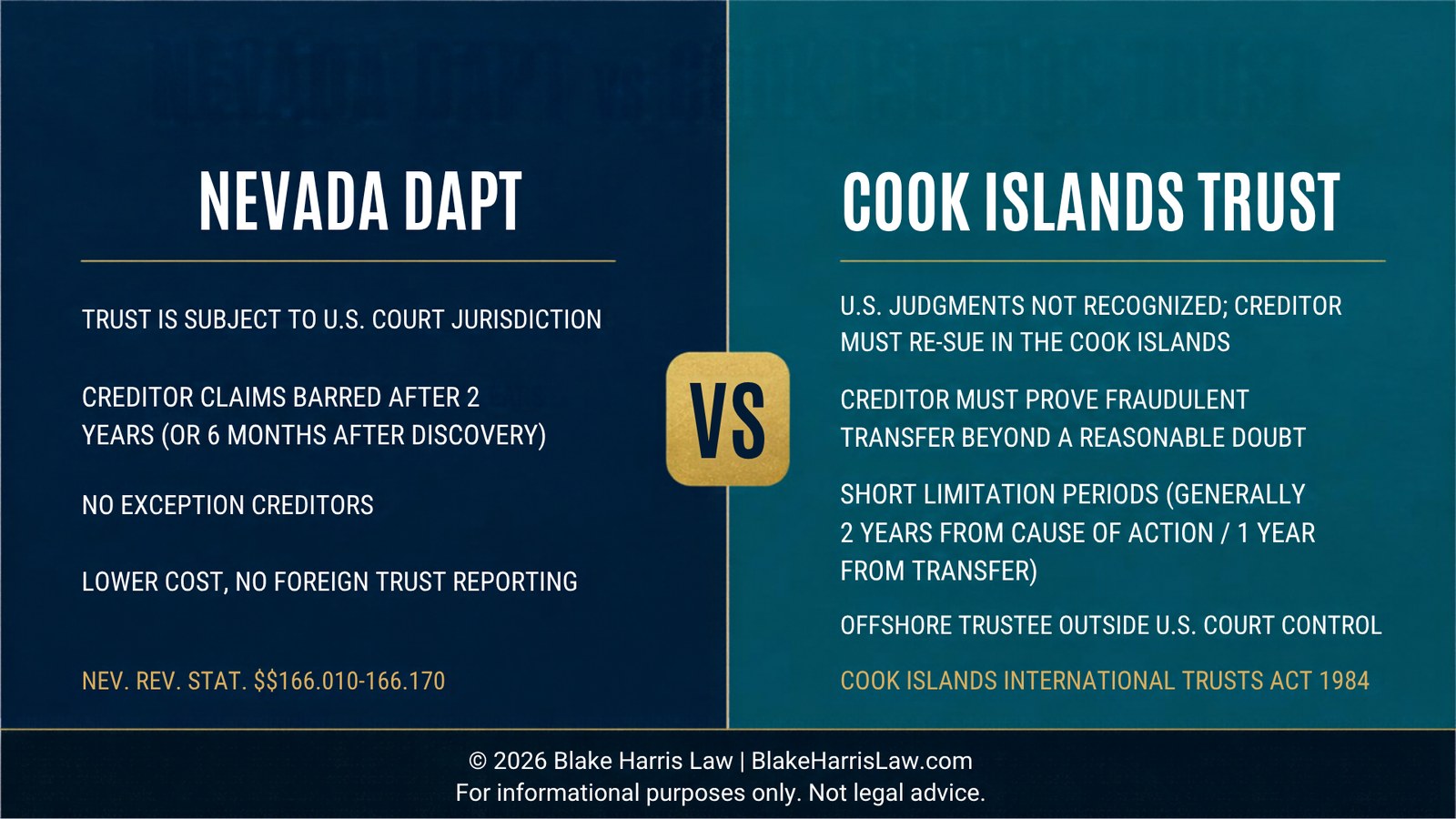
This is the fundamental dividing line between the two structures.
A DAPT sits inside the U.S. legal system. It relies on a U.S. state's laws to protect assets from creditors - but those laws are still subject to federal law, sister-state jurisdiction challenges, and the authority of U.S. federal courts.
A Cook Islands Trust sits outside the U.S. legal system. A U.S. court cannot compel a Cook Islands trustee to hand over assets. The Cook Islands does not enforce foreign judgments against its trusts. If a creditor wants to pursue a Cook Islands Trust, they must hire Cook Islands counsel, file suit in the Cook Islands, and prove their case under Cook Islands law - a significant practical barrier.
That single distinction drives most of the differences below.
## Creditor Protection: How Strong Is Each?
### DAPT Protection Strength
DAPTs offer meaningful protection in straightforward creditor scenarios. If a judgment creditor is operating purely within the DAPT state's legal framework, and the trust was funded well in advance of the claim, the protection can hold.
But DAPTs have documented vulnerabilities:
**Full Faith and Credit.** The U.S. Constitution requires states to give "full faith and credit" to the judgments of other states. If a creditor obtains a judgment in a non-DAPT state, courts have sometimes been willing to reach assets held in a DAPT formed in a different state.
**Federal court authority.** Federal courts are not bound by state DAPT statutes. In bankruptcy, for example, federal trustees have successfully reached assets held in DAPTs.
**Choice of law.** Courts outside the DAPT state may decline to apply DAPT state law and instead apply the law of the state where the debtor lives.
**Relatively short track record.** DAPTs have only existed since Alaska passed the first DAPT statute in 1997. There is limited case law on how they hold up under determined creditor attacks.
### Cook Islands Trust Protection Strength
The Cook Islands framework has been tested in U.S. courts repeatedly since the 1990s and has consistently held. The key advantages:
- **Foreign jurisdiction.** No U.S. court can directly compel the Cook Islands trustee. Enforcement requires starting a new proceeding in a foreign country.
- **Short statute of limitations.** Creditors have a narrow window to challenge transfers as fraudulent - two years from the transfer date, or one year from discovery.
- **High burden of proof.** Creditors must prove fraudulent intent beyond a reasonable doubt - the same standard as a criminal case.
- **[Duress clause](/articles/duress-clauses-cook-islands-trust).** If a U.S. court orders the settlor to [repatriate](/articles/cook-islands-trust-repatriation-court-order) assets, the trustee is instructed to treat that order as a signal to lock down the trust further.
- **Track record.** In every publicly reported case, properly structured Cook Islands Trust assets have not been repatriated, even when U.S. courts ordered it.
**Bottom line on protection:** The Cook Islands Trust is the stronger structure for high-stakes creditor scenarios. Among practitioners who work in offshore asset protection, this is the consensus view.
## Reporting and Compliance: What's Required?
### DAPT
- No foreign reporting requirements
- Assets remain in U.S. financial institutions
- Standard domestic trust reporting (Form 1041 in some cases)
- Simpler annual compliance
### Cook Islands Trust
- **[Form 3520](/articles/cook-islands-trust-reporting-requirements)** - Annual Return to Report Transactions with Foreign Trusts
- **Form 3520-A** - Annual Information Return of Foreign Trust with a U.S. Owner
- **FBAR (FinCEN 114)** - if the trust holds accounts at foreign financial institutions
- **Form 8938** - FATCA reporting
- Requires coordination between U.S. attorney, CPA, and the Cook Islands trustee
The reporting burden for a Cook Islands Trust is meaningfully higher. It is not onerous if you have a good CPA and attorney, but it is an ongoing obligation that must be taken seriously. Penalties for non-filing are severe.
## Cost Comparison
### DAPT
- Setup: typically $5,000–$15,000 in legal fees
- Annual trustee fees: $1,500–$5,000
- Lower complexity, lower overall cost
### Cook Islands Trust
- Setup: $25,000 (Blake Harris Law fixed engagement fee)
- Annual maintenance: $7,000 (trustee, legal oversight, protector) + \~$2,000–$4,000 CPA fees
- Higher cost, but commensurate with the higher level of protection
## Control and Access
Both structures require the settlor to give up legal ownership of the assets. In both cases, the settlor can typically be a discretionary beneficiary - meaning they can receive distributions during their lifetime at the trustee's discretion.
In practice, under normal conditions, both structures operate similarly: the trustee holds title but follows reasonable direction from the settlor.
The difference emerges in an emergency. A DAPT trustee is a U.S. entity subject to U.S. court jurisdiction. A court can compel a U.S. trustee to comply with an order. A Cook Islands trustee operates under a different legal system and cannot be compelled by a U.S. court.
## Which States Allow DAPTs?
As of 2026, roughly 20 states permit DAPTs. The jurisdictions most commonly used by out-of-state settlors are **Nevada, South Dakota, Delaware, Alaska, Tennessee, and Ohio**. Nevada and South Dakota are generally favored because they impose no waiting period before assets become protected and have well-developed spendthrift provisions.
## The Combination Strategy
Some practitioners use a DAPT and a Cook Islands Trust together. The DAPT provides a domestic first layer of protection that is simpler and less expensive to maintain. The Cook Islands Trust provides the backstop for high-stakes scenarios.
This is not always necessary. For clients with substantial assets and significant litigation exposure, going directly to a Cook Islands Trust is often the cleaner approach.
## Which Is Right for You?
There is no universal answer. Here is a framework for thinking about it:
**A DAPT may be sufficient if:**
- Your asset base is below $1 million
- Your litigation exposure is relatively moderate (not a physician with a large malpractice judgment risk, for example)
- You want simplicity and lower cost
- You are not facing an imminent creditor threat
**A Cook Islands Trust is likely the better choice if:**
- You have significant liquid assets ($1 million+)
- Your profession or business carries high lawsuit exposure
- You want the strongest protection available, not just adequate protection
- You are willing to handle the reporting requirements properly
- You understand this is a long-term structure, not a quick fix
## Summary
Both structures have a legitimate place in asset protection planning. The question is always which level of protection matches your level of risk. For moderate exposure and moderate asset levels, a DAPT can be sufficient. For high-stakes exposure and substantial assets, the Cook Islands Trust is the stronger structure - and the one with the longer track record under sustained creditor attack.
---
### Cook Islands Trust for Physicians - Malpractice Asset Protection
URL: https://blakeharrislaw.com/articles/cook-islands-trust-for-physicians
Published: 2026-05-12T00:00:00.000Z
Updated: 2026-05-18T00:00:00.000Z
Why physicians are exposed to malpractice judgments above insurance limits, and how a Cook Islands Trust protects accumulated personal wealth.
## Why do physicians set up Cook Islands Trusts?
Physicians face [malpractice](https://www.law.cornell.edu/wex/tort) lawsuit exposure that routinely exceeds insurance policy limits. A Cook Islands Trust protects the physician's personal assets - investment accounts, real estate, savings - separately from the practice and from malpractice insurance, so an above-policy judgment cannot reach the physician's long-term wealth. The structure does not replace malpractice insurance; it sits behind the insurance as the final layer.
- Physicians face [one of the highest litigation risks of any U.S. profession](/articles/asset-protection-for-dentists) - malpractice judgments routinely **exceed insurance policy limits**, leaving personal assets exposed.
- Malpractice insurance is the **first** layer of protection; a Cook Islands Trust is the **backstop** for the portion of judgments that exceed coverage.
- A PC or PLLC protects against business-level liabilities but **does not** shield personal professional negligence - most state courts hold physicians personally liable for malpractice regardless of corporate structure.
- Economically makes sense at roughly **$750,000+ in liquid personal assets** outside retirement accounts - typically reached within 5–10 years of practice.
- The trust holds personal investment assets only - no effect on your medical license, your practice, your malpractice insurance, or your ability to earn income.
## Introduction
Physicians face one of the highest litigation risks of any profession in the United States. The combination of large potential jury verdicts, high personal wealth, and professional liability that extends beyond insurance limits creates a unique threat profile that demands serious asset protection planning.
A Cook Islands Trust is a durable tool for protecting a physician's assets from a malpractice judgment that exceeds insurance coverage. This article explains why physicians are particularly vulnerable, how a Cook Islands Trust addresses that vulnerability, and what a typical protection structure looks like.
## Why Physicians Are High-Risk Targets
### Malpractice Exposure Exceeds Insurance
Medical malpractice judgments routinely exceed physicians' malpractice insurance policy limits. The average malpractice verdict in the U.S. is in the hundreds of thousands of dollars, but catastrophic cases - wrongful death, severe permanent injury, birth injury - can produce judgments of $5 million, $10 million, or more.
When a judgment exceeds the insurance limit, the physician is personally liable for the remainder. That remainder comes from personal assets.
### Physicians Accumulate Significant Personal Wealth
A physician in practice for 10–20 years typically has accumulated substantial wealth: a home with equity, retirement accounts, a brokerage portfolio, possibly real estate investments, and practice ownership interests. These assets are all potentially reachable by a judgment creditor.
### High Visibility as Defendants
Plaintiffs' attorneys know that physicians are insured and that many have significant personal assets beyond insurance limits. They are attractive defendants because the economics of litigation - potential recovery vs. cost of pursuit - work in the plaintiff's favor more than they do against, say, an individual without professional credentials or wealth.
### Malpractice Insurance Has Limits
Even "adequate" malpractice coverage is not infinite. Policy limits range from $1M/$3M (per occurrence/aggregate) to $2M/$6M at the higher end for most specialists. A catastrophic verdict in the right case can blow through those limits. Umbrella policies help but have their own limits.
## The Asset Protection Gap
Most physicians' actual protection plan is: "I have malpractice insurance." That is not a complete asset protection plan. It is the first layer of defense, not a comprehensive one.
The gap is the exposure that sits between:
- What insurance will pay, and
- What a jury might award
In high-stakes specialties - obstetrics, surgery, neurosurgery, emergency medicine, anesthesiology - the gap can be millions of dollars.
A Cook Islands Trust protects the assets that sit in that gap.
## How a Cook Islands Trust Protects a Physician
The core mechanic is straightforward: assets transferred into a properly structured Cook Islands Trust before a malpractice claim arises are no longer personally owned by the physician. A judgment creditor - including a malpractice plaintiff - cannot reach assets held in a Cook Islands Trust through ordinary U.S. enforcement mechanisms.
The physician still benefits from the assets (as a discretionary beneficiary), still pays U.S. taxes on trust income ([grantor trust](/articles/cook-islands-trust-tax-treatment) rules apply), and still controls their daily financial life. But a portion of their accumulated wealth - typically liquid investment assets, not retirement accounts or the primary residence - is protected behind a foreign trustee and a foreign legal framework that U.S. courts cannot directly compel.
### Specific Protections for Physicians
**Defense against post-judgment collection.** If a jury returns a verdict exceeding your insurance limits, the plaintiff's attorney's next step is collection. If your assets are in a Cook Islands Trust, the assets are not reachable through routine domestic collection actions.
**Protection during long litigation timelines.** Medical malpractice cases often take years from incident to verdict. Assets that are in a Cook Islands Trust before the complaint is filed are better protected than assets transferred during litigation. This is a strong argument for setting up the trust early in one's career.
**Protection of investment portfolio.** A physician's liquid investment assets - brokerage accounts, cash savings - are the most directly exposed to a malpractice judgment. These are also the assets that transfer most cleanly into a Cook Islands Trust.
## What a Typical Physician's Structure Looks Like
Most physician asset protection plans combine multiple layers. A Cook Islands Trust typically sits at the outer layer:
### Layer 1: Malpractice Insurance
The first line of defense. Essential, but not sufficient.
### Layer 2: Corporate Practice Structure
Practicing through a professional corporation or LLC limits business-level liability, though physicians generally cannot eliminate personal professional liability for their own negligence.
### Layer 3: Domestic Asset Protection
Maximize use of domestic protection: retirement accounts (ERISA-protected 401(k)s, IRA protections), homestead exemption for the primary residence, and domestic LLCs for investment real estate.
### Layer 4: Cook Islands Trust
Liquid investment assets - brokerage portfolio, cash savings above operating needs - transferred to a Cook Islands Trust (often through a trust-owned Nevis or Cook Islands LLC). This is the most durable protection for the most significant exposed assets.
## Timing: When Should a Physician Set This Up?
**The right time is early in your career, before any malpractice claim has been filed.**
A Cook Islands Trust that has been funded for two or more years, before any specific creditor threat existed, is the strongest version of this structure. The Cook Islands' two-year statute of limitations on [fraudulent transfer](/articles/pre-litigation-fraudulent-transfer-cook-islands-trust) challenges gives maximum protection to assets transferred well in advance of any litigation.
For physicians in mid-career who haven't yet set up protection: now is better than waiting. A malpractice case filed six months from now starts a very different analysis than one filed three years from now.
**Common timing mistakes:**
- Setting up the trust after a specific adverse event has occurred
- Waiting until receiving a demand letter
- Waiting until a lawsuit is filed
None of these situations make offshore planning impossible, but they require careful analysis of [fraudulent transfer](/articles/pre-litigation-fraudulent-transfer-cook-islands-trust) risk before any assets are moved.
## What a Cook Islands Trust Does Not Protect
**Malpractice insurance does not become unnecessary.** The trust protects personal assets, not professional liability itself. You still need adequate malpractice insurance.
**Assets not in the trust are not protected.** A Cook Islands Trust holding $2 million does not protect the $3 million in retirement accounts sitting in your personal IRA. Those need their own protection strategies.
**The trust does not cover future earnings.** If a judgment creditor cannot reach your trust assets, they may try to garnish future wages or medical practice income. The trust protects accumulated wealth, not future income streams. Additional planning may be needed to address that exposure.
**Criminal actions are different.** If a physician faces criminal charges - healthcare fraud, Stark Law violations, DEA enforcement - the analysis is different. Criminal forfeiture operates outside the civil judgment framework.
## Case Study: Why Timing Matters
Dr. A is a general surgeon who sets up a Cook Islands Trust in year one of her practice, funded with $500,000 in savings. Over the next 15 years, she continues funding the trust annually. By the time a catastrophic malpractice case goes to trial - a $4 million verdict against her $1M/$3M policy - she has $3.2 million protected in a Cook Islands Trust. The $1 million judgment above her policy limit finds nothing to collect domestically.
Dr. B is a similarly situated surgeon who put off planning. After a jury verdict exceeding his coverage, he contacts an attorney. Any assets he transfers now are within the look-back period for fraudulent transfer. His options are limited.
The difference is timing.
---
### Duress Clauses in Cook Islands Trusts Explained
URL: https://blakeharrislaw.com/articles/duress-clauses-cook-islands-trust
Published: 2026-05-11T00:00:00.000Z
Updated: 2026-05-16T00:00:00.000Z
What a duress clause is, how it works under a U.S. court repatriation order, what it does not do, and why it is central to Cook Islands Trust protection.
## What is a duress clause in a Cook Islands Trust?
A duress clause is a provision that instructs the Cook Islands trustee to refuse any distribution request made under U.S. court compulsion. It is the legal mechanism that lets the settlor comply with a U.S. order - demanding repatriation as ordered - while the trustee complies with its fiduciary duty by refusing the demand under the duress clause. Properly drafted duress clauses are what defeat [contempt findings](https://www.law.cornell.edu/wex/contempt_of_court) in repatriation cases.
- The **duress clause** is a provision in every Cook Islands Trust deed that instructs the trustee to refuse instructions from the settlor - or any party - when those instructions are given under legal compulsion, including U.S. court orders.
- It exists to counter the most common creditor attack: when a U.S. court cannot reach the offshore trustee, it tries to order the **settlor** to demand repatriation under threat of contempt.
- When activated, the trustee - bound by Cook Islands law, not U.S. orders - is legally authorized and required to **disregard** the compelled instruction.
- This mechanism is why a properly structured trust withstands direct U.S. court orders: the settlor cannot be forced to do something they no longer have the legal authority to do, and the trustee cannot be forced to do something the Cook Islands courts will not enforce.
- Under normal conditions the clause sits dormant. It activates **only** when a real legal threat materializes - and is the reason no creditor has successfully recovered assets from a properly funded Cook Islands Trust through Cook Islands court proceedings.
## Introduction
If you have done any research on Cook Islands Trusts, you have probably encountered the term "duress clause." It comes up in nearly every serious discussion of how these trusts actually work under pressure.
The duress clause is not legal boilerplate. It is one of the most important - and least understood - provisions in the entire Cook Islands Trust structure. It is the mechanism that makes it possible for a properly structured trust to withstand even a direct U.S. court order.
This article explains what a duress clause is, how it works, why it was designed, and what happens when it gets tested.
## The Problem the Duress Clause Solves
To understand why the duress clause exists, you first need to understand the attack vector it is designed to counter.
When a creditor cannot reach offshore trust assets directly, they sometimes turn to the [settlor](/articles/cook-islands-trust-trustee-protector-settlor). The logic is straightforward: if the court cannot reach the Cook Islands trustee, it can reach the U.S. resident who created the trust. The court issues an order requiring the settlor to instruct the trustee to bring the assets back to the United States - or face contempt of court.
On its face, this seems like a way to go around the trust. The creditor gets a U.S. judge to order the settlor to "[repatriate](/articles/cook-islands-trust-repatriation-court-order)" the assets, the settlor complies under threat of jail, and suddenly the offshore protection evaporates.
The duress clause is designed to close this loop.
## Why a Coerced Instruction Is Not a Valid Instruction
A duress clause (also called a duress provision or anti-duress provision) is a provision in the trust deed that instructs the trustee how to interpret and respond to instructions from the settlor when those instructions may be the result of legal compulsion rather than the settlor's genuine wishes.
In plain terms: if a court orders you to tell your trustee to hand over the assets, and you relay that order to the trustee, the duress clause tells the trustee to refuse.
The underlying legal theory is that instructions given under compulsion (under the threat of contempt, imprisonment, or other legal sanction) are not the settlor's true, voluntary instructions. They are forced. The trust deed says: in that situation, the trustee should protect the assets, not comply with the coerced instruction.
## How a Duress Clause Works in Practice
Here is the sequence of events when a duress clause is triggered:
### Step 1: Creditor Obtains a Court Order
A U.S. court, at a creditor's request, issues an order requiring the settlor to [repatriate](/articles/cook-islands-trust-repatriation-court-order) trust assets - to instruct the trustee to transfer the funds to a court-controlled account or to a creditor.
### Step 2: Settlor Faces a Choice
The settlor is now in a difficult position. If they refuse, they face contempt of court - which can mean fines or imprisonment.
### Step 3: Duress Clause Activates
The trust deed's duress clause provides that if the settlor communicates with the trustee while subject to legal compulsion - for example, while under a court order requiring repatriation - the trustee is authorized and directed to disregard that communication. It is treated as given under duress, not as a genuine expression of the settlor's wishes.
### Step 4: Trustee Acts Independently Under Cook Islands Law
The Cook Islands trustee, now acting under the duress provision and under Cook Islands law, does not repatriate the assets. The trustee is legally authorized to refuse - and is bound by Cook Islands law to do so.
### Step 5: U.S. Court Cannot Compel the Trustee
The U.S. court has no jurisdiction over the Cook Islands trustee. It cannot hold the trustee in contempt. It cannot order the trustee to do anything. The trustee is a foreign entity operating under foreign law.
## What a Duress Clause Does Not Do
It is equally important to understand the limits.
**It does not protect against criminal forfeiture.** If assets were acquired through criminal activity, a duress clause in a civil trust does not prevent criminal forfeiture proceedings.
**It does not make contempt consequences disappear.** The settlor can still be held in contempt of court if they fail to repatriate assets per a court order. The duress clause protects the assets; it does not insulate the settlor from legal process.
**It does not work with a poorly drafted trust deed.** A duress clause must be carefully drafted and must be included in the trust deed from the beginning. A generic or template trust deed may have inadequate duress provisions that fail when tested.
**It does not work if the trustee is a U.S. entity.** The duress clause only works because the Cook Islands trustee is beyond U.S. jurisdiction. If the trustee were a U.S. company, a U.S. court could compel it directly, bypassing the duress provision entirely.
**It does not work if assets remain in U.S. accounts.** The trust must be properly funded with assets held outside the United States. Assets in U.S. financial institutions can be frozen or seized directly by U.S. courts, regardless of the trust's structure.
## How a Duress Clause Is Drafted
The specifics of duress clause language matter. A well-drafted duress clause typically:
1. **Defines triggering events** - what constitutes "duress." This usually includes being subject to a court order requiring the settlor to take action with respect to trust assets, being under threat of contempt, or being under arrest or detention in connection with the trust.
2. **Specifies the trustee's response** - what the trustee must do when duress is triggered. Typically: disregard instructions from the settlor that appear to be given under duress.
3. **Provides for trustee independence** - under the trustee's discretion, and subject to oversight by the protector if one is designated, the trustee manages assets independently until the duress condition is removed.
4. **Defines when duress ends** - typically when the legal proceeding has concluded, the court order has been lifted, or the settlor is no longer subject to legal compulsion.
5. **Addresses communication protocols** - how the trustee confirms whether duress conditions exist, and how the trustee communicates with the settlor during the duress period.
The specific language should be drafted by an attorney experienced in Cook Islands Trust law. Off-the-shelf language may be inadequate.
## The Settlor's Position: What You Need to Understand Going In
Using a Cook Islands Trust with a duress clause is a decision that requires clear-eyed understanding of the tradeoffs.
**The upside:** If a creditor obtains a judgment and tries to reach your trust assets through a court order requiring repatriation, the duress clause gives the trustee the legal authority and the obligation to refuse. Your assets remain protected.
**The downside:** Most creditors, when they understand the mechanics, choose to negotiate a settlement rather than pursue a protracted offshore battle. The cost and difficulty of attacking a Cook Islands Trust - including the remote possibility of contempt proceedings against the settlor - is often enough to bring a creditor to the table.
The practical outcome in most cases involving a well-structured Cook Islands Trust is settlement, not contempt proceedings.
## Summary
The duress clause is what turns a Cook Islands Trust from a paper structure into an asset protection mechanism that holds under direct court attack. Without it, a U.S. court could reach trust assets by compelling the settlor. With it, the trustee has independent legal authority under Cook Islands law to refuse repatriation - even if the settlor is ordered by a U.S. court to request it.
It has been tested. It has held. The assets in the cases where it was invoked were not repatriated.
Understanding the duress clause - how it works, what it requires, and what its limits are - is essential to understanding why a properly structured Cook Islands Trust holds up where domestic structures often do not.
---
### Cook Islands Trust for High-Net-Worth Families
URL: https://blakeharrislaw.com/articles/cook-islands-trust-for-high-net-worth-families
Published: 2026-05-11T00:00:00.000Z
Updated: 2026-05-18T00:00:00.000Z
How a Cook Islands Trust serves wealthy families for both creditor protection and multigenerational wealth transfer, alongside estate-tax planning vehicles.
## Why do high-net-worth families use Cook Islands Trusts?
Families with $2 million or more in liquid assets face lawsuit exposure that scales with net worth - once visibility crosses a threshold, plaintiffs and their attorneys become more aggressive about pursuing personal assets.
A Cook Islands Trust functions as a multi-generational asset-protection vehicle: the structure outlives the original settlor, can fund education and medical expenses across generations, and removes high-value assets from the reach of U.S. judgments without changing the family's lifestyle or [U.S. tax obligations](https://www.irs.gov/businesses/small-businesses-self-employed/estate-tax). See it explained live in our [free webinar](/articles/cook-islands-trust-webinar), or start with [how a Cook Islands Trust works](/articles/how-a-cook-islands-trust-works).
- For high-net-worth families, asset protection is about **preserving wealth across generations** in a world where concentrated wealth is a visible litigation target.
- A Cook Islands Trust serves two roles: **creditor protection** during the settlor's lifetime and a **multigenerational wealth-transfer vehicle**.
- Without proper structuring, inherited wealth becomes exposed to the **inheriting child's creditors** - divorcing spouses, business creditors, professional liability - the moment it is received.
- Each adult family member with separate exposure (professional liability, business risk, etc.) represents a **separate liability source** the family wealth needs protection from.
- For estates above the federal exemption, offshore trust planning intersects with **estate tax planning** - the two strategies must be coordinated.
## Introduction
For high-net-worth families, asset protection is not just about defending against a single lawsuit - it is about preserving family wealth across generations in a world where concentrated wealth is a visible target.
A Cook Islands Trust can serve a dual role for wealthy families: it provides creditor protection during the [settlor](/articles/cook-islands-trust-trustee-protector-settlor)'s lifetime, and it can serve as a vehicle for structured multigenerational wealth transfer. This article covers both dimensions and explains how the structure fits into a comprehensive family wealth plan.
## Why Wealthy Families Face Heightened Risk
### Greater Assets Mean Greater Targets
A family with $10 million in liquid assets is a more attractive defendant than one with $500,000. Plaintiffs' attorneys evaluate defendants' ability to pay before deciding whether to pursue. More assets means more incentive to litigate - and to litigate aggressively.
### Multiple Family Members with Separate Exposures
In a family with multiple adults who are professionals, [business owners](/articles/cook-islands-trust-for-business-owners), or investors, each person represents a separate liability source. A malpractice claim against one spouse, a business dispute involving another, or a judgment from a child's car accident can all reach family wealth if it is not properly protected.
### Inherited Wealth Is Exposed to Children's Creditors
Wealth passed to the next generation through ordinary inheritance can immediately become exposed to the inheriting child's creditors - their divorcing spouse, their business creditors, or their professional liability. Without proper structuring, inherited wealth loses its protection the moment it is received.
### Estate Tax for Ultra-High-Net-Worth Families
Families with estates above the federal estate tax exemption face significant estate tax exposure. For these families, offshore trust planning intersects with estate tax planning - and the interaction must be carefully managed.
## The Cook Islands Trust as a Family Protection Vehicle
A Cook Islands Trust can be structured to serve multiple family members simultaneously:
**The settlor(s)** - one or both spouses - establish the trust and fund it with liquid family wealth. Both spouses can be discretionary beneficiaries.
**Children and grandchildren** can be named as current or future discretionary beneficiaries. The trustee can make distributions to any beneficiary according to the trust's distribution standards.
**The trust can hold assets for the benefit of multiple generations** - allowing family wealth to remain protected even as it passes from the founding generation to their children and grandchildren.
## Structuring for Multigenerational Use
### Dynasty Trust Features
A Cook Islands Trust can be structured with dynasty trust provisions - designed to last for multiple generations, accumulate assets, and make distributions to beneficiaries based on need and circumstance rather than distributing everything to children immediately.
Under Cook Islands law, the perpetuity constraints that limit trust duration in many U.S. states do not apply in the same way. This allows Cook Islands Trusts to be designed for very long duration.
### Spendthrift Protections for Beneficiaries
A well-drafted Cook Islands Trust includes spendthrift provisions that prevent beneficiaries from voluntarily assigning their interests to creditors. This means:
- A child who is named as a beneficiary cannot pledge their trust interest to a lender
- A child's divorcing spouse cannot attach to the child's beneficial interest
- A creditor of a child cannot seize the child's trust interest - they can only receive distributions the trustee decides to make
The spendthrift protection effectively extends the Cook Islands framework's creditor protection to beneficiaries across generations.
### Distribution Standards That Protect Beneficiaries
The trust deed should include distribution standards that give the trustee meaningful discretion rather than mandating distributions. Mandatory distributions to beneficiaries can sometimes be intercepted by creditors. Discretionary distributions - made only at the trustee's discretion - are much harder to attach.
A trust that provides for distributions "as the trustee deems appropriate for the beneficiary's health, education, maintenance, and support" gives the trustee flexibility to hold distributions when a beneficiary is under creditor attack, and to make them when circumstances permit.
## Protecting Inherited Wealth Across Generations
One of the most useful features of a well-structured Cook Islands Trust is that assets can remain in the trust even after the founding generation passes away - continuing to protect the wealth for children and grandchildren.
When the settlor dies:
- The trust does not terminate automatically
- The trustee continues to manage assets for the benefit of remaining beneficiaries
- Distribution provisions in the trust deed govern how assets flow to the next generation
The key planning decision is whether inherited wealth passes to children:
- **Outright:** Children receive the assets personally and immediately. Simple, but the assets are immediately exposed to the child's creditors.
- **In continuing trust:** The assets remain in (or are distributed into) a subtrust for each child. Protected from the child's creditors; distributions at the trustee's discretion.
High-net-worth families choosing between these options should carefully consider the creditor exposure of each child - their profession, their marriage, their business activities, and their overall liability profile.
## Estate Tax Considerations for Large Estates
For families with estates above the federal estate tax exemption (currently $13.61 million per individual in 2024, indexed for inflation), a Cook Islands Trust designed purely as a creditor protection vehicle is tax-neutral - it does not reduce estate taxes. Assets remain in the settlor's gross estate because the settlor retained beneficial interest as a discretionary beneficiary.
If estate tax reduction is also a priority, the family may need additional planning layers:
**Irrevocable Life Insurance Trust (ILIT):** Removes life insurance proceeds from the taxable estate and can fund the Cook Islands Trust structure.
**Grantor Retained Annuity Trust (GRAT):** Allows appreciation to pass to heirs free of gift and estate tax in a zero-interest rate environment.
**Charitable giving structures:** Charitable lead trusts, charitable remainder trusts, and donor-advised funds can reduce the taxable estate while meeting philanthropic goals.
These estate tax strategies are often used in parallel with a Cook Islands Trust - the trust handles creditor protection; the other vehicles handle estate tax. A comprehensive family wealth plan addresses both.
## The Family Governance Question
For very large families with significant shared wealth, the Cook Islands Trust is one component of a broader family governance structure that may also include:
- A family limited partnership (FLP) or family LLC
- A family constitution or family council
- A philanthropic vehicle (private foundation or donor-advised fund)
- An estate plan for each family member
The Cook Islands Trust coordinates with these structures. For example, a family LLC that holds operating assets or investment real estate may itself be owned by the Cook Islands Trust, so that the trust provides the outer protection layer for all of the family's holdings.
## Practical Access: Maintaining Family Liquidity
A common concern for families: if the trust holds our assets, how do we access them for large purchases, lifestyle expenses, or investment opportunities?
As discretionary beneficiaries, family members can request distributions. Under normal conditions, the trustee honors reasonable requests. The trust is not a lockbox that denies access - it is a protective structure that holds assets while the family retains beneficial access.
For large families where different members have different needs and different distributions patterns, the distribution provisions of the trust deed should be carefully drafted to give the trustee the right level of flexibility.
---
### IRS Scrutiny of Cook Islands Trusts - What You Need to Know
URL: https://blakeharrislaw.com/articles/irs-scrutiny-cook-islands-trusts
Published: 2026-05-10T00:00:00.000Z
Updated: 2026-08-21T00:00:00.000Z
What the IRS actually targets in offshore-trust enforcement, why properly disclosed Cook Islands Trusts are not the target, and how to stay compliant.
## Does the IRS scrutinize Cook Islands Trusts?
Cook Islands Trusts trigger several U.S. reporting obligations - Form 3520, Form 3520-A, FBAR, and Form 8938 - and any one of those filings can lead to IRS review. Properly structured Cook Islands Trusts are fully transparent to the IRS: trust income flows through to the settlor's Form 1040, no tax is deferred or avoided, and every dollar is reported. Audit risk attaches to non-filing or under-reporting, not to the structure itself.
- The IRS pays attention to offshore trusts - but what they **prosecute** is offshore tax evasion (hiding income, fraudulent returns), not legal, fully-disclosed asset-protection trusts.
- A properly structured Cook Islands Trust is **fully visible** to the IRS through four mandatory filings: **Form 3520, Form 3520-A, FBAR (FinCEN 114), and Form 8938**.
- A compliant Cook Islands Trust is the **opposite** of what the IRS targets - all income is reported, all forms are filed, no fraud is committed.
- Establishing an offshore trust is **not** an audit trigger by itself. The IRS writes detailed regulations for these structures specifically because they are real, recognized legal entities.
- The real risk is **non-compliance**, not the structure. Missed filings carry percentage-based penalties that can dwarf the underlying tax owed.
## Introduction
The IRS pays attention to offshore trusts. If you have a Cook Islands Trust, you should expect that the IRS is aware of it - because you tell them about it every year through mandatory reporting filings.
The question is not whether the IRS knows about your Cook Islands Trust. They do. The question is whether a properly structured and properly disclosed Cook Islands Trust creates any meaningful tax risk for a compliant [settlor](/articles/cook-islands-trust-trustee-protector-settlor). The short answer: no. The longer answer is worth understanding.
## What the IRS Is Actually Targeting
The IRS's enforcement activity around offshore trusts falls into two distinct categories that are often confused:
**Category 1: Tax evasion using offshore structures.** This is what the IRS [actively prosecutes as abusive trust schemes](https://www.irs.gov/businesses/small-businesses-self-employed/abusive-trust-tax-evasion-schemes) - U.S. persons using foreign trusts or foreign bank accounts to hide income from the IRS, file fraudulent returns, or evade U.S. tax.
This is a federal crime. The IRS has devoted significant enforcement resources to this over the past two decades, resulting in FATCA, expanded [FBAR](/articles/cook-islands-trust-reporting-requirements) requirements, and numerous high-profile criminal prosecutions.
**Category 2: Legal offshore asset protection trusts that are fully disclosed and properly reported.** This is what a Blake Harris Law client operates. All income is reported on the U.S. tax return. All required forms are filed. No income is hidden. No fraud is committed. This category is not what the IRS is prosecuting.
The conflation of these two categories - the assumption that because the IRS targets offshore tax evaders, it therefore targets all offshore trust holders - is a persistent misconception. A compliant, fully disclosed Cook Islands Trust is the opposite of what the IRS is hunting.
## The Reporting Regime: Why You Are Already Visible
When you establish and fund a Cook Islands Trust, you file:
- **[Form 3520](/articles/cook-islands-trust-reporting-requirements)** - discloses the trust's existence, the amount transferred, and your identity as the settlor
- **Form 3520-A** - provides the IRS with annual trust financial information including assets, income, and distributions
- **FBAR (FinCEN 114)** - discloses any offshore financial accounts held by the trust
- **Form 8938** - FATCA disclosure of specified foreign financial assets
These filings are not optional and are not secret. The IRS receives this information annually. They know about your trust, the value of its assets, and the income it generates.
This transparency is actually protective for a compliant settlor. You cannot be accused of hiding an asset that you have disclosed in four separate mandatory annual filings.
## Does Having a Cook Islands Trust Increase Audit Risk?
The IRS does scrutinize foreign trust filers. Foreign trust reporting (Forms 3520 and 3520-A) is an area where the IRS knows mistakes and non-compliance are common. A return that includes foreign trust reporting may receive more attention than a return that does not.
However, [an audit of a properly maintained Cook Islands Trust](/blog/will-an-offshore-trust-get-you-audited) should not result in any additional tax liability, because:
- All trust income is being reported correctly on the personal return under the [grantor trust](/articles/cook-islands-trust-tax-treatment) rules
- All required forms are filed
- The trust's structure is consistent with the reported treatment
An audit is an examination of whether you filed correctly. If you filed correctly, an audit produces nothing. The risk is process-risk - time and cost - not substantive-risk.
## Abusive Offshore Trust Schemes: What the IRS Actually Targets
The IRS has published guidance specifically identifying "abusive offshore trust schemes" on its Dirty Dozen list of tax scams. These schemes share common characteristics:
- Claiming that offshore trusts can eliminate U.S. tax liability
- Advising taxpayers not to report the trust or its income to the IRS
- Using chains of trusts and offshore entities to obscure the true owner's identity
- Mischaracterizing taxable income as loans or gifts from the trust
- Filing fraudulent returns that omit offshore income
None of these describe a properly structured Cook Islands Trust for asset protection purposes, where all income is reported, all forms are filed, and no tax liability is eliminated or concealed.
If your offshore trust advisor is telling you that the trust eliminates your U.S. taxes, or advising you not to file the required forms, you are looking at an abusive scheme - not legitimate asset protection.
## The Grantor Trust Rules: How Income Is Correctly Reported
Under IRC Sections 671–679, a Cook Islands Trust with a U.S. settlor who retains beneficial interest is treated as a [grantor trust](/articles/cook-islands-trust-tax-treatment). All trust income is reported on the settlor's Form 1040 as if the trust did not exist.
This means:
- Interest income → reported on Schedule B
- Dividends → reported on Schedule B
- Capital gains → reported on Schedule D
- Foreign tax credits → claimed on Form 1116 as applicable
The tax is the same as if you held the assets personally. The IRS is fully informed of the income and taxes it at the correct rate.
Reporting this correctly - consistently, every year - is what distinguishes a legally operated Cook Islands Trust from an abusive scheme.
## Penalty Exposure for Non-Compliance: The Real Risk
The legitimate risk area for Cook Islands Trust holders is not tax liability - it is reporting compliance. The penalties for failing to file the required forms are severe:
- **Form 3520:** 35% of the gross value of assets transferred or distributed, per year unfiled.
- **Form 3520-A:** 5% of the gross value of the trust's assets, per year unfiled.
- **FBAR:** $10,000 per non-willful violation; the greater of $100,000 or 50% of the account balance for willful violations.
- **Form 8938:** $10,000 base penalty, plus $10,000 per 30-day period after IRS notification (up to $50,000), plus a 40% penalty on understatements of tax attributable to undisclosed assets.
These penalties are assessed based on the value of the underlying assets - not on any tax owed. A $1 million trust with an unfiled Form 3520-A could face a $50,000 penalty in a single year.
Two statutory limits belong alongside those figures, because warnings about this regime routinely omit them. [IRC Section 6677](https://www.law.cornell.edu/uscode/text/26/6677) caps the penalties it authorizes at the gross reportable amount, so the exposure is bounded rather than open-ended.
And the same section imposes no penalty on a failure "shown to be due to reasonable cause and not due to willful neglect." Neither point makes the filings optional, and neither is a plan - you do not want to be arguing reasonable cause. But the regime is not the automatic trap it is sometimes described as. We take that argument apart in [what the reporting criticism leaves out](/blog/offshore-trust-reporting-requirements-criticism).
This is why working with a CPA experienced in foreign trust reporting is not optional. And it is why every Blake Harris Law client is advised to engage appropriate tax professionals before the first filing year.
## Common IRS Issues for Foreign Trust Filers
**Late-filed forms.** Form 3520-A is due March 15 - earlier than the individual return. Missing this date is easy if you are not tracking it specifically. The IRS assesses penalties automatically for late filing.
**Inconsistent reporting between forms.** If Form 3520 and Form 3520-A show different asset values, or if amounts on Form 8938 do not reconcile with Form 3520, the IRS will have questions.
**Incorrect grantor trust treatment.** Some tax preparers unfamiliar with the foreign trust rules do not properly apply the grantor trust pass-through. Income should flow directly to the 1040 - if it is not showing up there, the return is likely wrong.
**Missed FBAR filings.** The FBAR is filed separately from the tax return, with a different agency (FinCEN). Clients who file their taxes correctly but forget the FBAR are exposed to FBAR penalties.
**CPA unfamiliarity with offshore trust forms.** General-practice CPAs who do not regularly prepare Forms 3520/3520-A make errors. Using a CPA who files these forms regularly is important.
## If You Have Unfiled Prior Years
If you have a Cook Islands Trust with unfiled prior years - either because you were not aware of the requirements or because you were incorrectly advised - you should address this before the IRS addresses it for you.
The IRS has voluntary disclosure mechanisms, including the Streamlined Filing Compliance Procedures, that can reduce penalty exposure for taxpayers who come forward voluntarily with unreported foreign accounts or trusts. The penalties for voluntary disclosure are substantially lower than those for non-disclosure discovered through audit or investigation.
If this situation applies to you, speak with a qualified tax attorney immediately. The window for voluntary disclosure is better than the alternative.
## The Bottom Line
The IRS knows about your Cook Islands Trust because you tell them. A properly structured, fully disclosed, correctly reported Cook Islands Trust gives the IRS nothing to find - because nothing is hidden.
The IRS scrutiny that matters is directed at people who use offshore structures to evade taxes: hiding income, failing to file required forms, and submitting fraudulent returns. A client who files Form 3520, Form 3520-A, FBAR, and Form 8938 every year and reports all trust income on their 1040 is not in that category.
Compliance is not just a legal obligation. For a Cook Islands Trust, it is also what makes the asset protection credible and defensible.
---
### Cook Islands Trust vs. Belize Trust - An Honest Comparison
URL: https://blakeharrislaw.com/articles/cook-islands-trust-vs-belize-trust
Published: 2026-05-10T00:00:00.000Z
Updated: 2026-09-04T00:00:00.000Z
Cook Islands vs. Belize trusts compared - legal framework, statute of limitations, burden of proof, and track record under U.S. creditor attack.
## Cook Islands Trust vs. Belize Trust: which is stronger?
A [Cook Islands Trust](/asset-protection/cook-islands-trust) is the stronger asset-protection vehicle for most U.S. settlors. The Cook Islands has a longer case-law record establishing creditor difficulty, a more developed licensed-trustee industry, a one-to-two-year [fraudulent-transfer](https://www.law.cornell.edu/wex/fraudulent_conveyance) statute of limitations codified in the [International Trusts Act 1984](/articles/cook-islands-international-trusts-act-1984), and explicit non-recognition of foreign judgments.
Belize trusts share similar statutory features but have a thinner litigation record - most U.S. asset-protection attorneys default to Cook Islands and consider Belize only for niche cases.
- Belize modeled its trust legislation on the Cook Islands framework but has a thinner legal infrastructure and far less adversarial [case law](/articles/cook-islands-trust-contempt-cases) to confirm reliable enforcement.
- Belize uses a **clear and convincing** evidentiary standard for creditors - lower than the Cook Islands' beyond-a-reasonable-doubt criminal-law standard.
- The two protect by different mechanisms. The Cook Islands pairs a short challenge window with a criminal standard of proof; Belize's statute gives creditors no challenge provision at all, so there is no period to run. Broader on paper, far less tested in court.
- Belize is better known offshore for **International Business Companies (IBCs)** than for trusts, and became popular partly through low-cost marketing - which cuts both ways on regulatory rigor.
- For serious litigation exposure, the Cook Islands' deeper track record and stronger evidentiary burden make it the safer choice.
## Introduction
Belize has marketed itself as an offshore trust jurisdiction for years. You will find it mentioned in many asset protection discussions, often [positioned as a less expensive alternative to the Cook Islands](/blog/cook-islands-trust-vs-nevis-trust-vs-belize-trust). Some promoters pitch Belize trusts aggressively.
This article gives you an honest look at both - [what Belize offers](/blog/belize-trust), where it falls short, and why most experienced asset protection attorneys choose the Cook Islands when protection strength is the primary goal.
## Background on Each Jurisdiction
### The Cook Islands
The Cook Islands is a self-governing Pacific island nation with a 40-year track record in the offshore trust business. Its **International Trusts Act 1984** was purpose-built to maximize asset protection and has been tested extensively in U.S. courts.
The Cook Islands has a well-established trustee industry, a functioning legal system with English common law roots, and a long institutional history of protecting foreign trust assets from creditor attacks.
### Belize
Belize is a small Central American nation (formerly British Honduras) with English common law roots and a relatively young offshore finance sector. Its trust legislation - the **Belize Trusts Act 1992** and the **Offshore Banking Act** - was enacted in the early 1990s and has been amended over time.
Belize is better known in the offshore world for its **International Business Companies (IBCs)** than for its trusts. It became popular in part because of low setup costs and minimal regulatory scrutiny - which, as we will discuss, cuts both ways.
## Legal Framework Comparison
### Statute of Limitations on Creditor Claims
**Cook Islands:** Two years from the date of transfer, or one year from the date of discovery - whichever is earlier. One of the shortest windows in any jurisdiction.
**Belize:** None - and not because the window is long. The [Trusts Act, Chapter 202](https://www.belizefsc.org.bz/trusts-act-chapter-202/) contains no limitation period for a creditor challenge, because it contains no creditor-challenge provision to time-bar.
Section 7(6) instead directs that a Belize court "shall not vary it or set it aside or recognise the validity of any claim against the trust property pursuant to the law of another jurisdiction or the order of a court of another jurisdiction" in respect of, among other things, "the claims of creditors in an insolvency" - and section 7(7) applies that "notwithstanding" section 149 of the Law of Property Act, the provision that makes a transfer with intent to defraud creditors voidable.
On paper that is broader than a short window. In practice it has been tested far less.
**Note:** These are different mechanisms, not a longer and a shorter version of the same one. The Cook Islands narrows the window and raises the burden of proof for any creditor who sues inside it. Belize directs its courts not to entertain the claim at all. A protective provision is worth what a court will actually do with it, and the Cook Islands has decades of decisions behind its version. Belize does not.
### Burden of Proof for Creditors
**Cook Islands:** Beyond a reasonable doubt - the criminal standard.
**Belize:** Balance of probabilities - the civil standard.
This is a major difference. The Cook Islands' beyond-a-reasonable-doubt standard is far harder for creditors to satisfy. In Belize, a creditor who can show that, on balance, a transfer was made to defeat their claim can potentially prevail.
Advantage: **Cook Islands** - significantly.
### Enforcement of Foreign Judgments
**Cook Islands:** Does not enforce foreign judgments against Cook Islands Trusts. Creditors must re-litigate in Cook Islands courts under Cook Islands law.
**Belize:** Does not recognize foreign judgments against Belizean trusts in principle. However, Belize's judiciary is smaller, less well-resourced, and has faced questions about independence and consistency.
Advantage: **Cook Islands** - based on institutional reliability.
### Trustee Industry and Oversight
The Cook Islands has a professional, licensed, and regulated trust industry with companies that have operated for decades, hold professional indemnity insurance, and are subject to meaningful regulatory oversight.
Belize's offshore sector has been associated with less rigorous due diligence standards. Some Belize trust companies have been linked to questionable operators and promoters. This matters because the trustee is the person holding your assets.
Advantage: **Cook Islands** - not close.
## Track Record: The Decisive Factor
This is where the comparison becomes very clear.
The Cook Islands has a documented, published, appellate-court-tested record of protecting assets under attack from U.S. creditors, the FTC, and the SEC. In every publicly reported case, properly structured Cook Islands Trust assets were not repatriated, even under court orders and contempt proceedings.
Belize trusts have no comparable track record. There are no published U.S. federal court opinions testing a Belize trust's resistance to a serious creditor attack. That absence of case law is itself meaningful: either Belize trusts have not been seriously tested, or the cases that arose were not pursued to appellate level - possibly because the outcomes were not favorable for the asset protection side.
When you are placing significant assets in an offshore trust, you want to know how the structure performs under pressure. With the Cook Islands, you have four decades of documented evidence. With Belize, you are relying on theoretical legal arguments that have not been battle-tested.
## Who Should Consider Belize?
There are legitimate uses for Belize offshore structures, primarily for international business operations, not as the primary asset protection vehicle for high-value U.S. assets. If you are operating a cross-border business, need a simple offshore holding company structure, and do not have significant creditor exposure, a Belize IBC may serve those purposes at lower cost.
For serious asset protection - protecting significant liquid assets from a judgment creditor, a plaintiff's attorney, or a government agency - Belize is not the appropriate jurisdiction.
## Which Should You Choose?
For asset protection purposes: **the Cook Islands**.
The Cook Islands is more expensive, but it is the jurisdiction that has been tested under fire and held. The burden of proof for creditors is higher. The trustee industry is more professional. The legal infrastructure is more reliable.
Belize may appeal on cost. But asset protection is not the place to optimize for cost at the expense of protection strength. The purpose of the structure is to work when you need it most. The Cook Islands has proven it works. Belize has not.
---
### Cook Islands Trust for Cryptocurrency - Protecting Digital Assets
URL: https://blakeharrislaw.com/articles/cook-islands-trust-for-cryptocurrency
Published: 2026-05-10T00:00:00.000Z
Updated: 2026-05-18T00:00:00.000Z
How to hold crypto inside a Cook Islands Trust - custody mechanics, multisig, IRS reporting, and what makes the duress clause work for digital assets.
## Can a Cook Islands Trust hold cryptocurrency?
Yes. [Cryptocurrency](/articles/cryptocurrency-asset-protection), exchange balances, and other [digital assets](https://www.irs.gov/filing/digital-assets) can be funded into a Cook Islands Trust either by transferring custody to a regulated offshore custodian that the trust's account holds with, or by transferring private-key control through a Cook Islands LLC owned by the trust. The structure is designed for liquid digital wealth - pseudonymity alone does not protect against a U.S. judgment, but a Cook Islands Trust does.
- Cryptocurrency holdings are **just as vulnerable** to a civil judgment as any other liquid asset - but custody mechanics make the structuring different from cash or securities.
- Three viable custody approaches: a **qualified offshore custodian** holding private keys, a **trust-owned offshore LLC** controlling a multisignature wallet, or **multisig with trustee participation** (the trustee holds at least one required key).
- The duress clause's effectiveness depends on the trustee having **genuine, practical control** over the keys. A structure where the settlor holds all keys may not provide real trustee independence.
- Transferring crypto to a grantor trust is **not a taxable event** under current IRS rules - you are treated as the owner both before and after the transfer.
- Cybersecurity (key theft, exchange hacks) and asset protection (civil-creditor judgments) are different concerns - the trust addresses the latter, not the former.
## Introduction
Cryptocurrency has created a new category of high-value personal wealth - and a new category of asset protection challenge. Unlike a brokerage account or a bank balance, crypto holdings present unique questions about custody, valuation, reporting, and how offshore trust structures interact with digital assets.
The short answer: yes, cryptocurrency can be protected in a Cook Islands Trust. But the structuring requires careful attention to custody mechanics, IRS reporting, and the specific characteristics of digital assets. This article explains how it works.
## Why Crypto Holders Need Asset Protection
### Large Concentrated Holdings
Many early Bitcoin and Ethereum holders have accumulated significant wealth - in some cases, multimillion-dollar positions in digital assets. That wealth is just as vulnerable to a civil judgment as a brokerage account or a bank balance.
### Volatility Creates Disputes
Crypto-adjacent business activity - token projects, DeFi protocols, NFT ventures, cryptocurrency exchanges, and investment funds - generates a high volume of disputes. Founder liability, investor claims, regulatory enforcement, and partner disagreements are all live risks for people operating in the crypto space.
### Regulatory Exposure
The SEC, CFTC, and DOJ have all been active in crypto enforcement. Civil regulatory actions can result in disgorgement orders and civil penalties that reach personal assets. While a Cook Islands Trust does not shield against criminal forfeiture, it can protect assets from civil regulatory judgments in some circumstances.
### Digital Asset Business Risks
Crypto exchanges, custodians, protocols, and related businesses face operational risks (hacks, security failures, smart contract exploits) that can generate personal liability for founders and operators. Asset protection planning is essential for anyone operating a crypto-related business with personal exposure.
## How Cryptocurrency Fits in a Cook Islands Trust
### The Custody Question: This Is the Central Issue
Traditional assets held in a Cook Islands Trust are held in a bank account, brokerage account, or as LLC membership interests - all with established custodial infrastructure and legal title frameworks.
Cryptocurrency is different. "Ownership" of crypto is possession and control of private keys. There is no central register, no title document, no bank to call. Whoever holds the private keys, holds the crypto.
For a Cook Islands Trust to hold cryptocurrency, the question is: **who holds the private keys?**
There are three primary approaches:
### Option 1: Qualified Offshore Custodian
The cleanest structure for offshore crypto protection. An offshore custodian - a regulated digital asset custodian licensed in the Cook Islands or another suitable jurisdiction - holds the private keys on behalf of the trust. The trust is documented as the legal owner; the custodian holds the keys in custody.
This mirrors how a traditional brokerage holds securities for a trust. The trustee manages the trust ownership; the custodian manages the custody.
### Option 2: Trust-Owned Offshore LLC as Custodian
The Cook Islands Trust owns an [offshore LLC](/articles/cook-islands-trust-vs-offshore-llc), and the LLC controls a multisignature wallet. The trust deed documents the trust's ownership of the LLC and its authority over the digital assets.
This is flexible and can work with hardware wallet custody, but it requires careful documentation of the ownership chain and clear procedures for key management.
### Option 3: Multisig with Trustee Participation
A multisignature wallet (e.g., 2-of-3 or 3-of-5) can require the Cook Islands trustee's participation in any transaction, ensuring that the trustee has genuine independent control - consistent with the trust's asset protection function. Without the trustee's key, assets cannot be moved.
This structure most closely mirrors the trust's protective intent: the trustee must consent to any disposition of the digital assets, which means a U.S. court cannot compel the [settlor](/articles/cook-islands-trust-trustee-protector-settlor) alone to move the crypto.
## What Happens to the Crypto Under Duress?
The [duress clause](/articles/duress-clauses-cook-islands-trust)'s effectiveness depends on the trustee having genuine, practical control over the assets. For traditional assets in a bank account, this is automatic - the trustee is the account holder and controls the funds. For crypto, genuine trustee control requires that the trustee is actually a necessary party to any transaction.
A structure where the settlor holds all private keys - even if the trust is documented as the legal owner - may not provide genuine trustee independence. If a U.S. court orders the settlor to move the crypto, and the settlor holds all the keys, the court's order can be followed without the trustee's participation. That undermines the [duress clause](/articles/duress-clauses-cook-islands-trust) mechanism.
**The rule:** Structure custody so that the trustee's participation (or the trustee's key in a multisig) is genuinely required for any transaction. This ensures that a U.S. court cannot reach the assets through the settlor alone.
## IRS Reporting for Crypto in a Cook Islands Trust
Cryptocurrency in a Cook Islands Trust creates overlapping reporting obligations:
**[Form 3520](/articles/cook-islands-trust-reporting-requirements) / [Form 3520](/articles/cook-islands-trust-reporting-requirements)-A:** The foreign trust reporting forms apply regardless of what the trust holds. If the trust holds crypto, the value of those holdings must be reported.
**FBAR:** Whether offshore crypto accounts trigger FBAR reporting has been a moving legal target. The IRS has at various points taken the position that cryptocurrency accounts held at offshore platforms may be reportable. As of 2026, consult your CPA on current guidance.
**Form 8938 (FATCA):** Interests in a foreign trust are reportable on Form 8938 regardless of whether the assets are crypto or traditional. The crypto value is included in the trust's total asset value.
**Crypto-specific IRS reporting:** Crypto transactions (sales, exchanges, staking income, mining income) generate U.S. taxable events regardless of where the assets are held. The grantor trust rules mean all trust-level crypto transactions flow through to your personal return. Track every transaction.
**The bottom line:** the IRS reporting burden for crypto held in a foreign trust is significant. A CPA with both foreign trust experience and crypto tax experience is essential.
## Valuation Challenges
Crypto asset valuation for reporting purposes requires fair market value at each reportable date. For widely traded assets like Bitcoin and Ethereum, this is straightforward - use the closing price on the relevant date from a major exchange.
For less liquid tokens, DeFi positions, NFTs, and staking positions, valuation is more complex. Working with a CPA who understands crypto asset valuation is not optional - inaccurate valuation creates both tax and reporting compliance risk.
## NFTs and Other Digital Assets
Non-fungible tokens (NFTs) and other digital assets can technically be held in a Cook Islands Trust, but custody and valuation challenges are more acute:
- NFT custody typically means controlling the wallet that holds the NFT
- Valuation for reporting purposes requires a market value assessment for potentially illiquid assets
- The trustee must have genuine control for the duress clause to function
For high-value NFTs, the same multisig or custodian structure used for liquid crypto applies.
## DeFi Positions and Staking
DeFi positions (liquidity pool stakes, yield farming positions, governance tokens) and staking arrangements are more complex to hold in trust because:
- They are typically controlled by a wallet address, not a custodian
- They may have lock-up periods that limit transfer
- The income (yield, staking rewards) is taxable as earned and must be reported
These positions can be included in a Cook Islands Trust structure but require careful documentation of wallet control and specific planning for how they will be managed.
---
### Atlas Trust Company: A Cook Islands Trust Company
URL: https://blakeharrislaw.com/articles/introducing-atlas-trust-company
Published: 2026-05-09T00:00:00.000Z
Updated: 2026-07-28T00:00:00.000Z
Atlas Trust Company is the Cook Islands trustee Blake Harris Law now recommends for new Cook Islands International Trust engagements. Who they are, and why.
Atlas Trust Company is a licensed Cook Islands trust company, founded in 2025 and led by CEO Marcos Almeida, that Blake Harris Law recommends as the trustee for new Cook Islands Trust engagements. Here is who Atlas is, how a Cook Islands trust company fits into your structure, and the firm's disclosed relationship to it.
- **Atlas Trust Company is a licensed Cook Islands trust company**, formed in 2025 to serve U.S. clients establishing Cook Islands Trusts.
- **It is the trustee Blake Harris Law currently recommends** for new engagements, though clients are free to use another Cook Islands trustee.
- **A Cook Islands trust company acts as the independent trustee** that holds legal title to trust assets and administers them under Cook Islands law.
- **Blake Harris co-founded Atlas and discloses that relationship openly**; he is licensed to hold a Cook Islands trust-company license.
- **Atlas offers flat-fee, transparent annual pricing** and is staffed by an experienced team drawn from established trust companies and law firms.
I have exciting news to share. The Cook Islands Financial Supervisory Commission has approved me to hold a license for a [Cook Islands trust company](/articles/choosing-cook-islands-trustee).
Alongside my close friend and co-founder Marcos Almeida - formerly the head of the legal department at another long-standing trust company - I helped establish **[Atlas Trust Company](https://atlastrustcompany.com)**. Marcos leads Atlas as CEO.
While I provide general oversight and retain a beneficial interest via my Cook Islands trust, Marcos and an experienced team of professionals drawn from established trust companies and law firms are running day-to-day operations.
> "My goal in co-founding Atlas was simple: to build a trustee company that is relentless when protecting client assets, responds quickly to client needs, leverages modern technology, is crypto-friendly, and offers transparent, flat-fee pricing backed by a deep, well-resourced knowledge base."
This team was handpicked for one reason: their culture and professional standards align with those of Blake Harris Law and with the expectations of our American clients. Atlas offers prompt service and transparent, flat-fee pricing. It is [the trustee company we always wished existed for our clients](/blog/why-i-co-founded-atlas-trust-company).
---
## What Sets Atlas Apart
**Relentless asset protection**
Atlas is built to hold the line. When a creditor comes, your trustee needs to be immovable. We built Atlas around that standard.
**Rapid response times**
Asset protection can require fast action. Atlas prioritizes responsiveness so you are never left waiting when it matters most.
**Crypto-friendly infrastructure**
Atlas is designed for the modern client. Digital assets receive the same serious protection as traditional wealth.
**Transparent, flat-fee pricing**
No surprises on your annual trustee bill. Atlas offers straightforward, flat-fee pricing so you always know what to expect.
**Deep knowledge base**
Atlas operates with deep familiarity with Cook Islands law, American legal exposure, and the specific needs of U.S. clients. CEO Marcos Almeida previously led the legal department at Southpac, one of the Cook Islands' most established trust companies.
---
[Atlas Trust Company is now accepting clients](/blog/cook-islands-trust-registrations-record). If you are interested in establishing a Cook Islands trust or learning how Atlas fits into your asset protection structure, visit [atlastrustcompany.com](https://atlastrustcompany.com) or [contact Blake Harris Law](/contact).
---
_[Blake Harris, Esq.](/about/blake-harris)_
_Managing Attorney, Blake Harris Law_
---
### How a Cook Islands Trust Works - A Step-by-Step Guide
URL: https://blakeharrislaw.com/articles/how-a-cook-islands-trust-works
Published: 2026-05-09T00:00:00.000Z
Updated: 2026-05-18T00:00:00.000Z
A plain-English, step-by-step walkthrough of how a Cook Islands Trust is structured, funded, and operated to protect assets from U.S. creditors.
## How does a Cook Islands Trust work?
A Cook Islands Trust works by separating legal title from beneficial use. The U.S. settlor funds the trust with assets; a Cook Islands-licensed trustee holds legal title under Cook Islands law; the settlor and family remain beneficiaries with continued access through trustee-approved distributions.
Because the assets sit outside U.S. court jurisdiction and the Cook Islands does not recognize foreign judgments, a U.S. creditor with a U.S. judgment has no enforcement path to the assets.
- A Cook Islands Trust is an irrevocable offshore trust formed under the Cook Islands International Trusts Act 1984 - not a tax shelter, but a jurisdictional firewall against U.S. creditor judgments.
- Four parties run the structure: the **settlor** (you), a **licensed Cook Islands trustee**, an optional **protector**, and **beneficiaries** (typically you and your family).
- The protection comes from three statutory features: Cook Islands courts do not recognize U.S. judgments, creditors must meet a beyond-a-reasonable-doubt burden of proof, and a **duress clause** requires the trustee to refuse repatriation orders.
- Typical setup is **30 to 40 days** from engagement to a fully funded trust - including the trust deed, licensed-trustee onboarding, offshore banking, and IRS reporting setup (Form 3520, 3520-A, FBAR, Form 8938).
- Best fit for individuals with meaningful litigation exposure and roughly **$500,000 or more in personal assets** outside retirement accounts.
## Introduction
A Cook Islands Trust is a well-tested asset protection tool for U.S. residents. It is a legal trust - not a tax shelter, not a loophole - formed under the laws of the Cook Islands, a self-governing nation in the South Pacific that has spent four decades building a legal framework specifically designed to resist foreign court judgments.
If you have significant assets and real exposure to lawsuits - whether you're a physician, business owner, real estate investor, or executive - this guide will walk you through exactly how the structure works, step by step, in plain English.
## What Is a Trust, in Plain Terms?
Before getting into Cook Islands specifics, it helps to understand what a trust is at its core.
A trust is a legal arrangement where one party (the **[settlor](/articles/cook-islands-trust-trustee-protector-settlor)**) transfers ownership of assets to a second party (the **trustee**) to hold and manage for the benefit of a third party (the **beneficiary**). The settlor, trustee, and beneficiary can be different people - or in some cases the same person plays multiple roles.
Think of it like handing your valuables to a trusted manager with a detailed instruction manual. The manager holds legal title to the assets, but they must follow the instructions you set out in the trust document.
A Cook Islands Trust works on this same principle. The difference is _where_ the trustee sits and _which laws_ govern what happens if someone tries to take those assets.
## The Core Parties in a Cook Islands Trust
Every Cook Islands Trust involves at least three roles:
### The Settlor (You)
The settlor is the person who creates the trust and transfers assets into it. As a U.S. resident, this is typically you. You draft the trust document, define the terms, name the beneficiaries, and fund the structure.
Importantly, after the trust is formed, you step back. The assets are no longer titled in your name - they belong to the trust.
### The Trustee (A Licensed Cook Islands Company)
The trustee is a professional trust company licensed in the Cook Islands. This is not a friend, family member, or your U.S. attorney. Cook Islands law requires the trustee to be a licensed entity in-country.
The trustee holds legal title to trust assets and has a fiduciary obligation to act in the interests of the beneficiaries according to the trust deed. Under normal conditions, the trustee largely follows the settlor's direction. In an emergency - a lawsuit judgment, a creditor attack - the trustee has the power and the legal obligation to protect the assets independent of any U.S. court order.
### The Protector (Optional but Common)
The protector is an additional layer of oversight, often a trusted advisor or attorney, who can monitor the trustee, replace them if needed, and act as a check on the trustee's conduct. The protector role is not legally required but is common in well-drafted Cook Islands Trusts.
### The Beneficiaries
Beneficiaries are the people who benefit from the trust - typically you, your spouse, and your children. You can include yourself as a discretionary beneficiary, which means you can receive distributions from the trust during your lifetime.
## Step-by-Step: How a Cook Islands Trust Is Set Up
### Step 1: Engage a U.S. Attorney with Offshore Experience
The process begins with your U.S. attorney, not directly with a Cook Islands trustee. Your attorney drafts the trust deed, advises on structure, and coordinates with the offshore trustee. This is critical: you need someone who understands both U.S. tax law (because reporting obligations don't disappear) and Cook Islands trust mechanics.
Attorney-client privilege attaches to your communications from day one. That privilege is a significant and often underappreciated feature of working through a licensed U.S. attorney.
### Step 2: Draft the Trust Deed
The trust deed is the governing document. It specifies:
- Who the settlor, trustee, protector, and beneficiaries are
- What powers the trustee has
- Distribution standards - when and how beneficiaries receive funds
- The "[duress clause](/articles/duress-clauses-cook-islands-trust)" - instructions to the trustee about what to do if the settlor appears to be acting under legal compulsion
- Governing law (Cook Islands)
- Succession provisions
The trust deed is a sophisticated legal document. It should not be templated or rushed.
### Step 3: Select a Cook Islands Trustee
Your attorney will help you evaluate licensed Cook Islands trustee companies. The trustee must be a trustee company licensed under the Trustee Companies Act 2014. The trust itself is governed by the [Cook Islands International Trusts Act](/articles/cook-islands-international-trusts-act-1984) 1984. You want a company with a long operating history, financial stability, and experience working with U.S. clients.
### Step 4: Execute the Trust Deed
Once the trust deed is finalized and reviewed, you sign it as settlor. The trustee countersigns. The trust is now legally formed under Cook Islands law.
### Step 5: Fund the Trust
A trust without assets is just a piece of paper. Funding means transferring assets into the trust. This can include:
- Cash and liquid investments (typically held in an offshore bank account in the trust's name)
- Interests in LLCs or other business entities
- Real property
- Brokerage accounts
The most common and cleanest structure is to fund the trust with cash or liquid assets held in an offshore account, often paired with an [offshore LLC](/articles/cook-islands-trust-vs-offshore-llc) that the trust owns.
**Timing matters here.** Assets transferred into the trust within the statute of limitations window for [fraudulent transfer](/articles/pre-litigation-fraudulent-transfer-cook-islands-trust) claims carry legal risk. The trust is not a same-day fix - it needs to be in place well before any creditor threat materializes.
### Step 6: Satisfy U.S. Reporting Requirements
Funding an offshore trust triggers IRS reporting obligations. These are mandatory and ignoring them carries serious penalties. Your U.S. attorney and CPA will handle:
- **[Form 3520](/articles/cook-islands-trust-reporting-requirements)** - Annual Return to Report Transactions with Foreign Trusts
- **Form 3520-A** - Annual Information Return of Foreign Trust with a U.S. Owner
- **FBAR (FinCEN 114)** - Report of Foreign Bank and Financial Accounts, if the trust holds offshore accounts
- **Form 8938** - Statement of Specified Foreign Financial Assets (FATCA)
This is not optional. Proper reporting is part of operating a Cook Islands Trust correctly and legally.
## How the Protection Actually Works
Here is the mechanism people most want to understand: how does a Cook Islands Trust actually stop a creditor?
### The Judgment Problem for U.S. Creditors
When a U.S. court enters a judgment against you, the creditor can pursue your domestic assets through domestic enforcement. They can garnish wages, levy bank accounts, and put liens on property.
The moment assets are held in a properly structured Cook Islands Trust, they are outside the reach of U.S. enforcement mechanisms. A U.S. court cannot compel the Cook Islands trustee - a foreign entity operating under foreign law - to hand over assets. The Cook Islands does not enforce foreign judgments against its trusts.
### The Cook Islands Legal Framework
The [Cook Islands International Trusts Act](/articles/cook-islands-international-trusts-act-1984) 1984 (as amended) contains several provisions that make this possible:
- **Short statute of limitations on [fraudulent transfer claims](https://www.law.cornell.edu/wex/fraudulent_conveyance)** - two years from the date of transfer, or one year from when the creditor discovers the transfer, whichever is earlier. Compare this to longer windows in most U.S. states.
- **High burden of proof** - a creditor challenging a transfer must prove fraudulent intent beyond a reasonable doubt (a criminal standard), not merely on the balance of probabilities.
- **No enforcement of foreign judgments** - Cook Islands courts will not automatically enforce a U.S. court judgment against a Cook Islands Trust.
- **Must re-litigate in Cook Islands** - if a creditor wants to attack the trust, they must bring a new case in a Cook Islands court, retain local counsel, and prove their case under Cook Islands law. The practical cost and difficulty is prohibitive for most creditors.
### The Duress Clause
A duress clause instructs the trustee to treat any instruction from the settlor as suspect if it appears the settlor is under legal compulsion - for example, if a U.S. court has ordered the settlor to repatriate trust assets.
This is critical because U.S. courts have at times ordered settlors to bring offshore assets back. The duress clause means the settlor can truthfully say to a court: "I cannot comply - the trustee has full discretion and will not follow that instruction." The Cook Islands trustee, bound by Cook Islands law, does not comply with the U.S. court order.
This has been tested. Courts have held that the settlor of a properly structured Cook Islands Trust does not have the power to repatriate assets when a duress clause is in effect and the trustee has assumed full control.
## What a Cook Islands Trust Is Not
**It is not a tax avoidance tool.** U.S. citizens and residents are taxed on worldwide income regardless of where assets are held. The trust does not eliminate your tax obligations.
**It is not anonymous.** You have mandatory IRS reporting obligations. The government knows about the trust.
**It is not a last-minute fix.** Transfers made when a creditor threat already exists can be challenged as fraudulent transfers. The trust must be funded well in advance of any litigation.
**It is not illegal.** Properly structured, operated, and reported, a Cook Islands Trust is a fully legal asset protection strategy used by thousands of U.S. residents.
## How It Compares to Other Structures
Cook Islands Trusts are frequently compared to Domestic Asset Protection Trusts (DAPTs), Nevis Trusts, and Belize Trusts. Each has tradeoffs. The Cook Islands framework has the longest track record under attack, the most developed case law, and is the structure most experienced asset protection attorneys reach for first. We cover those comparisons in dedicated articles in this series.
## Next Steps
A Cook Islands Trust is not a product you buy off the shelf. It is a legal strategy that requires careful structuring, proper funding, and ongoing compliance. It is most effective when set up before you need it - pre-litigation planning is materially stronger than mid-litigation planning.
If you have significant exposed assets and want to understand whether a Cook Islands Trust makes sense for your situation, contact Blake Harris Law for a confidential consultation. Blake Harris is a licensed U.S. attorney with direct experience in Cook Islands trust formation and offshore asset protection planning.
---
### Cook Islands Trust vs. Nevis Trust - Which Is Stronger?
URL: https://blakeharrislaw.com/articles/cook-islands-trust-vs-nevis-trust
Published: 2026-05-09T00:00:00.000Z
Updated: 2026-09-17T00:00:00.000Z
When people shop for an offshore trust, two names come up more than any others: the Cook Islands and Nevis.
## Cook Islands Trust vs. Nevis Trust: which is stronger?
For the wider field - [Belize and Cayman alongside these two](/blog/cook-islands-trust-vs-nevis-trust-vs-belize-trust) - see [how to choose an offshore trust jurisdiction](/blog/best-offshore-trust-jurisdiction). Both are strong asset-protection structures with similar statutory features - non-recognition of foreign judgments, short [fraudulent-transfer](https://www.law.cornell.edu/wex/fraudulent_conveyance) windows, and heightened burdens of proof for creditors.
The Cook Islands has a longer track record: more decades of case law, more battle-tested duress clauses, and a more mature licensed-trustee industry. The Cook Islands is the default jurisdiction for U.S. settlors; Nevis is a credible alternative when specific factors (cost, jurisdiction-of-trustees) favor it.
- Both **Cook Islands** and **Nevis** offer strong statutory asset-protection trust laws - but they are not equivalent in track record or evidentiary burden.
- Cook Islands uses a **beyond-a-reasonable-doubt** (criminal-law) evidentiary standard for creditors; Nevis uses **clear and convincing** - a meaningfully lower bar.
- Cook Islands has been tested against determined U.S. creditors (FTC, SEC) over 40+ years and the structure has held; Nevis trusts have far less adversarial case law to point to.
- Nevis is more often used for its **LLC** legislation than for its trusts. A common pattern is a Cook Islands Trust at the top, owning a Nevis LLC for operational management.
- For high-stakes personal asset protection, the Cook Islands is generally the stronger choice. Nevis typically fits moderate exposure or LLC charging-order strategies.
## Introduction
When people shop for an offshore trust, two names come up more than any others: the Cook Islands and Nevis. Both are small island jurisdictions. Both generally have strong asset protection laws. Both are used by U.S. residents to hold assets outside the reach of domestic creditors.
But they are not equivalent. The differences in legal framework, track record, and practical enforceability are significant enough to affect which one is right for your situation.
This article gives you a direct, side-by-side comparison.
## Quick Geography and Legal Background
### The Cook Islands
The Cook Islands is a self-governing nation in free association with New Zealand, located in the South Pacific. It has a common law legal system with English as the official language.
Its flagship legislation, the **[Cook Islands International Trusts Act](/articles/cook-islands-international-trusts-act-1984) 1984**, was drafted specifically to create unusually strong debtor protections for offshore trusts. It has been refined through amendments in 1989, 1991, and subsequently to close loopholes and respond to case law. The Cook Islands has been in the offshore trust business for over 40 years.
### Nevis (Saint Kitts and Nevis)
Nevis is a small island in the Eastern Caribbean, part of the Federation of Saint Kitts and Nevis. It also operates under English common law.
Its trust legislation - the **Nevis International Exempt Trust Ordinance 1994** - followed the Cook Islands model and borrowed heavily from it. Nevis is better known for its LLC legislation (the Nevis LLC) than for its trusts. Many practitioners use a Nevis LLC paired with a Cook Islands Trust rather than using Nevis as the trust jurisdiction itself.
### The Creditor Bond
This is the clearest statutory advantage Nevis has, and it is the one most often described incorrectly.
**Nevis:** Section 61 of the [Nevis International Exempt Trust Ordinance](https://lawcommission.gov.kn/wp-content/documents/Ord17TOC/Ch-07_03N-Nevis-International-Exempt-Trust-Ord.pdf) requires that "every creditor before bringing any action or proceeding against any trust property governed by this Ordinance shall first deposit with the Permanent Secretary in the Ministry of Finance a bond in the sum of $270,000.00 from a financial institution in Nevis." Section 2 of the same Ordinance defines "Dollars" and "$" as **Eastern Caribbean Dollars** unless stated otherwise, and the EC dollar has been pegged at EC$2.70 to US$1.00 since 1976.
That is where the familiar **US$100,000** figure comes from, and it is genuine.
**Cook Islands:** No equivalent. The [International Trusts Act 1984](/articles/cook-islands-international-trusts-act-1984) fixes no bond amount anywhere, and [the number is routinely misattributed to the Cook Islands](/articles/cook-islands-trust-bond-requirement). Cook Islands deterrence comes from a different mechanism: a two-year limitation window, mandatory re-litigation in Rarotonga, and a criminal-standard burden of proof.
Advantage: **Nevis**, on this single point.
Two qualifications matter, and skipping them is how the figure gets misused:
- **It is a TRUST provision, not an LLC one.** The string "100,000" appears nowhere in either Ordinance, and the [Nevis Limited Liability Company Ordinance](https://lawcommission.gov.kn/wp-content/documents/Revised-Ordinances-of-Nevis/Revised-Ordinances-of-Nevis-2020/Ch-07_04-N-Nevis-Limited-Liability-Company-Ordinance.pdf) fixes **no sum at all**. Its section 62 requires a bond "in an amount to be determined by the High Court", which section 62(2) lets the Court "increase or vary" later. Attaching $100,000 to a Nevis LLC is wrong on both the amount and who decides it.
- **The triggers differ.** The trust bond is payable before **any action or proceeding** against trust property. The LLC bond arrives later, before an action "to collect on a judgment" - that is, at enforcement rather than at the start.
## Legal Framework Comparison
### Statute of Limitations on Fraudulent Transfer Claims
**Cook Islands:** Two clocks, off different events. A transfer made more than two years after the creditor's cause of action accrued is generally beyond challenge; where it was made inside that two-year period, the creditor generally has one year from the date of the transfer to commence proceedings (International Trusts Act 1984, section 13B(3)). There is no discovery rule. This is one of the shortest windows in any offshore jurisdiction.
**Nevis:** Two years from the date of transfer.
Advantage: **Cook Islands**
### Burden of Proof for Creditors
**Cook Islands:** A creditor challenging a transfer as fraudulent must prove their case **beyond a reasonable doubt** - the same standard used in criminal prosecutions. This is extremely difficult to satisfy.
**Nevis:** A creditor must prove fraudulent intent on a **balance of probabilities** - a civil standard, which is lower and easier to meet than the Cook Islands' criminal standard.
This is one of the most important differences between the two jurisdictions. The Cook Islands' beyond-a-reasonable-doubt standard is a significant practical barrier for creditors.
Advantage: **Cook Islands**
### Enforcement of Foreign Judgments
**Cook Islands:** Does not enforce foreign judgments against Cook Islands Trusts. A creditor with a U.S. judgment must bring an entirely new case in Cook Islands courts, under Cook Islands law, with Cook Islands counsel.
**Nevis:** Also does not recognize or enforce foreign judgments directly, but the legal framework for resisting them has been less tested than the Cook Islands'.
Advantage: **Cook Islands** (based on track record)
### Required Local Presence
**Cook Islands:** Trustee must be a licensed Cook Islands trust company.
**Nevis:** Trustee must be a Nevis entity, but the licensing framework and oversight infrastructure is less developed than the Cook Islands'.
Advantage: **Cook Islands** (more established regulatory infrastructure)
## Track Record: This Is the Key Differentiator
The Cook Islands has the most tested and documented track record of any offshore trust jurisdiction in the world. There are published U.S. federal court decisions - including cases that went to the U.S. Court of Appeals - where creditors, the SEC, and the FTC attempted to reach assets held in Cook Islands Trusts. In every documented case, the assets were not repatriated.
The landmark cases include:
- **FTC v. Affordable Media (9th Cir. 1999)** - The Andersons were held in contempt of court for refusing to [repatriate](/articles/cook-islands-trust-repatriation-court-order) assets from a Cook Islands Trust. The assets remained in the Cook Islands.
- **In re Lawrence** - A federal bankruptcy court found the debtor in contempt for failing to comply with a turnover order. The assets remained in the Cook Islands Trust.
These cases are not advertisements for the structure - the settlors faced serious legal consequences. But they demonstrate that the Cook Islands legal framework held under maximum creditor pressure.
Nevis trusts have a shorter history and significantly less published case law. That is not necessarily an indictment of Nevis, but it does mean there is more uncertainty about how the framework performs under sustained legal attack by a well-funded creditor.
For high-stakes asset protection, a proven track record generally matters a great deal. The Cook Islands wins here.
## The Nevis LLC: Where Nevis Shines
It is worth being direct about where Nevis excels. The **Nevis LLC** - not the trust - is one of the most popular offshore entity structures in the world. Nevis LLCs have strong charging order protection (a creditor cannot seize LLC membership interests, only attach to distributions), low maintenance costs, and a well-developed legal framework.
Many sophisticated asset protection structures combine both jurisdictions: a **Cook Islands Trust owns a Nevis LLC**, which holds the operating assets or brokerage account. This layered structure can combine the trust-level protection of the Cook Islands with the LLC-level flexibility of Nevis.
If you are comparing Cook Islands Trusts to Nevis Trusts specifically, the Cook Islands is the stronger choice. If you are considering a Cook Islands Trust that owns a Nevis LLC, that is a different - and complementary - conversation.
## Cost and Complexity
Both jurisdictions require:
- Licensed local trustee
- Proper trust deed drafted by an experienced attorney
- U.S. tax and reporting compliance (Forms 3520, 3520-A, [FBAR](/articles/cook-islands-trust-reporting-requirements), 8938)
**Setup costs** are broadly similar between the two jurisdictions - typically in the $20,000–$50,000 range for legal fees and initial trustee fees. The Cook Islands may carry slightly higher trustee fees because the infrastructure is more developed and the trustees are larger, more established companies.
**Annual maintenance** is also comparable: $5,000–$15,000 per year, depending on the trustee, the complexity of the structure, and your U.S. accounting and reporting costs.
Lower figures circulate for a standalone Nevis trust, commonly quoted around $5,000 to $10,000 to form, but those quotes generally cover formation rather than full legal oversight - we break the numbers down in [how much a Nevis trust costs](/blog/nevis-trust-cost).
Neither jurisdiction offers a meaningful cost advantage over the other.
## Regulatory Stability
Both Nevis and the Cook Islands have maintained their asset protection legislation over decades and have shown no signs of dismantling it. Offshore trust business is generally economically significant for both jurisdictions.
However, the Cook Islands has a longer and more stable legislative history specifically for trusts. Its relationship with New Zealand (and by extension, the broader Commonwealth legal tradition) provides an additional layer of institutional stability.
## Which Should You Choose?
For a standalone trust structure, the Cook Islands is the stronger choice in almost every scenario. The combination of:
- Shorter statute of limitations
- Higher burden of proof for creditors (beyond a reasonable doubt)
- Longer track record under attack
- More established trustee infrastructure
...makes it the structure most experienced asset protection practitioners reach for first.
Nevis is not a bad choice, but when clients ask which is stronger, the honest answer is the Cook Islands - and that is the consensus view among practitioners who work in this area.
The one scenario where Nevis plays a meaningful role is in a layered structure where a Cook Islands Trust owns a Nevis LLC. In that case, you are not choosing between them - you are using both for different purposes.
---
### Cook Islands Trust for Business Owners - Personal Wealth Protection
URL: https://blakeharrislaw.com/articles/cook-islands-trust-for-business-owners
Published: 2026-05-09T00:00:00.000Z
Updated: 2026-05-18T00:00:00.000Z
Why business owners face personal liability that pierces through the LLC veil, and how a Cook Islands Trust protects accumulated personal wealth.
## Why do business owners set up Cook Islands Trusts?
Business owners face lawsuit exposure from multiple directions - employment claims, breach-of-contract suits, partner disputes, and personal-guarantee defaults - that LLCs and corporations cannot fully shield against because [veil-piercing](https://www.law.cornell.edu/wex/piercing_the_corporate_veil) is common in business litigation.
A Cook Islands Trust protects personal wealth (post-tax earnings, real estate held through U.S. LLCs, investment accounts) that sits outside the operating business, so a lawsuit against the business does not reach the owner's personal savings.
- Business owners face personal exposure through three main channels: **personal guarantees** on loans and leases, **veil-piercing** claims when corporate formalities slip, and **personal liability for business torts** (fraud, negligence) that LLCs do not shield.
- A Cook Islands Trust protects accumulated personal wealth from business-creditor reach - even when a personal guarantee is called or the corporate veil is pierced.
- The trust does **not** eliminate the guarantee itself or the underlying obligation - it removes the personal assets from the creditor's collection path.
- Most effective when set up well **before** exposure materializes; transfers made after a known claim is forming are vulnerable to fraudulent-transfer challenge.
- Common structure: the business stays in its operating entity; the owner's **accumulated personal wealth** (savings, investments, real-estate holdings) moves into the trust.
## Introduction
Building a successful business creates significant personal wealth - and significant personal risk. Even with a properly structured business entity, business owners face personal liability exposures that can reach their accumulated personal assets.
A Cook Islands Trust is a durable way to protect that accumulated personal wealth from the liability that follows business ownership. This article explains the specific risks business owners face, how a Cook Islands Trust addresses them, and how to structure the protection alongside an existing business.
## Why Business Owners Have Unique Exposure
### Personal Guarantees
The most direct route for business creditors to reach a business owner's personal assets is the personal guarantee. Banks and commercial lenders require personal guarantees on small and mid-size business loans. Landlords require personal guarantees on commercial leases.
If the business cannot perform, the guarantee is called, and personal assets are exposed. That gap, and the layers that close it, are set out in our guide to [asset protection for business owners](/articles/asset-protection-for-business-owners).
A Cook Islands Trust protects personal assets from a called guarantee - assets inside the trust are not reachable through ordinary domestic collection - but it does not eliminate the guarantee itself.
### Veil-Piercing Claims
Courts can "pierce the corporate veil" - disregard the liability protection of the business entity - when a plaintiff can show that the business was operated as an alter ego of its owner, formalities were not observed, or the entity was undercapitalized. Business owners who mix personal and business funds, fail to maintain separate records, or treat the business as a personal piggy bank face this risk.
When veil-piercing succeeds, business creditors can pursue personal assets. A Cook Islands Trust protects those personal assets even if the veil is pierced.
### Personal Liability for Business Torts
LLCs and corporations protect against contract creditors and arm's-length business claims. They generally do not protect against personal torts - if you, as an individual, commit fraud, negligence, or a wrongful act in connection with the business, your personal liability is not eliminated by the corporate structure.
### Vendor and Customer Disputes
Contract disputes, supplier claims, customer fraud allegations, and similar business conflicts can lead to litigation that targets the business owner personally if veil-piercing is attempted or if the owner was personally involved in the disputed conduct.
### Employment Liability
Business owners who personally supervise employees can face personal exposure for employment practices violations: discrimination claims, harassment allegations, wage-and-hour violations. Employment litigation in the U.S. is expensive and results can be unpredictable.
### Regulatory and Government Enforcement
Regulatory agencies (OSHA, EPA, DOL, state licensing boards) can impose personal liability on business owners for violations that occur in the business context. In some cases, personal civil liability and even criminal liability can attach.
## The Protection Gap: What Business Structures Don't Cover
The typical business owner's protection stack is:
1. Business entity (LLC or corporation) for business-level liability
2. General liability insurance
3. E&O or professional liability insurance (if applicable)
4. Maybe an umbrella policy
The gap is personal assets accumulated outside the business - investment portfolio, savings, the equity in personal real estate - that are exposed to creditors who successfully pierce the corporate veil, call a personal guarantee, or pursue personal tort claims.
That gap is exactly what the Cook Islands Trust addresses.
## The Two Categories of Wealth to Protect
For a business owner, asset protection planning typically involves two separate categories:
### Category 1: The Business Itself
The value of the operating business is most often protected through entity structure, buy-sell agreements, proper capitalization, and careful contract drafting. A Cook Islands Trust does not typically hold an operating business directly (though it can hold ownership interests in a holding company).
### Category 2: Personal Liquid Wealth Accumulated from the Business
Cash distributions, investment portfolios, savings from compensation - this is the wealth that sits outside the business and is most exposed to personal creditors. A Cook Islands Trust is the appropriate protection vehicle for this category.
## Structuring the Protection
A typical business owner's Cook Islands Trust structure:
**The operating business** remains in its domestic entity structure (LLC or corporation), with appropriate insurance and contracts.
**Compensation and distributions** flow to the owner personally. Amounts retained for investment (above operating needs) are periodically transferred to the Cook Islands Trust.
**The Cook Islands Trust** holds liquid assets - typically through a trust-owned [offshore LLC](/articles/cook-islands-trust-vs-offshore-llc) - providing protection of accumulated personal wealth from personal creditors, guarantee calls, and veil-piercing plaintiffs.
**Optional:** The Cook Islands Trust can also hold ownership interests in a holding company that sits above the operating business, though this layer of complexity is not always necessary or appropriate.
## Exit Event Planning: When the Business Is Sold
A business sale is often the largest liquidity event in an entrepreneur's life. The proceeds - potentially millions of dollars - land in the owner's personal name (or in a pass-through entity that flows to the owner's personal return).
Post-sale proceeds are highly exposed. The business no longer has its operating cash flow to satisfy creditors, guarantees may be called during the transition, and the owner is a newly liquid target.
**Optimal approach:** Establish the Cook Islands Trust well before a sale and fund it with available liquid assets during the business's operating years. At exit, the trust is already in place, the statute of limitations on existing transfers has run, and the sale proceeds can be funded into the trust efficiently.
Establishing a Cook Islands Trust immediately after a sale, using fresh sale proceeds, is a weaker position - those transfers are recent, and any pre-existing creditors would have a stronger [fraudulent transfer](/articles/pre-litigation-fraudulent-transfer-cook-islands-trust) argument.
## S-Corporation and Partnership Considerations
**S-corporations:** A Cook Islands Trust cannot be a shareholder of an S-corporation - doing so terminates the S-election, which can have severe tax consequences. If you have an S-corp, the trust can hold a holding company that sits above the S-corp, but the S-corp interest itself cannot be held directly by a foreign trust. This requires careful structuring.
**Partnerships and LLCs taxed as partnerships:** Membership interests in LLCs and partnership interests can generally be transferred to the trust. Review your operating agreement for transfer restrictions and consent requirements from other members.
**C-corporations:** C-corp stock can be held by a Cook Islands Trust without the S-election complication.
## Business Owner Timing: Before the Problem Materializes
The most common mistake business owners make is waiting until something goes wrong. The time to implement protection is during the good years - when revenue is strong, there is no pending litigation, and you have time to structure properly.
Signs that urgency is increasing:
- A major contract or client relationship that creates significant dependency (and potential breach claims)
- Regulatory scrutiny or government inquiry
- A specific vendor or partner dispute that has become adversarial
- A renegotiated personal guarantee on a facility expansion
- An employee complaint that has escalated
None of these events make protection impossible, but each one narrows the window and increases the [fraudulent transfer](/articles/pre-litigation-fraudulent-transfer-cook-islands-trust) risk analysis.
**Frequently Asked Questions**
**My business is an LLC. Don't I already have personal liability protection?**
An LLC provides liability protection between the business and you personally for most business debts. But personal guarantees bypass that protection entirely. Veil-piercing claims attack it directly. Personal torts that you commit personally in a business context are generally not shielded by the LLC. The LLC is one layer; it is not complete personal protection.
**Can the Cook Islands Trust own my business?**
In some structures, yes - the trust can own a holding company that owns the business. But operating businesses in the trust raise complications (foreign trust as operating business owner, S-corp issues, banking and vendor relationships). Most practitioners prefer to keep the operating business in a domestic entity and use the trust to protect accumulated personal wealth, not the business itself.
**What happens to my business if I die and the trust owns it?**
This is addressed in the trust deed and your estate plan. If the trust owns business interests, succession planning must account for what happens to those interests on your death. This is one of the reasons comprehensive planning - not just a standalone trust - is important.
**I have multiple business interests. Can they all be in one trust?**
Yes. The Cook Islands Trust can hold multiple LLC interests, investment accounts, and other assets. The trust is the holding vehicle for all of them.
**My business is in a regulated industry. Does offshore trust ownership create any regulatory issues?**
Possibly. Some regulated industries (financial services, certain healthcare entities, licensed professions) have ownership disclosure requirements. If your business operates in a regulated industry, confirm with your attorney whether the trust ownership structure needs to be disclosed to any regulatory body.
---
### Cook Islands Trust and Divorce Protection - What You Need to Know
URL: https://blakeharrislaw.com/articles/cook-islands-trust-divorce-protection
Published: 2026-05-08T00:00:00.000Z
Updated: 2026-05-18T00:00:00.000Z
What a Cook Islands Trust can and cannot do in a divorce - separate property, community property limits, and the role of a prenup.
## Does a Cook Islands Trust protect against divorce?
Sometimes. A Cook Islands Trust set up well before a marriage, or before a divorce becomes reasonably foreseeable, can protect separate-property assets from [equitable distribution](https://www.law.cornell.edu/wex/equitable_distribution) in a later divorce proceeding.
A Cook Islands Trust set up after divorce papers are filed will typically be reachable by the family court and may trigger fraudulent-transfer findings. The timing rule that governs ordinary lawsuit protection applies equally to divorce protection.
- Divorce protection via a Cook Islands Trust is **highly fact-specific** - outcome depends heavily on timing, your state's marital-property regime, and how the trust was structured.
- **Strongest case**: pre-marital assets transferred into the trust **before marriage** and kept separate from marital funds typically retain their separate-property character.
- **Inheritance and gift proceeds** received during marriage may also be preserved if kept clearly separate from marital funds.
- Transfers made **during marriage** with the intent to defeat a spouse's marital claims are vulnerable to challenge - courts can unwind them.
- **Community-property states** (California, Texas, Arizona, Nevada, Washington, etc.) treat assets very differently from common-law states. State-specific legal advice is essential.
## Introduction
Divorce is one of the most common reasons people inquire about asset protection trusts. The question of whether a Cook Islands Trust can protect assets from a spouse in a divorce proceeding is a legitimate one - but it is also one of the most fact-specific and jurisdiction-sensitive questions in this area of law.
The honest answer: it depends heavily on timing, your state's marital property laws, and how the trust was structured. This article explains what a Cook Islands Trust can and cannot do in the divorce context, when it is effective, and when it is not.
## Important Disclaimer
Divorce law is state-specific. Marital property regimes vary dramatically between community property states (California, Texas, Arizona, Nevada, Washington, and others) and common law property states. What applies in Florida may not apply in California. This article provides general principles, not legal advice specific to your jurisdiction. You must consult an attorney in your state for advice tailored to your situation.
## What a Cook Islands Trust Can Potentially Protect
### Pre-Marital Assets Transferred Before Marriage
Assets you owned before marriage that you transferred into a Cook Islands Trust before the marriage - and that remained separate (not commingled with marital assets) - may retain their character as separate property in many jurisdictions.
If the trust was established and funded before the marriage, with pre-marital separate property, and was never commingled with marital funds, many states would treat those trust assets as the [settlor](/articles/cook-islands-trust-trustee-protector-settlor)'s separate property, not marital property subject to division.
The earlier this planning is done relative to the marriage, the cleaner the analysis.
### Inheritance and Gift Proceeds
Inheritance received during marriage is typically separate property in most states if it is kept separate from marital funds. Placing inherited assets in a Cook Islands Trust - with care to avoid commingling - may help preserve their separate property character.
### Pre-Marriage Wealth Protection Before a Remarriage
For someone entering a second marriage with significant pre-existing wealth, a Cook Islands Trust established before the marriage and funded with pre-existing separate assets can be a component of a comprehensive plan to protect that wealth.
This is most effective in conjunction with a prenuptial agreement that specifies the trust's assets as separate property.
## What a Cook Islands Trust Cannot Protect (Critical Limitations)
### Marital Property in Community Property States
In community property states (California, Texas, Arizona, Nevada, Washington, Idaho, Louisiana, New Mexico, Wisconsin), most assets acquired during the marriage are community property - owned equally by both spouses regardless of how they are titled.
A Cook Islands Trust that holds community property does not transform that community property into separate property. The other spouse's claim to half of the community property exists regardless of where it is held. A court in a community property state can characterize trust assets as community property and order division accordingly.
### Marital Assets Transferred to Defraud a Spouse
In most states and under most circumstances, transferring marital assets into an offshore trust with the intent to hide them or defraud your spouse in an anticipated divorce is fraudulent. Courts take this seriously and have the authority to:
- Set aside the transfer
- Hold the transferring spouse in contempt
- Order the assets returned to the marital estate
- Impose sanctions on the spouse and potentially their attorneys
Unlike transfers made to protect against commercial creditors, transfers made specifically to defeat a spouse's marital claims face more aggressive scrutiny from domestic courts because the other party has standing in the same court system.
### Assets Already Subject to Divorce Proceedings
If divorce proceedings have already been filed, transferring assets into an offshore trust is subject to automatic restraining orders that most courts impose at the outset of divorce proceedings. Violating those restraining orders by transferring assets offshore can result in serious contempt sanctions.
## The Timing Problem: The Most Critical Factor
The fundamental issue with using a Cook Islands Trust for divorce protection is timing.
**Effective protection requires:**
- The trust was established and funded well before any marital dispute arose
- The trust holds assets that were separate property (pre-marital or inherited) that were never commingled with marital funds
- There was no intent at the time of transfer to defraud a spouse
**Ineffective or problematic scenarios:**
- Transferring assets to the trust after marriage problems develop
- Transferring marital assets while contemplating divorce
- Transferring assets after a divorce has been filed
- Attempting to use the trust to hide assets in divorce discovery
Courts are sophisticated about asset protection maneuvers in the divorce context. Judges who see offshore trust activity in the period preceding a divorce filing are not naive about what is happening.
## The Role of a Prenuptial Agreement
A Cook Islands Trust used in conjunction with a prenuptial agreement is a stronger combination than either alone for pre-marital wealth protection.
A well-drafted prenuptial agreement that:
- Identifies the Cook Islands Trust's assets as the settlor's separate property
- Specifies that neither the trust nor its assets become marital property during the marriage
- Is executed well before the marriage by both parties with independent legal counsel
...provides contractual confirmation of the separate property status that the trust structure alone does not guarantee.
A prenup and a Cook Islands Trust together, established before marriage with pre-marital separate property, is the most defensible asset protection approach for the divorce context.
## Discovery in Divorce Proceedings
A common question: can my spouse find out about the Cook Islands Trust in divorce discovery?
The answer is almost certainly yes. In a U.S. divorce proceeding, both spouses are obligated to make full financial disclosure. Trust assets and offshore accounts must be disclosed. Failure to disclose assets in divorce discovery is perjury and can result in severe sanctions - courts have made this clear.
Moreover, IRS reporting forms ([Form 3520](/articles/cook-islands-trust-reporting-requirements), [Form 3520](/articles/cook-islands-trust-reporting-requirements)-A, FBAR, Form 8938) are filed annually and are available to courts in litigation. The trust is not a secret. It is a legal structure with mandatory disclosure obligations.
**Do not use a Cook Islands Trust as a mechanism to hide assets from a spouse in divorce.** That is not what it is for, it does not work, and it will make your legal situation significantly worse.
## What a Cook Islands Trust Can Legitimately Do in the Divorce Context
The legitimate role of a Cook Islands Trust in divorce planning is:
1. **Protect pre-marital separate property** - assets you owned before marriage, held in a trust established before marriage, with care to avoid commingling.
2. **Serve as part of an agreed-upon arrangement** - when both spouses know about and agree to the trust structure, perhaps in connection with a prenuptial agreement.
3. **Protect against third-party creditors** - not the spouse, but other creditors who might try to reach assets during a contentious divorce proceeding.
4. **Estate planning function** - structuring assets to pass to children from a prior marriage or other beneficiaries in a way that is protected from the surviving spouse's elective share claims (this is estate planning, not divorce protection per se).
## State-Specific Considerations
A few jurisdictions warrant particular mention:
**Florida:** Florida is a common-law property state with an equitable distribution regime. Assets are divided "equitably" (not necessarily equally) based on factors including each spouse's contribution to the marriage and economic circumstances. Florida also has a strong homestead exemption and significant retirement account protection. The Cook Islands Trust analysis in Florida must account for equitable distribution principles.
**California:** A community property state. All income earned during marriage and all assets acquired with that income are community property. A Cook Islands Trust holding community property does not change the community property characterization.
**Texas:** A community property state with a homestead exemption so strong that many Texas residents already have significant protection for real estate. The Cook Islands Trust's value is primarily for liquid assets.
**Nevada:** A community property state with its own DAPT law. Nevada residents considering Cook Islands Trusts for divorce protection should analyze the interaction with Nevada's community property rules carefully.
---
### Cook Islands Trust Cost Breakdown: Setup, Annual Fees
URL: https://blakeharrislaw.com/articles/cook-islands-trust-cost-breakdown
Published: 2026-05-07T00:00:00.000Z
Updated: 2026-09-17T00:00:00.000Z
The first question most people ask after learning about Cook Islands Trusts is: what does it cost?
## How much does a Cook Islands Trust cost?
A Cook Islands Trust typically costs $25,000–$35,000 to set up and $7,000–$10,000 per year to administer. The setup fee covers attorney drafting, Cook Islands trustee onboarding, entity formation, and asset-transfer documentation; the annual fee covers Cook Islands trustee services, U.S. tax-reporting coordination, and recordkeeping. Blake Harris Law publishes flat-fee pricing - no hourly billing.
- **Setup**: $25,000 flat (one-time). **Annual**: $7,000 (recurring). Both are fixed and transparent - no hourly billing, no add-ons.
- The $25,000 covers everything required to establish the structure: Blake Harris Law legal fees, Atlas Trust Company establishment, and trust-protector setup.
- The $7,000 annual breakdown: **$5,000** trustee administration (Atlas Trust Company), **$1,500** ongoing legal oversight (Blake Harris Law), **$500** protector.
- CPA filings for the required IRS reporting (Form 3520, 3520-A, FBAR, Form 8938) are **additional** - typically $2,000–$3,000 per year, handled by your accountant.
- The structure is designed for individuals with **roughly $500K+ in personal assets** at meaningful creditor risk; below that threshold, the economics often don't justify it.
## Introduction
The first question most people ask after learning about Cook Islands Trusts is: what does it cost?
It is a fair question - and one that deserves a straight answer rather than a vague "it depends." This article breaks down the actual cost of setting up and maintaining a Cook Islands Trust through Blake Harris Law: what you pay, who you pay it to, and what you are getting for the money.
At Blake Harris Law, the engagement fee is **$25,000**. The annual fee is **$7,000**. Both figures are fixed and transparent - no surprises.
## The Two Cost Categories
Cook Islands Trust costs fall into two buckets:
1. **One-time engagement fee** - paid when the trust is created and funded
2. **Annual fee** - paid every year to keep the trust running and compliant
Both matter. Some advisors quote only the setup fee and bury the annual costs. Here is exactly how both break down.
## The Engagement Fee: $25,000
The $25,000 engagement fee covers everything required to establish a properly structured, fully documented, and funded Cook Islands Trust. It is an all-in number - not a base price subject to add-ons.
The fee covers:
**Blake Harris Law legal fees** - trust deed drafting, structure advice, [fraudulent transfer](/articles/pre-litigation-fraudulent-transfer-cook-islands-trust) timing analysis, coordination with the trustee, and U.S. tax reporting setup. Blake is a licensed U.S. attorney with direct experience in Cook Islands trust formation and co-founder of [Atlas Trust Company](/articles/introducing-atlas-trust-company).
**[Atlas Trust Company](/articles/introducing-atlas-trust-company) establishment fee** - [Atlas Trust Company](https://www.atlastrustcompany.com) is a licensed Cook Islands trustee. The establishment fee covers their KYC/AML due diligence on the [settlor](/articles/cook-islands-trust-trustee-protector-settlor), review and acceptance of the trust deed, and formal acceptance of the trusteeship.
Blake Harris's co-founder relationship with Atlas means the U.S. attorney and Cook Islands trustee operate from a shared understanding of the structure, with established communication protocols that matter most in an emergency.
**Trust protector fee** - Every Blake Harris Law Cook Islands Trust includes a designated protector. The protector provides oversight of the trustee, can replace the trustee if necessary, and serves as an independent check on the trust's administration.
Working with Blake Harris Law means your U.S. attorney and your Cook Islands trustee have a direct institutional relationship. That coordination is not a convenience - it is a structural advantage that most independently assembled arrangements do not have.
## The Annual Fee: $7,000
The $7,000 annual fee generally covers [the ongoing maintenance required to keep a Cook Islands Trust operative](/blog/cook-islands-trust-annual-fee), compliant, and ready to perform. It breaks down as follows:
**Atlas Trust Company ($5,000/year)** - Annual trustee administration: maintaining trust records, filing required Cook Islands regulatory reports, managing trust assets per the Letter of Wishes, and being available to act immediately if a creditor event triggers the [duress clause](/articles/duress-clauses-cook-islands-trust).
**Blake Harris Law ($1,500/year)** - Ongoing legal oversight: annual trust review, updating the Letter of Wishes as needed, advising on asset changes, and being available to respond to any legal developments that touch the trust.
**Protector ($500/year)** - The protector's annual fee for oversight services.
**Note:** The $7,000 annual fee does not include U.S. tax reporting ([Form 3520](/articles/cook-islands-trust-reporting-requirements), Form 3520-A, FBAR, Form 8938). Those filings are handled by your CPA. Budget approximately $2,000–$4,000 per year for that work.
## What You Are Getting for These Numbers
### Transparent, Fixed Pricing
No hourly billing surprises. No add-on fees for routine trust administration. The engagement fee and annual fee cover what they say they cover.
### An Established Attorney-Trustee Relationship
Most Cook Islands Trust arrangements involve a U.S. attorney on one side and a Cook Islands trustee they have limited direct experience with on the other. Blake Harris Law's co-founder relationship with Atlas Trust Company means both parties are working from the same foundation. That matters in a crisis.
### A Trust Deed Built to Hold
The trust deed is drafted to withstand legal attack - with a properly constructed duress clause, appropriate distribution standards, and protector provisions that provide genuine oversight.
### A Protector From Day One
Many lower-cost arrangements omit the protector or treat it as optional. Blake Harris Law includes it as standard. The protector is the mechanism through which you can replace the trustee if something goes wrong - it is not optional in a properly structured trust.
## How This Compares to the Market
The market for Cook Islands Trust services is not standardized. Prices vary significantly, and low prices often signal corner-cutting on structure quality, trustee selection, or ongoing oversight.
Blake Harris Law's pricing sits within normal market range for a properly structured Cook Islands Trust, with the advantage of fixed, predictable fees and an established trustee relationship built into the engagement.
## The Return on Investment Question
The median jury verdict in a U.S. medical malpractice case exceeds $500,000. Business litigation judgments routinely reach seven figures.
A client paying $7,000 per year protecting $2 million in liquid assets is spending 0.35% of protected assets annually. That is less than most investment management fees - and it addresses risks that investment management does nothing about.
The structure typically makes financial sense at $750,000 or more in liquid assets at risk, with $1 million being the conventional practical entry point.
## What the Annual Fee Does Not Cover
**U.S. tax reporting (CPA fees).** Forms 3520, 3520-A, FBAR, and Form 8938 are prepared by your CPA. Budget $2,000–$4,000 per year.
**Creditor defense legal fees.** If a creditor challenges the trust, Cook Islands counsel fees and additional U.S. attorney time are event-driven costs not included in the annual retainer. Most creditors settle rather than litigate once they understand what attacking a Cook Islands Trust requires.
**Significant structural changes.** Major trust amendments or addition of new offshore entities may carry additional fees depending on complexity.
## Summary
For clients with significant exposed assets, this is a known, fixed cost for a legal structure that has been tested under real-world creditor attack and held.
---
### Cook Islands Trust Contempt of Court Cases - What the Record Shows
URL: https://blakeharrislaw.com/articles/cook-islands-trust-contempt-cases
Published: 2026-05-06T00:00:00.000Z
Updated: 2026-05-18T00:00:00.000Z
What the Anderson, Lawrence, and other Cook Islands Trust contempt cases show about the structure's performance under maximum legal pressure.
## Have Cook Islands Trusts ever resulted in contempt of court?
A small number of U.S. cases - notably FTC v. Affordable Media (the "Anderson case"), [SEC v. Solow](/blog/sec-v-solow-cook-islands-trust-contempt), and U.S. v. Lawrence - have resulted in [contempt findings](https://www.law.cornell.edu/wex/contempt_of_court) against settlors who refused to repatriate trust assets when ordered by a U.S. court.
In each case the underlying trust held the assets safely; the contempt risk attached to the settlor's personal conduct, not the structure. Properly drafted duress clauses and disciplined client behavior are what avoid contempt findings.
- The published U.S. contempt cases involving Cook Islands Trusts (**Anderson**, **Lawrence**, and others) all follow the same pattern - and in every single one, the assets are never returned to U.S. court control.
- The pattern: U.S. court orders repatriation → settlor contacts trustee → trustee invokes the duress clause and refuses → U.S. court holds settlor in contempt → assets **remain offshore**.
- What fails in these cases is not the trust structure - it is the settlor's ability to demonstrate **genuine trustee independence**. Courts found enough retained control to disbelieve the claim of powerlessness.
- The contempt sanction is **personal** to the settlor (jail time, fines) - it does not reach the trust assets themselves.
- The pattern confirms what [proper structuring requires](/blog/four-rules-of-offshore-trusts): **early establishment**, proper funding, **genuine** trustee independence, and clean documentation.
## Introduction
The most common legal challenge to a Cook Islands Trust is a [repatriation order](/articles/cook-islands-trust-repatriation-court-order) - a court directing the [settlor](/articles/cook-islands-trust-trustee-protector-settlor) to instruct the trustee to return assets to the United States. When the Cook Islands trustee refuses (as the [duress clause](/articles/duress-clauses-cook-islands-trust) instructs), the settlor may be held in contempt of court.
This article provides an overview of the published contempt cases involving Cook Islands Trusts, what they collectively show, and what the pattern of outcomes means for anyone evaluating this structure as an asset protection tool.
## The Pattern Across All Published Cases
Before walking through individual cases, here is the consistent pattern across every published U.S. court opinion involving a Cook Islands Trust repatriation order:
1. A U.S. court issues an order requiring the settlor to repatriate trust assets.
2. The settlor contacts the Cook Islands trustee.
3. The Cook Islands trustee invokes the duress clause and refuses.
4. The U.S. court holds the settlor in contempt.
5. The settlor may face fines or incarceration as a coercive sanction.
6. **The assets are not returned.**
[This pattern has held in every publicly reported case](/blog/has-a-foreign-trust-ever-failed). The person faces consequences; the assets remain protected.
## The Major Published Cases
### FTC v. Affordable Media (Anderson), 179 F.3d 1228 (9th Cir. 1999)
**The situation:** The Andersons operated a fraudulent investment scheme and transferred approximately $6 million to a Cook Islands Trust before the FTC moved against them.
**The repatriation order:** The district court ordered the Andersons to instruct their Cook Islands trustee to return the funds.
**The trustee's response:** The trustee invoked the trust's duress clause, determined the Andersons were acting under legal compulsion, and refused.
**The contempt outcome:** The Andersons were held in civil contempt and incarcerated. The Ninth Circuit upheld the contempt finding on appeal.
**What happened to the assets:** They were not repatriated during the litigation. The matter eventually resolved through settlement.
**Significance:** The most-cited Cook Islands Trust case. It established the pattern of duress-clause-triggered trustee refusal + settlor contempt + assets remaining protected that subsequent cases followed.
### In re Lawrence (Bankr. S.D. Fla.)
**The situation:** A Florida attorney in bankruptcy held assets in a Cook Islands Trust. The bankruptcy trustee sought recovery of those assets for creditors.
**The repatriation order:** The bankruptcy court ordered Lawrence to repatriate the trust assets to the bankruptcy estate.
**The trustee's response:** The Cook Islands trustee invoked the trust's duress provisions and refused.
**The contempt outcome:** Lawrence was held in contempt and incarcerated.
**What happened to the assets:** They were not recovered for the bankruptcy estate. The proceeding eventually resolved through settlement.
**Significance:** Extended the Anderson pattern to the federal bankruptcy context, demonstrating that Cook Islands Trust protection holds even against bankruptcy trustee pursuit under federal bankruptcy law.
### Other Reported Cases
Beyond Anderson and Lawrence, there are additional published and unpublished decisions involving Cook Islands Trust repatriation orders and contempt findings. The pattern across all of them is consistent with Anderson and Lawrence: the duress clause triggers, the trustee refuses, the settlor faces contempt, and the assets remain offshore.
No published U.S. case reports a successful compelled repatriation of assets from a properly structured Cook Islands Trust.
## What the Case Law Shows - and What It Does Not Show
### What It Shows
**The duress clause mechanism works.** In every reported case, the Cook Islands trustee invoked the duress clause and refused to repatriate assets. The mechanism functioned exactly as designed.
**U.S. courts cannot directly compel the Cook Islands trustee.** This is not in dispute. The trustee is a foreign entity under Cook Islands law. U.S. courts have no jurisdiction over it.
**Contempt of court is a real risk for settlors.** The cases establish that when a U.S. court issues a repatriation order and the settlor cannot comply, the court can and does hold the settlor in contempt - with real sanctions including incarceration. This is a meaningful personal consequence.
**Assets remain protected even under contempt.** The coercive contempt sanction is designed to pressure compliance. In every reported case, the contempt sanction was insufficient to produce repatriation. The assets remained offshore.
**Cases typically resolve through settlement.** The pressure created by contempt sanctions - combined with the practical reality that assets cannot be collected - creates settlement dynamics. Most creditors, facing an indefinite stand-off with a Cook Islands Trust, eventually negotiate.
### What It Does Not Show
**The cases do not establish that the Cook Islands Trust is completely bulletproof.** Fraudulent transfers can be challenged. Transfers made in close proximity to litigation carry greater risk. The case law demonstrates the framework's durability, not its invincibility.
**The cases do not mean contempt will never be imposed on a legitimate asset protection client.** The Anderson and Lawrence facts involved fraud and deliberate pre-litigation transfers. The contempt risk for a client who established their trust years before any litigation is substantially lower - but not zero. It depends on the specific facts and the specific judge.
**The cases do not address criminal forfeiture.** The contempt cases are civil enforcement cases. Federal criminal forfeiture proceedings involve different mechanisms and different legal authority.
## The Impossibility Defense: Its Status in the Case Law
The "impossibility defense" - the argument that a person cannot be held in contempt for failing to do something genuinely beyond their control - has been raised in every major Cook Islands Trust contempt case.
The results have been mixed. Courts have generally found that settlors retain some theoretical ability to influence the trustee, even if they cannot compel compliance. The courts' reasoning typically focuses on the fact that the settlor themselves created the mechanism that prevents compliance.
The strength of the impossibility defense in any specific case depends on:
- How independently the trustee is actually acting
- Whether the settlor has genuinely exhausted all means of possible compliance
- The specific facts of when and why the trust was funded
- The individual judge's interpretation of the "present ability" standard
The impossibility defense is available but not guaranteed. It is one of several arguments available to a settlor who faces a repatriation order.
## Practical Implications for Cook Islands Trust Clients
### The Structure Performs Under Pressure
The case law is the most direct evidence of how the Cook Islands Trust performs under maximum legal pressure. Federal agencies, federal courts, and bankruptcy trustees have all attempted to reach these assets. They have not succeeded in compelling repatriation.
### Contempt Risk Is Proportional to the Adversary
The Anderson and Lawrence cases involved federal agency enforcement (FTC) and bankruptcy trustees. Most civil litigation involving a Cook Islands Trust will involve a private plaintiff's attorney with limited resources. The contempt pursuit seen in Anderson and Lawrence requires a determined, well-funded adversary. Most creditors settle rather than sustain that level of pursuit.
### The Settlement Dynamic Is the Key Practical Outcome
For most clients, the real question is not "will I face contempt?" but "what outcome can I negotiate given that my assets are protected?" The case law establishes that a well-structured Cook Islands Trust puts the client in a strong negotiating position. The creditor knows the assets cannot be easily collected. Settlement at a fraction of the judgment value is often the result.
### Fund Early, Structure Correctly
Every case in which the protection held most durably involved a trust that was in place before the litigation began. The [fraudulent transfer](/articles/pre-litigation-fraudulent-transfer-cook-islands-trust) issue - though the assets were still not repatriated in Anderson - is the weakest point in every late-funded structure. Earlier funding, earlier statute-of-limitations running, and a cleaner separation between trust formation and creditor events is always stronger.
---
### Cook Islands Trust: Before vs. After a Lawsuit
URL: https://blakeharrislaw.com/articles/cook-islands-trust-before-vs-after-lawsuit
Published: 2026-05-05T00:00:00.000Z
Updated: 2026-05-18T00:00:00.000Z
A stage-by-stage analysis of Cook Islands Trust timing - what is defensible before, during, and after a lawsuit, and how fraudulent transfer law applies.
## Can you set up a Cook Islands Trust after a lawsuit is filed?
Yes, but the protection is materially weaker. A Cook Islands Trust set up before any lawsuit is filed or even reasonably foreseeable is the strongest structure available.
A Cook Islands Trust set up after a creditor claim has arisen risks being unwound as a fraudulent transfer under both Cook Islands law and the U.S. [Uniform Voidable Transactions Act](https://www.uniformlaws.org/committees/community-home?CommunityKey=64ee1ccc-2b70-4b3d-8bf5-4bd720a2f2ec). The statute-of-limitations clock starts when assets are transferred - earlier funding compounds the protection.
- **Timing is the single most important variable** in Cook Islands Trust effectiveness. The earlier the trust is funded, the stronger its protection.
- **Before** a claim arises: transfers are normal asset-protection planning. Courts view them favorably; statute-of-limitations clocks start running immediately.
- **After** a claim arises but before judgment: transfers face **fraudulent-transfer scrutiny**. A trust can still be created, but recently-transferred assets are vulnerable to challenge.
- **After** judgment: very limited options. The trust may still create settlement leverage but offers little protection for assets transferred at this stage.
- The fraudulent-transfer **"badges of fraud"** - insider transfers, retained control, insolvency, pending litigation at the time of transfer - are what courts use to unwind transfers.
## Introduction
The most common call an asset protection attorney receives sounds something like this: "I just got served with a lawsuit. Can I still protect my assets?"
Sometimes the answer is yes - with appropriate caveats and careful analysis. Sometimes the window has already closed. And sometimes a client can act, but must understand the risks clearly before doing so.
Timing is the most important variable in Cook Islands Trust effectiveness. This article explains the legal framework for why timing matters, what the [fraudulent transfer](/articles/pre-litigation-fraudulent-transfer-cook-islands-trust) doctrine is, how it applies to Cook Islands Trusts, and what your options are at different stages of the legal process.
## The Fraudulent Transfer Doctrine
### What It Is
A "[fraudulent transfer](/articles/pre-litigation-fraudulent-transfer-cook-islands-trust)" (also called a fraudulent conveyance) is a transfer of assets made with the intent to hinder, delay, or defraud a creditor. Under both state law (most states follow the Uniform Voidable Transactions Act, formerly the Uniform Fraudulent Transfer Act) and federal law (the Bankruptcy Code), a creditor can seek to unwind - "void" - a transfer that qualifies as fraudulent.
There are two types of fraudulent transfers:
1. **Actual fraud:** A transfer made with the _actual intent_ to hinder, delay, or defraud a creditor.
2. **Constructive fraud:** A transfer made for less than reasonably equivalent value when the transferor was insolvent or became insolvent as a result of the transfer.
### The "Badges of Fraud"
Courts use circumstantial indicators - "badges of fraud" - to infer actual fraudulent intent. Relevant factors include:
- Was the transfer made to an insider (family member, related entity)?
- Was the transfer made while a lawsuit was pending?
- Was the transfer concealed?
- Was substantially all of the transferor's assets transferred?
- Was the transferor insolvent at the time of transfer or did they become insolvent?
- Did the transfer occur shortly before a large debt became due?
- Was adequate consideration paid?
The more badges of fraud present, the more likely a court is to find actual fraudulent intent.
## The Cook Islands on Fraudulent Transfer
Under the [Cook Islands International Trusts Act](/articles/cook-islands-international-trusts-act-1984) 1984, fraudulent transfer challenges to Cook Islands Trust funding are subject to:
**A short statute of limitations:** Two years from the date of transfer, or one year from the date the creditor discovers (or should have discovered) the transfer - whichever is earlier. After this window closes, the transfer cannot be challenged as fraudulent, regardless of the creditor's claim.
**A criminal burden of proof:** The creditor must prove fraudulent intent beyond a reasonable doubt - the same standard used in criminal cases. This is difficult to satisfy.
These Cook Islands protections are significant. But they operate in the Cook Islands, not in U.S. courts. U.S. courts apply U.S. fraudulent transfer law to the transfer itself - and can find the transfer fraudulent under U.S. law even if the Cook Islands statute of limitations has run.
**The practical implication:** A transfer challenged in U.S. court under U.S. fraudulent transfer law may be set aside under U.S. law, even if the Cook Islands would not recognize the challenge. However, if the assets are in Cook Islands and the creditor must litigate there to collect, they still face the Cook Islands framework.
## Stage-by-Stage Analysis
### Stage 1: No Litigation, No Known Threats - The Strongest Position
This is when asset protection is most defensible. You are a physician, business owner, or investor with significant assets and general professional risk - but no specific lawsuit pending, no demand letter received, no known adverse party.
Transfers made in this environment:
- Have no specific creditor to be defrauded
- Do not carry the badges of fraud (no pending litigation, no insolvent transfer, no concealment)
- Begin the two-year Cook Islands statute of limitations clock immediately
- Are the most defensible transfers in any subsequent legal proceeding
**Recommendation:** Set up and fund the Cook Islands Trust now, while you are in Stage 1. Every year you wait is a year the statute of limitations has not run on your existing assets.
### Stage 2: General Risk Environment - Reasonable Window Still Open
You have received signals that litigation is possible but not imminent: a patient complaint that may become a malpractice claim, a business dispute that is getting contentious, a regulatory inquiry, an adversarial letter from a former partner.
At this stage, transfers are riskier than Stage 1 but may still be defensible:
- A general professional risk environment, without a specific pending claim, may not constitute an existing "creditor" under fraudulent transfer law
- The transfer still needs to leave you solvent
- The intent at the time of transfer matters - transfers made for legitimate asset protection reasons (not for hiding from a specific known creditor) are more defensible
**Recommendation:** This is a judgment call requiring specific legal advice. If you can credibly establish that the transfer was for general asset protection purposes unrelated to the specific developing situation, it may be defensible. Do not wait until Stage 3.
### Stage 3: Demand Letter or Pre-Litigation Threat - The Line Gets Harder
A specific party has sent a demand letter or threatened a lawsuit. You are not yet served, but a specific adverse party exists.
At this stage:
- The "creditor" may already legally exist even before a lawsuit is filed (depending on state law, a creditor can be anyone who has a claim, even if not yet reduced to judgment)
- Transfers made now carry the badge of fraud of occurring after a specific adverse party emerged
- The transfer may be constructively fraudulent if it renders you insolvent or effectively asset-naked
**Recommendation:** Do not transfer assets without specific legal advice on this exact situation. The analysis is highly fact-specific. In some cases, transfers can still be defensible; in others, they cannot. Every situation is different.
### Stage 4: Lawsuit Filed - High Risk Territory
A complaint has been filed and you have been served.
At this stage:
- An existing creditor is clearly present
- Courts will scrutinize any offshore transfers made after service
- Many courts impose temporary restraining orders or preliminary injunctions early in litigation that restrict asset transfers
**This does not mean all transfers are automatically void.** It means that any transfer made at this stage carries significant risk and must be evaluated with extreme care by an experienced attorney before execution.
**Recommendation:** Do not transfer assets to a Cook Islands Trust after being sued without specific advice from an experienced asset protection attorney. The risks are real, but so are the options in some cases. Get proper advice.
### Stage 5: Judgment Has Been Entered
A judgment has been entered against you.
At this stage, the analysis is the most restrictive. A judgment creditor has the strongest possible fraudulent transfer argument against subsequent transfers. In U.S. courts, post-judgment transfers to offshore structures are extremely difficult to defend.
**What still may have protection:** Assets that were transferred into the Cook Islands Trust before the judgment - particularly assets transferred before the lawsuit was filed - may still be protected if they were transferred in a Stage 1 or Stage 2 environment and the Cook Islands statute of limitations has run.
**What is not protected:** Assets transferred after a judgment is entered face the strongest possible fraudulent transfer claims in U.S. courts.
## The Critical Insight: Early Funding Accumulates Protection
One of the most powerful features of a Cook Islands Trust is that the two-year statute of limitations under Cook Islands law runs independently for each transfer. Assets funded in year one are fully outside the Cook Islands limitation period in year three, regardless of what happens later.
This means a client who funds $1 million in year one, $500,000 in year two, and $500,000 in year three has three tranches of assets with different protection levels. The year-one tranche is the strongest; the year-three tranche is the weakest (still within the two-year Cook Islands window).
The practical implication: fund as much as makes sense as early as possible. The protection gets stronger with time.
## What "Insolvency" Means in This Context
Transfers that render you insolvent are treated differently from transfers that leave you with adequate remaining assets. A transfer is constructively fraudulent if:
- You were insolvent at the time of the transfer, OR
- The transfer made you insolvent
"Insolvent" means your liabilities exceed your assets, or you cannot pay your debts as they come due.
An important practical point: a properly structured Cook Islands Trust funding typically does not render you insolvent. You retain personal assets for daily operations, retain retirement accounts, retain your home, and retain ongoing income streams. Funding the trust with a portion of liquid investment assets typically leaves you solvent.
Do not fund the trust with everything you own. Keep adequate liquid assets outside the trust for normal operations and to clearly avoid insolvency.
## Summary: The Timing Framework
The earlier you fund, the stronger your position. Stage 1 - no litigation, no specific threat - is the only stage that gives every transfer a clean year-zero start on both the Cook Islands two-year clock and the U.S. fraudulent-transfer look-back.
Each subsequent stage narrows the defensible options. By Stage 4 or 5, transfers are presumptively suspect and require careful legal evaluation before execution. The honest summary: this structure is built to be funded in advance, not as a reaction to a lawsuit already filed.
---
### The Cook Islands International Trusts Act 1984 - A Plain-English Guide
URL: https://blakeharrislaw.com/articles/cook-islands-international-trusts-act-1984
Published: 2026-05-04T00:00:00.000Z
Updated: 2026-08-05T00:00:00.000Z
Cook Islands trust law in plain English: the International Trusts Act 1984, the statute behind every Cook Islands Trust, provision by provision.
## What is the Cook Islands International Trusts Act 1984?
The Cook Islands International Trusts Act 1984 is the statute that created the modern asset-protection trust. It codifies non-recognition of foreign court judgments, imposes a one-to-two-year statute of limitations on [fraudulent-transfer claims](https://www.law.cornell.edu/wex/fraudulent_conveyance), requires creditors to re-litigate the entire underlying claim in Rarotonga under Cook Islands law to a "beyond reasonable doubt" standard, and is the legal foundation every Cook Islands Trust is settled under.
- The **Cook Islands International Trusts Act 1984** is the statute that powers every Cook Islands Trust - drafted specifically to resist foreign creditor claims.
- Five core provisions do the work: Cook Islands law governs the trust, foreign judgments are not enforced, a short **1–2 year statute of limitations** on fraudulent-transfer claims, the criminal-law **beyond-a-reasonable-doubt** evidentiary burden on creditors, and licensed-trustee oversight by the Cook Islands Financial Services Authority.
- The Act has been amended multiple times (1989, 1991, and after) - each amendment has strengthened protections, never weakened them.
- A transfer made **more than two years after a creditor's cause of action accrued** is generally beyond challenge on fraudulent-transfer grounds, and where it was made inside that window the creditor generally has **one year from the transfer** to sue.
- This statute is the reason a U.S. judgment carries zero legal force inside the Cook Islands - creditors must restart the case under Cook Islands law from scratch.
## Introduction
Every Cook Islands Trust is built on the same legal foundation: the **Cook Islands International Trusts Act 1984** (ITA 1984). This legislation is the reason the Cook Islands has the longest track record of any offshore trust jurisdiction for resisting U.S. creditor attacks.
Most guides tell you the Cook Islands has "strong asset protection laws" without explaining what those laws actually say or why they work. This article does the opposite. We walk through the key provisions of the ITA 1984 in plain English - what each one says, what it means for you, and why it matters.
You do not need a law degree to understand how this legislation protects you. But you do need to understand it before you commit to the structure.
## Background: Why the Cook Islands Wrote This Law
The Cook Islands International Trusts Act was enacted in 1984 for a specific purpose: to position the Cook Islands as a serious offshore financial center by creating a trust framework that offers genuine, durable protection for foreign assets.
The legislation was drafted with the explicit goal of resisting foreign creditor claims - including judgments from U.S. courts. It was not an accidental feature. It was deliberate design.
Since 1984, the Act has been amended multiple times - in 1989, 1991, and subsequently - to close loopholes, respond to evolving case law, and strengthen the framework. Each amendment has generally made the Cook Islands' position stronger, not weaker. The result is a statute that is now over 40 years old and has been refined through decades of real-world creditor attacks.
## The Core Provisions
### 1. Governing Law: Cook Islands Law Applies
The ITA 1984 establishes that Cook Islands trusts are governed by Cook Islands law, regardless of where the [settlor](/articles/cook-islands-trust-trustee-protector-settlor) lives, where the assets originated, or what a foreign court might say.
This is foundational. A U.S. court might issue an order concerning your trust, but that order has no legal force in the Cook Islands. The trustee is bound by Cook Islands law - not U.S. law, not a U.S. court order.
**Why it matters:** Every protection in the Act flows from this premise. If a foreign court's orders could override Cook Islands law, nothing else in the Act would hold.
### 2. Foreign Judgments Are Not Enforced
The Act explicitly states that the Cook Islands courts will not recognize or enforce foreign judgments against Cook Islands Trusts. A U.S. judgment - regardless of how it was obtained - cannot be registered in the Cook Islands and used to seize trust assets.
A creditor who has won a judgment in a U.S. court cannot simply take that judgment to the Cook Islands and collect. They must start over - file a new case in Cook Islands courts, under Cook Islands law, with Cook Islands counsel.
**Why it matters:** This single provision eliminates the most direct attack route for U.S. creditors. It is the wall that forces creditors to re-litigate on hostile legal terrain.
### 3. Short Statute of Limitations on Fraudulent Transfer Claims
One of the ITA's most powerful provisions concerns the window within which a creditor can challenge a transfer as fraudulent.
Under the Act, the two clocks run off **different events**, and neither of them is the date a creditor found out.
Section 13B(4) puts a transfer made **before** the creditor's cause of action accrued outside the section altogether. Beyond that, [section 13B(3)](https://www.fsc.gov.ck/Documentation/FC/International%20Trusts%20Amendment%20Act%201989.pdf) provides that a trust and a disposition to it are deemed not to have been made with intent to defraud a creditor if -
- the transfer takes place **more than two years after the date that creditor's cause of action accrued**; or
- where the transfer takes place **within** that two-year period, the creditor **fails to commence proceedings within one year of the date of the transfer** ([as substituted in 1989](https://www.fsc.gov.ck/Documentation/FC/International%20Trusts%20Amendment%20%28No.2%29%20Act%201989.pdf)).
So the two-year clock runs from the **cause of action**, and the one-year clock runs from the **transfer**. The Act contains no discovery rule: when the creditor learned of the transfer does not start or extend either period.
Compare this to the U.S. Uniform [Fraudulent Transfer](/articles/pre-litigation-fraudulent-transfer-cook-islands-trust) Act, which generally gives creditors four years from the transfer, or one year from discovery if that is later. The Cook Islands window is significantly shorter, and it is not extended by late discovery.
Once the limitation period has expired, the transfer is unassailable. No matter how strong the creditor's underlying claim might be, if they missed the window, they cannot attack the transfer.
**Why it matters:** A creditor whose claim arose before the transfer generally has **one year from the transfer** to sue in the Cook Islands, and a transfer made more than two years after that claim arose is generally beyond challenge on fraudulent-transfer grounds.
### 4. The Burden of Proof
This is perhaps the most underappreciated provision in the Act.
In U.S. civil litigation, a party must prove their case by a "preponderance of the evidence" - meaning it is more likely than not that their position is correct (a 51% standard). In more serious cases, the standard rises to "clear and convincing evidence."
The Cook Islands ITA requires a creditor challenging a trust transfer to prove fraudulent intent **beyond a reasonable doubt** - the same standard used in criminal prosecutions in the United States.
This is an enormous practical burden. Proving beyond a reasonable doubt that a transfer was made with the _specific intent_ to defraud a specific creditor is extremely difficult, particularly when:
- The trust was established before any litigation began
- The settlor had multiple legitimate reasons for the transfer (estate planning, family protection, portfolio management)
- There is no direct evidence of fraudulent intent
Most creditors cannot meet this standard. In practice, the beyond-a-reasonable-doubt requirement operates as a near-complete bar to fraudulent transfer claims in Cook Islands courts.
**Why it matters:** Even if a creditor gets into Cook Islands court and tries to unwind the trust, they face a burden of proof that is almost impossible to satisfy.
### 5. The Spendthrift Provision
The ITA validates spendthrift provisions in Cook Islands Trusts. [Section 13F](https://www.fsc.gov.ck/Documentation/FC/International%20Trusts%20Amendment%20Act%201989.pdf) makes it lawful for a trust instrument to provide that a beneficiary's interest will not "be alienated or pass by bankruptcy, insolvency or liquidation or be liable to be seized, sold, attached, or taken in execution by process of law." That covers both directions: the beneficiary cannot transfer the interest, and a creditor cannot take it through bankruptcy or seizure.
This means a creditor cannot argue that because the settlor is a beneficiary, the creditor is entitled to the settlor's interest. The spendthrift clause blocks that avenue.
**Why it matters:** Without a spendthrift clause, a creditor could potentially argue they are entitled to whatever distributions the settlor-beneficiary would have received. The Cook Islands statute makes spendthrift clauses fully enforceable, closing that gap.
### 6. Self-Settled Trusts Are Valid
Traditional trust law in many jurisdictions holds that you cannot create a trust for your own benefit and use it to defeat creditors - the concept being that you cannot put assets beyond your reach while still enjoying them.
The ITA 1984 explicitly validates self-settled trusts in the Cook Islands context. The settlor can be a discretionary beneficiary - can receive distributions from the trust during their lifetime - without that self-benefit undermining the asset protection.
This is what makes Cook Islands Trusts useful for living, operating individuals, not just estate planning vehicles.
**Why it matters:** You can protect your assets and still access them as a beneficiary. You are not required to permanently give up access to the money in order to protect it.
### 7. Duress Provisions
The ITA supports - and Cook Islands courts recognize - "[duress clauses](/articles/duress-clauses-cook-islands-trust)" in trust deeds. A [duress clause](/articles/duress-clauses-cook-islands-trust) is a provision that instructs the trustee to treat any request or instruction from the settlor as suspect if it appears the settlor is acting under legal compulsion.
In practice, this means: if a U.S. court orders you to instruct your trustee to [repatriate](/articles/cook-islands-trust-repatriation-court-order) assets, and you convey that order to the trustee, the trustee is authorized - and obligated - to refuse. The instruction is treated as having been given under duress, not as a genuine expression of the settlor's wishes.
**Why it matters:** The duress clause is what makes it impossible for a U.S. court to reach the assets through the settlor. It removes the settlor's ability to be the instrument of the creditor's collection.
### 8. Licensed Trustee Requirement
A Cook Islands trustee company must be licensed under the [Trustee Companies Act 2014](https://www.fsc.gov.ck/Documentation/FC/Trustee%20Companies%20Act%202014.PDF) and is supervised by the Cook Islands Financial Supervisory Commission (FSC). This is not optional.
Carrying on trustee company business in the Cook Islands without a license is an offense under that Act, and the FSC states that [only licensed trustee companies are able to register international entities](https://www.fsc.gov.ck/public/content.aspx?cn=Registry). A provider that is not on the FSC's list cannot register your trust under this Act.
The licensing requirement also serves a quality-control function. Cook Islands trustee companies are professional institutions that are regulated, capitalized, and accountable under Cook Islands law. They are not anonymous shell companies or unregulated offshore operators.
**Why it matters:** The trustee is the cornerstone of the structure. The licensing requirement ensures that the person holding your assets is a regulated professional operating under legal obligations.
### 9. Perpetuity Period
Under traditional English common law, trusts were subject to the "rule against perpetuities" - a rule limiting how long a trust could exist. In the Cook Islands, the ITA provides an extended perpetuity period (in practice, Cook Islands Trusts can be structured to last much longer than most domestic trusts).
For most U.S. clients, this is not a limiting factor - you are not trying to create a dynasty trust that lasts centuries. But it means the structure can be maintained for your lifetime and passed to beneficiaries without perpetuity concerns.
## How Cook Islands Trust Law Differs From U.S. Trust Law
Most people arrive at Cook Islands trust law with U.S. assumptions, and almost every one of those assumptions is wrong here. The differences are not matters of degree - they are structural.
| Question | U.S. trust law | Cook Islands trust law |
| --------------------------------------------------- | ------------------------------------------------------------------------------------- | --------------------------------------------------------------------------- |
| Is a self-settled asset protection trust valid? | Only in the roughly 20 DAPT states, and courts outside them have declined to honor it | Yes, expressly authorized by statute |
| Does a judgment from another jurisdiction transfer? | Yes, under Full Faith and Credit | No - a foreign judgment carries no force and the claim must be re-litigated |
| What must a creditor prove to unwind a transfer? | Preponderance, or clear and convincing | Beyond a reasonable doubt |
| How long does a creditor have? | Commonly four years, and up to ten under federal bankruptcy law | One to two years from the transfer |
| Who regulates the trustee? | Varies by state; many trustees are individuals | Licensed and supervised by the Cook Islands Financial Services Authority |
The practical consequence is that Cook Islands trust law does not try to make assets disappear. It makes recovery slow, expensive, and uncertain enough that a rational creditor settles. Every provision above raises the cost of pursuit rather than hiding anything - which is also why the structure has to be fully reported to the IRS and why it is [tax-neutral rather than a tax shelter](/articles/cook-islands-trust-tax-treatment).
## What the Act Does Not Do
It is equally important to understand what the ITA 1984 does not do:
**It does not protect pre-existing creditors if transfer was clearly fraudulent.** If you are being sued and transfer assets to a Cook Islands Trust the day after you are served, the fraudulent transfer challenge is real and the short statute of limitations has not yet run. The Act is not designed to help people escape existing, accrued obligations through last-minute transfers.
**It does not eliminate U.S. tax obligations.** All income is reported on your U.S. tax return. The trust does not change your tax liability.
**It does not protect against criminal prosecution.** The ITA protects civil creditors. It does not shield assets from criminal forfeiture, tax evasion charges, or other criminal law enforcement.
**It does not protect assets never transferred into the trust.** Assets that remain outside the trust are not protected by the trust's structure.
## Amendments and Current Status
The Cook Islands International Trusts Act has been amended several times since 1984. Key amendments have:
- Strengthened the anti-enforcement provisions against foreign judgments
- Clarified the duress clause framework
- Responded to specific arguments raised in U.S. litigation
- Addressed money laundering and OECD compliance requirements (the Cook Islands cooperates with international anti-money-laundering standards while maintaining its civil asset protection framework)
The Cook Islands is currently not on the OECD or FATF blacklists for non-cooperation. It has agreed to international standards for tax information exchange and AML/KYC compliance. What it has not agreed to do is enforce foreign civil judgments against its trusts.
## The Bottom Line
The Cook Islands International Trusts Act 1984 is not generic offshore legislation - it is specifically engineered asset protection, refined over four decades, and tested under real-world creditor attacks. Understanding its key provisions helps you understand why a properly structured Cook Islands Trust holds up against U.S. court orders that domestic structures often do not.
The four provisions that do the most work are:
1. No enforcement of foreign judgments
2. Two-year / one-year statute of limitations
3. Beyond-a-reasonable-doubt burden of proof
4. Duress clause support
Together, these provisions create a legal framework that makes successful creditor attacks extraordinarily difficult and extremely expensive - which is precisely the point.
---
### Choosing a Cook Islands Trustee Company - What to Look For
URL: https://blakeharrislaw.com/articles/choosing-cook-islands-trustee
Published: 2026-05-03T00:00:00.000Z
Updated: 2026-05-18T00:00:00.000Z
How to evaluate a Cook Islands trustee - licensing, U.S. client experience, financial stability, responsiveness, and the red flags to avoid.
## How do you choose a Cook Islands trustee?
A Cook Islands trustee is the licensed Cook Islands corporation that holds legal title to your trust assets and is responsible for enforcing the trust against creditor claims.
Choosing one comes down to seven criteria: regulatory licensing with the Cook Islands Financial Supervisory Commission, capitalization, professional indemnity insurance, ownership transparency, working relationships with U.S. asset-protection attorneys, asset-protection track record, and responsiveness on settlor communications.
- The trustee is the **single most important party** in a Cook Islands Trust - they hold legal title and must act independently against creditor pressure.
- **Non-negotiable**: the trustee must be licensed by the **Cook Islands Financial Supervisory Commission (FSC)**. Carrying on trustee company business without a license is an offense, and only a licensed trustee company can register an international trust.
- What to look for: long operating history, real adversarial experience, demonstrated financial stability, and proven capacity to exercise independent control during a duress event.
- Red flags: undercapitalized firms and trustees that have not been tested in real creditor scenarios.
- Blake Harris Law recommends **Atlas Trust Company**, co-founded by Blake Harris - the direct institutional relationship between U.S. counsel and the Cook Islands trustee shortens response time when an emergency hits.
## Introduction
The trustee is the most important party in a Cook Islands Trust. They hold your assets. They are the entity that must stand firm when a creditor attacks. Their judgment, their financial stability, their experience, and their willingness to exercise independent control in a crisis are the difference between a trust that holds and one that collapses.
Choosing a trustee is not a formality. This article tells you what to look for, what questions to ask, and what red flags to avoid.
## Why the Trustee Selection Matters So Much
In most legal structures, the parties you choose affect convenience and cost. With a Cook Islands Trust, the trustee choice affects whether your assets are actually protected.
Here is why:
**The trustee must be beyond U.S. jurisdiction.** The entire protection mechanism depends on the trustee being a foreign entity that a U.S. court cannot compel. A poorly structured, undercapitalized, or compromised trustee undermines that independence.
**The trustee may need to act unilaterally in a crisis.** When a duress condition is triggered, the trustee must exercise independent discretionary control - ignoring the [settlor](/articles/cook-islands-trust-trustee-protector-settlor)'s instructions, refusing foreign court orders, and protecting assets under Cook Islands law. A trustee that lacks the experience, the institutional resolve, or the legal capacity to do this is not providing real protection.
**You are handing this entity your assets.** The trustee holds legal title to your wealth. Their integrity, their solvency, and their professional obligations must be beyond question.
## Licensing Requirement: Non-Negotiable Starting Point
Cook Islands law requires that the trustee of a Cook Islands International Trust be licensed by the **[Cook Islands Financial Supervisory Commission (FSC)](https://www.fsc.gov.ck/)**. This is not optional.
Under the Trustee Companies Act 2014, carrying on trustee company business in the Cook Islands without a license is an offense, and the FSC states that only licensed trustee companies are able to register international entities. A provider that is not on the [FSC's list of licensed trustee companies](https://www.fsc.gov.ck/public/content.aspx?cn=TrusteeCompanies) cannot register your trust as a Cook Islands international trust.
Before anything else, confirm that any trustee you are considering holds a current, valid license from the Cook Islands Financial Supervisory Commission. Your attorney should be able to confirm this directly.
## Key Criteria for Evaluating a Cook Islands Trustee
### 1. Operating History and Tenure
How long has a trustee company been operating? It's a reasonable starting point - but it's not the whole picture.
Tenure doesn't guarantee competence. There are trustee companies with decades on their website and a track record of slow communication, opaque reporting, and clients who can't get a straight answer when it matters. A long history tells you a company has survived. It doesn't tell you how they treat clients.
What actually matters is how responsive and transparent a trustee is - especially under pressure. Can you reach them when something urgent comes up? Do they communicate clearly, or do you get vague updates and long delays? Do they explain what's happening with your trust, or do you have to chase them for answers?
[Atlas Trust Company](/articles/introducing-atlas-trust-company) was purpose-built around exactly those standards. Every process, every client interaction, every reporting structure was designed from the ground up with responsiveness and transparency as the baseline - not an afterthought added onto a decades-old operation.
Look for a trustee that answers your questions clearly and quickly, keeps you informed, and operates like a partner - not a gatekeeper.
### 2. Experience with U.S. Clients
Cook Islands trustees serve clients from many countries. Not all of them have deep experience with U.S.-specific issues: IRS reporting coordination, U.S. [fraudulent transfer](/articles/pre-litigation-fraudulent-transfer-cook-islands-trust) challenges, U.S. court orders, and the specific dynamics of U.S. creditor attacks.
A trustee experienced with U.S. clients will understand the [Form 3520](/articles/cook-islands-trust-reporting-requirements)/3520-A reporting requirements, will have existing relationships with U.S. attorneys, and will have encountered the full range of U.S. creditor tactics.
**Look for:** A trustee with a demonstrated U.S. client base and experience working alongside U.S. asset protection attorneys.
### 3. Financial Stability
The trustee holds your assets in custody. Their financial health matters. An insolvent or financially distressed trustee creates risk - not because they could steal your assets (that is covered by fiduciary law and criminal liability), but because financial distress can disrupt the trust's administration and create operational problems at the worst possible time.
**Look for:** A trustee that can provide some evidence of financial stability - professional indemnity insurance, regulated capital requirements under Cook Islands FSC rules, and a long operating history (which itself is an indirect indicator of solvency).
### 4. Professional Staff and Infrastructure
Who actually runs the trust on a day-to-day basis? A trustee that is run by a small team with high turnover is a different proposition than one with a stable team of experienced trust administrators.
In an emergency, you need the trustee to respond quickly, make sound legal judgments, and coordinate with Cook Islands counsel. That requires people who know what they are doing and have done it before.
**Look for:** Experienced, stable trust administration staff; evidence of legal counsel availability; clear escalation procedures for crisis situations.
### 5. Communication and Responsiveness
You will communicate with your trustee regularly - to provide Letters of Wishes updates, to request distributions, to update beneficiary information, to coordinate annual reporting. In a crisis, you may need to communicate with them urgently.
A trustee that is difficult to reach, slow to respond, or communicates poorly is a problem during ordinary administration and a serious problem in an emergency.
**Look for:** A clear point of contact, responsiveness to inquiries, and a demonstrated willingness to communicate proactively. Ask directly how they handle urgent communications and what their response time commitments are.
### 6. Fee Structure Transparency
Trustee fees should be disclosed clearly and in writing before you engage. There should be no surprise fees or unclear billing.
Ask for:
- The annual administration fee (flat or hourly)
- Fees for specific transactions (distributions, responding to legal matters, replacing accounts)
- Fee escalation terms - what happens to fees over time?
- How fees are billed and when payment is due
**Red flag:** A trustee that is vague about fees or that offers unusually low fees without a clear explanation. Low fees often mean either thin margins (financial vulnerability) or inadequate service levels.
### 7. Your Attorney's Relationship with the Trustee
This matters more than most clients realize. When your attorney has an established working relationship with a trustee - when they have worked together on multiple structures, when the trustee knows the attorney's standards, when communication channels are already established - the setup process is faster and the ongoing administration is smoother.
In a crisis, the relationship between your U.S. attorney and the Cook Islands trustee is the coordination channel through which your protection is exercised. A warm relationship, with established trust and communication protocols, functions better than a cold introduction made under pressure.
**Look for:** Your U.S. attorney's recommendation based on their direct experience. This is one area where your attorney's network should carry significant weight.
## Red Flags: What to Avoid
**Unlicensed trustees.** A provider that is not on the FSC's list cannot register a Cook Islands international trust - a common hallmark of [discount trust providers](/articles/discount-cook-islands-trust-providers) that are not law firms.
**Trustees promoted by non-attorney salespeople.** Be very cautious about any trustee that reaches you through an offshore promoter, wealth preservation seminar, or non-attorney sales channel. These arrangements are often driven by referral fees, not by what is right for your structure.
**Opacity about fees, operations, or regulatory status.** A legitimate, well-run trustee should be able to answer straightforward questions about their licensing, fees, experience, and staff. Evasiveness is a red flag.
**Trustees that promise unusually strong results.** The Cook Islands framework is strong. No trustee can guarantee any specific outcome in litigation. A trustee that makes extravagant promises about protection outcomes is overstating their authority and yours.
**Trustees with no U.S. client experience.** The nuances of U.S.-specific creditor tactics and reporting requirements require specific expertise. A trustee that primarily serves European or Asian clients may lack that expertise.
## The Role of Your U.S. Attorney in Trustee Selection
Your U.S. attorney should take the lead in recommending and coordinating with the trustee. This is one of the primary reasons why working with an attorney experienced in offshore asset protection - rather than a generalist - matters so much.
An experienced offshore attorney will have working relationships with one or more established Cook Islands trustees. They will know the trustees' operations from the inside, will have navigated prior structures and creditor situations with them, and will be able to provide a recommendation based on your specific situation.
Do not select a trustee independently without your attorney's input. The attorney-trustee relationship is a critical operational element of the structure.
## Atlas Trust Company
Blake Harris Law works with [Atlas Trust Company](/articles/introducing-atlas-trust-company), a licensed Cook Islands trustee co-founded by Blake Harris. This relationship gives our clients direct access to an experienced, U.S.-attorney-aligned trustee with deep knowledge of the specific nuances that arise in U.S. client structures.
## Summary: What Good Trustee Selection Looks Like
- Licensed by the Cook Islands FSC - verified, not just claimed
- Demonstrated experience with U.S. clients and U.S. creditor attacks
- Financially stable; insured; regulated
- Experienced trust administration staff
- Responsive and communicative
- Clear, transparent fee structure
- Recommended by your U.S. attorney based on direct working experience
The trustee you choose is the entity that will actually protect your assets when it matters. Choose accordingly.
---
### Are Cook Islands Trusts Legitimate or a Scam?
URL: https://blakeharrislaw.com/articles/are-cook-islands-trusts-legitimate
Published: 2026-05-02T00:00:00.000Z
Updated: 2026-05-18T00:00:00.000Z
The Cook Islands Trust structure is a real legal tool - but the offshore market has bad actors. Here is how to distinguish legitimate engagements from scams.
## Are Cook Islands Trusts legitimate?
Yes. A Cook Islands Trust is a legitimate legal structure used by U.S. high-net-worth individuals to protect liquid assets from future lawsuits. It is governed by the Cook Islands International Trusts Act 1984, administered by Cook Islands trustees licensed and regulated by the Cook Islands Financial Supervisory Commission, and fully disclosed on U.S. tax filings each year.
- The **structure is legitimate** - the Cook Islands International Trusts Act has been in force for 40+ years and is recognized by the IRS, FinCEN, federal courts, and international regulators.
- The **market** for offshore trust services has bad actors: promoters who oversell, charge excessive fees, or deliver poorly drafted trusts that collapse under scrutiny.
- Red flags to walk away from: promises of **tax reduction**, secrecy claims, marketing that emphasizes "hiding" assets, pressure sales tactics, or fees that seem unusually low.
- A legitimate engagement is run by a **licensed U.S. attorney**, uses a **licensed Cook Islands trustee** (FSC), includes a properly drafted duress clause, and is fully disclosed to the IRS.
- The IRS writes detailed tax rules specifically for Cook Islands Trusts - it does not write tax regulations for scams.
## Introduction
When people research Cook Islands Trusts, two camps emerge online: attorneys and financial planners who discuss them as legitimate legal tools, and skeptics who treat any offshore trust as either a [scam or a scheme for tax cheats](/articles/cook-islands-trust-myths-debunked).
The truth is more nuanced. The Cook Islands Trust itself is a legitimate, legal, well-documented asset protection structure that has been in use for over 40 years. But the market for offshore trust services has attracted a share of promoters, salespeople, and unqualified advisors who misrepresent what these structures do, charge excessive fees, or deliver poorly constructed trusts that fail under scrutiny.
This article gives you a direct assessment: the structure is real, but the market has bad actors. Here is how to tell the difference.
## The Structure Is Legitimate - Here Is the Evidence
### 40+ Years of Legal History
The [Cook Islands International Trusts Act](/articles/cook-islands-international-trusts-act-1984) was enacted in 1984. For over four decades, this legislation has been used by thousands of U.S. residents as a legal asset protection tool. If the structure were a scam, it would have collapsed under regulatory scrutiny long ago.
### The IRS Treats It as a Real Legal Structure
The IRS has detailed rules for reporting and taxing Cook Islands Trusts ([grantor trust](/articles/cook-islands-trust-tax-treatment) rules under [IRC Sections 671–679](https://www.law.cornell.edu/uscode/text/26/671), reporting under IRC 6048). The IRS does not write detailed tax regulations for scams. It writes them for legal structures it recognizes and intends to tax.
### U.S. Federal Courts Have Litigated It Repeatedly
Cook Islands Trusts have been challenged in federal court by the FTC, SEC, and private creditors. Those courts have issued published opinions analyzing how the structures work. Not one of those courts declared the structure itself to be fraudulent or illegal.
### It Is Used by Legitimate Professionals
Thousands of [physicians](/articles/cook-islands-trust-for-physicians), [business owners](/articles/cook-islands-trust-for-business-owners), attorneys, and investors use Cook Islands Trusts. These are people with professional licenses to protect, accountants and attorneys reviewing their arrangements, and sophisticated understanding of what they are doing.
## What Makes an Offshore Trust Arrangement a Scam
The Cook Islands Trust structure is real. The scams in this market are not usually about the structure itself - they are about how some advisors sell and implement it.
### Scam Pattern 1: Promoters Selling Cookie-Cutter Templates at Inflated Prices
Some operators charge premium fees for offshore trust setups while delivering template documents, unlicensed trustees, and zero ongoing support. The "trust" may be technically formed but inadequately drafted - missing [duress clauses](/articles/duress-clauses-cook-islands-trust), using unlicensed trustees, failing to coordinate with U.S. tax reporting requirements.
**Red flags:**
- Offshore trust setup advertised far below the legitimate market rate of $20,000–$50,000
- The seller is not a licensed attorney
- No mention of IRS reporting requirements
- Trustee is not identified or is clearly unlicensed
- No discussion of [fraudulent transfer](/articles/pre-litigation-fraudulent-transfer-cook-islands-trust) risk or timing
### Scam Pattern 2: Offshore Trusts Marketed as Tax Avoidance Tools
A Cook Islands Trust does not reduce U.S. taxes. A properly structured trust is tax-neutral - all income is reported on your U.S. return at the same rates that would apply without the trust.
Anyone selling an offshore trust as a way to avoid paying U.S. income tax is either misinformed or committing fraud. The IRS prosecutes offshore tax evasion. Some of the highest-profile tax prosecution cases in recent decades have involved offshore accounts and trusts used to hide income.
**Red flags:**
- Sales pitch emphasizes "tax savings" or "tax-free growth"
- Advisor suggests you don't need to disclose the trust to the IRS
- Advisor suggests you can "roll over" or "roll back" income through offshore structures
### Scam Pattern 3: Non-Attorney Promoters Operating as Offshore Brokers
Some offshore trust promoters are not licensed attorneys. They are salespeople who receive referral fees from overseas trustee companies for bringing in clients. Their incentive is to close the sale - not to ensure the client receives an appropriate, properly structured arrangement.
Non-attorneys cannot legally give you advice on whether a Cook Islands Trust is appropriate for your situation, what the fraudulent transfer risks are in your specific circumstances, or how the structure interacts with your existing legal and tax position.
**Red flags:**
- Person introducing you to the structure has no legal credentials
- They refer you to an offshore trustee without any U.S. attorney involvement
- They receive a commission from the trustee they recommend
### Scam Pattern 4: Promising Guaranteed Protection
No asset protection structure can guarantee protection in all circumstances. A Cook Islands Trust dramatically raises the barriers for creditors - it does not create an impenetrable wall. Anyone who promises you that your assets will be "completely protected" or "100% safe" in a Cook Islands Trust is overstating what the structure provides.
## How to Identify a Legitimate Cook Islands Trust Provider
### Work With a Licensed U.S. Attorney
The starting point for any Cook Islands Trust engagement should be a licensed U.S. attorney - not an offshore broker, not a promoter, not a non-attorney financial advisor. The attorney should be experienced specifically in offshore asset protection, not just general estate planning.
The attorney drafts the trust deed, advises on fraudulent transfer timing, coordinates with the Cook Islands trustee, and ensures the IRS reporting is handled correctly.
### Verify the Trustee's License
Any Cook Islands trustee should hold a current license from the Cook Islands Financial Supervisory Commission. This is verifiable. Your attorney should confirm the license directly.
### Expect to Pay Market Rates
Legitimate Cook Islands Trust setups cost $20,000–$50,000 in initial fees and $6,000–$15,000 per year in ongoing maintenance. If you are being offered a price far below this, ask why - and expect an unsatisfying answer.
### Expect a Discussion of Risks and Limitations
A legitimate attorney will discuss the fraudulent transfer doctrine with you, explain the timing considerations, walk through the IRS reporting requirements, and tell you what the structure does not protect. If the presentation you are receiving is all upside and no risk, something is wrong.
### The Offshore Reporting Requirements Will Be Central to the Conversation
A legitimate Cook Islands Trust arrangement requires [Form 3520](/articles/cook-islands-trust-reporting-requirements), Form 3520-A, FBAR, and Form 8938 filings every year. Any advisor who does not bring this up is either uninformed or trying to sell you something that will not survive scrutiny.
## The IRS's View on Abusive Offshore Tax Schemes
The IRS maintains a "Dirty Dozen" list of abusive tax schemes. Offshore trusts used for tax evasion - hiding income, using offshore structures to avoid U.S. reporting - appear on this list regularly.
What does not appear on this list: a properly disclosed, properly reported Cook Islands Trust used for legitimate asset protection purposes. The IRS targets the abuse of offshore structures, not the structures themselves.
This distinction is important. A Cook Islands Trust operated as described in this series - with full IRS disclosure and proper tax reporting - is not what the IRS is targeting when it warns about offshore tax schemes.
## The Bottom Line
Is a Cook Islands Trust legitimate? Yes - when properly structured, properly disclosed, and used for legitimate asset protection rather than tax evasion.
Is the market for Cook Islands Trust services full of scams? Also yes - there are promoters, unlicensed advisors, and cookie-cutter template sellers who will take your money and deliver something that will not work.
The way to get a legitimate Cook Islands Trust is straightforward:
1. Work with a licensed U.S. attorney experienced in offshore asset protection.
2. Use a licensed Cook Islands trustee with a verifiable long operating history.
3. Complete all IRS reporting.
4. Understand and accept the timing constraints and limitations.
5. Pay appropriate professional fees.
Anyone who promises you more than this - more protection, less cost, no reporting, instant results - is not being honest with you.
---
### Asset Protection Live Q&A - November 18 Panel Webinar
URL: https://blakeharrislaw.com/articles/cook-islands-trust-webinar
Published: 2026-03-31T00:00:00.000Z
Updated: 2026-10-18T00:00:00.000Z
A free live panel: two of our attorneys and Atlas Trust Company's CEO answer asset protection questions and yours. November 18th, 2026, 1:00 PM Eastern.
Most people come to offshore planning with a specific worry rather than a general one: a lawsuit that could exceed insurance, a professional-liability exposure, or a business carrying personal guarantees. This free session is an open panel discussion.
Attorneys Blake Harris and Ali El-Haj, joined by Marcos Almeida, CEO of Atlas Trust Company, take the questions people most often ask about a [Cook Islands Trust](/asset-protection/cook-islands-trust) and offshore planning generally, then answer questions from the audience live. It streams on **Wednesday, November 18th, 2026 at 1:00 PM Eastern**. No pitch, no pressure.
The session assumes no prior knowledge of offshore planning. You can send a question in when you register, or ask one during the stream.
## What the panel will cover
- What a Cook Islands Trust is in plain terms: who the settlor, trustee and Protector are, and what each one can and cannot do
- Why a qualifying foreign trust generally sits outside the reach of a U.S. judgment, and what that does not mean
- **TICC - Timing, Illegal, Comply, Control** - the four conduct rules the reported decisions turn on, and why timing is usually the decisive one. Each is set out in [the four rules of offshore trusts](/blog/four-rules-of-offshore-trusts)
- What state exemptions may already protect, and when moving an asset into a trust may add cost without adding much protection
- The reporting a foreign trust carries, including [Form 3520](https://www.irs.gov/forms-pubs/about-form-3520) and Form 3520-A, and why an offshore trust does not reduce U.S. tax. More in our note on [reporting requirements](/articles/cook-islands-trust-reporting-requirements)
- What these structures generally cost to establish and maintain, as a flat fee rather than a range. The breakdown is on our [pricing page](/about/pricing)
- How to evaluate a provider, and why "licensed attorney" and "licensed trustee" are two separate questions
- Your own questions, answered live by the panel
## Is an offshore trust the right fit?
Not always, and the session says so directly. A qualifying homestead or qualifying retirement account may already carry significant creditor protection under state law. Where most of someone's exposure sits inside those categories, an offshore structure may add cost and administration without adding much protection.
Where it tends to matter is the gap. Equity beyond an exemption, investment accounts, business interests and investment property are often reachable by a judgment creditor in a way a primary residence may not be. An offshore trust can address exposure that state exemptions may leave open, provided it is funded before a claim exists and administered by a genuinely independent trustee.
The tradeoffs are real and the session covers them plainly. It is irrevocable, requires independent trustee involvement, carries ongoing costs, and cannot properly be used to defeat a known creditor. We decline engagements structured to defeat a known creditor.
## Who should attend
This webinar is designed for high-net-worth individuals, business owners, real estate investors, and medical and legal professionals weighing whether offshore planning fits their situation. It will be most useful to anyone deciding between a domestic structure, an offshore one, or leaving things as they are.
It is equally useful from the other side of the table. Attorneys, CPAs and advisors whose clients ask about offshore trusts will get a working account of the mechanics, the reporting and the conditions that generally decide these cases.
The session requires no prior knowledge. The goal is plain-language clarity, not legal jargon. A good starting point beforehand is our list of [questions to ask before creating an offshore trust](/blog/questions-you-must-ask-before-creating-an-offshore-trust).
## Webinar details
- **Date:** Wednesday, November 18th, 2026
- **Time:** 1:00 PM Eastern · 10:00 AM Pacific
- **Format:** Live-streamed open panel discussion with audience Q&A - access link sent via email upon registration
- **Cost:** Free
## About the panel
- **[Attorney Blake Harris](/about/blake-harris)** is the Managing Attorney of Blake Harris Law, a firm focused exclusively on [offshore asset protection](/asset-protection/cook-islands-trust) planning. He is a U.S.-licensed attorney who has been approved in the Cook Islands to hold a trust company license. He has authored multiple books on asset protection, teaches continuing legal education courses for attorneys nationwide, and speaks at national and international conferences on offshore planning strategies.
- **[Attorney Ali El-Haj](/about/ali-el-haj)** structures offshore asset protection trusts, including Cook Islands and Nevis trusts, for entrepreneurs, high-net-worth families and international clients.
- **[Marcos Almeida](/articles/introducing-atlas-trust-company)** is the CEO of Atlas Trust Company, the Cook Islands trust company Blake Harris Law currently recommends. Blake Harris co-founded Atlas and discloses that relationship openly. Marcos is a lawyer admitted to the Brazilian Bar and a STEP-registered Trust and Estate Practitioner, and he previously led the legal department at a long-established Cook Islands trust company.
_This session is educational and does not constitute legal advice. Whether any structure is appropriate depends on individual circumstances, and attending does not create an attorney-client relationship._
---
### The Truth about Offshore Asset Protection Trust Case Law.
URL: https://blakeharrislaw.com/articles/case-law-cit
Published: 2025-12-07T00:00:00.000Z
Updated: 2026-09-15T00:00:00.000Z
We reviewed every circulating list of failed offshore trust cases. None shows a properly built trust defeated on the merits, or anyone jailed for creating one.
Has an offshore asset protection trust ever failed in court? Not in any reported decision our attorneys have reviewed. The two cases critics cite most, _FTC v. Affordable Media_ (the Andersons) and _In re Lawrence_, were contempt rulings against settlors who kept control or funded late. In both, the trust assets were never recovered.
**September 15, 2026.** Blake Harris Law and Verdon Law Group have asked Washington, D.C. attorney and former White House Special Counsel Lanny J. Davis to lead a public-information campaign on how offshore trust case law is described.
In nine minutes, this video covers what the reported decisions actually hold, and why the widely circulated lists of "failed" offshore trust cases do not survive a reading of the underlying opinions. The case-by-case record is in [Offshore Trust Cases, Category by Category](/articles/offshore-trust-cases).
Two things are true about offshore asset protection trust case law, and most of what circulates about it obscures both. First, in every reported decision our attorneys have reviewed, no properly formed and timely funded offshore trust with an independent trustee has been defeated on the merits.
Second, nobody in those cases went to jail for creating a trust. The people who were jailed did one of four things - we call them TICC: Timing, Illegal, Comply, Control - and every one of the four is a choice about conduct rather than a weakness in the structure itself.
This page is the foreign half of the record. We keep a separate case register for [domestic asset protection trusts](/articles/dapt-facts), and an [overview of both structures and what their decisions show](/articles/apt-facts). The questions these entries raise, put to the attorney who published them, are set out in [our open letter on the case lists](/blog/steven-oshins-questions).
- **No properly structured offshore trust has been defeated on the merits in any reported decision we have reviewed.** Across every circulating "failure" list, what the courts punished was bad timing, retained control, concealment, and criminal conduct.
- **Nobody went to jail for creating a trust.** Every incarceration in these cases traces to concealing assets, defying a court order, retaining control while claiming compliance was impossible, or moving assets after a claim already existed.
- **TICC decides these cases:** **T**iming, **I**llegal, **C**omply, **C**ontrol. Fund before a claim exists, stay inside the law, comply with the orders you are given, and keep control within proper limits.
- **A contempt order against a debtor is not a piercing of the trust.** In case after case the settlor was sanctioned personally while the trust corpus stayed offshore, untouched.
- **The circulating lists overlap, and their counts are unreliable.** The best-known one has been reduced from forty-five entries to twenty-one; earlier compilations of roughly twenty and twenty-eight cases cite substantially the same decisions, and several entries involve no trust at all.
- [Download our full case-by-case review (PDF)](/docs/45-fapt-rebuttal.pdf) for the complete facts and analysis of every entry, and [read the original list (PDF)](/docs/45-fapt-cases-gone-wrong.pdf) so you can compare the two yourself.
## TICC: What Actually Decides These Cases
Every adverse outcome across every one of these lists traces to one or more of four things, and they spell **TICC** - Timing, Illegal, Comply, Control. None is a technicality. None is a property of the trust or of the jurisdiction. Each is a decision the client makes, and each is what counsel is meant to screen for before a trust is ever funded.
**T is for Timing.** Fund the trust before any claim, judgment, or investigation is on the horizon and timing never becomes an issue. Transfer assets too late and a court can act - a transfer made after a claim has arisen is vulnerable to ordinary [fraudulent-transfer law](/articles/pre-litigation-fraudulent-transfer-cook-islands-trust) whether the recipient is an LLC, a spouse, a domestic trust, or an offshore trust.
Note also what contempt for a late transfer usually is: purgeable. Undo the transfer and the contempt ordinarily ends with it. Bad timing is the most common fact pattern in the reported cases, and it has nothing to do with where the trust sits.
**I is for Illegal.** If the underlying conduct is criminal, no structure prevents the consequences. Nothing onshore or offshore protects the proceeds of fraud or tax evasion, and a prosecution for those crimes is a prosecution for those crimes. Counting one as a trust failure is a category error.
**C is for Comply.** When a court orders you to do something - request a distribution from your trustee, produce documents, file a schedule - you make the request and you comply to the best of your ability. Courts hold people in contempt for refusing, not for asking and being turned down.
This is also where disclosure sits, because concealment is simply non-compliance under oath: an offshore trust is legal and reportable, it carries annual IRS filing obligations including [Form 3520](https://www.irs.gov/forms-pubs/about-form-3520), and it must be disclosed truthfully in bankruptcy schedules, discovery responses, and sworn testimony. Every bankruptcy case on these lists turns on concealment or a false oath rather than on the trust.
**C is for Control.** Keep control within proper limits and the structure holds. Too much control - and particularly too much control at the wrong moment - is what hands a court the lever it then uses.
The settlors who lost kept protector powers carrying repatriation authority, retained trustee-appointment and beneficiary powers, or directed distributions in practice. A properly formed trust is administered by a genuinely independent licensed trustee whom the settlor cannot compel.
So yes: someone who does TICC things can be held in contempt, and in the worst cases jailed. But read what that means. In every reported decision we have reviewed where a settlor was jailed, the conduct that put him there - the late transfer, the retained control, the refusal, the underlying crime - would have produced the same outcome behind a domestic trust. TICC conduct is what produces contempt. The jurisdiction is not.
Which is why the possibility of contempt is not a reason to avoid asset protection planning. It is a reason to work with counsel who [screens for TICC](/blog/four-rules-of-offshore-trusts) before anything is funded, because the same four landmines sit in domestic planning and nobody presents them as a reason to skip a Nevada trust.
Across the decisions reviewed on this page we have not found a case where a settlor who funded early, kept control within proper limits, complied with the orders he was given, and stayed inside the law was held in contempt.
Break none of these and the reported case law does not describe your situation. Break one and the jurisdiction of the trust stops being the question.
## Why the Circulating Case Lists Do Not Change That
Several compilations of "failed offshore trust" cases circulate in estate-planning discussions, quoted at seminars and used to talk clients out of offshore planning. The best known is ["45 FAPT Cases Gone Wrong"](/docs/45-fapt-cases-gone-wrong.pdf), which has since been reduced to twenty-one entries. Others run to roughly twenty and twenty-eight cases. They overlap heavily, citing substantially the same decisions.
The earliest of them is a **twenty-nine case list published in a subscriber newsletter on 13 August 2025** - LISI Asset Protection Planning Newsletter #450 - which is where the forty-five began. It matters for a reason none of the others do: the chart was withdrawn from social media in August 2026, but the numbered newsletter is still sitting in the LISI archive, and an archived newsletter is the version practitioners actually cite.
We take those twenty-nine apart entry by entry, and set out what the count has done since, in [Twenty-Nine Failed Offshore Trust Cases? What the Decisions Say](/blog/twenty-nine-failed-fapt-cases).
Our attorneys have read every decision cited across all of them. The finding is the same each time, and it is the one stated at the top of this page: not one shows a properly formed, timely funded offshore trust with an independent trustee defeated on the merits, and not one shows anyone jailed for creating a trust.
The number of entries on any given list is not the point, and a shorter list is not a more accurate one. What matters is what the underlying decisions actually held. The rest of this page works through them.
**This is a living review.** As new versions of these lists, and new claims about offshore asset protection case law, are published and circulate, our attorneys apply the same process documented on this page: read every cited decision, compare what it held to what is claimed, and record the findings here.
If you have seen a newer version of any list, check back; this review is updated to address it. The method applies whichever way the claims run: our [fact-check of a circulating offshore trust guide](/blog/offshore-trust-guide-fact-check) corrects three pro-offshore case summaries by the same standard.
## What the Lists Claim and What a Case-by-Case Review Shows
The largest of these compilations is the 45-case list, and it is the one worked through below, with every case set out in [Offshore Trust Cases, Category by Category](/articles/offshore-trust-cases).
It presents each of its forty-five decisions as an example of an offshore trust failing to protect a settlor's assets from a creditor, a divorce, a bankruptcy trustee, or a government enforcement action. Because it is frequently cited to discourage clients from offshore planning, it deserves scrutiny on its own terms.
A case-by-case review shows a very different picture. Many of the cited matters never involved a properly structured offshore asset protection trust at all.
Others involve settlors who retained impermissible control, transferred assets only after a claim had already arisen, concealed assets in bankruptcy, or engaged in conduct that would defeat _any_ asset protection structure, onshore or offshore. Still others resulted in a court holding the debtor personally in contempt or liable, without the offshore trust itself ever being reached.
Conflating those outcomes with "trust failure" overstates the case against offshore planning. The [Cook Islands Trust](/asset-protection/cook-islands-trust) is the structure these decisions most often involve, and the one our firm focuses on, so the record matters to us, and it deserves to be read accurately.
## Eight Problems With the 45-Case List
**1. It collapses distinct legal concepts into one category.** Adverse events involving offshore bank accounts, self-settled trusts, fraudulent transfers, bankruptcy misconduct, contempt, divorce, tax evasion, and regulatory enforcement are all treated as failures of a properly structured offshore trust. They are not the same thing.
**2. Many entries are not offshore-trust cases at all.** _Chadwick v. Green_ (annuities and a Panamanian bank account), _FTC v. Fortuna Alliance_ (corporate funds in an Antiguan bank account), _U.S. v. Plath_ (offshore credit-card accounts), _SEC v. Cook_ (accounts and entities the defendant personally controlled), the _Jerome Schneider_ case (sham offshore banks), and _In re Omegas Group_ (a constructive-trust dispute from a commercial deal) involve no offshore asset protection trust being defeated on the merits.
Counting non-trust cases as "trust failures" inflates the number and obscures the legal issue.
**3. Contempt is not piercing.** In a contempt proceeding, the U.S. court exercises personal jurisdiction over the _debtor_ and asks whether the debtor can presently comply. A finding of retained control, concealment, or self-created impossibility says something about the debtor's conduct and credibility.
It does not show that the foreign trustee was compelled to distribute assets or that the trust corpus was reached. It often proves the opposite: the court resorted to coercion against the settlor precisely because it could not directly reach the trust.
**4. The fraudulent-transfer cases are ordinary debtor-creditor law.** A [transfer made after a claim has arisen](/articles/pre-litigation-fraudulent-transfer-cook-islands-trust), after litigation has begun, after judgment, or while an injunction is pending, is vulnerable whether the recipient is an LLC, a spouse, a domestic trust, or an offshore trust. The legal problem is bad timing and badges of fraud, not "offshore trust failure."
**5. The retained-control cases are examples of what not to do.** Settlors who served as protectors with repatriation powers, kept trustee-appointment and beneficiary-control powers, directed distributions, or used the trust as a personal checking account built structures fundamentally different from a properly formed offshore trust with genuine divestiture.
**6. The divorce cases are mischaracterized.** Decisions like _Riechers_, _Westrate_, and _Breitenstine_ involve marital-property division and in personam remedies against a spouse. Courts made equitable-distribution awards enforceable against the spouse personally; they did not bind the foreign trustee or invade the foreign trust corpus.
**7. The bankruptcy cases turn on disclosure misconduct.** _Brennan_ involved concealment and bankruptcy fraud. _Colburn_ lost his discharge for false oaths, while the court found the trust's assets were _not_ proven to be property of the estate. _Portnoy_ involved sweeping retained control and non-disclosure. Debtors must disclose their interests truthfully; none of these cases shows that fully disclosed, properly timed offshore planning is ineffective.
**8. The count includes a duplicate and entries that cannot be found.** _In re Brooks_ duplicates _Sattin v. Brooks_ - one bankruptcy, two entries under the same heading. _In re Steering Committee_ and _In re Tinsley_ could not be located despite extensive research. The chart itself carries 44 bullet entries beneath a title of forty-five. The list's rhetorical force depends heavily on the number forty-five; the number does not survive scrutiny.
## The Cases, Category by Category
The list organizes its entries into eight categories: contempt of court, fraudulent conveyance, bankruptcy, divorce, tax evasion, regulatory enforcement, piercing offshore trusts and court orders, and other notable outcomes.
Every case, what actually happened, and why it is not a failure of a properly formed offshore asset protection trust is set out in [Offshore Trust Cases, Category by Category](/articles/offshore-trust-cases). The [full review (PDF)](/docs/45-fapt-rebuttal.pdf) carries the complete facts and analysis for each.
## So, Will You Go to Jail for Setting Up a Cook Islands Trust?
This is the question behind these lists' scare value, and the honest answer comes straight from [the cases](/articles/offshore-trust-cases): **no one in these cases was jailed for setting up a trust.** The incarcerations were for [contempt](/articles/cook-islands-trust-contempt-cases) grounded in concealment, defiance of court orders, retained control, or transfers made after a claim, judgment, or investigation already existed.
Several defendants were engaged in outright fraud that no structure, onshore or offshore, protects.
Lawful offshore planning looks nothing like those facts. A properly established Cook Islands Trust is funded [before any claim arises](/articles/pre-litigation-fraudulent-transfer-cook-islands-trust), administered by a genuinely independent licensed trustee, fully disclosed to the IRS on the required annual filings, and operated without retained settlor control. Every consequence cataloged on these lists attaches to the opposite conduct.
## TICC in the Cases Themselves
Read together, the cited decisions are a catalog of TICC conduct. Each is an execution or conduct failure, not a failure of offshore trust law:
- **T, timing.** Funding a trust after a judgment (_Legendre_, _Solow_), during litigation (_Allen_, _Weese_), or amid an investigation (_AmeriDebt_) invites ordinary fraudulent-transfer law, offshore or not.
- **I, illegal conduct.** Tax evasion and fraud prosecutions (_Thompson_, _Butselaar_, _Schneider_) involve crimes, not asset protection.
- **C, comply.** Bankruptcy fraud and non-disclosure (_Brennan_, _Portnoy_, _Colburn_) are failures to comply with an obligation under oath, and are the opposite of how legitimate planning works, in the open. Where a settlor was jailed rather than sanctioned, it was for refusing an order he could have obeyed.
- **C, control.** Settlors who kept protector powers with repatriation authority (_Affordable Media_), trustee-appointment and beneficiary powers (_Lawrence_), or de facto direction of distributions (_Rogan_, _Grant_) gave courts the very handle used against them.
## The Jurisdictional Advantage the Cases Actually Demonstrate
A common misconception holds that U.S. courts can compel a foreign trustee to release assets. They cannot, and the contempt cases across these lists prove it. When a U.S. court jails a debtor, it is pressuring the person precisely because it cannot reach the trust. In [case after case reviewed](/articles/offshore-trust-cases), the corpus remained offshore and undisturbed while the fight played out over the settlor's personal conduct.
That is the structural difference between domestic and offshore planning. A [domestic asset protection trust's trustee](/articles/cook-islands-trust-vs-dapt) sits inside U.S. jurisdiction and can be ordered to turn assets over. An independent Cook Islands trustee, governed by Cook Islands law, cannot.
The domestic side of that ledger has its own case record, and we keep it the same way: [DAPT Facts](/articles/dapt-facts) reviews the decisions in which a domestic asset protection trust was actually defeated, beginning with the Alaska trust unwound in _Battley v. Mortensen_ under the federal ten-year reach-back.
The case law does not contradict the strength of properly built offshore trusts, it reinforces that timing, structure, disclosure, and genuine divestiture are what determine whether the protection holds.
A 2026 decision shows the same jurisdictional point from the domestic side, and by a second mechanism.
In [_United States v. Huckaby_](https://www.govinfo.gov/content/pkg/USCOURTS-caed-2_23-cv-00587/pdf/USCOURTS-caed-2_23-cv-00587-3.pdf), No. 2:23-cv-00587 (E.D. Cal. Mar. 2, 2026), the settlors of a Nevada spendthrift trust were also its trustees and its sole beneficiaries, and they had transferred California real estate into it in 2011 - more than six years before the United States obtained the judgment it later sought to enforce, though on the government's account about a month after the IRS levy that produced it.
The court agreed that the trust instrument itself is construed under Nevada law. It then held that whether the land held in that trust can be reached is governed by the law of the place the land sits, which was California, where self-settled spendthrift provisions are void. The judgment lien attached, and foreclosure was permitted.
What makes _Huckaby_ instructive here is what the court did not need. There was no finding of fraudulent transfer, no finding of concealment, and no finding of misconduct of any kind. The government's alter-ego and nominee theories were left undecided, and so was its argument about the timing of the transfer, which the court recorded and expressly set aside as unnecessary to reach.
The trust's chosen law simply did not control the asset, because the asset was inside the United States.
That is a different failure mode from the retained-control and bad-timing patterns that run through the offshore lists above, and it is one an offshore structure does not present in the same way: a Cook Islands trust's protection does not rest on a governing-law clause surviving a U.S. court's situs analysis, because neither the trustee nor the corpus is within that court's reach.
It is the mirror image of the point _Bilzerian_ makes from the offshore side, where the only asset a court could touch was U.S.-situs real estate.
To be precise about what this case is and is not: _Huckaby_ is a domestic trust decision, and it is not an offshore trust failure. It appears on this page as the contrast that the offshore record keeps pointing to. The full entry, written from the court's own order, is in [DAPT Facts](/articles/dapt-facts).
We take the underlying concern seriously. Adverse cases exist and are worth understanding, which is why we read all forty-five rather than dismissing the list - and why we went on to apply the same method to the other compilations that circulate alongside it. That review follows.
## The 20- and 28-Case "FAPT Failure" Lists, Reviewed the Same Way
The forty-five-case list reviewed above is not the only compilation of its kind. Three earlier lists circulate in the same discussions and are often cited alongside it - one of roughly twenty cases, two of roughly twenty-eight. Between them, they cite substantially the same decisions: _Portnoy_, _Lawrence_, _Affordable Media_, _Bilzerian_, _Weese_, _Brennan_, _Grant_, _Solow_, and the rest of the familiar roster, with a handful of additions.
We have now reviewed each of those lists entry by entry, against the underlying decisions, using the same method applied above. The findings are the same:
- **None of the cited cases involves a properly structured offshore asset protection trust failing on the merits.** The outcomes turn on the settlor's retained control, transfers made after claims arose, nondisclosure or concealment in bankruptcy, or structures that were not offshore asset protection trusts at all.
- **The contempt cases follow the pattern [documented for the 45-case list](/articles/offshore-trust-cases#contempt-of-court)** - the debtor sanctioned personally while the trust corpus was never reached.
- **Several entries cut against the lists that cite them.** In _In re Colburn_, the debtor lost his discharge to concealment and false oaths - yet the court held the creditor failed to prove the trust's assets were property of the estate.
Because the same case summaries circulate secondhand from list to list, the same misreadings replicate with them - we found identical characterizations, and identical errors, repeated across compilations that appear independent. That is not an accusation of bad faith against any author; it is how citation without verification behaves, and it is exactly why this article checks every entry against the decision itself.
We have prepared case-by-case corrections for each list's author and are providing them directly, with an invitation to tell us where they believe our reading of any decision is wrong. That conversation is open, and if any of it changes our analysis, this article will say so.
### Update, September 2026: All Three Lists Have Changed
Every one of the three articles reviewed above has moved since we published our corrections. One has been rewritten, one has been taken down altogether, and one now carries our corrections on the page itself.
**The revised one.** When we reviewed it, [the list published by attorney Paul Deloughery of Sudden Wealth Protection Law](https://suddenwealthprotectionlaw.com/cases-defeating-offshore-trusts/) opened by describing "a list of over 2 dozen court cases commonly cited as defeating offshore trusts." As of August 29, 2026 it runs under a different title, "Offshore Trust Cases: Risks, Limits, and Lessons From U.S. Courts," and works through nine cases, each under its own heading: _In re Lawrence_, _In re Portnoy_, _FTC v. Affordable Media_, _Riechers v. Riechers_, _Breitenstine v. Breitenstine_, _United States v. Grant_, _SEC v. Solow_, _SEC v. Greenberg_, and _FTC v. AmeriDebt_.
A tenth decision, _Arizona Bank v. Morris_ (Ariz. App. 1967), is cited in a closing note on Arizona practice rather than as an entry. The URL is unchanged, so a reader following an old citation to "cases defeating offshore trusts" now arrives at the revised page.
The more consequential change is the framing.
**Not one of the nine is presented as an offshore asset protection trust failing.** The revised page attributes the outcomes to what the people involved did - transfers made after claims arose, powers the settlor kept, continued personal use of trust property, incomplete disclosure, and non-compliance with court orders - and states that the warning signs are "not simply that an offshore trust exists."
That is the same conclusion this review reaches, and it is close to the TICC framework set out at the top of this page. We think the revision is the right one, and we credit the author for making it. We have taken down our redlined corrections to that list: they mark up an article that no longer exists in that form, and republishing them now would misrepresent what the page says.
**The removed one.** The list published by McCullough Law at `mlutah.com/court-cases-defeating-offshore-trusts` is gone. As of September 2, 2026 that URL returns 404 while the rest of the site resolves normally, so the page was taken down rather than the site going offline. We were given no notice of it and have made no request about it.
There is a difference between the two changes that matters here. The revised list can still be read, so anyone can check our reading against the author's. The removed list cannot - and there is no capture of it in the Internet Archive, so our redlined corrections are now the only public record of what it said.
We are leaving those corrections up for that reason, with the limitation stated plainly: a reader can no longer check our markup against the original page. We would rather that were not the case. It is also the second time material has come down rather than been corrected, and the pattern is worth noting on its own - a 2025 newsletter carrying the same errors is [still in the archive](/blog/twenty-nine-failed-fapt-cases), which is the version practitioners will actually cite.
**The annotated one.** The third article, [Derren Joseph's list of roughly thirty cases at HTJ Tax](https://htj.tax/2025/07/thinking-of-cook-islands-nevis-and-belize-list-of-court-cases-defeating-offshore-trusts/), is still published, and what changed on it is that our corrections now sit on the page. He engaged further than either of the others: he added them in full and did not alter a word.
The entries themselves are unedited, though, and the original list still stands above the corrections under its original heading, so a reader who scans the page meets the claim and not the correction. We have set out that sequence, and the questions it leaves open, in a [separate review of the HTJ Tax list](/blog/htj-tax-offshore-trust-case-list).
Our full redlined corrections are available for review:
- [Lee McCullough's list - redlined corrections (PDF)](/docs/offshore-trust-case-list-review-mccullough-redline.pdf) - the source page has been removed
- [Derren Joseph's article - redlined corrections (PDF)](/docs/offshore-trust-case-list-review-derren-joseph-redline.pdf)
For the complete facts and analysis of every entry, read our full case-by-case review.
---
### Homestead Protection: How It Works and Where It Stops
URL: https://blakeharrislaw.com/articles/homestead-asset-protection
Published: 2025-10-26T00:00:00.000Z
Updated: 2026-10-08T00:00:00.000Z
What homestead exemptions actually protect, why state law matters more than you think, and where the strongest exemption still leaves wealth exposed.
## What a Homestead Exemption Actually Is
A homestead exemption is a state-law protection that shields some or all of the equity in a person's primary residence from civil judgment creditors. It is one of the oldest forms of asset protection in U.S. law, written into many state constitutions long before modern [asset-protection trusts](/asset-protection/cook-islands-trust) existed. It sits alongside other statutory shields, such as [public-benefits exemptions](/articles/public-benefits-exemptions).
The exemption works by carving out a specific category of property - the family home - and placing it outside the ordinary collection process. A creditor who has obtained a money judgment can typically force the sale of bank accounts, brokerage holdings, and investment real estate to satisfy that judgment. A creditor pursuing the protected portion of homestead equity generally cannot.
That protection is real, but it is also narrow. It applies only to the primary residence, only against ordinary judgment creditors, and only up to whatever cap the relevant state imposes.
## State Variation Drives the Outcome
Homestead protection is not federal law. It is state law, and the variation between states is enormous.
**Florida and Texas** offer unlimited homestead exemptions in dollar terms. Acreage limits apply - [Florida caps the protected area at one-half acre](/articles/florida-asset-protection) inside a municipality and 160 acres outside it; Texas caps it at 10 acres in a city and 100 acres rural (200 for a family) - but within those limits, no judgment creditor can reach the equity in a qualifying primary residence.
This is why Florida and Texas residents with significant home equity often hold a meaningful portion of their net worth in their primary residence by design.
**A handful of other states** - including Iowa, Kansas, Oklahoma, and South Dakota - provide unlimited or very generous homestead protection.
**Most states** impose a dollar cap, often a modest one. California's homestead exemption was raised in 2021 to a range tied to county median home prices, $300,000 to $600,000, adjusted each year for inflation. Many states cap the exemption at $50,000 or less.
**A few states** - notably New Jersey and Pennsylvania - provide no statutory homestead exemption at all for state-court judgments. Equity in the home is reachable like any other asset.
The practical lesson: residents of strong-homestead states have a powerful tool that residents of weak-homestead states simply do not.
## Homestead Exemptions by State
The table below summarizes the homestead exemption rules for each U.S. state and Puerto Rico. Figures were checked against each state's statute or official adjustment notice in October 2026; many states index the dollar cap to inflation, so verify the current number against the controlling statute before relying on it for planning. Special increases for joint owners, dependents, age, or disability are noted where they apply.
| State | Exemption | Joint / increased | Notes |
| -------------- | --------------------------------------------------------- | --------------------------------------------------------- | -------------------------------------------------------------------------------------------------------------------------------------------------------------------------- |
| Alabama | $18,800 | Each co-owner claims separately; $56,400 (62+ / disabled) | Includes mobile homes; 160-acre cap; survives owner's death; indexed every 3 years ($20,475 from April 2027) |
| Alaska | $72,900 | - | Joint owners split the limit |
| Arizona | $400,000 base, indexed annually | - | Adjusted for inflation each January since 2024; one exemption per person or married couple; 18-month protection on sale proceeds |
| Arkansas | Unlimited | - | Married persons or heads of family only; ¼-acre city / 80-acre rural cap; additional acreage covered up to $2,500 |
| California | $300,000 – $600,000 base, indexed annually | - | Tied to county median home price; adjusted each January for inflation |
| Colorado | $250,000 | $350,000 (owner, spouse, or dependent 60+ / disabled) | Not indexed |
| Connecticut | $250,000 | - | $75,000 cap for judgments arising from sexual abuse, sexual assault, or willful misconduct |
| Delaware | $200,000 | - | Bankruptcy and state insolvency proceedings only; includes manufactured homes |
| Florida | Unlimited | - | ½-acre city / 160-acre rural cap; in bankruptcy, equity acquired within 1,215 days of filing is capped at $214,000 |
| Georgia | $50,000 (bankruptcy) | $100,000 (both spouses' home, titled to one spouse) | Raised July 2026; indexed annually from July 2031 |
| Hawaii | $20,000 | $30,000 (head of family / 65+) | Pre-existing liens not protected; one exemption per property |
| Idaho | $175,000 | - | Includes undeveloped land with a recorded declaration of homestead; 1-year protection on sale proceeds |
| Illinois | $50,000 | $100,000 (two or more owners, shared by ownership) | Raised January 2026; includes farms; 1-year sale protection |
| Indiana | $22,750 | $45,500 (joint debtors, tenancy by the entirety) | $12,100 on other property; entireties property protected from one spouse's debts; next adjustment by March 2028 |
| Iowa | Unlimited | - | ½-acre city / 40-acre rural cap; pre-existing liens / debts excluded |
| Kansas | Unlimited | - | 1-acre city / 160-acre rural cap; in bankruptcy, equity acquired within 1,215 days of filing is capped at $214,000 |
| Kentucky | $5,000 | - | Pre-purchase debts excluded |
| Louisiana | $35,000 | - | 5-acre city / 200-acre rural cap; full equity protected against catastrophic illness / injury debts |
| Maine | $94,300 | $188,550 (minor dependents / 60+ / disabled) | Indexed every 3 years (next April 2027); 12-month sale protection; does not apply to judgments for torts beyond ordinary negligence |
| Maryland | $31,575 (bankruptcy only) | - | Tracks the federal bankruptcy homestead amount (next adjustment April 2028); no homestead exemption outside bankruptcy |
| Massachusetts | $1,000,000 (declared); $125,000 automatic | Full $1,000,000 for each elderly (62+) / disabled owner | Declaration of Homestead required for the $1,000,000 tier; 1-year sale protection |
| Michigan | $51,150 (bankruptcy) | $76,725 (65+ / disabled) | 1-lot city / 40-acre rural cap; includes boats and motor homes; indexed every 3 years; $3,500 outside bankruptcy |
| Minnesota | $540,000 | $1,350,000 (agricultural) | 160-acre cap; indexed in even years (next July 2028) |
| Mississippi | $75,000 | - | 160-acre cap; $30,000 for mobile homes without land; spouses and widowed owners 60+ keep the exemption after moving out |
| Missouri | $15,000 ($40,000 from Jan. 1, 2027) | - | $5,000 for mobile homes without land ($12,000 from Jan. 1, 2027); owner selects protected portion |
| Montana | $350,000 (2021 base), rising 4% a year | - | 18-month protection on sale, condemnation, or insurance proceeds; Declaration filing required |
| Nebraska | $120,000 | - | 2-lot city / 160-acre rural cap; available to any resident; 6-month sale protection |
| Nevada | $605,000 | - | Sale proceeds protected if a replacement home is identified within 45 days and occupied within 180 days; Declaration filing required |
| New Hampshire | $400,000 | $550,000 (total cap) | Raised January 2026; mortgages and certain liens excluded; can be held in revocable trust |
| New Jersey | None | - | No statutory homestead exemption; federal bankruptcy exemptions may apply |
| New Mexico | $150,000 | $300,000 (spouse died within 2 years) | $15,000 in lieu of homestead; indexed for inflation every 2 years from July 2025 |
| New York | $102,400 – $204,825 | - | Tier varies by county; adjusted every 3 years (next April 2027); survives owner's death |
| North Carolina | $35,000 | $60,000 (unmarried, 65+, former co-owner deceased) | Up to $5,000 of unused amount applies to other property |
| North Dakota | $150,000 | - | 1-year sale protection; mortgages, mechanics' liens, purchase-money debts, and taxes excluded |
| Ohio | $182,625 | - | Statutory base $125,000, adjusted every 3 years (current figure through March 2028); certain judgments and liens excluded |
| Oklahoma | Unlimited | - | 1-acre city / 160-acre rural cap; drops to $5,000 if more than 25% used for business; temporary renting does not forfeit protection |
| Oregon | $158,300 | $316,700 (two or more debtors in a household) | Indexed each July 1; 1-block urban / 160-acre rural cap; 1-year sale protection if repurchasing; $40,000 / $50,000 cap for support and restitution judgments |
| Pennsylvania | None | - | No statutory homestead exemption ($300 general exemption only); federal bankruptcy exemptions may apply |
| Puerto Rico | Unlimited | - | Primary residence only; does not apply against a mortgage on the home; registry notation optional |
| Rhode Island | $500,000 | - | Current or intended primary residence; pre-purchase liens / debts excluded |
| South Carolina | $80,125 | $160,250 (aggregate per residence) | Statutory base $50,000, adjusted every 2 years (current from July 2026); surviving spouse may claim an additional exemption |
| South Dakota | Unlimited | - | 1-acre city / 160-acre rural cap; $170,000 cap for owners 70+ or an unremarried surviving spouse; up to $100,000 sale-proceeds protection (1 year); survives owner's death |
| Tennessee | $35,000 | $52,500 (joint) | Survives owner's death |
| Texas | Unlimited | - | 10-acre city / 100-acre rural single / 200-acre rural family caps; designation optional |
| Utah | $42,000 base, indexed annually | $84,000 base per household, indexed | 1-acre cap; includes water rights; $5,000 base for other property, also indexed |
| Vermont | $125,000 | - | Includes outbuildings, rents, and profits; passes to surviving spouse |
| Virginia | $50,000 principal residence, plus $5,000 ($10,000 if 65+) | +$500 per dependent | Raised July 2024; homestead deed required (a bankruptcy schedule suffices); inflation adjustment from April 2027 |
| Washington | $125,000 or county median (greater applies) | - | 1-year sale / insurance protection; no dollar limit against another state's income-tax judgment on retirement benefits |
| West Virginia | $35,000 (bankruptcy); $5,000 otherwise | - | Physicians who meet malpractice-insurance conditions: up to $250,000 per household |
| Wisconsin | $75,000 | $150,000 (joint) | 40-acre cap; 2-year sale protection; certain liens excluded |
| Wyoming | $100,000 | $100,000 per joint owner-occupant | Includes trailers; survives owner's death |
A few patterns are worth pulling out:
- **Seven states (plus Puerto Rico) offer unlimited equity protection** - Arkansas, Florida, Iowa, Kansas, Oklahoma, South Dakota, Texas, and the territory of Puerto Rico. Acreage limits still apply (Arkansas protects value without limit only up to ¼ acre in a city or 80 acres rural, and Oklahoma's protection drops to $5,000 if more than 25% of the home is used for business), and the federal 1,215-day cap still applies in bankruptcy.
- **Two states offer no statutory homestead exemption at all** - New Jersey and Pennsylvania. Residents of those states must rely on federal bankruptcy exemptions, which are substantially less generous, or on other forms of structural protection.
- **Most state caps are modest** relative to typical home equity for high-net-worth individuals. A $50,000 or $100,000 cap protects very little of the equity in a home worth $1M+.
- **Many states require a recorded declaration** before the exemption attaches - Massachusetts (for its $1,000,000 tier), Montana, Nevada, and Virginia among them. The exemption is not always automatic.
## What Homestead Protection Does Not Cover
A homestead exemption is a shield against unsecured judgment creditors. It is not a shield against everything.
- **Mortgage lenders** - homestead does not defeat a properly recorded mortgage. The lender retains the right to foreclose on default.
- **Mechanics' liens** - contractors who improved the property and recorded a lien can typically force a sale to satisfy that lien.
- **Federal tax liens** - the IRS is not bound by state homestead exemptions. A federal tax lien attaches to all property, including the homestead.
- **Family-court orders** - child support, alimony, and equitable-distribution awards generally pierce homestead protection in the same way the IRS does.
- **Pre-existing creditors in some states** - some state homestead statutes do not protect equity that existed before the homestead was claimed.
- **Investment real estate** - only the primary residence qualifies. A second home, vacation property, or rental cannot be homesteaded.
## The Federal Bankruptcy Cap
For high-equity homesteads in unlimited-exemption states, federal bankruptcy law imposes an important limit.
Under [11 U.S.C. § 522(p)](https://www.law.cornell.edu/uscode/text/11/522), a debtor who acquires a homestead within **1,215 days** (roughly 3 years and 4 months) of filing bankruptcy can only claim a federal cap on the homestead exemption - currently $214,000 for cases filed on or after April 1, 2025 (adjusted every three years for inflation). The full state exemption is preserved only for homesteads acquired before that 1,215-day window.
The rule was added to the Bankruptcy Code in 2005 specifically to close what was popularly called the "millionaire's mansion" loophole - the practice of relocating to Florida, sinking large sums into an unlimited-exemption homestead, and then filing bankruptcy to discharge unsecured debt while preserving the residence.
The 1,215-day window matters for planning purposes. Homestead protection in an unlimited-exemption state is most useful when established well in advance of any creditor exposure, the same principle that governs every other form of asset protection.
## Where Homestead Fits in a Broader Plan
For someone who lives in Florida or Texas, owns a substantial primary residence, and faces ordinary civil-judgment risk, homestead protection alone may be sufficient for that asset. The exemption is automatic, requires no trust structure, and costs nothing to maintain.
The complication is that most clients have substantially more wealth outside the home than inside it. Brokerage accounts, business interests, investment real estate, and retirement assets all sit outside the homestead exemption. For those assets, homestead protection contributes nothing.
A complete asset-protection plan typically pairs homestead protection with structures that reach the rest of the balance sheet:
- **[Cook Islands Trust](/asset-protection/cook-islands-trust)** for liquid wealth and investment assets that can be moved offshore.
- **Limited-liability entities** for investment real estate and operating businesses.
- **Retirement-account positioning** to take advantage of ERISA and state retirement-account exemptions.
- **Insurance layering** appropriate to the client's professional and personal risk profile.
The homestead is a piece of the plan, not the plan itself. Treating it as comprehensive protection is one of the most common mistakes individuals make when their net worth grows beyond what a single statutory exemption can reasonably cover.
## Practical Steps
If you currently own your primary residence and have not actively considered homestead protection:
1. **Confirm the exemption applies in your state** and what the dollar cap is.
2. **Verify the homestead is properly claimed.** Some states grant the exemption automatically; others require a recorded declaration.
3. **Avoid [converting non-exempt assets](/articles/exemption-planning) into homestead equity in proximity to known creditor exposure.** That timing is exactly what fraudulent-transfer law and the federal 1,215-day rule are designed to address.
4. **Inventory the rest of your balance sheet.** Whatever value sits outside the residence is unprotected by homestead and needs its own structural answer.
Homestead protection is real and worth understanding. It is also bounded - and the boundary is usually closer than people assume.
---
### Public Benefits Exemptions: How They Protect Assets
URL: https://blakeharrislaw.com/articles/public-benefits-exemptions
Published: 2025-09-18T00:00:00.000Z
Updated: 2026-05-13T00:00:00.000Z
How Social Security, disability, veterans' benefits, and insurance shield income from creditors - and where each exemption stops.
_Public Benefits, Insurance & Government Assistance Exempt from Creditors_
When creditors come knocking, most people instinctively worry about their bank accounts, [their home](/articles/homestead-asset-protection), and [their retirement savings](/articles/retirement-asset-protection). But there is an entire category of income and benefits that the law shields almost completely, money you have earned or are owed through public programs, government assistance, and certain insurance contracts.
Understanding these protections is not just useful in a financial crisis; it is a fundamental part of [any sound asset protection plan](/articles/lawsuit-asset-protection) - one that, for clients with assets above what exemptions cover, typically pairs these statutory protections with an offshore structure like the [Cook Islands Trust](/asset-protection/cook-islands-trust).
Federal and state laws have long recognized that stripping someone of Social Security checks, disability payments, or veterans' benefits to satisfy a private debt would be both unjust and counterproductive. As a result, most of these benefits carry exemptions that are among the strongest in all of creditor law. Below is a guide to what is protected, how that protection works, and where the important exceptions lie.
Social Security is the cornerstone of retirement income for tens of millions of Americans, and the federal government has gone to considerable lengths to make sure creditors cannot reach it. [Section 207 of the Social Security Act](https://www.ssa.gov/OP_Home/ssact/title02/0207.htm) ([42 U.S.C. § 407](https://www.law.cornell.edu/uscode/text/42/407)) provides that Social Security benefits cannot be assigned, transferred, or seized by any creditor.
This means that credit card companies, medical debt collectors, personal loan lenders, and virtually any other private creditor are legally barred from garnishing your Social Security payments.
The protection extends beyond the moment of payment. Under federal banking regulations, if you receive Social Security by direct deposit, your bank is required to protect two months' worth of those deposits from garnishment, even after the funds have landed in your account. This "two-month lookback" rule is a practical safeguard that prevents creditors from timing a bank levy to coincide with your benefit deposit.
That said, the protection is not absolute. The federal government itself can still reach Social Security under certain circumstances. The IRS has the authority to levy benefits to satisfy unpaid federal income taxes, and the Department of Education may garnish payments if you have defaulted on a federal student loan.
Courts can also order withholding for child support and alimony obligations. Outside of these government-backed claims, however, your Social Security income is effectively off-limits.
**Practical tip:** _Keep Social Security deposits in a dedicated account rather than mixing them with other funds. Commingling can complicate your ability to claim the two-month protection if a creditor ever targets your bank account._
## Disability Benefits
Disability benefits come in two main varieties, government programs and private insurance - and the level of protection each receives depends largely on its source.
### Government Disability Programs
Social Security Disability Insurance (SSDI) is, at its core, a Social Security benefit. It carries the same federal protections described above: private creditors cannot garnish it, and the same exceptions for the IRS, federal student loans, and domestic support obligations apply.
Supplemental Security Income (SSI), the needs-based counterpart to SSDI, is similarly protected and is generally excluded entirely from bankruptcy estate calculations, making it one of the most sheltered forms of income a person can receive.
### Private and Employer-Sponsored Disability Insurance
When disability coverage comes from an employer-sponsored plan, it typically qualifies under ERISA, the same federal law that protects 401(k)s and pensions, and creditors generally cannot reach it. For people who purchase individual disability policies on their own, protection comes from state law, and the good news is that most states have enacted statutes that explicitly exempt disability benefit payments from creditor claims.
It is worth keeping in mind that disability insurance, whether short-term or long-term, is not immediate cash. Both types carry waiting periods before benefits begin, often 90 days for short-term and up to a year for long-term plans. That delay does not affect the exemption, but it does underscore why having other protected assets in place matters.
**Note:** _Even if a private disability policy falls outside ERISA coverage, state exemption statutes often fill the gap. Reviewing your state's specific laws - or consulting an attorney - can clarify exactly what is shielded._
## Unemployment Benefits
Unemployment compensation serves as a temporary bridge for workers who have lost their jobs through no fault of their own, and the law treats it accordingly.
Federal statute ([26 U.S.C. § 3304](https://www.law.cornell.edu/uscode/text/26/3304)) requires every state, as a condition of receiving federal unemployment funding, to prohibit the assignment or pledge of unemployment benefits. In practice, this means that commercial creditors cannot attach, garnish, or seize unemployment payments before they reach the recipient.
Beyond the federal requirement, virtually every state has its own statute reinforcing this protection. The combination of federal and state law creates a durable shield that applies both to the weekly benefit payments and, generally, to funds held in a bank account, provided they remain identifiable as unemployment compensation rather than being commingled with other money.
The main exceptions mirror those for Social Security. The state unemployment agency itself can recover funds paid in error as an overpayment. Child support and alimony obligations can be withheld directly from benefits. And federal and state tax debts may be offset against payments.
**Practical tip:** _As with Social Security, maintaining unemployment deposits in a separate account makes it easier to assert the exemption if a creditor attempts a bank levy._
## Veterans Benefits
Of all the benefit categories discussed here, veterans' benefits arguably enjoy the most sweeping protection under federal law. Title 38 of the United States Code, Section 5301, is explicit: benefits administered by the Department of Veterans Affairs are exempt from attachment, levy, seizure, and garnishment by any creditor, period.
The statute applies broadly to disability compensation, pension payments, dependency and indemnity compensation paid to surviving family members, education benefits under the GI Bill, and vocational rehabilitation assistance.
The protection follows the money in the same way it does for Social Security. The two-month federal lookback rule applies to direct-deposited VA benefits, giving recipients a buffer even after funds are in their bank accounts. This level of protection reflects a long-standing congressional judgment that people who served in the military should not have the benefits they earned stripped away by private debt.
There are two meaningful exceptions. Courts can apportion VA benefits to support dependents, so a child support or alimony order may result in a portion of benefits being redirected. The VA itself can also withhold payments to recover overpayments or other debts owed to the agency. But commercial and private creditors, regardless of the size of the debt, have no legal path to these funds.
**Important:** _Once VA benefits are commingled with non-exempt assets in a bank account, tracing the funds becomes essential to maintain the exemption. Careful account management protects the shield Congress intended._
## Workers' Compensation
Workers' compensation exists to ensure that employees injured on the job receive medical care and income replacement without having to sue their employers.
Consistent with that purpose, every state in the country has enacted a statute protecting workers' compensation benefits from creditor claims. Whether benefits are paid as weekly disability payments or a lump-sum settlement, commercial creditors cannot attach or garnish those funds.
The protection covers medical reimbursements as well as cash payments, and it applies regardless of whether the claim is resolved through ongoing payments or a single negotiated settlement. This broad coverage reflects the recognition that workers' compensation is essentially a substitute for wages, and wages themselves are protected from total garnishment under federal law.
The exceptions in this area, however, deserve special attention. Domestic support orders, child support and alimony, can override the exemption, just as they can for other benefit types. More practically significant are medical provider liens: hospitals and physicians who treated a work-related injury often have a statutory right to assert a lien against the workers' compensation proceeds that fund the claim.
Similarly, workers' compensation attorneys frequently hold liens for their fees. In a contested case, a meaningful portion of the settlement may be allocated to lien holders before the worker ever sees the money. Understanding these priorities, and negotiating them carefully, is critical when resolving a workers' compensation claim.
**Keep in mind:** _Workers' compensation liens held by medical providers and attorneys can significantly reduce the net amount a worker receives. This is one area where legal counsel before settling a claim can make a substantial financial difference._
## Life Insurance and Annuities
Life insurance and annuity contracts occupy a unique space in asset protection planning. Unlike the government benefit programs described above, which derive their protection from federal statutes, life insurance and annuities rely primarily on state law for their creditor exemptions. The result is a patchwork of protections that range from modest to extraordinarily broad, depending on where you live.
### Life Insurance
At its most basic, a life insurance policy is a contract: in exchange for premium payments, an insurer agrees to pay a death benefit to named beneficiaries when the policyholder dies. The death benefit paid directly to a named beneficiary, rather than to "the estate", is generally beyond the reach of the deceased's creditors.
This is one of the simplest and most effective asset protection strategies available: naming a specific person as beneficiary keeps those funds out of the probate estate and away from estate creditors.
The cash value component of permanent life insurance policies, whole life, universal life, and variable life, is where creditor exposure becomes more nuanced. Most states exempt the cash surrender value of life insurance from creditor claims, but many cap the exemption at a specific dollar amount.
Florida and Texas are among the most protective states, offering unlimited exemptions on life insurance cash value. California, by contrast, limits the exemption to the amount reasonably necessary to support the debtor and their dependents, a more subjective and potentially narrower standard.
Term life insurance, which provides a death benefit for a fixed period but accumulates no cash value, presents minimal creditor exposure to the policy itself. The premium payments are simply an expense, and there is no asset to attach while the policyholder is alive.
### Annuities
Annuities function as income-generating contracts: you contribute money to an annuity, and in exchange the insurer agrees to make periodic payments to you, either immediately or at a future date. The creditor protection afforded to annuities is broadly similar to that for life insurance cash value, most states provide a statutory exemption, though the scope varies considerably.
Annuities held within ERISA-qualified employer plans, such as a 401(k) or pension, receive the full anti-alienation protection that ERISA provides. Individual annuities purchased outside of a qualified plan rely entirely on state law. In states with strong exemptions, an individually purchased annuity can serve as a meaningful shelter for accumulated savings, essentially providing both asset protection and a guaranteed income stream simultaneously.
One important caveat applies to both life insurance and annuities: contributions made on the eve of bankruptcy, typically in the period immediately before filing, may be challenged as fraudulent transfers and clawed back by a bankruptcy trustee. Asset protection planning is most effective when done well in advance of any financial distress, not as a last-minute measure.
**Strategy note:** _Naming a specific beneficiary on both life insurance and annuity contracts - rather than defaulting to 'my estate' - is one of the most impactful and easiest steps in any asset protection plan. It costs nothing and can protect significant assets from estate creditors._
**The Bottom Line**
The law provides meaningful protection for people who depend on public benefits, government assistance, and certain insurance products. Social Security, disability payments, unemployment compensation, veterans' benefits, and workers' compensation are broadly shielded from private creditors by a combination of federal statutes and state law.
Life insurance and annuities add another layer of protection, particularly in states with generous exemptions, and serve as versatile tools for anyone building a comprehensive asset protection strategy.
These protections are not self-executing, however. Commingling protected funds with other assets, failing to name beneficiaries, or making last-minute contributions to sheltered accounts can all erode the very exemptions the law provides. Understanding both what is protected and how to preserve that protection is what separates a sound financial plan from a fragile one.
### Disclaimer
_This article is for general informational purposes only and does not constitute legal advice. Exemption laws vary significantly by state and are subject to change. Consult a qualified attorney for advice tailored to your specific circumstances._
---
### Hidden Dangers of Irrevocable Trusts (and How to Avoid Them)
URL: https://blakeharrislaw.com/articles/dangers-of-irrevocable-trust
Published: 2025-09-15T00:00:00.000Z
Updated: 2026-09-17T00:00:00.000Z
Eight dangers of irrevocable trusts that catch grantors off-guard - loss of control, tax exposure, inflexibility, liquidity, trustee risk.
- An irrevocable trust permanently moves legal ownership of assets out of the grantor's name - that loss of control is the core tradeoff.
- The eight most common dangers are loss of control, inflexibility, tax complications, trustee mismanagement, Medicaid impact, complexity and cost, principal loss risk, and liquidity challenges.
- Most dangers are managed through structural design - protectors, controlled LLCs owned by the trust, multi-jurisdiction layering, and clearly drafted distribution standards.
- Liquidity and trustee risk are the two dangers that catch high-net-worth grantors hardest; both are addressable but only with pre-funding planning.
- Irrevocable trusts are powerful when designed deliberately and dangerous when set up reactively - pre-litigation structuring matters more than the trust itself.
## Quick Summary
This article explains 8 hidden dangers of irrevocable trusts, including loss of control, tax complications, and liquidity challenges. Knowing these risks is essential before committing. Learn how assets can be protected through careful trust design and legal safeguards. For more insight into trust planning and offshore strategies, explore our other [articles](/articles) on asset protection.
## Looking to Set Up an Irrevocable Trust? Know the Risks First
Irrevocable trusts are powerful tools, but they come with risks that many do not see until it is too late. At Blake Harris Law, we help clients understand these risks before making permanent decisions.
This [Blake Harris Law](/contact) article outlines the 8 most common dangers you may encounter with irrevocable trusts.
## Why Listen to Us?
At Blake Harris Law, we focus exclusively on [Cook Islands Trusts](/asset-protection/cook-islands-trust) as our asset-protection structure, generally to protect qualifying assets from lawsuits and divorce. [Our clients](/testimonials) commend our firm's reliability and personalized service.
Our four-step process is built to give high-net-worth individuals tailored, confidential planning.
## What Is an Irrevocable Trust?
An irrevocable trust is a legal structure that transfers ownership of assets such as cryptocurrency, real estate, or business interests, out of your name permanently. Once formed, the terms cannot be changed without court involvement or beneficiary consent.
This structure can help limit legal exposure and may protect qualifying assets from potential claims. It also generally removes assets from your taxable estate, which may reduce estate taxes.
The tradeoff is control. You cannot access or direct the assets like before. That is why we design [Cook Islands Trusts](/asset-protection/cook-islands-trust) carefully at Blake Harris Law - the jurisdiction whose statute, courts, and trustee ecosystem make the protection durable.
## Why Is It Important to Understand Irrevocable Trusts?
- **Loss of Control**: Once assets are in an irrevocable trust, you no longer own or manage them. This can affect how you access or use those assets.
- **Tax Impact**: Trusts can shift estate and income tax burdens. Without planning, you may trigger unintended tax consequences.
- **Legal Protection**: A well-structured trust can shield assets from potential claims. A poorly drafted one may not hold up under scrutiny.
- **Inflexibility**: Modifying terms later is difficult. Understanding limitations upfront avoids future regrets.
## 8 Hidden Dangers of an Irrevocable Trust
1. Loss of Control Over Assets
2. Inflexibility in Modifying Trust Terms
3. Potential Tax Implications
4. Risk of Trustee Mismanagement
5. Impact on Medicaid Eligibility
6. Complexity and Associated Costs
7. Possible Loss of Principal Amount Invested
8. Challenges with Asset Liquidity
### 1. Loss of Control Over Assets
An irrevocable trust removes legal ownership of your assets. Once transferred, you no longer hold title to them, your trustee does. That is the core tradeoff.
This loss of control is not just legal. It affects how you can interact with the assets day to day. You cannot:
- Withdraw funds or reassign distributions without trustee approval
- Modify how real estate, cryptocurrency, or business interests are managed
- Reverse decisions once the trust is funded
For high-net-worth individuals, this creates real tension. The more wealth you move into the trust, the more reliant you become on the trustee’s actions and judgment.
At Blake Harris Law, we address this risk through careful structural design. We work with independent, licensed [Cook Islands](/asset-protection/cook-islands-trust) trustees, generally the jurisdiction with the most tested statutory protections and the most predictable enforcement record for asset-protection trusts. That is intended to keep the trustee operating in line with the trust's purpose and your original intent.
We also build in layers of oversight and flexibility where permitted, including:
- **Trust protectors**, who hold powers to replace trustees if needed
- **Limited powers of appointment**, which let you influence future distributions
- **Cook Islands LLCs**, owned by the trust but managed by you day-to-day - see the [Cook Islands LLC structure](/articles/cook-islands-trust-vs-offshore-llc)
These tools do not restore full control, but they do help align the trust’s operation with your goals.
Understanding this shift in control, what you give up, and what safeguards you can build in, is essential to making the right trust decision.
### 2. Inflexibility in Modifying Trust Terms
Irrevocable trusts are designed to be permanent. Once signed and funded, you cannot revoke or easily amend them. That is the strategic risk.
Most clients assume some flexibility remains. In practice, change requires unanimous beneficiary consent or court involvement. This creates friction when:
- Tax laws shift and expose you to new liabilities
- A trustee underperforms or becomes uncooperative
- Family or business dynamics evolve in ways the trust never anticipated
These scenarios are common. Without the right mechanisms in place, your options will be limited or expensive.
At Blake Harris Law, we address this in the trust creation phase. We structure trusts to include key tools that preserve lawful flexibility:
- **Protectors**: Appointed third parties who can replace trustees or approve limited changes
- **Powers of Appointment**: Built-in rights to shift asset distributions or add beneficiaries
- **Jurisdictional Leverage**: We use the [Cook Islands](/asset-protection/cook-islands-trust) jurisdiction, whose [International Trusts Act 1984](/articles/cook-islands-international-trusts-act-1984) provides the strongest statutory protection available to a U.S. settlor
Each of these features creates pathways to respond to change while preserving asset protection. You still give up direct control, but you do not give up options.
If your financial future spans decades, your trust design should, too. That means planning not just for today, but for what might come next.
### 3. Potential Tax Implications
Irrevocable trusts trigger unique tax rules. These rules can reduce estate taxes, but also create traps if not planned correctly. For high-net-worth individuals, the cost of a misstep can be steep.
Trusts are separate tax entities. That means:
- The trust must file its own return (Form 1041)
- Income retained in the trust is taxed at compressed rates-[reaching 37% at just $15,200](https://smartasset.com/taxes/trust-tax-rates) (2024 threshold)
- Deductions and credits are limited compared to individual returns
Improper drafting can also eliminate key tax advantages. If a primary residence is transferred without careful structuring, you may lose the capital gains exclusion on a future sale. Income-generating assets may also lose step-up basis protections, increasing future tax exposure.
Our firm structures trusts to avoid these pitfalls. We collaborate with CPAs to align trust design with your broader tax plan. When appropriate, we use grantor trust status to retain favorable income tax treatment while generally preserving asset protection.
Jurisdiction matters here, too. A [Cook Islands Trust](/asset-protection/cook-islands-trust) treated as a U.S. grantor trust offers a predictable [IRS reporting framework](/articles/irs-scrutiny-cook-islands-trusts) (FBAR, Form 3520, Form 8938) - predictable in the sense that the rules are well-defined and the trust is fully disclosable.
Tax exposure is not just about rates. It is about structure, jurisdiction, and proactive planning. We treat it that way.
### 4. Risk of Trustee Mismanagement
Irrevocable trusts shift legal control to the trustee. That makes trustee selection the single most important operational decision you will make.
Trustees control distributions, manage investments, and handle tax filings. If a trustee acts carelessly or with bias, it can damage the trust’s performance, or even trigger legal challenges. This risk compounds when trusts hold high-volatility assets like cryptocurrency or illiquid holdings such as private equity or real estate.
Mismanagement can include:
- Failing to diversify investments or follow prudent investor rules
- Overpaying themselves or outside advisors
- Ignoring beneficiary needs or breaching fiduciary duties
Our team solves for this by working only with licensed [Cook Islands](/asset-protection/cook-islands-trust) trustees. The Cook Islands Financial Supervisory Commission enforces strict fiduciary standards on its licensed trust companies, making it easier to hold trustees accountable than in jurisdictions with looser oversight. Where trustee selection itself becomes the question, see our [guide to choosing a Cook Islands trustee](/articles/choosing-cook-islands-trustee).
We also recommend appointing a protector. This role provides oversight and authority to remove and replace a trustee without court action. It is one of the most effective ways to keep the structure aligned with your goals.
### 5. Impact on Medicaid Eligibility
Irrevocable trusts are often used in Medicaid planning, but poor timing or structure can backfire. The government applies a five-year “look-back” period when evaluating asset transfers. If assets are moved into a trust within that window, they may still count against you.
This issue is especially common with:
- Residential property transferred too close to the application date
- Trusts that grant the applicant indirect benefits or access
- Improperly drafted distribution clauses that violate Medicaid rules
The result? Disqualification, penalties, or delayed eligibility, just when long-term care becomes urgent.
If long-term care planning is a priority, it must be built into the trust’s legal and operational design from the start. That includes:
- Avoiding retained interest that triggers inclusion in eligibility formulas
- Timing the transfer well in advance of care needs
- Ensuring compliance with both federal and state rules
Medicaid planning and asset protection are not always compatible. When they are, it takes precision, not assumptions.
### 6. Complexity and Associated Costs
Irrevocable trusts are not plug-and-play. They require tailored planning, multi-jurisdictional coordination, and ongoing administration. That complexity comes at a price, and the costs add up fast.
Expect to pay for:
- Legal structuring and review
- Trustee fees from offshore jurisdictions like the Cook Islands - see the [Cook Islands Trust cost breakdown](/articles/cook-islands-trust-cost-breakdown) for the typical line items
- Annual tax filings, accounting support, and possible valuation reports
- Ongoing communication between advisors, including legal, tax, and financial teams
Many high-net-worth individuals underestimate the administrative layer. Managing a trust that holds cryptocurrency, foreign accounts, or private business interests requires precision and regulatory awareness. A mistake in reporting or recordkeeping can trigger IRS scrutiny or compromise the trust’s asset protection.
We streamline this process with a [four-step system](/contact): consultation, trust creation, funding, and ongoing support. We collaborate with accountants and fiduciaries so the structure is legally sound and functionally efficient.
Like any structure, an irrevocable trust generally needs maintenance, coordination and oversight to deliver the protection it is designed for. Without that, the costs, both financial and legal, can outweigh the benefits.
### 7. Possible Loss of Principal Amount Invested
An irrevocable trust generally protects legal ownership, but not investment performance. Once you fund the trust, you typically give up investment authority unless you structure otherwise.
If the trustee chooses poor allocations, or market volatility impacts performance (especially in crypto or private assets), the trust may lose value. Unlike a personal brokerage account, you cannot simply move the funds or change direction.
Common risk points include:
- Overconcentration in a single asset class
- Failure to hedge or rebalance
- Illiquid investments held without proper exit planning
At Blake Harris Law, we reduce this risk during the setup phase. For clients funding trusts with complex or volatile holdings such as [cryptocurrency](/articles/cook-islands-trust-for-cryptocurrency), [real estate](/articles/cook-islands-trust-for-real-estate-investors), or business equity, we recommend using a controlled Cook Islands LLC owned by the trust. This structure separates day-to-day asset management from legal ownership.
This gives clients the ability to:
- Appoint a trusted manager to oversee investments
- Maintain control over how assets are deployed within the protective shell
- Create a clear division between management and legal ownership for liability purposes
Protection does not mean performance. Asset growth requires strategy, especially when control shifts to someone else. A well-structured trust anticipates risk and installs the tools needed to manage it legally and effectively.
### 8. Challenges with Asset Liquidity
Irrevocable trusts protect assets, but they can complicate how and when you access cash. Liquidity becomes a strategic concern, especially when the trust holds illiquid assets like real estate, closely held businesses, or cryptocurrency.
The challenge is structural. Trusts do not function like checking accounts. Distributions require trustee approval, and trustees are bound by fiduciary duties, not convenience. If liquidity planning is overlooked, you may find:
- Delays in meeting tax obligations or personal cash needs
- Forced sales of trust assets at inopportune times
- Inability to capitalize on time-sensitive investments or emergencies
For trusts funded with less liquid holdings, asset-segregation strategies may help, which include:
- Funding a parallel sub-trust or LLC with liquid reserves
- Building in scheduled distribution triggers based on milestones or needs
- Designating flexible investment policies for the trustee
For example, a Cook Islands Trust may hold a [Cook Islands LLC](/articles/cook-islands-trust-vs-offshore-llc) that owns real estate and digital assets, while a separate offshore bank account holds liquid reserves. This split approach balances long-term growth with short-term responsiveness.
Protection without liquidity can create risk, not just inconvenience. A well-designed trust structure aims to keep assets protected while remaining strategically available when life, business, or markets shift.
## Trust Blake Harris Law to Guide You
Irrevocable trusts can offer strong asset protection, but they generally come with real tradeoffs. Those typically include loss of control, limited flexibility, tax exposure and liquidity constraints. Understanding them is key. That is where Blake Harris Law comes in.
We build and manage [Cook Islands Trusts](/asset-protection/cook-islands-trust) for high-net-worth individuals, applying established structuring strategies. Our focus is to protect assets, preserve flexibility, and plan with clarity.
Secure your legacy with confidence-[contact Blake Harris Law](/contact) to build smarter trust structures.
### Blake Harris
---
### Common Types of Irrevocable Trusts (And How They Work)
URL: https://blakeharrislaw.com/articles/types-of-irrevocable-trusts
Published: 2025-08-20T00:00:00.000Z
Updated: 2026-06-02T00:00:00.000Z
The five common irrevocable trust structures - Asset Protection Trusts, Crypto APTs, ILITs, Charitable Remainder, Special Needs - and how each works.
- An irrevocable trust permanently transfers ownership of assets out of the grantor's name and locks the terms in place.
- Asset Protection Trusts shield wealth from creditors, lawsuits, and divorce; offshore APTs - most notably the [Cook Islands Trust](/asset-protection/cook-islands-trust) - carry the strongest legal protection.
- Crypto Asset Protection Trusts adapt the APT structure for digital assets and address IRS-reporting and custody mechanics.
- Irrevocable Life Insurance Trusts (ILITs) hold life insurance policies outside the grantor's taxable estate to reduce [estate tax](https://www.irs.gov/businesses/small-businesses-self-employed/estate-tax).
- Charitable Remainder Trusts provide income while supporting a charity; Special Needs Trusts preserve government-benefit eligibility for disabled beneficiaries.
## Quick Summary
This article explains the most common types of irrevocable trusts, including Asset Protection Trusts, Crypto Asset Protection Trusts, ILITs, Charitable Remainder Trusts, and Special Needs Trusts. Learn how they work, their benefits, and who should consider them. Visit the [Blake Harris Law Blog](/articles) to learn more about protecting your assets.
## Looking to Understand How Irrevocable Trusts Work?
Irrevocable trusts are powerful tools for protecting your wealth, reducing estate taxes, and ensuring your assets are distributed according to your wishes. But with so many types to choose from, finding the right one can be overwhelming. Choosing the wrong trust could expose your assets to unnecessary risks or tax liabilities.
In this [Blake Harris Law](/contact) article, we are going to explain the most common types of irrevocable trusts and how they work. You will learn which trusts offer the right protection, tax benefits, and flexibility, helping you make an informed decision for your financial future.
## Why Listen to Us?
At Blake Harris Law, asset protection is our sole focus. Led by Managing Attorney Blake Harris, our experienced team has [helped many clients](/testimonials) safeguard their wealth through offshore trusts.. With a global network and a track record of client success, we provide trusted, tailored solutions for lasting financial security.
## What is an Irrevocable Trust?
An irrevocable trust is a legal arrangement that permanently transfers assets out of the grantor's control, protecting them from creditors, lawsuits, and estate taxes. Once created, the terms of the trust often **cannot be changed or revoked**, ensuring long-term security for the assets placed within it. However, in some circumstances, an irrevocable trust can be amended or dissolved.
Offshore irrevocable trusts - the strongest of which is the [**Cook Islands Trust**](/asset-protection/cook-islands-trust) - provide an extra layer of protection by leveraging a jurisdiction whose statute does not recognize foreign judgments.
For the structural details of the Cook Islands Trust specifically, see [how a Cook Islands Trust works](/articles/how-a-cook-islands-trust-works).
## Why Set Up an Irrevocable Trust?
- **Asset Protection:** Assets placed in an irrevocable trust are no longer personally owned, and depending on how the trust is structured they will be shielded from creditors, lawsuits, and financial risks.
- **Tax Advantages:** By removing assets from the grantor’s taxable estate, irrevocable trusts may reduce estate taxes, preserving more wealth for beneficiaries. Whether the trust itself must [file a tax return](/blog/do-irrevocable-trusts-file-tax-returns) depends on how it is structured.
- **Government Benefit Eligibility:** Certain irrevocable trusts allow individuals with disabilities to retain assets without jeopardizing eligibility for government assistance programs.
- **Controlled Asset Distribution:** Grantors can set specific terms and conditions for when and how beneficiaries receive assets, ensuring responsible financial management. At Blake Harris Law, we help clients design [customized trust structures](/contact) to meet their unique distribution goals.
- **Safeguarding Complex Assets:** Ideal for protecting high-value or complex assets, including cryptocurrency, from legal risks.
## 5 Common Types of Irrevocable Trusts
### 1. Asset Protection Trusts (APT)
An [Asset Protection Trust](/asset-protection/cook-islands-trust) (APT) safeguards assets from creditors, lawsuits, and financial risks. It provides strong legal protection by placing assets beyond the reach of potential claims, ensuring long-term financial security.
#### How It Works
- **Legal Separation of Assets:** Once assets are placed in an APT, they no longer belong to the grantor, making them inaccessible to creditors.
- **Jurisdictional Protections:** Offshore APTs are governed by pro-debtor laws that do not recognize foreign court judgments, requiring legal action within the trust’s jurisdiction.
- **Independent Trustee Control:** A licensed offshore trustee manages the trust, adding another layer of protection by preventing forced asset repatriation.
#### Who Should Consider This Trust
- High-net-worth individuals seeking to protect substantial wealth from legal claims.
- Business owners at risk of lawsuits or creditors.
- Individuals looking to safeguard complex assets from financial threats.
At Blake Harris Law, we focus exclusively on the [Cook Islands Trust](/asset-protection/cook-islands-trust) - the offshore APT structure with the strongest statutory protection and the longest track record under U.S. creditor attack. We compare the Cook Islands Trust to alternative offshore structures in our [Nevis comparison](/articles/cook-islands-trust-vs-nevis-trust) and [Belize comparison](/articles/cook-islands-trust-vs-belize-trust) - but every engagement we accept is built on a Cook Islands Trust.
### 2. Crypto Asset Protection Trusts
[Crypto Asset Protection Trusts](/articles/cook-islands-trust-for-cryptocurrency) safeguard digital assets, including cryptocurrency, from legal claims, creditors, and market volatility. They help maintain privacy while ensuring compliance with tax regulations, making them an ideal choice for protecting digital wealth.
#### How It Works
**Asset Security:** Cryptocurrencies are transferred to the trust, separating ownership from personal liability and shielding them from lawsuits or creditor claims.
**Offshore and Domestic Options:** Offshore trusts provide robust legal protection by not recognizing foreign judgments.
**Tax Implications:** Cryptocurrencies are treated as property by the IRS, requiring capital gains tax reporting. Proper structuring can optimize tax efficiency.
**Management and Privacy:** The trust is managed by a third-party trustee, enhancing privacy while maintaining legal compliance.
#### Who Should Consider This Trust
- High-net-worth individuals with significant cryptocurrency investments.
- Investors seeking to protect digital assets from creditors, legal disputes, or divorce settlements.
- Those looking to preserve digital wealth for future generations while maintaining privacy.
At Blake Harris Law, we apply our [Cook Islands Trust](/asset-protection/cook-islands-trust) experience to digital-asset protection - see our dedicated guide on [Cook Islands Trusts for cryptocurrency](/articles/cook-islands-trust-for-cryptocurrency) for the full structure walkthrough.
### 3. Irrevocable Life Insurance Trust (ILIT)
An Irrevocable Life Insurance Trust (ILIT) is a focused irrevocable trust designed to own and manage life insurance policies while keeping the policy proceeds outside the grantor’s taxable estate. This strategy reduces estate taxes, preserves wealth, and ensures structured asset distribution.
#### How It Works
- **Ownership Transfer:** The trust owns the life insurance policy, preventing it from being included in the grantor’s estate.
- **Premium Payment Strategy:** The grantor gifts funds to the trust to cover policy premiums. The trustee must notify beneficiaries via a Crummey letter, allowing them a limited window to withdraw the gifted funds. This ensures the gift qualifies for the annual gift tax exclusion.
- **Tax-Free Payouts:** Upon the insured’s death, the policy proceeds are distributed according to the trust’s terms, avoiding estate taxation and creditor claims.
#### Who Should Consider This Trust
- High-net-worth individuals seeking to minimize estate taxes.
- Those wanting to provide financial security for beneficiaries without giving them immediate access to large sums.
- Individuals with complex family dynamics, such as blended families, to ensure fair and controlled distributions.
### 4. Charitable Remainder Trust (CRT)
A Charitable Remainder Trust (CRT) provides income to the grantor or other beneficiaries for a set period before donating the remaining assets to a qualified charitable organization. This structure reduces taxes, creates a charitable legacy, and ensures a steady income stream.
#### How It Works
- **Asset Transfer:** The grantor donates appreciated assets, such as stocks, real estate, cryptocurrency, or business interests, to the trust. This avoids capital gains tax on asset sales.
- **Income Payouts:** The trust distributes income to the grantor or designated beneficiaries, typically as a fixed annuity (CRAT) or percentage-based distribution (CRUT).
- **Charitable Gift:** At the end of the trust term (or upon the grantor’s death), the remaining assets pass to a designated 501(c)(3) nonprofit, qualifying for an immediate charitable tax deduction.
#### Who Should Consider This Trust
- Individuals with highly appreciated assets seeking to minimize capital gains taxes.
- Those looking to supplement retirement income while maintaining philanthropic objectives.
- High-net-worth individuals aiming to reduce estate taxes and leave a charitable legacy.
### 5. Special Needs Trust (SNT)
A Special Needs Trust (SNT) is designed to financially support individuals with disabilities without jeopardizing their eligibility for government assistance programs like Medicaid and Supplemental Security Income (SSI). Proper structuring ensures that assets held in the trust do not count toward the beneficiary’s [personal asset](/articles/llc-asset-protection) limits.
#### How It Works
- **Funding the Trust:** The trust is funded with assets from a parent, guardian, or third party (Third-Party SNT) or using the beneficiary’s assets (First-Party SNT).
- **Discretionary Distributions:** The trustee has complete control over spending and can supplement; but not replace, government benefits by covering housing, education, medical care, and personal expenses.
- **Government Compliance:** Funds cannot be given directly to the beneficiary. Instead, the trustee must make payments directly to service providers to avoid disqualification from public benefits.
#### Who Should Consider This Trust
- Families with a disabled child or dependent needing lifetime care and support.
- Individuals receiving an inheritance or settlement who wish to maintain eligibility for government benefits.
- Parents or grandparents wanting to provide financial security without disrupting public assistance.
- Those seeking to ensure high-quality care and life enhancements for loved ones with special needs.
## Secure Your Legacy with Blake Harris Law
Irrevocable trusts provide powerful tools for safeguarding your wealth, minimizing taxes, and ensuring your loved ones are cared for according to your wishes. Choosing the right type of trust can make all the difference in protecting your assets from legal threats and maximizing your financial legacy.
At **Blake Harris Law**, we focus exclusively on the [Cook Islands Trust](/asset-protection/cook-islands-trust) - the irrevocable asset-protection structure with the strongest track record under U.S. creditor attack. We compare it against domestic and other offshore alternatives across [our articles library](/articles), and our team guides you through each step, from initial consultation to ongoing trust administration, including for complex assets like cryptocurrency.
---
### The Hybrid DAPT: How It Works and Where It Fails
URL: https://blakeharrislaw.com/articles/hybrid-dapt
Published: 2025-08-12T00:00:00.000Z
Updated: 2026-09-28T00:00:00.000Z
How a hybrid DAPT works, the absence of reported case law on one, and how a court would likely treat it as an ordinary DAPT once the settlor can be added.
## Introduction
[Domestic Asset Protection Trusts (DAPTs)](/articles/domestic-asset-protection-trusts) have become a common feature in U.S. estate planning and asset protection strategies.
Alaska enacted the first [self-settled asset protection trust](https://www.law.cornell.edu/wex/spendthrift_trust) statute in 1997, and since then more than a dozen states, including Nevada, Delaware, and South Dakota, have adopted similar legislation permitting a settlor to create an irrevocable trust for his or her own benefit while attempting to shield trust assets from future creditors.
A more recent variation, often referred to as a "Hybrid DAPT," attempts to improve on this model by excluding the settlor as an initial beneficiary while granting an independent trustee or protector the discretionary power to add the settlor as a beneficiary at a later date.
The theory is straightforward: by avoiding formal "self-settled" status at inception, the trust may sidestep certain statutory vulnerabilities associated with traditional DAPTs.
Although marketed as an enhanced domestic solution, a Hybrid DAPT does not eliminate the central legal vulnerability of [all domestic asset protection trusts](/articles/cook-islands-trust-vs-dapt): they remain subject to the jurisdiction and enforcement powers of United States courts. When litigation arises, judges do not rely solely on the formal drafting of trust documents.
They examine economic substance, intent, control, and fairness under public policy considerations. Under several well-established legal doctrines, a court may disregard or penetrate a Hybrid DAPT despite careful drafting. The label itself does no work either: [a "hybrid trust" is not a legal category](/blog/hybrid-trust).
This article addresses the key issues every individual should understand before implementing a Hybrid DAPT, how courts can and do defeat these structures, and how they compare to foreign asset protection trusts, particularly the [Cook Islands Trust](/asset-protection/cook-islands-trust), when maximum creditor resistance is the objective.
## Part One: Three Foundational Issues With Hybrid DAPTs
### I. The Trustee Is Subject to U.S. Court Orders
Courts evaluating creditor claims do not confine their analysis to formalistic beneficiary designations. Instead, they examine control, retained powers, practical access to trust benefits, and the surrounding circumstances of asset transfers. In litigation, substance consistently prevails over drafting technique.
A Hybrid DAPT attempts to avoid even the appearance of a self-settled beneficial interest by structuring the trust so that the settlor is not initially a beneficiary. Instead, an independent party holds a discretionary power to add the settlor as a beneficiary in the future. However, courts analyze substance over form.
If the settlor retains powers, or if the trust arrangement reflects continued practical control or beneficial enjoyment, courts may disregard the structure. The Restatement (Third) of Trusts §§ 58 and 60 continue to emphasize that creditor protection cannot be maintained where a settlor retains effective control or access to benefits.
Under the Uniform Voidable Transactions Act (UVTA), transfers made with intent to hinder, delay, or defraud creditors may be set aside. Even absent actual intent, transfers may be voidable if made without reasonably equivalent value while the debtor was insolvent.
Regardless of beneficiary designation mechanics, funding a Hybrid DAPT remains subject to fraudulent transfer analysis under applicable state law and, in bankruptcy, federal law provides a ten-year lookback for certain self-settled trusts.
The technical drafting differences between a DAPT and a Hybrid DAPT do not eliminate this exposure.
### II. Full Faith and Credit and Jurisdictional Reach
A more fundamental issue concerns constitutional structure. Article IV, Section 1 of the United States Constitution, the Full Faith and Credit Clause, requires states to recognize and enforce the public acts, records, and judicial proceedings of other states. While this clause does not mandate automatic enforcement in every procedural context, it significantly limits the ability of one state to disregard another state's valid judgment.
This creates an unresolved but substantial conflict of laws issue in the DAPT context. Suppose a resident of a non-DAPT state such as California creates a Nevada Hybrid DAPT.
If a California court enters a judgment against the settlor and determines that California public policy does not recognize self-settled asset protection trusts, the court may apply its own law to determine creditor rights. Non-DAPT states may refuse to apply the law of the DAPT jurisdiction where doing so would violate strong public policy.
Moreover, the trustee of a Hybrid DAPT is located within the United States and subject to personal jurisdiction of U.S. courts. A domestic trustee who is ordered to comply with a turnover or charging order faces contempt sanctions for refusal. Unlike a foreign trustee operating under a separate sovereign legal system, a domestic trustee cannot disregard a U.S. court order without severe legal consequences.
In practice, this means that trust assets held within the United States remain within the enforcement reach of U.S. courts. Even if the trust is formed in a favorable jurisdiction, the assets themselves are not removed from the constitutional structure of interstate enforcement. The difference between domestic and offshore structures is not merely statutory language, it is jurisdictional power.
### III. Fraudulent Transfer Law and Settlement Leverage
Asset protection planning is frequently misunderstood as a litigation shield rather than a risk management and leverage strategy. The effectiveness of any structure must be evaluated not only by theoretical statutory protections but by how opposing counsel will assess the likelihood of recovery.
Under both state fraudulent transfer statutes and federal bankruptcy law, courts may examine transfers made several years prior to a claim. Even outside bankruptcy, many states apply four-year statutes of limitation under the UVTA, with potential extensions in cases involving delayed discovery of fraudulent intent.
When assets are transferred into a Hybrid DAPT, a creditor may pursue discovery regarding the timing of transfers, the debtor's solvency at the time, whether there were pending or anticipated claims, and whether the settlor retained powers or indirect control. If a court concludes that the transfer was voidable, it may order the assets returned to the debtor's estate for creditor satisfaction.
The practical consequence is diminished settlement leverage. Where assets are clearly beyond the immediate enforcement reach of a domestic court, creditors must evaluate the economic viability of pursuing recovery. Where assets remain under U.S. jurisdiction and subject to domestic trustee compliance, creditors often perceive a realistic path to collection. A structure that can be unwound or compelled reduces deterrence.
## Part Two: How a Court Would Likely Defeat a Hybrid DAPT
One point needs to be clear before the analysis. **Our review has not identified a reported court decision addressing a hybrid DAPT specifically.** The structure is comparatively recent, and much asset protection litigation settles or is decided without a published opinion, so an unreported trial-level failure may well exist.
What follows is therefore an assessment of how a court would likely approach a hybrid, drawn from the decisions on ordinary [domestic asset protection trusts](/articles/dapt-facts) and on foreign trusts. Those decisions point consistently in one direction: courts look at what a settlor can actually reach, not at how the document is labelled.
### Fraudulent Transfer Law
The most common method by which courts defeat asset protection trusts is through fraudulent transfer law, codified in many states as the Uniform Voidable Transactions Act (UVTA). The core principle is both simple and well-established: a debtor may not move assets beyond the reach of creditors with intent to hinder, delay, or defraud them.
When assets are transferred into a Hybrid DAPT, courts scrutinize the circumstances surrounding the transfer. The formal absence of the settlor as a named beneficiary does not insulate the transaction from review.
Instead, courts consider "badges of fraud", circumstantial indicators of improper intent, including pending or threatened litigation at the time of transfer, the transfer of substantially all personal assets, continued use of the property by the settlor, lack of adequate consideration, secrecy, and insolvency either before or after the transfer.
A hybrid structure may argue that because the settlor is not initially a beneficiary, the transfer is not self-settled. Yet courts frequently look at the realistic probability of future benefit. If the trust instrument allows the settlor to be added later, particularly through a mechanism the settlor influences, a judge may conclude that the economic reality resembles a self-settled trust from inception.
If fraudulent intent is found, courts may void the transfer entirely, allowing creditors to reach the assets as though the trust never existed. In some cases, trustees themselves may face liability if they knowingly participated in a fraudulent scheme.
### Federal Bankruptcy Law
Even where state law appears protective, federal bankruptcy law can override it. Congress specifically addressed self-settled trusts in 11 U.S.C. § 548(e), creating [a ten-year lookback period](/blog/hybrid-dapt-10-year-lookback) for transfers made to such trusts when there is actual intent to hinder, delay, or defraud creditors.
In _In re Mortensen_, a bankruptcy court examined transfers into an Alaska DAPT and concluded that the debtor's actions constituted fraudulent transfers, emphasizing that federal bankruptcy policy limits the extent to which states can shield assets from creditors. While _Mortensen_ involved a traditional DAPT, its reasoning applies equally to hybrid structures if they are functionally self-settled.
Bankruptcy courts are particularly focused on substance, if the settlor's financial trajectory suggests that insolvency was foreseeable at the time of transfer, or if the trust effectively preserved access to wealth while eliminating creditor remedies, the court may unwind the arrangement.
Because bankruptcy law is federal, it preempts inconsistent state protections. Even the most carefully drafted Hybrid DAPT established in a favorable jurisdiction may not hold up under federal scrutiny in a bankruptcy scenario.
### The Full Faith and Credit Clause
Hybrid DAPTs often rely on favorable governing law provisions. A settlor living in a non-DAPT state may establish a trust governed by the laws of Nevada or South Dakota and appoint a trustee there. The question becomes whether a court in the settlor's home state will honor that choice of law.
Judges examine factors such as domicile, location of creditors, place of administration, and location of trust assets. Many states retain a longstanding rule that self-settled spendthrift trusts are void as against creditors.
If a debtor creates a trust in a distant DAPT jurisdiction but maintains substantial ties to their home state, a local court may apply its own law, particularly if the DAPT state appears selected primarily for legal arbitrage rather than genuine administrative connection.
Hybrid trusts do not eliminate this risk. If a court views the structure as an attempt to circumvent the public policy of the settlor's home state, it may refuse to honor the protective statute of the chosen jurisdiction.
### Retained Powers and De Facto Control
Asset protection doctrine consistently turns on control. The more control a settlor retains, the more vulnerable the trust becomes. In hybrid structures, drafting often attempts to insulate the settlor from direct authority.
However, courts analyze not only express powers but also practical influence. If the settlor can remove and replace trustees at will, appoint compliant fiduciaries, veto distributions indirectly, or exert informal pressure, a court may conclude that the trust is an alter ego.
Under alter ego or sham trust theories, courts pierce formal separateness when the trust operates as a mere extension of the settlor's personal finances.
Continued personal use of trust assets, living in trust-owned property rent-free, directing investments, or treating trust accounts as personal reserves, undermines credibility. Even the power to become a discretionary beneficiary later can be problematic if the mechanism for addition is predictable or controlled by allies.
### A Court May Not Need Its Contempt Power
The foreign-trust cases that end badly for a settlor usually end in contempt. The court orders the settlor to bring the assets back, and the settlor either cannot or will not. A hybrid DAPT may never reach that stage, because a domestic court may have a simpler route available to it.
**It may simply treat the hybrid as a DAPT.** The hybrid design rests on the settlor not being a beneficiary. If the power to add the settlor is realistic and within reach, a court may conclude that the trust is self-settled in substance.
It can then apply the failure modes already seen in ordinary DAPT cases, from the federal reach-back that set aside a transfer into an Alaska trust in [_Battley v. Mortensen_](/blog/battley-v-mortensen-alaska-dapt), even though the court accepted the trust was validly formed, to a home-state court declining to honor another state's statute. No finding of contempt is needed, and the creditor reaches the assets through an ordinary order.
**Or it may follow the pattern of the foreign-trust cases.** A court could order the settlor to write to the trustee or Protector and ask to be added as a beneficiary, and then, once the settlor is added, treat the trust as the self-settled trust it has become.
That mirrors the repatriation orders at the center of cases such as [_FTC v. Affordable Media_](/blog/ftc-v-affordable-media-anderson-case), with one practical difference: here the trustee, the Protector and the assets are generally all within the court's reach.
Either way, the analysis tends to arrive at the same place. A hybrid DAPT's protection generally depends on one fact, that there is **no understanding, spoken or unspoken, that the settlor will be added on request**. That fact is known only to the settlor, the trustee and the Protector, which is why a court may look closely at who holds the power to add beneficiaries and how that person has used it.
That is also where the structure's limit lies. A hybrid DAPT does not depend on concealment when it is used as designed, with a settlor who genuinely expects to stay outside the trust. But where the settlor does expect to be added, the protection would hold only if that expectation stayed hidden from the court.
A plan that worked only that way would not be asset protection, and concealing such an understanding from a court would be a fraud on the court. That is the practical reason the design asks the settlor to give up access in substance, and not merely on paper.
### Exception Creditors and Statutory Carve-Outs
Even DAPT statutes themselves contain limitations. Many states permit certain classes of creditors to reach trust assets despite statutory spendthrift protections.
These frequently include child support claimants, former spouses seeking alimony, and in some cases tort claimants whose injuries predate the transfer. If a Hybrid DAPT falls within these statutory exceptions, the protective structure may offer little defense regardless of how carefully it was drafted.
### Equity and Judicial Discretion
Beyond the statutory language lies the doctrine of equity. Courts of equity possess broad authority to prevent abuse. When a trust appears engineered primarily to defeat known obligations rather than serve legitimate estate planning objectives, judges may apply equitable principles to prevent injustice.
Timing often becomes decisive. A Hybrid DAPT created years before any hint of liability, funded while the settlor remains solvent, and administered with strict fiduciary discipline presents a far different profile than one established after a demand letter arrives.
Courts are deeply sensitive to reactive planning, the closer in time the transfer is to the claim, the greater the skepticism. Equity also considers proportionality: if a debtor transfers virtually all wealth into a trust yet continues living comfortably from trust distributions, a court may perceive an imbalance inconsistent with creditor rights.
## Part Three: Hybrid DAPTs vs. Foreign Asset Protection Trusts
### The Structural Difference
A Hybrid DAPT is formed under the laws of certain U.S. jurisdictions that allow self-settled asset protection trusts. In the hybrid model, the settlor is not initially named as a beneficiary but may later be added as a discretionary beneficiary. The theory is to reduce the appearance of a "self-settled" trust at inception while preserving flexibility to have the settlor benefit from the trust assets at a later date.
A Cook Islands trust, by contrast, is governed by foreign law, administered by a foreign trustee, and structured under legislation specifically designed to resist creditor claims.
The Cook Islands has built its statutory framework around asset protection, including not recognizing foreign court orders, imposing short limitation periods for fraudulent transfer claims, and placing high burdens of proof on creditors. The difference is not cosmetic; it is based on the jurisdictional power that a foreign sovereign can offer.
### The Enforcement Question
Asset protection ultimately comes down to enforceability. A U.S. court has clear authority over domestic trustees and domestic assets. If litigation arises against a Hybrid DAPT, a U.S. judge can issue orders directly affecting the trustee. Even if the trust is formed in Nevada or South Dakota, another state's court may apply its own public policy principles rather than defer to DAPT statutes.
A Cook Islands trust operates differently. While a U.S. court may issue a judgment against the settlor, it does not have jurisdiction over a Cook Islands trustee. To reach trust assets, a creditor must initiate new litigation in the Cook Islands itself, under Cook Islands law, requiring local counsel, substantial expense, and compliance with strict procedural requirements.
The burden shifts dramatically. A Hybrid DAPT fights creditors inside the U.S. legal system. A Cook Islands trust [moves the battlefield offshore](/blog/cook-islands-trust-vs-hybrid-dapt) to a much more challenging environment for potential plaintiffs.
### Fraudulent Transfer: Different Practical Treatment
Both structures are vulnerable to fraudulent transfer claims if created reactively. No trust, whether domestic or foreign, can lawfully shield assets transferred with actual intent to defraud known creditors. However, practical treatment differs significantly.
With a Hybrid DAPT, fraudulent transfer litigation occurs entirely within U.S. courts applying U.S. law. The court can freeze assets, compel trustees, and enforce judgments efficiently. In the Cook Islands, a creditor must prove fraudulent intent under Cook Islands statutes, where the statute of limitations is typically shorter than in most U.S. states, the burden of proof is higher, and contingency fee arrangements are often unavailable.
Cook Islands law generally does not recognize foreign judgments automatically, the creditor must relitigate the merits locally. This combination of short limitation periods, high evidentiary burdens, and non-recognition of foreign judgments creates a much more significant deterrence.
### Bankruptcy Pressure and Contempt Risk
Critics of offshore trusts often point to bankruptcy courts' ability to issue repatriation orders and hold debtors in contempt. However, modern Cook Islands trusts are typically structured with independent trustees and "duress clauses", provisions that prevent the trustee from complying with foreign court orders if the settlor is under legal compulsion.
If the settlor truly lacks legal control over the trustee, compliance may be impossible. Courts cannot compel what a debtor does not control. The key becomes genuine relinquishment of authority.
By contrast, Hybrid DAPTs typically involve U.S.-based trustees and more direct connections to the settlor. A bankruptcy court's reach is more immediate and practical. While neither structure is immune in bankruptcy, offshore structures often provide greater practical resistance when properly designed and established well in advance of any claim.
### Jurisdictional Arbitrage vs. Structural Sovereignty
Hybrid DAPTs rely on favorable state statutes within a federal system. But the United States is a unified judicial environment. Courts regularly apply conflict-of-law principles and public policy exceptions. A non-DAPT state may decline to honor another state's asset protection statute.
The Cook Islands is a separate sovereign nation. Its courts are not bound by U.S. public policy. This sovereign separation is the central advantage of offshore planning, it is not about secrecy, but about the jurisdictional independence that comes with operating beyond the reach of U.S. courts.
Foreign Asset Protection Trusts, when properly structured in jurisdictions such as the Cook Islands, Nevis, or Belize, operate under legal premises that often do not recognize U.S. judgments automatically, require creditors to litigate locally, impose short statutes of limitation on fraudulent transfer claims, require creditors to prove claims beyond a reasonable doubt in some contexts, and prohibit contingency fee arrangements.
The significance is not that foreign courts are "immune" but that they represent a separate sovereign system not bound by Article IV's Full Faith and Credit Clause. A U.S. court cannot directly compel a foreign trustee operating exclusively under foreign law to comply with its orders. Offshore trusts introduce a jurisdictional barrier that domestic trusts, however cleverly drafted, simply cannot replicate.
### Cost, Complexity, and Compliance
Hybrid DAPTs are generally less expensive to establish and maintain, involving familiar domestic trustees and straightforward IRS reporting. Cook Islands trusts require greater investment, including foreign trust disclosures to the IRS, careful drafting, and professional ongoing oversight.
These costs must be measured against the resulting protection. For individuals facing multimillion-dollar liability risk, the incremental expense of offshore planning may be proportionally small compared to potential losses.
### Strategic Leverage and Optics
In litigation, leverage often determines outcomes. If a plaintiff's attorney understands that collecting on a judgment requires new litigation in a remote Pacific jurisdiction with high legal hurdles, short statutes of limitations, and no contingency fee arrangements, settlement dynamics change significantly.
The strength of a Cook Islands trust lies not merely in legal doctrine but in practical deterrence, many cases resolve not because the trust is invincible, but because enforcement is economically unattractive.
### Timing: The Decisive Variable
No trust structure is invulnerable to bad timing. If established after a lawsuit is filed or insolvency is imminent, both Hybrid DAPTs and Cook Islands trusts become more vulnerable. Courts examine intent, solvency, and foreseeability of claims.
When implemented early, before claims arise, while fully solvent, and as part of comprehensive estate planning, both structures gain legitimacy. But when comparing two properly timed structures, offshore planning generally provides a higher level of protection.
### Conclusion: Which Structure Is Right for You?
Hybrid DAPTs are often presented as a sophisticated evolution of domestic asset protection planning. In reality, they remain subject to common law hostility toward self-settled protection, state and federal fraudulent transfer statutes, bankruptcy claw back provisions, interstate judgment enforcement under Article IV, and direct jurisdiction over trustees and assets.
The case law does not establish that domestic asset protection trusts are categorically invalid, nor that offshore trusts are invulnerable. Instead, it underscores a more fundamental distinction: domestic structures rely on statutory exceptions within a single sovereign system that ultimately enforces creditor rights, while offshore structures rely on separation of sovereign authority.
Hybrid DAPTs refine drafting technique but do not alter that structural reality. When litigation arises, courts examine jurisdiction, public policy, fraudulent transfer doctrine, and control, not marketing terminology.
For individuals seeking moderate protection within a domestic planning framework, a Hybrid DAPT may be sufficient. It is often simpler and carries fewer tax reporting requirements. However, for high-liability professionals, business owners, real estate developers, or individuals with significant litigation risk, a properly structured Cook Islands trust typically offers stronger protection.
Cook Islands asset protection trusts benefit from a sovereign jurisdiction outside U.S. court authority, non-recognition of U.S. judgments, short limitation periods, and high burdens of proof.
In asset protection planning, the decisive question is not whether a statute authorizes a trust form. It is whether the assets are beyond the immediate enforcement reach of the court entering judgment. The case law consistently demonstrates that for domestic structures, including Hybrid DAPTs, they remain within that reach.
When maximum resistance is the objective and planning is done proactively and lawfully, a Cook Islands trust generally provides a more formidable defensive position. Asset protection is strongest when it is preventative rather than reactive, transparent rather than concealed, and structured with genuine respect for both fiduciary integrity and creditor rights.
---
### Protecting Assets From Lawsuits: A Practical Guide
URL: https://blakeharrislaw.com/articles/lawsuit-asset-protection
Published: 2025-05-21T00:00:00.000Z
Updated: 2026-09-17T00:00:00.000Z
Protecting Your Assets From Lawsuits: A Complete Guide
## Introduction
You work hard to create wealth, enjoy the lifestyle you desire, and secure your family's future. But have you stopped to consider how a civil lawsuit could decimate your personal assets? The threat is more real than many people realize. About 100 million lawsuits are filed on the state level each year in the United States, with another 400,000 filed federally.
Reports suggest that roughly one-third of Americans will face a lawsuit at some point in their lifetimes. Between 36% and 53% of small businesses face lawsuits or the threat of lawsuits each year, and the average liability suit costs at least $54,000.
All it takes is one lawsuit to wipe out personal wealth that took decades to build. The good news is that effective, legal strategies exist to protect your assets, but the key is acting before trouble arises. Once a lawsuit is under way, a court may view last-minute asset transfers as an attempt to defraud a potential judgment creditor. The time to protect your assets is now.
## Part One: The Financial and Personal Consequences of Lawsuits
### Financial Impact
When someone files a lawsuit against you, it might not cost them anything, many plaintiffs' lawyers work on a contingency basis, only collecting payment if they win. If you need to defend yourself, however, you face hourly attorney rates averaging around $313 per hour. With the average lawsuit taking nearly a year to resolve, legal fees alone can reach tens or even hundreds of thousands of dollars.
The financial consequences extend beyond legal fees. You may lose income from time missed at work attending hearings and meetings. If a judgment is entered against you and you lack sufficient liquid assets to pay it, creditors can pursue a wide range of your property. In the worst cases, defendants face bankruptcy, over 430,000 non-business bankruptcies were filed in 2023 alone.
**Asset seizure and liquidation** is among the most devastating outcomes. If you cannot pay a judgment from liquid funds, assets including jewelry, vehicles, real estate, cryptocurrency, stocks, bonds, cash, businesses, and investment portfolios can all be seized and liquidated to satisfy the debt.
**Insurance coverage limitations** are another hidden consequence. Insurance companies sometimes place coverage restrictions on customers who have been sued, leaving you with less protection than you had before the claim.
**The Emotional and Personal Toll**
The financial impact of a lawsuit is only one dimension of its damage. A 2022 American Psychological Association survey found that about 66% of people routinely stress over their financial situations, and a lawsuit compounds that stress dramatically.
During litigation, you will likely feel overwhelmed and uncertain about the future, ruminating on potential outcomes. Losing a lawsuit can cause anxiety, stress, and in extreme cases post-traumatic stress symptoms.
It can damage your reputation, strain relationships with partners and family, and in the case of business owners, disrupt operations, reduce revenue, and even cause permanent reputational harm that drives customers away.
**Managing the emotional impact** requires building a support network, maintaining your physical health through routine, exercise, and sleep, practicing mindfulness and relaxation techniques, and communicating openly with your legal team.
Two of the strongest emotions when facing a lawsuit are anxiety and fear, it helps to remember that the episode will eventually be behind you. One of the most important coping strategies is accepting uncertainty: giving up on trying to control the uncontrollable frees up precious time and energy for the things you can influence.
Clear communication with your attorneys is essential. Your lawyer needs the full truth to prepare an effective defense. Understanding the general stages of civil litigation, pleadings, discovery, pre-trial, trial, and post-trial, can also provide structure during what otherwise feels like a chaotic process.
**Business Consequences**
For business owners, the consequences of a lawsuit can be existential. While your business is fighting a lawsuit, you may not be able to devote enough resources to developing products or services, and revenue can drop dramatically. A lawsuit can also be devastating to a company's reputation, customers may shy away from a business caught up in litigation.
Small business bankruptcies increased by 13% between September 2022 and September 2023. Many stemmed directly from lawsuits. The legal expenses alone, which can start at $3,000 and exceed $250,000, can be enough to close a small business even if the defendant ultimately prevails.
## Part Two: What Assets Can Be Taken in a Lawsuit?
The assets subject to seizure depend on the type of case filed against you. Understanding which assets are vulnerable, and which are protected, is the foundation of any asset protection strategy.
### Debt Collection and Civil Lawsuits
If a creditor files a lawsuit and wins a judgment, they can garnish your wages, levy your bank account, and go after personal property including cars, furniture, clothing, and household goods. Cryptocurrency, real estate, stocks, bonds, and investment portfolios can all be seized.
What can be protected: The homestead exemption in your state may help you retain your primary residence. Social Security and disability benefits are generally protected. A creditor can only garnish a percentage of your wages, not all of them.
### Divorce Cases
In divorce proceedings, many valuable assets are subject to division, including real estate, bank accounts, cryptocurrency, retirement accounts, personal property, and business interests.
Social Security benefits, educational degrees, property owned by your children, and anything specifically protected by a valid prenuptial agreement are generally protected. Advance planning, including offshore trusts, can protect significant assets from divorce proceedings when structures are put in place before a marriage ends.
### Bankruptcy Cases
In Chapter 7 bankruptcy, creditors can seize real estate, land, vehicles, savings accounts, cryptocurrency, and collectibles. In Chapter 13, you can protect more assets by agreeing to a repayment plan. Even in Chapter 7, you can generally protect your primary residence (subject to your state's homestead exemption), a percentage of jewelry and household goods, work tools, health aids, and life insurance.
### Personal Injury Cases
Personal injury lawsuits can expose money in bank accounts, cryptocurrency, real estate, vehicles, and jewelry. Protected assets typically include your primary residence in certain states, retirement accounts, Social Security benefits, veterans' benefits, and your spouse's separate assets.
### Civil Asset Forfeiture
Under civil asset forfeiture laws, police can seize assets they suspect were obtained unlawfully or used in criminal activity, even without a criminal conviction. This is one of the most difficult scenarios for asset protection because of the broad authority granted to law enforcement.
## Part Three: Types of Lawsuits That Can Devastate Personal Wealth
### Personal Injury Lawsuits
Personal injury cases, including auto accidents, slip-and-fall accidents, workplace accidents, wrongful death, and medical malpractice, are among the most common sources of large civil judgments. Los Angeles businessman James Khuri paid more than $18 million to the family of a woman killed in an accident caused by his 17-year-old son.
A family-owned restaurant in Stockton, California, that had operated for nearly 40 years was forced to close after a disability lawsuit resulted in a potential $75,000 fine plus mounting legal fees.
### Contract and Employment Disputes
Contract disputes are a leading cause of lawsuits, some reports suggest almost 10% of contracts cause disputes. Employment-related lawsuits, which can allege unpaid wages, wrongful termination, harassment, retaliation, or discrimination, cost companies an average of $160,000 per claim and take nearly a year to resolve.
A recent SCORE Association report revealed that about 43% of U.S. businesses face lawsuits or the threat of lawsuits each year.
### Product Liability
Product liability lawsuits have grown from over 3,300 filings in 2013 to over 5,800 a decade later. Cy Elmburg, the founder of gas can manufacturer Blitz USA, filed bankruptcy and sold his company after 42 product liability lawsuits were filed against it, a cautionary example of what a single product line's litigation exposure can do to even an established business.
### Divorce Proceedings
The CDC reports almost 675,000 divorces per year. For high-net-worth individuals, divorce can cost millions. Without proper advance planning, hard-earned assets including business interests, real estate, and investment portfolios can be divided by a court in ways that neither party anticipated.
## Part Four: Parental Liability - When Your Child's Actions Put Your Assets at Risk
### The Legal Framework
Parents bear legal responsibility for their children until the age of majority, typically 18, though some states extend this to 19 or 21. This creates substantial exposure for families. Vicarious liability means parents are presumed responsible for their children's actions, making parental asset protection a critical but often overlooked planning issue.
When a lawsuit is filed against a minor, plaintiffs typically pursue those with the ability to pay, the parents, family trusts, or household insurance policies. For high-net-worth families, an uncovered judgment can escalate quickly and impact family wealth.
The chain of liability typically runs from a lawsuit filed against the minor, to a settlement or judgment, to collection efforts targeting the parents' insurance or assets, to potential garnishment or seizure of unprotected property if coverage is inadequate.
### Social Media and Digital Liability
An estimated 90% of teens actively use social media, exposing most parents to lawsuit risk if their child causes harm online. Posting defamatory statements or explicit material can lead to legal action for reputational harm and emotional distress.
Cyberbullying, when it rises to the level of harassment, stalking, or hate crimes, can make a parent liable for resulting emotional distress, particularly when courts find evidence of inadequate supervision or a failure to intervene.
In a 2011 New Jersey case, the parents of a 14-year-old were sued after their child participated in online harassment that escalated into severe emotional distress for the victim. Although the case settled confidentially, the court allowed the lawsuit against the parents to proceed because they allegedly failed to supervise or intervene.
Many homeowners and umbrella insurance policies exclude intentional online acts, leaving parents personally exposed. Monitoring apps, parental-control software, and clear household policies are straightforward, defensible tools that can reduce exposure.
Copyright infringement is another digital risk. Copyright claims can reach tens of thousands of dollars per item, and plaintiffs may pursue parents if the child cannot cover the damages. In one Minnesota case, a mother was held liable for her teenager's unauthorized music downloads, resulting in a judgment exceeding $200,000.
### Physical Injuries and Property Damage
Accidents during play, sports, and recreational activities can create significant liability. In a Florida case, the parents of a 13-year-old were sued after their child caused a serious eye injury while playing with an airsoft gun at a friend's home, with claims alleging negligent supervision. Even damage caused during an innocent game of catch can lead to a parent having to pay repair or replacement costs.
High-value homes, swimming pools, and recreational equipment amplify exposure. Maintaining clear safety protocols, signage, and liability insurance endorsements, such as pool riders, demonstrates due care and can limit damages.
Waivers and releases can help but are not foolproof. Courts often disregard waivers that are overly broad or attempt to excuse gross negligence. Parents should keep copies of signed documents, confirm that clubs or camps carry their own insurance, and maintain umbrella policies with sufficient limits, typically $5 million to $10 million for high-net-worth households.
### Group Activity and Peer Influence
When multiple minors act together in cases of vandalism, pranks, or hazing, joint and several liability means any one family could be held responsible for the full amount of damages. In 2018, a group of Colorado teens caused more than $50,000 in property damage, and several parents were named in the civil lawsuit. Some families faced wage garnishment after insurance did not fully cover the damages.
High-net-worth families should maintain thorough documentation of supervision plans and keep clear records of communications with other parents and event organizers.
### Protecting Your Family's Wealth
Key strategies for families include maintaining umbrella insurance scaled to net worth, holding homes, investment properties, or vehicles in properly drafted entities or trusts, keeping business and personal accounts separate, working with an attorney to establish household rules and supervision protocols, and educating children about the permanence and legal consequences of online activity.
These measures are relatively low-cost compared to defending or satisfying a large civil judgment.
## Part Five: Asset Protection Strategies
### Insurance - The First Line of Defense
Insurance is the most accessible and immediate form of asset protection. Every comprehensive protection plan should include the following:
**Umbrella policies** cover unusual situations and extend your coverage beyond the limits of homeowners, auto, and other primary policies. If a judge awards $1 million in damages but your auto insurance covers $400,000, an umbrella policy can cover the remaining $600,000.
For high-net-worth individuals, umbrella coverage should be at least equal to your total net worth. Umbrella policies typically cost a few hundred dollars annually per million dollars of coverage, one of the most cost-effective protections available.
**Professional liability insurance** protects physicians, lawyers, architects, and other professionals against malpractice and negligence claims. A standard $1 million/$3 million malpractice policy may be insufficient against a multi-million-dollar jury verdict, any amount exceeding your coverage becomes your personal liability.
**Commercial liability insurance** protects businesses from bodily injury, property damage, and libel or slander claims. Workers' compensation insurance is legally required in most jurisdictions.
**Cyber liability insurance** is increasingly essential. According to IBM's Cost of a Data Breach Report 2024, the average financial impact of cybercrime in the U.S. amounts to $27.37 million. Cyber liability insurance covers notification costs, legal fees, regulatory fines, and business interruption losses.
**Life insurance and annuities** are typically exempt from seizure by creditors in most states, providing an additional layer of protection for the cash value and death benefits they hold.
**Business Structure - Creating Legal Separation**
The right business structure is fundamental to protecting personal assets from business liabilities. A sole proprietorship offers no personal liability protection. A general partnership may drag you into any of your business partners' lawsuits. In contrast, a limited liability company (LLC) or corporation separates personal and business assets so that creditors generally cannot make claims against the business owner's private property.
[LLCs](/articles/llc-asset-protection) offer several advantages over corporations for small to mid-size businesses: easier setup, more flexibility in taxation, and stronger charging order protections in many states. If a court awards a creditor interest in your LLC, the creditor can only receive distributions, they cannot force the company to make distributions or take over management of the business.
This catch can help you settle lawsuits on better terms. Corporations, while offering similar protection, may be more appropriate for larger businesses with outside investment, multiple stock classes, or venture capital requirements.
The most important rule: follow all required formalities. A judge can "pierce the corporate veil" and hold you personally liable if you mix personal and business finances, skip required meetings or documentation, undercapitalize the business, or use corporate funds for personal expenses.
A court that finds these violations may determine your business is operating as a general partnership or sole proprietorship, eliminating your protections entirely.
### Homestead Exemptions
Homestead protection laws can shield your primary residence from creditors in cases of bankruptcy or the death of a spouse. Exemptions vary dramatically by state. Florida and Texas offer unlimited homestead protection, your home cannot be seized to satisfy a judgment regardless of its value, as long as it is your primary residence.
California offers up to $600,000 in protection depending on county and homeowner status. New Jersey offers only $10,000. If you have significant home equity and live in a state with limited homestead protection, holding your home in a properly structured trust or entity can provide an additional layer of defense.
Homestead exemptions do not protect against all debts, federal tax liens, child support, and home equity loans are generally not covered, and the exemption does not prevent foreclosure if you fail to make mortgage payments.
### Retirement Accounts
Federal law provides strong protection for employer-sponsored retirement accounts and 401(k)s under ERISA (Employee Retirement Income Security Act). IRAs also receive protection in most states, though the rules are more complex, protection typically applies up to a "reasonably necessary" amount, which as of 2022 was approximately $1.5 million.
Government agencies including the IRS can tap into IRAs to pay federal debts such as back taxes. Child support and alimony obligations may also reach retirement accounts.
Maximizing contributions to retirement accounts is a smart asset protection strategy, particularly for self-employed individuals and high-income professionals.
### Prenuptial and Postnuptial Agreements
Prenuptial agreements protect assets you had before marriage in case of divorce. They can protect children from a previous marriage, shield a business from being seized as part of a divorce settlement, and exclude certain gifts or inheritances from being considered marital property.
Postnuptial agreements accomplish similar goals for couples who are already married. Both types of agreements, when properly drafted, can preserve wealth and dramatically reduce the cost and contentiousness of a future divorce.
### Alternative Dispute Resolution
Alternative dispute resolution (ADR) methods, including mediation, arbitration, neutral factfinding, and minitrials - can keep disputes out of court entirely. Mediation brings in a neutral third party to help both sides find common ground.
Arbitration settles disputes through hearings that are typically far faster and less expensive than court trials. Many employers write mandatory arbitration into employment contracts, reducing the risk of expensive employment lawsuits. Including ADR clauses in client contracts also signals a commitment to resolution over litigation.
### Asset Protection Trusts
Asset Protection Trusts (APTs) are specifically designed to protect assets from lawsuits, creditors, and other judgments. Once you transfer assets to a properly structured trust, you relinquish legal ownership, those assets become trust property and are shielded from the claims of most creditors. Trusts can hold cash, real estate, business properties, LLCs, stocks, and cryptocurrency.
**[Domestic Asset Protection Trusts (DAPTs)](/articles/cook-islands-trust-vs-dapt)** operate within U.S. jurisdiction and are available in states including Nevada, Alaska, Delaware, South Dakota, Wyoming, and Utah.
They offer meaningful protection but carry vulnerabilities, including conflict of laws issues, constitutional limitations, and the federal ten-year bankruptcy lookback under [11 U.S.C. § 548(e)](https://www.law.cornell.edu/uscode/text/11/548). Most states recognize ex-spouses as exception creditors, so domestic trusts may not fully protect against divorce claims.
**Offshore Asset Protection Trusts** particularly those established in the Cook Islands, Nevis, and Belize, offer the strongest available protection. These jurisdictions do not recognize U.S. court judgments, require creditors to re-litigate claims from scratch under foreign law, impose short statutes of limitation, and demand high burdens of proof. No U.S. court can directly compel a foreign trustee to comply with its orders.
In [every reported decision our attorneys have reviewed](/articles/case-law-cit), no properly formed and timely funded offshore trust with an independent trustee has been defeated on the merits. Combining an offshore trust with a Nevis or Cook Islands LLC creates a layered structure that is among the most effective protection frameworks available anywhere in the world.
**Part Six: Protecting Your Business From Employment Lawsuits**
Employment lawsuits have become increasingly common. A single claim can cost a business an average of $160,000 and take nearly a year to resolve. Key prevention strategies include the following.
**Establish clear employment policies.** Comprehensive employee handbooks, codes of conduct, and well-documented procedures for attendance, safety, privacy, and time off give employees the guidance they need and provide your company a documented record in the event of a dispute.
Regular training on legal rights, ethics, and conflict resolution is equally important - approximately one-third of U.S. workers report receiving no formal workplace training from their employers.
**Conduct thorough hiring practices.** Background checks should cover not just criminal history but employment history as well. Standardized interview processes ensure all candidates are evaluated consistently, reducing the risk of discrimination claims.
**Use alternative dispute resolution.** Incorporating mandatory arbitration clauses into employment contracts is one of the most effective ways to reduce the chance of costly litigation. Even when arbitration resolves in favor of the employee, the company's loss is typically far less than what a judge or jury might award.
**Create a [Cook Islands Trust](/asset-protection/cook-islands-trust) for asset protection.** If your company ever faces an employment lawsuit, a Cook Islands Trust can protect your assets from being reached by U.S. courts. Setting up the trust in advance, in full compliance with IRS reporting requirements, ensures your company's most valuable assets remain insulated from employment litigation outcomes.
**Maintain open communication channels.** Companies that provide regular feedback to employees have approximately 15% lower turnover rates than others. Gathering employee feedback through surveys, suggestion boxes, and focus groups can help identify problem areas before they become legal disputes.
**Part Seven: Protecting Inheritances From Lawsuits**
An inheritance can be at risk from creditors, a divorcing spouse, or a bankruptcy trustee, depending on timing and how the assets are held. The best protection starts before the inheritance is received, not after.
### When an Inheritance Is Vulnerable
**Debt collection cases.** Creditors can file claims against estates during the probate process, potentially reducing what beneficiaries inherit. If inherited assets are deposited into a personal account after receipt, they become personal assets that judgment creditors can pursue.
**Divorce cases.** Inheritances are often classified as separate property in common law states, but they lose that protection if commingled with marital funds.
Depositing inherited money into a joint account, using it to purchase shared property, or paying joint expenses with it can transform separate property into marital property subject to division. In community property states, Arizona, California, Idaho, Louisiana, Nevada, New Mexico, Texas, Washington, and Wisconsin, the rules are even more aggressive.
**Bankruptcy cases.** If you receive an inheritance within 180 days of filing Chapter 7 bankruptcy, that inheritance becomes part of your bankruptcy estate and can be used to satisfy creditors. Under Chapter 13, receiving an inheritance may increase your required monthly payments to creditors.
**Protecting an Inheritance**
The most effective strategies for protecting an inheritance include having your loved one place assets in an offshore trust during their lifetime, so assets pass to you as a beneficiary outside of probate and shielded from both the estate's creditors and your own.
A Cook Islands Trust holds assets under Cook Islands law, which does not recognize U.S. court judgments. A creditor, divorcing spouse, or bankruptcy trustee who wants to reach assets inside a Cook Islands Trust must relitigate their claim from scratch under Cook Islands law, an expensive and time-consuming process that most simply abandon.
Other protective strategies include keeping inherited assets in a separate account and never commingling them with marital funds, placing assets into a domestic or offshore trust in your own name after receipt, and using prenuptial or postnuptial agreements to specify that any inheritance received before or during the marriage remains separate property.
## Part Eight: Medical Malpractice and Asset Protection for Physicians
A 2023 American Medical Association study found that one in three physicians faces a lawsuit in their career. Among surgeons, emergency medicine physicians, and radiologists, the rate exceeds 40%. Medical schools rarely teach doctors about malpractice risk, yet the financial consequences can be devastating.
### What Assets Are at Risk
A successful malpractice plaintiff may be able to access bank accounts, investment accounts, real estate, cryptocurrency and digital assets, personal property including jewelry and vehicles, artwork and collectibles, and business ownership interests. Between legal defense fees, forced asset liquidation, time away from work, and increased insurance premiums, a malpractice claim can threaten a physician's ability to sustain their practice.
Several factors influence exposure: the severity of the injury and evidence of negligence, jurisdictional caps on malpractice awards (over half of U.S. states impose caps, while states like Arizona, Pennsylvania, Vermont, and Florida do not), and whether the physician's insurance policy limits are sufficient to cover the judgment. A standard $1 million/$3 million policy would be insufficient against a multi-million-dollar jury verdict.
### Insurance Protections
Malpractice insurance is the first line of defense. Umbrella policies provide additional coverage when judgments exceed primary policy limits. Personal liability insurance protects against third-party claims unrelated to clinical care. Regularly reviewing policy coverage limits, deductibles, and exclusions is essential, many physicians are underinsured without realizing it.
### Structural Asset Protection for Physicians
The strongest protection for physicians is a layered approach combining insurance with legal structures:
A **Cook Islands Trust** is the most powerful available option. A physician who places investment portfolios, real estate, and other personal assets into a Cook Islands Trust gains protection that U.S. court orders cannot override.
A plaintiff who wins a malpractice verdict cannot simply collect from a Cook Islands Trust, they would need to relitigate the claim from scratch under Cook Islands law, at enormous cost and with minimal chance of success.
**Nevis LLCs** are effective for holding business or real estate assets. Under section 62 of the Nevis Limited Liability Company Ordinance, a creditor must post a bond - in an amount set by the Nevis High Court, which the Court may later vary - before bringing an action to collect on a judgment against the LLC. The [frequently quoted $100,000 figure](/articles/cook-islands-trust-bond-requirement) belongs to the Nevis **trust** statute, not the LLC one.
**Domestic Asset Protection Trusts** in states like Nevada, South Dakota, or Alaska can protect assets from future creditors, though they remain under U.S. jurisdiction and may face challenges from out-of-state courts.
**Separate LLCs for each non-medical asset**, particularly rental properties and investment holdings, isolate risk so that a judgment against one property or venture does not endanger the others.
**Professional and umbrella insurance** coverage should be scaled to match net worth. A physician with a $5 million net worth who carries only $1 million in umbrella coverage has a $4 million gap.
Assets that are generally protected from malpractice judgments include ERISA-governed retirement plans (401(k)s and pensions), most IRAs up to a "reasonably necessary" amount, annuities in many states, and primary residences in states with strong homestead exemptions such as Florida and Texas.
**Part Nine: Protecting Your Assets After a Car Accident**
Car accidents are among the most common triggers of personal liability claims. Even if you are not at fault, medical expenses and legal claims can quickly add up. Many high-net-worth individuals assume their insurance provides enough protection - but judgments can easily exceed policy limits, and personal wealth often becomes a target. Without the right planning, your assets can be left exposed.
### Understanding Your Exposure
A car accident creates financial risk through three primary channels. First, the direct costs, medical bills, vehicle repairs, and lost income, can quickly surpass insurance limits. Second, being found at fault can result in lawsuits seeking compensation beyond your policy's coverage, threatening your savings, real estate, and other assets.
Third, without proper asset protection structures already in place, individuals may unknowingly expose their wealth to creditors and claimants before they even realize what is happening.
Demonstrating that your assets are legally protected can also enhance your negotiating leverage. When opposing parties see that your assets are out of reach, they are more inclined to settle within your insurance limits. Certain asset protection tools also keep ownership details confidential, reducing the likelihood of being targeted in the first place.
### Steps to Take Immediately After an Accident
**Call emergency services and document everything.** After an accident, call emergency services right away to address medical needs and create an official police report, this report plays a key role in resolving insurance and liability issues later.
Stay at the scene, share only factual information, and request medical attention for any injuries immediately. On-site medical reports made shortly after the accident carry more credibility than delayed evaluations.
Take clear photos from multiple angles capturing vehicle positions, license plates, road signs, skid marks, and weather conditions. Secure contact details from all involved parties, full names, driver's license and plate numbers, and insurance information. Collect eyewitness names and brief statements. Once you have a copy of the police report, review it for accuracy and request a supplemental statement if anything is incorrect.
**Avoid admitting fault.** What you say at the scene can significantly affect your financial liability. Even a simple apology might be interpreted as an admission of fault. Avoid discussing fault with other drivers or witnesses.
Do not say "I'm sorry" or "I didn't see you," and avoid commenting on speed, distractions, or road mistakes. Let your legal and insurance teams determine fault. Preserving neutrality limits your liability exposure.
**Notify your insurance provider promptly.** Report the accident as soon as possible, ideally within 24 hours. Before calling, prepare your policy number, a timeline of events, names of involved parties, the police report number, photos, and any injuries reported.
Stick to factual, concise statements. Insurers often record calls and ask leading questions, take notes, and if you are unsure about something, say so rather than guessing. Prompt notification allows your insurer to investigate early and helps contain your exposure within policy limits.
**Consult legal counsel.** After any accident involving injuries, property damage, or potential legal claims, legal counsel is highly recommended. A qualified attorney can help you understand your rights, responsibilities, and possible liabilities.
For individuals with significant assets, [business owners or licensed professionals](/articles/asset-protection-for-licensed-professionals) in particular, advanced asset protection planning may be necessary to ensure that existing structures are adequate or to put new ones in place.
**Understanding Which Assets Are Protected After an Accident**
In many states, specific asset types receive legal protection from creditors and legal judgments following an accident. Primary residences may be protected by homestead exemptions. Retirement accounts such as 401(k)s and IRAs often receive protection, though the extent varies by jurisdiction. Assets owned jointly between spouses may be protected from claims against only one owner.
Other assets, including brokerage accounts, rental properties, and business interests, may not have the same protections and could be at risk in legal proceedings.
### Best Practices After an Accident
Whether the money you eventually receive is taxable is a separate question, and it turns on what the settlement compensates - see [how settlement money is taxed](/blog/how-to-avoid-paying-taxes-on-settlement-money). Avoid transferring or retitling assets after an accident.
Such transfers may be viewed as fraudulent by a court and reversed, potentially increasing your liability and weakening your legal position. Maintain consistent records of every interaction related to the accident, calls, emails, and written correspondence, to support your defense and protect against misstatements.
Enter any settlement negotiations with a clear view of your exposure: if opposing parties understand that your assets are legally protected, they are often more willing to settle within policy limits. And review your asset protection structures at least annually, as laws and personal circumstances change, your strategy may need adjustments.
## Part Ten: Protecting Life Insurance Policies From Creditors and Lawsuits
Most people think of life insurance primarily as income replacement, a way to ensure their family is taken care of if something unexpected happens. But life insurance can serve a broader purpose: it can provide liquidity to pay estate taxes, balance inheritances among family members, increase overall wealth, and prevent beneficiaries from having to sell assets such as business interests or real estate.
What most people do not know is that life insurance policies can also be at risk from creditors and lawsuits, and that legal strategies exist to protect them.
### Life Insurance Creditor Protection - What the Law Says
The courts have established that, barring fraud, the death benefit of a life insurance policy is generally protected from creditors, the beneficiary's creditors, the policy owner's creditors, and the creditors of the insured. However, modern life insurance often focuses more on cash value than on the death benefit alone. Today's policies allow funds to be deposited, grow tax-free, and be used for retirement income.
Whether the cash value of a life insurance policy receives the same protection as the death benefit is far less clear. The major court cases have only addressed death benefits, not cash value.
Asset protection for life insurance also varies significantly by state, some states offer no protection at all, while others grant complete exemptions. Most states' exemption laws include conditions that must be fulfilled to receive any protection, as well as exclusions that can serve as pitfalls.
Because products such as whole life and universal life insurance policies are relatively recent inventions, there is a lack of clarity on how much legal protection they will receive in the event of a lawsuit. For high-net-worth individuals, relying on the assumption that cash value life insurance income is protected from creditors is a significant risk.
### Irrevocable Life Insurance Trusts (ILITs)
To protect life insurance policies, attorneys created a specialized legal structure called an Irrevocable Life Insurance Trust (ILIT). As with other asset protection solutions, an ILIT is an irrevocable trust, meaning it generally cannot be altered or undone after it is created.
With an ILIT, the settlor deposits cash into the trust, which is in turn used to purchase life insurance. The trust owns and controls the policy, not the grantor personally. Since the life insurance policy is held in the trust, the grantor no longer owns it, it is managed by the trustee on behalf of the beneficiaries.
An ILIT protects wealth from creditors and judgments and also reduces a future estate tax liability. Since an ILIT is an irrevocable non-grantor trust, policy benefits are not included in the insured's taxable estate for federal estate tax purposes.
**How an ILIT is created.** An ILIT is a complex legal document that should be drafted by an experienced attorney and signed before any premium payments are made. It must contain specialized language covering the terms and conditions for holding the insurance policy and ensuring compliance with current tax laws.
The grantor nominates a trustee, often a professional fiduciary with experience managing ILITs, and the trust can include rules for how beneficiaries receive the death benefit. The trust is named as both owner and beneficiary of the insurance policy.
**How an ILIT operates.** The trustee is responsible for ensuring policy premiums are paid and the policy remains effective. The grantor must avoid any incident of ownership in the policy to maintain the integrity of the ILIT. Premiums should always be paid by the trust, never by the grantor directly.
When assets are gifted to an ILIT to fund premium payments, the trustee must send a special notification to the beneficiaries known as a Crummey letter, informing them of their right to receive the gift proceeds. Beneficiaries typically understand that withdrawing the gift would cause the premiums to go unpaid and the policy to lapse.
Modern life insurance policies include provisions to allow the insured to borrow for medical or late-in-life expenses. These benefits are not necessarily lost just because the policy is held in an ILIT, certain specially structured ILITs allow the grantor to borrow from the policy during their lifetime, with the caveat that borrowed funds must be repaid to the policy.
**When the grantor dies.** Once the insured passes away, the death benefit is paid into the trust. The trustees then pay the beneficiaries under the terms of the trust. If the trust was structured to pay out over a period of time, it can remain in effect until all funds are exhausted or a termination event is reached. Keeping funds in the trust ensures that asset protection features are preserved for beneficiaries as well.
Estate taxes should generally not be paid directly with ILIT funds, as doing so risks bringing the trust assets back into the decedent's estate. Many ILITs are drafted with swap power provisions, allowing the ILIT to substitute illiquid assets such as real estate, business interests, or cryptocurrency for insurance proceeds, after which the proceeds can be safely used for tax liabilities.
**Life Insurance and Offshore Trusts**
For the highest level of protection, a life insurance policy can also be held by an offshore asset protection trust managed from a jurisdiction such as the Cook Islands. Offshore trusts are beyond the jurisdiction of U.S. courts, providing protection that no domestic structure can fully replicate.
An offshore trust must own and pay for the life insurance policy, and the trust should be named as the beneficiary on the policy. When purchased through a Cook Islands Trust, a life insurance policy benefits from the strongest available legal protection against judgments and creditors.
### Conclusion: Building a Comprehensive Asset Protection Plan
No single strategy provides unlimited protection. The right combination of legal structures, however, can defend your personal and business assets against the full range of threats, lawsuits, creditors, divorce, bankruptcy, and malpractice claims.
A comprehensive asset protection plan typically includes multiple layers: risk management through smart insurance policies covering personal, business, professional, umbrella, cyber, and life insurance risks; the right business structure, an LLC or corporation with strict adherence to all required formalities; homestead exemptions and maximized retirement account contributions; prenuptial or postnuptial agreements where appropriate; Irrevocable Life Insurance Trusts (ILITs) to shield policy cash value and death benefits from creditors; domestic asset protection trusts for cost-effective baseline protection; and offshore trusts, particularly Cook Islands or Nevis structures, for the highest level of protection against substantial claims.
The most important principle in all of this is timing. Most states enforce a statutory look-back period of two to four years before a transferred asset becomes immune to creditor claims. Once a lawsuit is under way, or even anticipated, your options narrow significantly. Transfers made after litigation begins can be treated as fraudulent conveyances and reversed.
The time to protect your assets is before you need to, while you are solvent, before any claim arises, and with the guidance of experienced legal counsel. Every financial situation is different, and a tailored plan built around your specific assets, profession, family circumstances, and risk profile will always outperform a one-size-fits-all approach.
---
### DAPTs and Irrevocable Trusts: A Practical Guide
URL: https://blakeharrislaw.com/articles/domestic-asset-protection-trusts
Published: 2025-03-08T00:00:00.000Z
Updated: 2026-09-30T00:00:00.000Z
Domestic Asset Protection Trusts: A Complete Guide to Self-Settled Trusts, State Comparisons, and Offshore Alternatives
## Introduction
Asset protection is not just for the wealthy. It is a practical legal strategy for anyone looking to shield assets from future lawsuits, creditors, or unforeseen financial risks. For decades, the dominant model of asset protection trusts required the creator to give up all personal access to the assets placed inside, if you wanted creditor protection, you had to surrender control and benefits entirely.
That changed when states began passing legislation allowing "self-settled" trusts, in which the person who creates the trust can also remain a beneficiary.
Today, a growing number of states permit Domestic Asset Protection Trusts (DAPTs), and the differences between them, in statute of limitations, tax treatment, privacy, and creditor exceptions, are significant. Where you set up your structure can dramatically affect how well your wealth is shielded.
This guide covers everything you need to know: what self-settled spendthrift trusts are, which states offer the best domestic asset protection, the [legal vulnerabilities that all DAPTs share](/articles/domestic-asset-protection-trust-case-law), and why offshore trusts - most prominently the [Cook Islands Trust](/asset-protection/cook-islands-trust) - remain the strongest option for high-net-worth individuals seeking maximum protection.
## What Is an Irrevocable Trust?
An **irrevocable trust** is a legal arrangement where a grantor permanently transfers assets to a trustee for the benefit of designated beneficiaries - and gives up the right to amend, revoke, or take back those assets. This is what separates it from a revocable ("living") trust, where the grantor can modify the terms or unwind the trust at any time.
The "irrevocable" feature is what makes the trust useful for asset protection. Because the assets no longer legally belong to the grantor, they generally cannot be reached by the grantor's personal creditors. A revocable trust offers no creditor protection - courts treat its assets as still owned by the grantor.
Every Domestic Asset Protection Trust is, by definition, an irrevocable trust. The DAPT framework simply adds a layer of state-law-specific provisions that allow the grantor to remain a discretionary beneficiary while still claiming the creditor protection that comes from irrevocability.
The same principle underpins [offshore structures like the Cook Islands Trust](/articles/cook-islands-trust-vs-dapt) - the irrevocability is the foundation; the jurisdictional framework is what determines how durable the protection is in practice.
## Part One: Self-Settled Spendthrift Trusts - The Foundation
### What Is a Self-Settled Spendthrift Trust?
Like most trusts, a spendthrift trust is overseen by a trustee who manages funds and distributes them to beneficiaries according to the instructions or wishes of the original trust creator. What distinguishes a spendthrift trust from other trusts is that it prevents future creditors from accessing those funds.
The addition of the "self-settled" designation means that the creator and the beneficiary are the same person, this is a trust you set up to protect your own funds. A trustee is still named, but the beneficiary is the one who placed the funds into the trust.
Traditional trust law prohibited this arrangement, a principle known as the "self-settled spendthrift trust rule." Essentially, if you wanted creditor protection, you had to give up all control and benefits.
A growing number of states have changed this system by allowing domestic asset protection trusts that reverse the common law rule, permitting the grantor to transfer assets into an irrevocable trust while retaining a beneficial interest and protection against creditors.
### Who Can Benefit?
Because creditors can only access the funds that have been released from such a trust, all remaining assets stay out of reach. Neither future creditors nor, in some circumstances, future ex-spouses can touch the bulk of the trust money. Professionals who may face future personal lawsuits, those in the medical field, lawyers, business owners, may find self-settled spendthrift trusts a valuable solution.
These trusts are also a good option for those with a large sum of money who want to access portions themselves while passing the remainder to beneficiaries free of estate taxes, taking advantage of the lifetime gift tax exemption while still retaining access to distributions.
### Critical Limitations to Understand From the Start
A few important cautions apply to all self-settled trusts, regardless of jurisdiction. These trusts cannot be made in hindsight, once a creditor is seeking repayment, you cannot create a trust to avoid or hinder collection. This must be done in advance, and not just days in advance. These legalities were put in place to keep people from defrauding creditors.
Additionally, while you may initially serve as a trustee, the level of protection generally increases the more the grantor gives up direct benefit and control. Courts are more likely to uphold trust protections when the settlor has fully relinquished beneficial interest, the less personal benefit you retain, the stronger your trust's protection is likely to be.
## Part Two: Choosing a State - Key Factors and Top Jurisdictions
### What to Consider When Selecting a State
Only a limited number of U.S. states allow the creation of a DAPT. Those states include Alaska, Colorado, Delaware, Hawaii, Michigan, Mississippi, Missouri, Nevada, New Hampshire, Ohio, Oklahoma, Rhode Island, South Dakota, Tennessee, Utah, Virginia, West Virginia, and Wyoming.
Selecting the right state is a critical decision that can significantly affect how well assets are shielded from future claims. Important factors to evaluate include state income tax on trust earnings, the statute of limitations for future creditors, the statute of limitations for discovery by pre-existing creditors, whether the state allows spousal and child support exceptions, and whether exceptions exist for pre-existing tort claims.
Before forming a trust, you must clearly define your asset protection goals: from which creditors do you want to protect your assets, who will serve as trustee, what specific assets will be placed into the trust, and what kind of distributions do you expect?
Your primary reason for creating an asset protection trust must not be to avoid current claims or existing creditors. Trusts are designed to protect assets from future threats, and most states enforce a statutory waiting period, typically two years or longer, before trust protections fully apply.
Once assets are transferred into the trust, your access is typically limited to trustee-approved distributions under the terms of the trust agreement. This restriction is part of what makes the protection legally enforceable.
### The Five Leading DAPT Jurisdictions
### Alaska - Best for Creditor Protection
Alaska was the first U.S. state to allow self-settled asset protection trusts, and its trust laws remain among the strongest in the country. Unlike many states, Alaska does not recognize a special class of creditors, meaning a creditor must prove actual fraud before trust assets become vulnerable.
Alaska law also prohibits creditors from seeking court orders to compel distributions or attach trust assets. One drawback is Alaska's four-year statute of limitations, among the longer windows in DAPT states, so those needing more immediate protection may consider other jurisdictions.
### Delaware - Best for Gifting
Delaware allows a grantor to name themselves as a discretionary beneficiary, permitting limited access to trust assets in emergencies and potentially reducing gift tax exposure. The Delaware Chancery Court supports the enforceability of DAPTs and often rules in favor of protecting trust assets from creditors.
Transfers made through a Delaware DAPT may avoid triggering estate tax liability in ways that direct gifts would not, and if the grantor's home state imposes inheritance taxes, a Delaware DAPT may reduce those obligations. Delaware also offers a three-year seal on trust proceedings, which can be extended by court order, and like Alaska has a four-year look-back period for creditor claims.
### Nevada - Best Overall
Nevada is widely viewed as the leading jurisdiction for domestic asset protection trusts. It was an early adopter of self-settled trust legislation and offers a standard two-year statute of limitations, no requirement for an affidavit of solvency, and a high evidentiary burden, "clear and convincing evidence", for creditors bringing voidable transfer claims.
With no state income, estate, or inheritance taxes, Nevada also provides meaningful tax advantages. Nevada's spendthrift trusts are shielded from personal and corporate income taxes and generally protected from taxation by other states.
Notably, Nevada makes no exception for statutory creditors such as a divorcing spouse, NRS 166.090(1) prohibits child and spousal support orders from being enforced against a spendthrift trust if the obligations were not known at the time the trust was created.
Nevada also does not impose registration fees, annual reporting fees, or recurring maintenance costs, making it one of the most cost-efficient and protective domestic jurisdictions available.
Under Nevada's Spendthrift Trust Act (NRS 166), a grantor may also serve as the investment trustee with authority over investment decisions, retain the right to block distributions to other beneficiaries, and appoint or remove protectors. Creditors must meet a clear and convincing evidentiary standard to challenge any transfer, and Nevada law does not require the grantor to notify anyone when creating a spendthrift trust.
### South Dakota - Best for Privacy
South Dakota is ideal for individuals focused on long-term planning and maximum privacy. The state has no income or capital gains tax and no perpetuity limit, allowing trusts to potentially last indefinitely. What sets South Dakota apart is its unmatched privacy protections, it is the only U.S. state that provides a permanent total seal on trust litigation records.
This limits public exposure and shields trust details even in court disputes. South Dakota's directed trust statutes also allow flexibility in asset management, permitting trustees to work with external managers and hold nontraditional assets within the trust.
### Wyoming - Best for Settlor Control
Wyoming offers domestic asset protection through "qualified spendthrift trusts" that allow the grantor to retain a high degree of control. Although a Wyoming DAPT must be irrevocable, the settlor can veto distributions, appoint or remove trustees and protectors, receive retained income, and receive distributions based on the original value of the trust.
Wyoming supports purpose trusts for specific goals such as maintaining a family asset or philanthropic interest, and private trust companies approved by the Wyoming Banking Commission may act as trustees.
Wyoming imposes no income, capital gains, inheritance, or estate taxes on trust assets. Trust documents are kept off public record, preserving strong confidentiality. Trusts in Wyoming can last up to 1,000 years, supporting multi-generational wealth preservation.
The state follows a four-year look-back period for creditor claims, and trust records are sealed only at the court's discretion. Wyoming law requires at least one qualified Wyoming trustee, a state-resident individual or a Wyoming-chartered trust company, and the trust must be carefully drafted to meet the state's spendthrift and transfer rules.
### Utah - Immediate Protection With Unique Advantages
Utah joined the DAPT states in 2013. Under Utah Code Title 75B, a Utah DAPT allows the grantor to transfer assets into an irrevocable trust with beneficial interest and protection against creditors.
Utah Code Section 75B-1-302(1) states that creditors "may not satisfy a claim from the settlor's transfer to the trust or the settlor's beneficial interest." This means a Utah professional may transfer significant assets to a trust, remain a discretionary beneficiary, and still protect those assets against future claims.
Utah provides automatic protection against post-transfer claims, unlike Delaware's DAPT, which mandates specific waiting periods, Utah protects immediately against creditors whose claims arise after the transfer. The settlor may also serve as co-trustee, maintain the right to block distributions to other beneficiaries, act as investment advisor with authority over investment decisions, and appoint protectors with the power to remove or replace trustees.
Utah only taxes trust income that originates from Utah-based sources, such as rent from Utah property or income from a Utah-based business. Income earned outside the state is generally not taxed, which can mean significant savings compared to high-tax states.
Utah's statute of limitations for pre-existing creditors is two years from the transfer date, which can be shortened to 120 days if the settlor notifies pre-existing creditors in writing. Future creditors cannot pursue assets that have already been transferred.
### LLC Asset Protection: Best States
For those forming limited liability companies, the strongest states for LLC asset protection are Nevada, Wyoming, South Dakota, Delaware, and Alaska. Nevada offers exclusive charging order protection as the sole creditor remedy, even for single-member LLCs, with no corporate income tax, no franchise tax, and no annual reporting fees.
Wyoming protects single-member LLCs through charging order limitations and allows nominee filings to keep your identity off public records, with no state income tax and low annual fees. South Dakota provides charging order protection and exceptional privacy laws, including no public disclosure of member identities.
Forming an LLC in a protective state is only part of the solution, to maintain protection, you must treat your LLC as a separate business through clear documentation, proper bank accounts, and adherence to your operating agreement.
## Part Three: The Legal Vulnerabilities of Domestic Asset Protection Trusts
Despite their appeal, DAPTs carry significant legal vulnerabilities that every potential settlor must understand. The legal precedent surrounding DAPTs is inconsistent and has created more questions than answers. Courts have had numerous opportunities to test the limits of these structures, and the results are instructive.
### Three Principal Vulnerabilities
**Conflict of Laws.** Deciding which state's law should apply is not always straightforward, especially when the conduct, parties, and assets are in different states. If the settlor is from one state, a co-trustee is in another, and assets are in a third, courts must balance the states' interests when determining governing law.
When a court is faced with a conflict of laws issue, the validity of the DAPT may entirely depend on where the court believes the trust has the "most significant relationship." This is generally unfavorable for clients, because many people create DAPTs in states separate from where they are domiciled, and the cause of action giving rise to the liability rarely occurs in the state where the DAPT exists.
**Constitutional Issues.** Article IV of the U.S. Constitution provides that all U.S. state courts must give "full faith and credit" to the judgments of other state courts of competent jurisdiction.
Where this becomes problematic is when the DAPT is formed under the law of one state, but a trustee or settlor resides outside that state, or some assets are located outside the state, or the trust conducts business outside the state. In this scenario, the DAPT may be vulnerable to a non-DAPT state court judgment under the Full Faith and Credit Clause.
Similarly, the Supremacy Clause of Article VI provides that the Constitution and the laws of the United States are the supreme law of the land. Thus, if a U.S. Bankruptcy Court renders a judgment against a settlor under the federal Bankruptcy Code, federal law, not state DAPT law, may be determinative.
**Statutory Exceptions.** Even if a court applies the laws of a DAPT jurisdiction, the exceptions to the DAPT statute may render it useless. Most DAPT statutes provide express exceptions to spendthrift protection. Delaware provides exceptions for child support, alimony, and property division claims, as well as for tort claims arising from death, personal injury, or property damage occurring before the transfer to the trust.
Some states, such as Missouri and West Virginia, provide that a spendthrift provision is unenforceable to the extent a state statute or federal law so provides. The following is a summary of [common statutory exceptions across DAPT states](/blog/three-asset-protection-trust-claims-fact-checked):
Child support claims apply in Alabama, Alaska, Connecticut, Delaware, Hawaii, Indiana, Michigan, Mississippi, Missouri, New Hampshire, Ohio, Oklahoma, Rhode Island, South Dakota, Tennessee, Virginia, West Virginia, and Wyoming. Alimony exceptions apply in Connecticut, Delaware, Hawaii, Mississippi, Missouri, New Hampshire, Ohio, Rhode Island, South Dakota, and Tennessee.
Property division upon divorce exceptions apply in Alabama, Alaska, Connecticut, Delaware, Hawaii, Indiana, Michigan, Mississippi, New Hampshire, Ohio, Rhode Island, South Dakota, and Tennessee. Tort claim exceptions apply in Connecticut, Delaware, Hawaii, Mississippi, and Rhode Island.
These exceptions mean that DAPTs in some states offer no protection against certain creditors even when there is no fraudulent transfer, the trusts are penetrable by their own terms.
**Key Case Law: What the Courts Have Said**
**[Battley v. Mortensen (2011)](https://media.akb.uscourts.gov/10abr/10abr146.pdf).** A debtor established an Alaska self-settled trust and transferred real property into it, expressly stating the trust's purpose was protecting assets from creditors. The debtor later filed for Chapter 7 bankruptcy within ten years of funding the trust.
The court held the transfers voidable under [11 U.S.C. § 548(e)](https://www.law.cornell.edu/uscode/text/11/548), a federal provision allowing a trustee to void self-settled trust transfers made within ten years if made with actual intent to hinder, delay, or defraud creditors, and brought the assets back into the bankruptcy estate.
The court stated that "Congress has expressed a clear intent to reach self-settled trusts such as the Trust at issue here." The key lessons: bankruptcy is a structural stress test that DAPTs often fail, particularly within the ten-year § 548(e) window; purpose language that emphasizes creditor defeat can be fatal in litigation; and family-controlled governance with trustees lacking independence undermines defensibility.
We walk through the decision in detail, and track further defeats as they are reviewed, in [DAPT Facts](/articles/dapt-facts).
**Kilker v. Stillman (2012).** A California resident and soil engineer created a self-settled Nevada DAPT funded with virtually all of his assets because "soil engineers are frequently sued." About four years after the DAPT was created, homeowners sued the settlor for alleged damages arising from soil testing conducted in 2000, before the trust was created.
The court held that the transfer was a fraudulent transfer made to "hinder, delay or defraud any creditor," including future creditors, because the event giving rise to liability occurred before the trust was funded. While the DAPT may have been valid under Nevada law, the transfers to it were invalid as to all creditors.
**In re Huber (2013).** A Washington real estate developer created an Alaska DAPT in 2008 while experiencing severe financial distress. He transferred approximately 78% of his net worth into the trust, remained a discretionary beneficiary, continued to live in trust-held property, and continued to receive substantial financial support from the trust.
The debtor filed for bankruptcy in Washington in 2011. The bankruptcy court declined to apply Alaska law, instead applying Washington law, finding that the settlor, beneficiaries, and most assets were in Washington, and that Alaska's only meaningful connection was that it was the location of the trustee and the trust's administration.
The transfers were held fraudulent and voidable. The key lesson from Huber is that DAPTs are vulnerable to forum-state public policy overrides, that governing-law clauses are fragile when the settlor and assets are concentrated outside the DAPT state, and that a settlor's continued enjoyment of trust assets is often dispositive.
**The Federal Bankruptcy Override**
All domestic asset protection trusts share a critical vulnerability: [11 U.S.C. § 548(e)(1)](https://www.law.cornell.edu/uscode/text/11/548), which allows a bankruptcy trustee to unwind transfers made to a self-settled trust if they occurred within ten years before the bankruptcy filing, provided there was actual intent to hinder, delay, or defraud creditors.
When successfully invoked, this federal power to void transfers overrides state DAPT protections. This is a key weakness of every domestic asset protection trust under federal bankruptcy law, regardless of how strong the state statute may be.
### The Bottom Line on DAPTs
In the world of asset protection, the greatest deficiency of DAPTs is their inability to provide certainty. The inconsistent case law, paired with constitutional and legislative issues, makes DAPTs a risky protection tool for clients seeking absolute security.
Unlike offshore trusts, DAPTs are missing one crucial element: the ability to disregard the judgment of another jurisdiction. Because DAPTs are governed by U.S. law, they will always carry vulnerabilities that are not present offshore.
## Part Four: Offshore Trusts: Superior Protection for High-Net-Worth Individuals
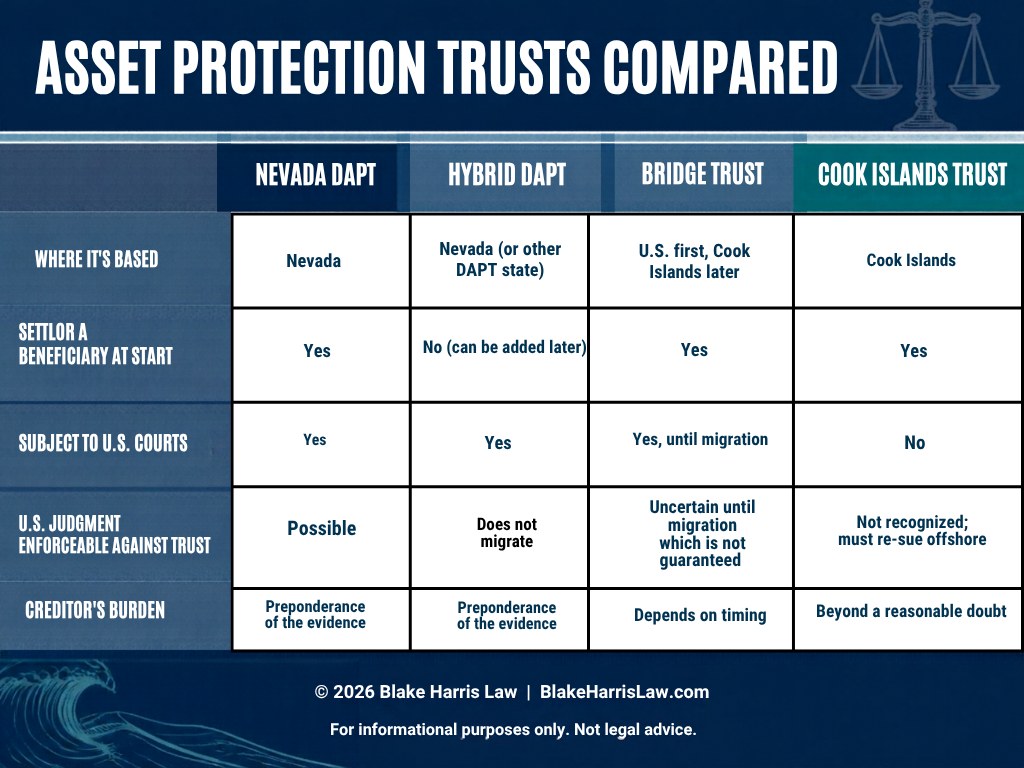
### Why Offshore Trusts Outperform Domestic Options
Offshore asset protection trusts are generally more expensive than DAPTs to implement and maintain annually. However, given the level of wealth generally involved when individuals are considering asset protection trusts, the cost differential on a relative basis is negligible. Any increase in price and additional regulatory requirements for offshore trusts are justified by the higher level of protection they provide.
Offshore trusts create a strong deterrent effect, or at worst, an inducement for creditors to settle early and for favorably low amounts. They accomplish this by erecting barriers that make litigation for the creditor expensive, time-consuming, and highly unlikely to succeed.
Most importantly, offshore trusts are not subject to U.S. laws. They can disregard judgments from U.S. jurisdictions. This alone makes them a stronger and more reliable asset protection tool.
Offshore trusts are governed internally by their contract provisions and governed externally by the laws of the situs jurisdiction, which are generally very debtor-friendly and more stringent than similar U.S. laws. A creditor who obtains a U.S. court order must begin entirely new litigation in the offshore jurisdiction, under dramatically different rules, with higher evidentiary standards and shorter filing windows.
### The Cook Islands
After passing its International Trusts Act in 1989, the Cook Islands has become the world's leading offshore trust jurisdiction. Cook Islands trusts have a legal framework that protects against creditor claims including foreign court judgments, and in [every reported decision our attorneys have reviewed](/articles/case-law-cit), no properly formed and timely funded offshore trust with an independent trustee has been defeated on the merits.
If a U.S. court orders the surrender of assets, a Cook Islands trustee has legal protection to resist such demands and safeguard the assets. The Cook Islands also maintains a statute of limitations on creditor claims and requires creditors to prove fraudulent transfer beyond a reasonable doubt, a standard virtually unheard of in civil litigation.
Cook Islands LLCs offer complementary protection. Cook Islands law only allows charging orders against Cook Islands LLCs and does not recognize judgments from overseas courts, meaning a U.S. creditor would have to file a lawsuit in a local court. Cook Islands LLCs also provide added confidentiality, unlike many U.S. LLCs, you are not required to list ownership on any public database.
### Nevis
Nevis is recognized for its favorable asset protection laws. It offers some of the strongest provisions for making assets virtually untouchable by creditors, restricting any attack on trust assets from outside the jurisdiction.
Nevis maintains high levels of confidentiality regarding trust and company ownership and has a streamlined legal process for setting up trusts. Like the Cook Islands, Nevis does not recognize foreign judgments, meaning American claimants must file a case of fraudulent transfer locally.
### Belize
Belize has a strong asset protection framework that makes it difficult for creditors or divorcing spouses to access assets placed in offshore trusts. Belize law restricts foreign courts from interfering with the validity or terms of a Belize-based trust, offering strong legal immunity from foreign claims.
Belize allows for the creation of trusts where the beneficiary maintains certain control, providing flexibility in how assets are managed, and is often preferred for its relatively low costs for setting up and maintaining offshore trusts.
### Layered Strategies: Offshore Trusts Combined With LLCs
Domestic LLCs offer a solid foundation for asset protection, but they remain subject to U.S. court authority. Offshore trusts take that protection further by operating under foreign laws that do not recognize U.S. judgments.
When combined, an LLC protects you from business liability while the offshore trust protects the LLC itself, creating one of the most effective protection structures available. This two-layer strategy is particularly effective because even if a U.S. court issues a judgment, offshore trustees are not obligated to comply without a separate trial in the trust's jurisdiction.
### Delaware Asset Protection Trust vs. Cook Islands Trust: A Comparison
The Delaware Asset Protection Trust is one of the strongest domestic options and is especially notable for allowing self-settled trusts in a state with no income tax on trust earnings, strong privacy protections, and a well-developed legal framework.
Setup costs typically range from $2,000 to $10,000, with ongoing annual fees of $1,000 to $3,000. The Delaware Chancery Court frequently supports trust enforceability, and the structure can be used to protect assets from civil judgments and divorce settlements.
However, because Delaware trusts are governed by U.S. law, they remain subject to the same conflict of laws, constitutional, and federal bankruptcy vulnerabilities described above.
A Cook Islands Asset Protection Trust, by contrast, typically costs $15,000 to $30,000 to set up, with annual fees in the range of $5,000 to $10,000, but offers protection that is difficult for creditors to breach, applies globally rather than just in one state, and cannot be overridden by U.S. court orders.
For high-net-worth individuals with assets ranging from $3 million to $20 million or more, the stronger protection of a Cook Islands trust is generally worth the additional cost.
### Conclusion: Choosing the Right Structure for Your Needs
Choosing the right asset protection structure requires a careful assessment of your risk profile, the nature and location of your assets, and the level of protection you genuinely need.
Domestic asset protection trusts offer meaningful protection at a lower cost and are appropriate for individuals with moderate risk exposure. Nevada stands out for its short statute of limitations, broad creditor protections, and absence of exception creditors.
Wyoming excels for those who want long-term, multi-generational planning with maximum settlor control. South Dakota is the top choice for those who prioritize privacy. Utah provides immediate protection for assets transferred before any claim arises. Delaware is particularly suited for gifting strategies and estate tax planning.
However, every domestic trust shares the same foundational weakness: subjection to U.S. law. Conflict of laws disputes, the Full Faith and Credit Clause, the Supremacy Clause, and the federal ten-year bankruptcy look-back all create vulnerability that no domestic structure can fully eliminate.
For high-net-worth individuals, particularly those in high-liability professions, those engaged in significant business activity, or those facing complex litigation exposure, offshore trusts in the Cook Islands, Nevis, or Belize provide protections that domestic structures simply cannot match. They are not extreme measures; they are the appropriate choice when the stakes are high enough to warrant the strongest available protection.
In all cases, the most effective asset protection is built proactively, before any claim arises, with the guidance of experienced legal counsel, and structured to meet the specific goals and risk profile of the individual.
---
### Cryptocurrency Asset Protection: A Practical Guide
URL: https://blakeharrislaw.com/articles/cryptocurrency-asset-protection
Published: 2025-01-19T00:00:00.000Z
Updated: 2026-10-19T00:00:00.000Z
How to protect cryptocurrency from lawsuits and creditors: custody and exchange risk, holding digital assets in an offshore trust, and how the IRS sees crypto.
## Cryptocurrency
Cryptocurrency has moved rapidly from a niche technology experiment into a mainstream financial asset class. Bitcoin, Ethereum, and thousands of other digital assets now represent significant wealth for millions of investors worldwide.
The number of investable assets in the digital space continues to increase day to day, and many veterans to the cryptocurrency space have managed to amass large sums by investing or trading digital assets. But with that wealth comes a set of legal, tax, and regulatory challenges that the traditional financial system was never designed to address.
Successful crypto investors need to be mindful of the need to protect crypto assets - whether from unreliable custodians, security breaches, the excessive market volatility associated with the crypto markets, or legal liability. Holders whose crypto sits alongside employer equity face both problems at once, which is its own planning question - see [asset protection for tech professionals](/articles/asset-protection-for-tech-professionals).
Just like traditional assets such as cash and real estate, digital assets also suffer from legal liability risk. This means digital assets can be a target of legal action, resulting in the loss of cryptocurrency assets. Fortunately, asset protection strategies can help protect a variety of different types of asset classes from potential legal threats, and cryptocurrencies are no exception.
This article brings together four critical dimensions of cryptocurrency ownership: the legal vulnerabilities that expose digital assets to seizure and litigation; the asset protection strategies, particularly [offshore trusts](/asset-protection/cook-islands-trust), that sophisticated investors use to safeguard their holdings; the [IRS rules that govern how crypto is taxed](https://www.irs.gov/filing/digital-assets) and reported; and the evolving regulatory landscape that will shape the future of the industry.
## Part One: Why Cryptocurrency Is Legally Vulnerable
Many crypto investors believe that the decentralized, pseudonymous nature of digital assets provides an inherent layer of protection. This belief is largely mistaken.
It is true that cryptocurrency by its very nature may appear to provide a degree of asset protection due to its apparent anonymity and the potential to avoid third-party risk if the owner personally holds coins or tokens in a physical wallet.
However, the protection afforded by these features is not absolute, far from it. If an owner of cryptocurrency is involved in litigation or bankruptcy, a court can require disclosure of all assets, including any cryptocurrency owned.
The level of privacy offered by most cryptocurrencies is often overestimated or misunderstood. In reality, blockchains act as a public ledger of all transactions and the respective addresses involved. While blockchain transactions are recorded without linking directly to a named individual, every transaction and address is visible to anyone who looks closely enough.
More critically, if you are involved in litigation or bankruptcy, a court can compel you to disclose all financial information, including all cryptocurrency and digital assets. Refusing to comply is not a viable strategy. Courts treat contempt orders seriously, and penalties can include fines, sanctions, and even incarceration until compliance is achieved.
This may come as a surprise to many who wrongly believe cryptocurrency is beyond the reach of governments and courts. But Bitcoin and other cryptocurrencies can be garnished by judgment creditors. Digital assets held in both hot wallets and cold wallets are subject to court orders.
When cryptocurrency accounts are held in popular exchanges such as Coinbase, Gemini, or Kraken, they are vulnerable to being frozen or seized in cases of government action. If you hold an account in any of these institutions, it is likely you have already agreed to this risk by accepting their terms of service. Bitcoin and other cryptocurrencies are also not exempt assets in the case of bankruptcy.
Cryptocurrency is a highly portable, highly liquid asset - a feature that makes it easy to use, but dangerously easy to seize. In litigation, U.S. courts treat crypto as property subject to turnover orders, compelling the defendant to surrender private keys or initiate on-chain transfers.
Because crypto keys can be stored on paper, a hardware device, a seed phrase, or even memorized, courts take an aggressive stance. If you control the keys, you are considered fully capable of turning them over. Domestic structures such as LLCs and U.S.-based trusts offer no meaningful defense; a judge can simply compel the managing member or trustee to comply.
As a result, self-settled domestic asset protection trusts - already vulnerable in litigation - are particularly susceptible for cryptocurrency. The combination of high visibility, seizure risk, and judicial pressure means that crypto investors require a level of protection beyond what U.S. law can generally provide.
As the use of cryptocurrency becomes more widespread, creditors and bankruptcy trustees increasingly investigate crypto wallets and accounts. Government entities and regulatory bodies are also increasing their sophistication when it comes to taking possession of cryptocurrency.
The United States Department of Justice has demonstrated this growing capability in a landmark seizure of 94,000 Bitcoin valued at over $3.6 billion. As the case law continues to develop, cryptocurrency garnishments and seizures in the U.S. are expected to become more common.
Those who are relying solely on the privacy of the blockchain to maintain their assets safe might be missing the bigger picture. Digital assets can be just as vulnerable to lawsuits and seizures as any other everyday assets.
While it might be tempting to simply claim that all cryptocurrency wallets were tragically lost in a boating accident, making false claims in a legal setting is never a recommended strategy. Anyone who opts to simply not disclose these assets if compelled by a court could be committing contempt of court or worse.
## Part Two: Asset Protection Strategies for Cryptocurrency
Fortunately, tried and true legal solutions exist that can help protect wealth from a variety of threats, and cryptocurrency can be safeguarded just like almost any other type of asset. Having an effective asset protection plan in place can help bring peace of mind that those cryptocurrencies will be safe from potential legal claims and future creditors.
Asset protection trusts work by turning over management authority over cryptocurrency holdings and other assets to a third-party trustee, thus leaving the cryptocurrency effectively out of the settlor's hands for legal purposes. This provides asset protection thanks to the legal separation between the settlor and the assets.
Before a legal claim ever arises, the owner can turn over management authority over his cryptocurrency holdings to a third-party trustee, thus leaving the cryptocurrency effectively out of his hands for legal purposes.
In addition, asset protection trusts can utilize experienced cryptocurrency and digital asset custodians familiar with cybersecurity and cold storage custody. In some cases, the original owner of the cryptocurrency may remain the custodian of the asset even after it has been transferred into the trust.
The best asset protection strategies available for cryptocurrency investors include offshore trusts and [domestic asset protection trusts](/articles/domestic-asset-protection-trusts) - with offshore options generally considered the strongest available by asset protection attorneys.
### Why Offshore Trusts Are the Gold Standard
Offshore asset protection trusts (APTs) have been the gold standard of asset protection for decades. Now, they are being applied to digital assets with powerful results. Offshore APTs fundamentally alter the power dynamic between U.S. creditors and the trust assets.
These trusts are established in foreign jurisdictions, most notably the Cook Islands, Nevis, and Belize, whose legal systems do not recognize U.S. judgments. A creditor who obtains a U.S. court order must start litigation anew in the offshore jurisdiction, often under dramatically different rules.
Asset protection attorneys generally agree that offshore trusts offer the highest level of security available in the market. The key to an offshore asset protection strategy is to remove the assets from the reach of the courts in the U.S. and instead transfer jurisdiction to a much more defendant-friendly location.
When structured effectively, an offshore trust can provide remarkable asset protection for almost any type of holdings, including many of the most common cryptocurrencies and digital assets.
The crucial advantage is that foreign trustees are not subject to U.S. court authority. If a U.S. court orders that crypto keys be turned over, the offshore trustee is under no obligation to comply.
Even if the beneficiary wanted to obey the order, they cannot direct the trustee to violate the laws of the foreign jurisdiction - such as those of the Cook Islands. This legal impossibility of compliance prevents the beneficiary from being held in contempt - a core principle of offshore protection.
These jurisdictions also impose short statutes of limitations on fraudulent transfer claims and require creditors to meet a very high burden of proof. Many require proof "beyond a reasonable doubt", a standard almost unheard of in civil litigation. As a result, once the trust has been established and properly funded, subsequent legal challenges become extraordinarily difficult.
Among the reasons leading asset protection attorneys utilize Nevis and Cook Islands trusts are the following: their legal systems are based on English common law, with legal institutions of a first-world nation; these countries do not charge income taxes on assets held under a trust; there is a two-year statute of limitations on all creditors that bring an action against the trust; a [Cook Islands Trust](/asset-protection/cook-islands-trust) and a Nevis Trust can protect assets that are not located within these jurisdictions, and you can transact with them electronically; and neither Nevis nor the Cook Islands recognizes foreign judgments, meaning an American claimant must file a case of fraudulent transfer in those jurisdictions if they want to reach any assets from the trust.
A key element of an offshore asset protection trust is ensuring that the trust management has no ties or business presence in the U.S. For this reason, it is important that the trust assets be removed to other offshore jurisdictions, such as Switzerland or Liechtenstein.
Additionally, a Nevis Trust and a Cook Islands Trust require a trustee that is physically present in that country. While not regulated by U.S. government bodies, offshore trustee companies are registered and regulated by the governments under which they operate.
### Structural Models for Holding Crypto in an Offshore Trust
The specifics of how cryptocurrency is held within an offshore trust depend on the client's risk profile, level of trading activity, and jurisdictional requirements. There are three main structural models.
**Direct trust custody** offers maximum protection. In this arrangement, the offshore trustee holds the cryptocurrency directly. Keys may be stored in offshore vaults, hardware devices, or secure multi-signature arrangements administered by the trustee. This model offers maximum protection, although it limits day-to-day hands-on management for clients who actively trade or participate in decentralized finance (DeFi).
**Trust-owned offshore LLC** is a more flexible structure and the preferred arrangement for most sophisticated crypto investors. The trust owns an offshore LLC, which in turn holds the cryptocurrency. The client may act as manager of the LLC during normal circumstances, allowing daily trading, staking, or DeFi activity.
If legal threats arise, a "flight clause" shifts management authority to the offshore trustee, who then secures the assets beyond U.S. jurisdiction. This hybrid approach combines practicality with strong protection.
**Trust-controlled multisig** suits clients who require more technical control. The trust may participate in a multi-signature wallet arrangement - for instance, one key held by the trustee, another by the client, and a third stored in an offshore vault.
The result is a system in which the trust maintains protective control, yet the client retains functional access for transactions. Courts cannot compel a turnover of assets held in a multisig arrangement when the beneficiary does not control a majority of the signing authority.
**What Offshore Trusts Protect Against**
When properly structured and funded before legal trouble arises, offshore APTs provide a formidable defense against creditor actions. They protect against business lawsuits, partnership disputes, malpractice claims, personal injury claims, personal guarantees, contractual disputes, and even certain claims arising in family court.
Most importantly for cryptocurrency holders, they protect against compelled turnover orders, the single greatest risk for digital asset seizure. Offshore trustees simply do not comply with U.S. instructions to surrender private keys or transfer crypto, and U.S. courts have no power to compel them.
Offshore trusts also add a substantial deterrent effect. The cost, complexity, and uncertainty of litigating in a foreign jurisdiction cause many creditors to settle faster or abandon their claims altogether. The added costs and complexity of filing a legal claim abroad is often enough to discourage plaintiffs, not to mention that the laws in these countries are much more favorable to defendants.
### What Offshore Trusts Cannot Do
Offshore trusts are not a license to hide assets or evade taxes. Transfers made after litigation begins can potentially still be challenged. Beneficiaries must remain fully compliant with IRS reporting and filing rules, which are well-established and routine for these structures. Offshore trusts protect assets from civil creditors, not from government investigations or criminal proceedings. In short: they provide robust asset protection, not secrecy.
### Common Mistakes That Undermine Protection
Despite the strength of offshore trusts, several common missteps can compromise effectiveness. Retaining personal control over private keys gives courts leverage. Leaving crypto on U.S. exchanges subjects it to subpoenas and freezes.
Improper drafting of trust or LLC documents may inadvertently preserve U.S. control. Poorly implemented multisig arrangements can compromise legal insulation. These errors are avoidable with proper planning and experienced legal structuring.
### A Growing Trend Among Crypto Investors
The rise of cryptocurrency has created an entirely new class of digital wealth, but not without new risks. Domestic laws were never designed to protect cryptographic assets, and courts routinely use their power to compel key turnover. Offshore trusts, built around the principle of jurisdictional independence, offer a solution uniquely suited to the nature of digital assets.
Investors who hold large crypto positions increasingly recognize that offshore trusts are not extreme measures; they are modern necessities. As the regulatory environment tightens and litigation becomes more aggressive, these structures provide certainty, stability, and peace of mind.
For clients with meaningful crypto exposure, especially those actively engaged in business, professional work, or investment activity, offshore trusts remain the strongest and most reliable asset protection vehicle available.
## Part Three: How the IRS Taxes Cryptocurrency
While offshore trusts can shield crypto from civil creditors, they do not change your tax obligations. As cryptocurrency gains popularity as an investment option, people are beginning to need guidance on how to report cryptocurrency on taxes. Understanding how the IRS classifies and taxes digital assets is essential for every crypto investor.
### IRS Classification
Currently, the Internal Revenue Service classifies cryptocurrency as property for tax purposes. This means it is not treated as a type of currency, it does not pay dividends or accrue interest, it may require an appraisal for estate tax purposes, and its value may fluctuate in the same way as real estate. The IRS treats all cryptocurrency as a capital asset and taxes it accordingly.
### Capital Gains Rules
When you sell your cryptocurrency - such as Bitcoin or Ethereum - for a profit, the capital gains tax rules apply. If you held your cryptocurrency for one year or less, you would have to pay short-term capital gains taxes. If you held your cryptocurrency for more than one year, long-term capital gains rates apply to profits earned on the sale.
Additionally, if you earn cryptocurrency by mining it, receive it as a promotion, or receive it as a payment for goods or services, it will be counted as part of your regular income at your ordinary tax rate. And if you hold that same cryptocurrency and its value increases, you would subsequently be required to pay capital gains taxes on the profits based on how long you have held it from the date of receipt.
### How the IRS Finds Out About Your Crypto
First and foremost, it is important to voluntarily report your earnings from cryptocurrency investments to avoid future tax audits. Some investors ask: if they must volunteer the information, how would the IRS know about crypto earnings in the first place? The answer is that there are several ways the IRS can find out about your crypto holdings.
**Form 1099-K and Form 1099-B**: Cryptocurrency exchanges in the United States, like Coinbase and Kraken, report to the IRS. If you have more than $20,000 in proceeds and 200 transactions in crypto exchanges, you will receive Form 1099-K that documents your proceeds each month - and your exchange will also send a copy to the IRS.
Once you file a tax return and neglect to include the amounts from Form 1099-K, the IRS computer system known as the Automated Underreporter will flag you for not reporting, and you could be subject to tax notices and penalties. Should you receive Form 1099-B and fail to report it, the same principles apply.
**Subpoenas**: The IRS has issued subpoenas to cryptocurrency exchanges requiring them to disclose user information and accounts. Large cryptocurrency exchanges like Coinbase and Bitstamp have been served subpoenas requiring the disclosure of information such as taxpayer identification numbers, names, birth dates, account activity logs, transaction logs, statements, and invoices.
If your name is listed in a subpoena, the IRS can match the records to see if you have been adequately reporting crypto on your taxes.
**Schedule 1 of Form 1040**: Beginning with the 2020 tax season, on Schedule 1 of Form 1040, each taxpayer is asked whether they received, sold, sent, exchanged, or otherwise acquired a financial interest from virtual currency. It is important to be truthful and volunteer this information.
It is possible that you do not owe taxes on your cryptocurrency if you simply held your coins and did not sell them - but the question must still be answered honestly. Voluntary and accurate reporting is not merely advisable; it is legally required.
**Law Enforcement and Cryptocurrency**
Law enforcement and other government entities, aside from the IRS, have begun to investigate cryptocurrency for both its legitimate uses and its potential for misuse. In October 2020, the Department of Justice released the Cryptocurrency Enforcement Framework authored by the Attorney General's Cyber-Digital Task Force.
The report identifies legitimate uses for cryptocurrency but also acknowledges how cryptocurrency can be used for criminal acts. The report states that, whatever the overall benefits and risks of cryptocurrency, the DOJ seeks to ensure that uses of cryptocurrency are functionally compatible with adherence to the law and with the protection of public safety and national security.
The report identifies three categories of how bad actors can exploit cryptocurrency: engaging in financial transactions associated with the commission of crimes, such as buying and selling drugs or weapons on the dark web, leasing servers to commit cybercrimes, or soliciting funds to support terrorist activity; engaging in money laundering or shielding otherwise legitimate activity from tax and reporting requirements; and committing crimes directly implicating the cryptocurrency marketplace itself, such as stealing cryptocurrency from exchanges through hacking or using the promise of cryptocurrency to defraud investors.
Throughout the report, the DOJ makes clear that law enforcement and federal agencies are within their rights to enforce against a variety of criminal conduct involving cryptocurrency.
Other federal agencies that can enforce statutes and regulations against people who use cryptocurrency in illicit ways include the Financial Crimes Enforcement Network (FinCEN), the Office of Foreign Assets Control (OFAC), the Office of the Comptroller of the Currency (OCC), the Securities and Exchange Commission (SEC), the Commodity Futures Trading Commission (CFTC), and the Internal Revenue Service (IRS).
## Part Four: The Regulatory Landscape
Beyond taxes and asset protection, cryptocurrency investors must understand the evolving regulatory environment. For much of its history, crypto operated in a regulatory gray zone. That is changing rapidly.
### The Wild West Era Is Ending
The cryptocurrency industry can aptly be compared to the Wild West. As we recall from old westerns, the Wild West wasn't a great place for commerce - random shootouts could break out at a moment's notice, and the town authority wasn't necessarily on the side of the law. In the Wild West that is the cryptocurrency industry, there have been rumblings of a new sheriff coming to town with plans to regulate the space.
In fact, there are several potential sheriffs. The Securities and Exchange Commission, the Commodity Futures Trading Commission, and the Conference of State Bank Supervisors have all begun taking steps to claim territory in the cryptocurrency regulation space. Once an unregulated free-for-all, it appears that cryptocurrency will soon have to live within some rules and boundaries.
Multiple federal agencies have staked competing claims over the space. The SEC has determined that some cryptocurrencies, such as Bitcoin, are not securities and fall outside their jurisdiction, but that most others - including initial coin offering tokens - are securities and therefore subject to SEC regulation.
The recent confirmation of Gary Gensler as SEC Chairman signaled a potential shift in the SEC's approach to cryptocurrencies. Gensler, a former professor who taught a course on cryptocurrency at MIT, has publicly stated that cryptocurrency needs clear rules in order to be fully adopted as mainstream.
He has indicated the SEC is looking into seven key issues: initial coin offerings, trading venues, lending platforms, DeFi, stablecoins, custody, and exchange-traded funds. Gensler has also called on Congress to expand the SEC's authority to regulate cryptocurrency trading, lending, and decentralized finance platforms.
The Commodity Futures Trading Commission classifies some cryptocurrencies, such as Bitcoin, as commodities.
This interpretation received a judicial boost in CFTC v. McDonnell, when the U.S. District Court for the Eastern District of New York ruled that cryptocurrencies "fall well within the common definition of 'commodity.'" However, the CFTC's authority over cryptocurrency commodities only extends to fraud cases and the enforcement of Commodity Exchange Act violations - it does not allow the CFTC to enact regulations that would prevent violations in the first place.
As CFTC Acting Chairman Rostin Benham described his agency's role: "Some people call this new technology 'the Wild West.' I guess my agency is the equivalent of Wyatt Earp in Tombstone." Earp's strong response to lawbreakers likely had some would-be outlaws giving Tombstone a wide berth, but even he was only as powerful as the laws he had to work with.
In December 2020, the DOJ's Cyber-Digital Task Force released their 83-page cryptocurrency enforcement framework - a document described by one fintech attorney as adopting a "consistently sinister tone, presenting a cavalcade of cryptocurrency-related illicit activity and vice." As one fintech executive put it, the message seemed to be that blockchain and digital currencies are not welcome in the U.S. But adopting regulations that slow mainstream adoption may be a necessary first step - one that gives lawmakers and regulators time to assess the issues at hand, determine where each agency has jurisdiction, and agree on how the pieces fit together.
In the end, a cohesive approach will benefit all players, from crypto businesses to investors.
### The Case for Regulation
The obvious question is what impact upcoming regulations will have on the cryptocurrency industry. Regulations are often seen as cumbersome and expensive red tape that stifles free trade and hurts businesses. In reality, regulation of crypto could actually be a good thing, allowing crypto to emerge from the shadows as a mainstream contender in the fintech industry.
In other industries, regulation has had a broadly beneficial impact. Without environmental regulations, our lakes, air, and wildlife would suffer, leading to a significantly reduced quality of life for residents of our country. Energy regulations protect the world from pollution caused by fossil fuels.
Consumer protection regulations keep Americans from being preyed upon by dishonest advertising and misleading contracts. Regulation is necessary in any government that wants to keep unethical actors from pursuing gains at any cost.
At the industry level, regulations can help by providing a level playing field, ensuring that each company plays by the same rules. If all crypto companies have to abide by the same regulations, that puts the odds of fair competition within easier reach.
As Geoffrey James has argued, the lack of regulation only benefits big business, which has the resources to compete in a laissez-faire market. Regulation helps smaller players compete on merit rather than on resources alone.
One important thing that regulation provides to any industry is legitimacy. This can be especially important in the fintech world. Cryptocurrencies are newcomers to the finance world and regarded with suspicion by the average investor.
This suspicion is not unwarranted, there have been some highly publicized scams in recent years that have left the public wary of these investments. Regulation of this industry could give investors and the companies they work with a higher confidence level when adding cryptocurrencies to their portfolios.
If "anything goes," consumers will understandably be hesitant to engage, preferring to stick to tried-and-true industries with regulated consumer protections.
Stop signs and speed limits regulate the roads, but these safeguards are exactly the reason people feel safe using our transportation infrastructure. Digital currency companies are looking to the government to make people feel as safe investing in Bitcoin as they do driving on U.S. highways.
### Cryptocurrency's Road to the Mainstream
Cryptocurrencies such as Bitcoin have been around for years, and blockchain had everyone from bankers to librarians eager to exploit it for their benefit. But from 2018 to 2021, digital currencies began to gain serious steam. In March 2018, the SEC, FinCEN, and the CFTC all issued statements about digital currency.
The SEC's "Statement on Potentially Unlawful Online Platforms for Trading Digital Asset" and the CFTC's court victory over Coin Drop Markets both warned of the dangers of the unregulated cryptocurrency industry and the threat it posed to investors.
FinCEN argued that cryptocurrency exchanges were being used to help facilitate money laundering by drug dealers and terrorist organizations. The timing of these three public responses - all published within a 24-hour time span - sent a clear message about the government's stance on digital currency at the time.
In 2019, regulatory talk began to ramp up in earnest. As investors began to see potential for large payouts in the cryptocurrency space, the volatility of the market increased. Massive price swings could make and lose fortunes in a single day.
This volatility, while attractive to a small group of investors, served to keep more risk-averse investors at bay. Those on the outside looking in began calling for regulation in order to level out the volatility and make the markets safer for both investment companies and retail investors.
The digitization of financial services was already gaining widespread adoption before 2020, but the pandemic shifted that adoption into overdrive. Suddenly there was an immediate need for commerce and banking that did not require leaving home. The pandemic increased the need for and interest in digital currencies as the demand for touchless technologies spiked in all sectors.
Restaurants, stores, and delivery services touted contactless payments, and banks scrambled to implement fully remote services. Always ready to cash in on trends, venture capitalists were quick to fund the fintech companies that had positioned themselves to partner with these service industries.
Unfortunately, the regulatory world was not prepared for the sudden surge in cryptocurrency and other financial technologies. Part of the issue is that as digital currencies and fintech were taking off, lawmakers were occupied with handling the intricacies of the pandemic and the legal and social ramifications of lockdown - not to mention the chaos that surrounds an election year.
Now the calls for regulatory reform are loud and clear. Cryptocurrency companies and the institutions that want to invest in them have begun to call for regulation, recognizing that the lack of clear rules hinders their growth and innovation.
What form that regulation takes remains to be seen, but the consensus seems to be that the current situation will both serve as a green light to scammers and hinder the ability of legitimate companies to operate freely in the United States.
### State-Level Regulation: A Patchwork Landscape
The current regulatory landscape for digital currency is inconsistent at best. At the state level, many governments have grown tired of waiting for the federal government to come up with a cohesive plan and have put together their own regulations governing digital currencies. These regulations have varied widely in their trust - or lack thereof - of the fintech industry.
Most states that have addressed digital currencies have limited their focus to how these products fit into the state's existing money transmitter laws. Some states, such as New York and California, have chosen to take a more heavy-handed approach to regulation and enforcement.
In New York, cryptocurrency businesses have had to apply for a special license - called a BitLicense - to operate in the state. The requirements companies must comply with to receive this license include consumer protection, cybersecurity, Know Your Customer, and anti-money laundering rules.
BitLicenses also only cover specific pre-approved cryptocurrencies, which include Binance, Bitcoin, Ethereum, Gemini Dollar, Litecoin, PAX Gold, and Paxos Standard. Crypto businesses initially balked at these strict regulations. In the end, however, New York's position as a financial giant meant that they could not ignore the regulations for long. Now companies tout their BitLicense approval as a sign of distinction.
As New York Department of Financial Services Superintendent Linda Lacewell told Bloomberg: "Companies came to realize that if they received a license from us, that means that they had been vetted… and that DFS was willing to say this company is okay to do business, to interact with NY consumers. Reasonable regulation provides a safe place to innovate."
On the other coast, California has proposed that all cryptocurrency companies get approval from the Department of Business Oversight before operating in the state - a move designed to better protect consumers.
In 2020, the governor signed the California Consumer Financial Protection Law, which created a Division of Consumer Financial Protection to monitor a variety of emerging markets, including cryptocurrencies. As with the regulations in New York, crypto businesses will likely balk at the outset, but in the end, financial businesses need to do business in California, so they will have to fall in line.
On the other side of the coin, other states are choosing to make themselves more friendly to fintech companies. Wyoming has passed numerous laws designed to attract cryptocurrency companies to operate there. One of these laws, the "Utility Token Bill," exempts utility tokens from the state's securities laws, provided the token and its issuer meet certain requirements.
Wyoming also amended its Money Transmitter Act to provide an exemption for virtual currency. In 2019, Colorado enacted the "Colorado Digital Token Act," which provides limited exemptions from securities registration and licensing requirements for persons dealing in digital tokens. The state is also actively exploring blockchain for use in a variety of agencies and government endeavors.
As these four states demonstrate, regulations can vary widely from state to state, making it difficult for fintech companies to operate across multiple jurisdictions. The Conference of State Bank Supervisors has worked to address this by supporting state regulators' efforts to engage with financial services companies involved in fintech.
The CSBS Fintech Industry Advisory Panel has released recommendations such as developing a menu of state licensing requirements for multi-state consistency, building a state examination system, and creating a central repository of licensing and fintech-related state guidance. These efforts have already begun to be implemented and should help states better manage the influx of digital currency.
Consistent language and licensing requirements will allow companies to more easily monitor compliance. With the CSBS providing consistent guidance to the states, different states can be encouraged to interpret statutory language in similar ways - further enhancing companies' ability to operate across many states and further aiding in their bid for legitimacy.
### Federal Regulation: What Comes Next
While state attempts at regulation are admirable and certainly understandable given the lack of clear direction at the federal level, it is simply impossible to keep digital currencies within a state border. The national and even global tendencies of digital currency require a federal-level response to regulation. State efforts have put a proverbial finger in the dike, but the dam will eventually burst.
On the federal level, regulations have focused on bits and pieces of digital currencies but lack a cohesive approach. The issue comes down to how the asset is classified, and different agencies have different opinions on classification.
The SEC, CFTC, FinCEN, and others have overlapping and sometimes conflicting jurisdictional claims. Resolving this question will require either congressional action or a coordinated inter-agency agreement.
Regardless of who ends up winning the battle for control over cryptocurrency, federal regulation of crypto may get worse before it gets better. There is discussion that the first step in federal regulation may be to implement policies that will slow the mainstream adoption of digital currencies - a necessary pause that gives lawmakers time to assess the issues at hand and agree on how those pieces fit together.
Can cryptocurrencies be regulated? The short answer is yes, and all indications lean toward the federal government making clear inroads in the years ahead. But effective legislation will require leaning on the very companies that the regulations seek to control.
Just as the CSBS relied on a panel of companies in the fintech industry to create their guidance for the states, federal regulations will require input from those who live and breathe in this space. Government agencies and fintech companies will need to be equally involved to ensure that new regulations are both effective and do not stifle innovation.
It has become clear over the last several years that crypto isn't going anywhere. In order for it to take what many believe is its rightful place in our financial system, regulation is imperative. Regulation benefits both the growth of the industry and the best interests of the American public. Even fintech companies themselves recognize that without regulation, they will not achieve true legitimacy in the eyes of the government or investors.
### Conclusion
Cryptocurrency represents a genuinely new class of digital wealth - highly liquid, globally portable, and structurally outside the traditional financial system. But it is not beyond the reach of courts, creditors, or tax authorities. Investors who treat it as unregulated and untouchable are taking significant risks that careful planning can avoid.
A comprehensive approach to cryptocurrency ownership means understanding all four dimensions covered here: the legal vulnerabilities that make digital assets uniquely seizure-prone in litigation; the offshore trust structures, particularly Cook Islands and Nevis trusts, that provide the strongest available legal protection; the IRS rules that govern classification, taxation, and mandatory reporting; and the regulatory trends at both the state and federal level that will increasingly define what it means to own and operate with digital assets.
For investors with meaningful crypto exposure, particularly those actively engaged in business, professional work, investment activity, or decentralized finance, these are not peripheral concerns. They are essential to preserving what has been built. The investors who will thrive in the next phase of the crypto era are those who treat legal and regulatory compliance not as an afterthought, but as a foundational element of their wealth strategy.
---
### Swiss Banking for U.S. Citizens
URL: https://blakeharrislaw.com/articles/swiss-banking
Published: 2024-11-04T00:00:00.000Z
Updated: 2026-10-19T00:00:00.000Z
Switzerland is still the world's largest offshore banking centre. How U.S. citizens open and fund a Swiss account, and what FATCA requires them to report.
## Introduction
Switzerland has been the world's primary hub for [offshore banking](/articles/offshore-banking) for centuries, built on a foundation of political neutrality, economic stability, and a tradition of financial discretion dating back to 1713. Films and television shows have portrayed Swiss banks as secret repositories for ill-gotten funds, but the reality today is quite different.
Switzerland has strict anti-money laundering laws and tax agreements that have made its banks far more difficult to use for illegal activities. What remains unchanged is the exceptional privacy, security, and investment flexibility that Swiss banking offers to legitimate clients, including U.S. citizens seeking to protect their wealth internationally.
This guide covers everything you need to know about Swiss banking as a U.S. citizen: why offshore banking matters for asset protection, how to open a Swiss bank account, what [reporting requirements](/articles/cook-islands-trust-reporting-requirements) apply, what investment opportunities are available, and how Swiss storage facilities can protect physical assets like gold and precious metals from legal threats at home.
## Part One: Why Offshore Banking Matters for Asset Protection
Opening a bank account offshore is more than a financial convenience. For anyone serious about protecting wealth from lawsuits, creditors, and adverse court judgments, keeping assets in a foreign jurisdiction is a logical and important step.
Offshore asset protection is generally about placing funds and valuable assets beyond the easy reach of domestic courts. An offshore trust removes the management and nominal ownership of trust assets to a different country, such as the Cook Islands or Nevis. See our overview of the [Cook Islands Trust](/asset-protection/cook-islands-trust) - the structure we focus on at Blake Harris Law and the one a Swiss account most commonly sits inside.
Once that is done, a U.S. court cannot assert authority over those assets. Because these jurisdictions are foreign sovereign nations, they can decide whether to recognize a foreign judgment or disregard it entirely. A court's authority generally does not travel beyond its country's borders.
This principle extends to banking. While it is entirely possible for an offshore trust to hold a bank account in the United States, doing so places the funds back within reach of domestic courts.
A local bank that receives a court order can be compelled to freeze or surrender those funds, potentially undermining all the legal planning that went into building the offshore structure. Keeping trust assets in a foreign bank account generally helps keep them beyond the practical reach of U.S. courts.
The added paperwork involved in offshore banking is a small price to pay for the benefit of having funds insulated from potential lawsuits at home. And from a negotiating standpoint, assets that creditors cannot easily reach significantly strengthen your position in any settlement discussion.
## Part Two: Swiss Banking, History, and What Makes It Special
Switzerland has been the world's leading center for offshore finance for more than three centuries. The tradition of banking discretion dates to 1713, when the Great Council of Geneva passed a federal act requiring bankers to maintain client registers while forbidding them from disclosing that information except under specific conditions.
In 1934, Switzerland signed the Banking Act, making it a crime for Swiss bankers to reveal client identities to foreign governments.
Swiss banking secrecy began to shift in the 21st century. In 2013, Swiss bank Wegelin and Co. pleaded guilty to aiding U.S. tax evaders, prompting significant regulatory changes. Switzerland adopted compliance measures under the U.S. [Foreign Account Tax Compliance Act (FATCA)](https://www.irs.gov/businesses/corporations/foreign-account-tax-compliance-act-fatca), which requires global banks to report account information of U.S. citizens to the IRS.
In 2014, Switzerland joined the global automatic exchange of financial information. A significant blow came in February 2022, when the "Suisse Secrets" leak exposed over 18,000 Credit Suisse accounts.
Despite these changes, Swiss banking remains one of the strongest options for offshore banking and financial privacy in the world. What has changed is the nature of the privacy offered. Swiss banks today operate with enhanced transparency toward tax authorities while still maintaining strong confidentiality standards relative to most other jurisdictions.
Information is disclosed when there is clear legal grounds for doing so, not simply upon request. For clients with legitimate asset protection goals who are fully compliant with their home country's tax laws, Swiss banking can still offer considerable value.
Switzerland's banking system benefits from a stable political climate, strong financial regulation, and one of the most robust currencies in the world. The Swiss franc has low inflation and is backed by approximately 40% in gold reserves. It is estimated that around one-third of the world's offshore wealth is stored in Swiss banks, making Switzerland the undisputed center of global private wealth management.
Swiss banks are also exceptionally safe from a financial stability standpoint. There has only been one bank failure in the modern history of Switzerland. Qualifying Swiss bank deposits are generally protected up to 100,000 CHF per client per bank under [esisuisse](https://www.esisuisse.ch/en/deposit-insurance/the-swiss-system), the country's depositor-protection scheme.
It is worth being precise about what that is: esisuisse is a self-regulatory organisation funded by its member banks rather than government insurance, and member banks collectively cover a shortfall up to a statutory ceiling.
## Part Three: Can U.S. Citizens Open Swiss Bank Accounts?
Yes. U.S. citizens can legally open Swiss bank accounts. Switzerland allows foreign individuals, including Americans, to establish personal or corporate accounts provided they meet strict verification and documentation requirements. The process requires full compliance with Swiss banking regulations, international transparency standards, and U.S. tax reporting laws.
Swiss banks do report to the IRS. If you are a U.S. citizen or resident, information regarding your Swiss bank account is required to be sent to the IRS under FATCA and the automatic exchange of information agreements between the U.S. and Switzerland.
This means Swiss bank accounts are not a tool for hiding assets from tax authorities. They are a tool for legitimate asset protection, privacy, and international diversification, all of which remain fully legal when conducted in compliance with applicable reporting requirements.
## Part Four: How to Open a Swiss Bank Account as a U.S. Citizen
The account opening process for a Swiss bank is more involved than opening an account at a domestic institution, but it is entirely manageable with proper guidance. Here is what the process involves.
**Step 1: Research and choose the right Swiss bank.** Switzerland has several types of banking institutions. Cantonal banks are government-owned banks for residents of the canton where the bank is located. Retail banks offer personal banking services including checking accounts, savings accounts, mortgages, and credit cards. International banks cater specifically to foreign clients.
Investment banks, often called private banks, are typically exclusive to high-net-worth individuals seeking to diversify assets and access sophisticated investment products. Before applying, consider the bank's available international services, online banking capabilities, minimum balance requirements, fee structures, and experience working with U.S. clients under FATCA.
**Step 2: Understand eligibility and documentation requirements.** To open a Swiss bank account as a U.S. citizen, you must be at least 18 years old, reside in an eligible country (the United States qualifies), have a clean legal background with no evidence of criminal activity or money laundering, and meet the bank's minimum deposit thresholds.
Required documents typically include a valid government-issued ID such as a U.S. passport, proof of address such as a recent utility bill or bank statement, documentation of the source of your funds such as tax returns or employment contracts or business agreements, and completed bank application forms.
Some banks require additional documentation depending on the origin of your assets and the type of account you want to open.
**Step 3: Complete the application and KYC process.** Swiss banks conduct Know-Your-Customer (KYC) verification, which includes confirming your name, address, date of birth, and nationality to comply with strict anti-money laundering laws. Many Swiss banks allow U.S. citizens to complete the entire account opening process online. Others may require an in-person meeting.
**Step 4: Undergo a background check.** Swiss banks generally perform thorough background checks for compliance with anti-money laundering regulations. The bank will assess whether you have any criminal history or financial irregularities. This process can take several weeks depending on the institution.
**Step 5: Choose the correct account type.** Common account types available at most Swiss banks include a personal account for basic banking and payments, a savings account to build and protect savings with interest, an investment account to hold securities and grow wealth, and a corporate account for business and commercial activities.
**Step 6: Meet the minimum deposit requirement and fund your account.** Many Swiss banks have minimum deposit requirements that can be substantial, particularly for non-resident clients. Requirements typically range from $500,000 to over $1 million depending on the bank and account type.
Working with an experienced asset protection attorney who has established relationships with Swiss banking institutions can help you access banks with lower entry thresholds. Once your account is approved, you transfer the required initial deposit, which can be done by international wire transfer. Travel to Switzerland is not required. The entire process can be completed remotely.
**Step 7: Set up online banking.** Most Swiss banks offer robust online banking services, allowing you to manage your account, make transfers, and oversee your assets from anywhere in the world.
Note that in Switzerland, most offshore accounts are opened not in a personal name but through a Registered Investment Advisor (RIA). An RIA is a firm registered with a federal or state agency that advises clients on fund management, financial planning, and portfolio investment.
In Switzerland, financial services are regulated by the Swiss Financial Market Supervisory Authority (FINMA) and the Swiss National Bank (SNB). An RIA assists in selecting the right bank and then guides the account opening process, providing a professional point of contact and a higher standard of care than other financial intermediaries.
**Part Five: Advantages of Swiss Banking for U.S. Citizens**
**Enhanced privacy and confidentiality.** Swiss banks maintain strong confidentiality standards. While required to comply with international transparency agreements for tax purposes, they offer far greater privacy protections compared to most U.S. financial institutions.
Swiss bankers cannot disclose information about clients without clear evidence of wrongdoing or strong legal grounds. Foreign banking clients have a much better chance of remaining anonymous and private than they would by banking in the U.S.
**Superior asset protection.** Swiss banks have some of the strictest capital and insurance requirements in the world. Unlike many banks in the European Union and around the world, Swiss banks require all accounts to have full insurance coverage. Holding assets in Switzerland can shield wealth from potential domestic legal risks, creditor claims, and economic instability.
**Access to a stable currency.** The Swiss franc is one of the world's most stable and reliable currencies, providing an additional layer of financial security against inflation and currency devaluation.
**International investment opportunities.** Swiss bank accounts provide access to a wide range of global investment options including real estate, equities, precious metals, commodities, cryptocurrency, bonds, and exchange-traded funds. Opening a Swiss investment account allows genuine diversification of assets across multiple asset classes and geographies.
**Financial stability.** Switzerland has a very stable economy with considerably lower inflation rates than many other countries. Its conservative monetary policy and gold-backed currency make it a top choice for high-net-worth individuals who want to grow and preserve wealth in a strong, stable financial environment.
**Part Six: Reporting Requirements for U.S. Citizens with Swiss Bank Accounts**
U.S. laws and international agreements, including FATCA and the Automatic Exchange of Information (AEOI), make U.S. citizens and Swiss banks jointly responsible for reporting specific information to the IRS. Full compliance with these requirements is not optional.
The IRS requires a Report of Foreign Bank and Financial Accounts (FBAR) from any U.S. citizen with a foreign financial account exceeding $10,000 at any point during the year. The FBAR requires the account holder's name, the name and address of the Swiss bank, the bank account number, the type of account, and the maximum account value during the year.
In addition to the FBAR, U.S. citizens may need to file IRS Form 8938 if offshore assets exceed applicable thresholds, report interest and dividend income on Schedule B of their federal tax return, and file additional forms depending on the structure of the Swiss account and any entities held within it.
Swiss bank accounts are not a means of avoiding U.S. taxes. The U.S. and Switzerland have agreements that facilitate the exchange of financial information.
Failure to declare a Swiss bank account can lead to severe consequences, including legal penalties, substantial fines, and potential criminal charges. When conducted in full legal compliance, however, Swiss banking is entirely lawful and provides significant financial and privacy benefits.
## Part Seven: Investment Options Available Through Swiss Bank Accounts
Once a Swiss bank account is established, a wide range of international investment opportunities becomes accessible. Swiss banks are known for offering flexible and secure access to global markets.
Real estate investments allow access to property in stable markets across Europe and beyond. Precious metals including gold, silver, platinum, and palladium can be held in allocated storage arrangements through Swiss financial institutions. Global equities and fixed-income instruments including stocks and bonds provide diversified growth potential.
Certain Swiss banks now offer custody services and investment options for digital assets including cryptocurrency. Exchange-traded funds provide broader market exposure with tax-efficient structures. Private equity and hedge funds are also accessible through Swiss private banking relationships.
## Part Eight: Protecting Gold and Precious Metals Through Offshore Structures
Gold and other precious metals can present a particular asset protection challenge. They are tangible, high-value, and relatively portable, which makes them attractive targets in litigation. Many investors use LLCs to hold ownership of gold and precious metals, which can offer a certain level of protection.
However, courts retain the ability to pierce the corporate veil and target personal assets of business owners when deemed appropriate, leaving precious metals holdings potentially vulnerable.
A comprehensive asset protection plan is generally important for protecting tangible assets like gold. Without proper protection, valuable metals can be exposed to seizure or liquidation to satisfy lawsuits or creditor judgments.
The full range of potential obligations in a legal dispute can reach from thousands to millions of dollars, and plaintiffs or creditors may seek court intervention to seize or liquidate any assets within reach, including gold, silver, and other precious metals.
Offshore asset protection trusts generally provide the strongest available protection for physical precious metals. Offshore trusts work by shifting the management and physical custody of assets outside your home country, making the trust and its holdings virtually impervious to domestic court orders.
Plaintiffs would be required to bring any lawsuit in a foreign country such as the Cook Islands or Nevis, jurisdictions that have established stringent trust protection laws, strict privacy controls, and court systems that heavily favor offshore investors.
Upon transferring assets to an offshore asset protection trust, a foreign trustee assumes management responsibilities and legal ownership over the assets held in the trust. While relinquishing direct control may seem like a concern, you retain meaningful influence over how assets are managed and ensure they are handled in accordance with your wishes.
For gold and precious metals specifically, it is important that the physical assets be stored outside your home country as well. If gold is held in a domestic vault or storage facility, a U.S. court can issue an order compelling you or a domestic custodian to surrender it. Parties and facilities domiciled in a foreign country are far harder or impossible to reach through U.S. courts.
Fortunately, there are reputable offshore companies specializing in secure trading and storage of gold and precious metals, including private vaults and depositories that provide enhanced security and insurance coverage for stored assets. These facilities employ advanced security measures including video surveillance, armed guards, and strict access controls.
Allocated storage services are particularly well-suited for precious metals held in offshore trusts. In an allocated storage arrangement, your gold is stored separately, identified as your specific property, and never leased, pledged, or subject to any third-party claim.
The storage provider generally handles physical custody and security while you or your trust retain legal ownership. This arrangement eliminates delivery delays, refabrication costs, and under-coverage risks.
### Why Switzerland Is the Preferred Location for Gold Storage
Switzerland is the world's largest importer and exporter of gold and the center of the global precious metals market. Storing gold in Switzerland has long been the preferred choice for high-net-worth individuals and institutions for several interconnected reasons.
Switzerland's political stability, economic strength, and secure banking system create an environment of confidence. The country's neutrality, strong rule of law, and respect for property rights have been consistent for centuries.
Swiss laws generally still prioritize privacy and confidentiality, which can provide meaningful discretion for individuals who prefer to keep their holdings private, even as transparency has increased in the banking sector more broadly.
Switzerland's legal framework generally provides clarity and protection for investors. Its reliable and efficient legal system generally makes it straightforward to establish legal entities and structures for asset protection purposes. The country's system of direct democracy and hard limits on governmental interventionism add further stability.
Switzerland is home to a range of reputable financial institutions and storage providers specializing in precious metals safekeeping. These facilities offer state-of-the-art security including high-tech vaults, advanced surveillance systems, and rigorous access controls.
Switzerland's central location in Europe, well-established transportation infrastructure, and connectivity make it easily accessible for international investors and facilitate the movement of assets in and out of the country.
For clients seeking both financial account privacy and physical asset protection, Switzerland offers an unmatched combination: a banking system respected globally for stability and discretion, a storage infrastructure purpose-built for precious metals, and a legal environment that has protected private wealth for over three centuries.
### Conclusion
Swiss banking and offshore banking more broadly are not tools for secrecy or tax evasion. They are legitimate, legally compliant strategies for protecting wealth from the reach of domestic courts, creditors, and adverse legal judgments.
When combined with a properly structured offshore trust in a jurisdiction like the Cook Islands or Nevis, a Swiss bank account keeps trust assets genuinely beyond the reach of U.S. courts while providing access to investment opportunities, currency diversification, and financial stability unavailable in domestic banking.
For U.S. citizens, the process of opening a Swiss bank account requires careful preparation, the right documentation, and full compliance with FATCA and FBAR reporting requirements.
The minimum deposit requirements are substantial, but working with an experienced asset protection attorney who has established relationships with Swiss banking institutions can make the process significantly more accessible and straightforward.
For investors in gold and other precious metals, the combination of an offshore trust and Swiss or other foreign allocated storage provides the strongest available protection against seizure, ensuring that physical assets remain genuinely beyond the reach of domestic courts and creditors.
The goal is not secrecy but legal separation: placing assets in a jurisdiction where domestic court orders simply do not reach, giving you meaningful protection and negotiating leverage if a legal dispute ever arises.
---
### Asset Protection in Divorce
URL: https://blakeharrislaw.com/articles/divorce-asset-protection
Published: 2024-09-15T00:00:00.000Z
Updated: 2026-05-13T00:00:00.000Z
How to protect assets in a divorce: what courts divide, which separate property survives, how prenups and trusts work, and where offshore planning fits.
When exchanging vows or walking down the aisle, divorce isn't on the minds of the couple. However, since roughly half of all marriages end in divorce, thousands of Americans face the reality of splitting assets every year. The U.S. divorce rate has also doubled for those over 55 since 1999, meaning this is not just a concern for younger couples.
When splitting from a long-term partner, you must go through the process of untangling your life from each other, and when it comes to your assets, this becomes extraordinarily complex. The longer you were with your ex-to-be, the more complicated this process will be.
You are already shouldering the emotional impact of a divorce. You do not need the added headache of trying to split assets on your own. Working with an experienced attorney can make this process significantly smoother.
This guide brings together the full picture of what you need to know: how high-net-worth divorces work, how to split assets legally and fairly, the role of irrevocable and offshore trusts (most notably the [Cook Islands Trust](/asset-protection/cook-islands-trust)), how to protect an inheritance, [how offshore trusts protect against divorce](/articles/cook-islands-trust-divorce-protection), and how [prenuptial and postnuptial agreements](https://www.law.cornell.edu/wex/prenuptial_agreement) compare to [trust-based strategies](/blog/all-about-using-a-trust-to-protect-assets-in-a-divorce).
## Part One: Understanding High-Net-Worth Divorce
### What Is a High-Net-Worth Divorce?
While it is difficult to set a precise threshold, high-net-worth divorces generally involve many assets and considerable marital property. The average divorcing couple must decide how to divide the marital home, a joint bank account, and perhaps a couple of savings accounts and insurance policies.
In contrast, high-net-worth couples may own multiple real estate properties, one or several businesses, company stocks, valuable vehicles and collectible items, foreign assets, and a substantial level of wealth overall. With so much property to split, asset division becomes a profound challenge.
### Why Such Divorces Require Special Attention
In a high-net-worth divorce, it can be far more difficult to achieve a settlement agreement that will satisfy both parties. The process may require business valuation, financial consulting, and intense, prolonged mediation. Furthermore, such a divorce is much more likely to turn into a contested divorce if negotiations fall through.
Even if you have a prenuptial agreement or a trust in place, your former arrangements may not reflect your current situation. You may discover that some of your assets are vulnerable, and you will need a skilled asset protection lawyer to help you defend your financial stability.
If you are planning to divorce and own significant assets, it is vital to consult not just a divorce attorney but an experienced asset protection lawyer who can help you safeguard your money while being fair to all parties.
### The Biggest Concerns in a High-Asset Divorce
**Tax Concerns.** Tax implications are an often-overlooked pitfall of high-net-worth divorces. When marital property splits between both parties, this can change capital gains exposure or create significant tax liabilities. For instance, if you divide holdings 50/50, one part may bear a substantially higher tax burden than the other. Consulting a professional to balance out tax considerations during property division is essential.
**Child Support.** Standard child support guidelines cover day-to-day expenses like housing, food, and medical care. Children from higher-income families may have additional costs, like private education and summer camps. Determining child support in a high-net-worth divorce may therefore involve a lot more back-and-forth negotiations.
**Inheritance and Separate Property.** When preparing to divorce, it is vital to determine which of your assets count toward marital property and which are separate assets. Generally, anything you earned during the marriage is marital property unless you have a pre- or postnuptial agreement keeping certain assets separate.
Some assets, like inheritance or gifts, count as separate property even if you acquired them while married. To prevent the mixing of funds, you should always keep your separate assets apart from joint property.
**Premarital Agreements.** You may have signed a prenuptial agreement before you were married, but if many years have passed, it may no longer be relevant, or it may overlook significant assets you have since acquired. Moreover, unless a prenup is rock-solid, your spouse may contest it.
**Lifestyle Maintenance.** If you are accustomed to a certain lifestyle, you and your soon-to-be-ex-spouse may wonder whether you will be able to maintain your standard of living after the divorce. This consideration may come into play when discussing property division and spousal support.
**Privacy and Public Exposure.** High-profile couples often find it hard to keep their divorces private. You will have a better chance of avoiding public exposure if you and your spouse choose a collaborative divorce and avoid litigation.
**Asset Valuation.** Wealthy couples typically hold substantial assets like real estate, businesses, stocks, cryptocurrency, expensive vehicles, and valuable collectible items. Valuing these assets correctly can be a challenge during asset division. Business appraisers, real estate appraisers, financial advisors, and forensic accountants may all be needed to source accurate valuations and help you reach an equitable divorce settlement.
**Spousal Support Determination.** Typically, the lower-earning spouse will seek spousal support from the higher-earner. Spousal support negotiations can lead to conflict if one spouse has unreasonable demands or if a prenuptial agreement stipulates a certain amount but one spouse contests it.
**Business Ownership and Division of Interests.** You or your spouse might own businesses that you worked hard to build, a family business nurtured together or a company established separately that still falls under the definition of marital property. You and your spouse may consider different solutions, such as one party buying out the other's shares or liquidating the business and splitting the proceeds.
**Equitable Distribution.** Most states follow the principle of equitable distribution when dividing property during a divorce. "Equitable" means splitting assets fairly, not necessarily equally. When a couple owns many diverse assets, achieving equitable distribution is often far more challenging and time-consuming. Courts may consider factors like how long the marriage lasted and how much each spouse contributed to acquiring marital wealth.
**Part Two: How to Split Assets in a Divorce**
### What Does Splitting Assets in a Divorce Mean?
"Splitting assets in a divorce" refers to separating your assets from those of your ex-spouse. There is a great deal to consider when dividing your marital estate, including individual vs. marital assets, state laws, debts and liabilities, tax consequences, child support, shared property, and wasted marital assets.
Most states use equitable division for splitting marital assets. This does not mean the assets are split evenly, however. A judge will divide marital property in a way they feel is fair to both parties, depending on the circumstances of the case.
### The Step-by-Step Process
**Consult With an Attorney.** Find an attorney as soon as you and your spouse decide to part ways. Even if you think you can settle amicably, having a legal professional on your side ensures your assets are protected. An attorney will explain the basics of asset division and any relevant state laws you should be aware of.
Some states use community property rules rather than equitable distribution. Community property states include Nevada, New Mexico, Arizona, California, Texas, Washington, Wisconsin, Idaho, and Louisiana.
Community property rules state that spouses share joint ownership of all marital property and divide all assets equally in a divorce. This differs from equitable distribution states, which focus on the individual needs of the spouses involved. Having an attorney who understands these different rules is essential.
**Identify and Value Assets.** Next, identify all the assets you share with your spouse. This list will likely be extensive if you have been married for several years or decades. Forgetting about certain assets could mean losing them.
Assets in a divorce may include joint bank accounts, homes or other properties, gifts or inheritances, retirement accounts, and investments. Your attorney can also help you determine which assets are not marital property. If you have a trust with assets that are yours alone, you may not need to share those with your ex-to-be.
**Negotiate or Mediate.** You and your spouse can then negotiate how to divide your assets. If you do not believe you can have a civil conversation, use a mediator - a neutral third party who can help you come to a settlement agreement. Your attorney can be as involved as you wish.
**Understand the Tax Implications.** Divorce only complicates an already complex tax picture. In many cases, you will not owe taxes on property transfers as long as you make the transfer within six years of filing for divorce. If you collect alimony from your ex-spouse, note that this may be taxable income.
For the IRS to consider a payment to be alimony, it must be a transaction between you and your spouse using cash under a divorce settlement instrument. Payments that may not count as alimony include child support, voluntary payments, and noncash property settlements.
Another tax implication to consider is your filing status. If you are still legally married at the end of the tax year, you can file jointly. When you are legally divorced, you must file separately. If you share a child with your soon-to-be ex, note that only one of you can claim the child tax credit per child.
**Court Resolution.** In many cases, you can divide your assets amicably. However, in complex situations or when there is conflict, a court resolution becomes necessary. Avoid litigation as much as possible, as it significantly adds to the cost of divorce. However, with a skilled attorney on your side, they will work to make the trial move efficiently.
**Types of Assets Subject to Division**
Any assets acquired during the marriage are subject to division in a divorce. This includes shared bank accounts, trusts, properties, and businesses. It also applies to smaller items you may not think of, such as household goods.
Closing joint bank accounts can be as simple as a visit to the bank with your ex. If you share retirement or investment accounts, liquidation is an option.
Retirement accounts have their own requirements for division depending on the type, to divide a 401(k) or 403(b) plan, you need a court-ordered qualified domestic relations order (QDRO). As for homes, you can either refinance to put the house in one name alone or agree to sell it and split the profit. Continued co-ownership is an option, but this can get complicated if you are not on good terms with your ex-spouse.
### What Happens With Debt?
You did not just share assets with your spouse; you likely also shared debts. These include loans, mortgages, and credit card debts. Use your credit report to determine what your shared debt is. Any debt accumulated during the marriage is generally divided between both spouses, while debt acquired before the marriage stays separate.
The ideal approach to shared debts is to pay them off and close the accounts as soon as possible. Filing for legal separation or divorce will usually protect you from liability for any new debt your spouse acquires going forward.
### Pitfalls to Avoid
**Rushed Settlements.** No one wants a prolonged divorce that drains time, energy, and resources. On the other hand, you also need enough time to reach a fair, comprehensive settlement that values your assets correctly and covers all essential points.
**Tax Oversights.** Overlooking taxation could leave you with an unbalanced settlement. For example, if you sell your marital home and its value exceeds the capital gains tax exemption, your settlement must account for this.
**Hiding Assets.** Concealing assets during a divorce is illegal. Divorce involves discovery, a process during which both spouses provide a full picture of their assets, debts, and income. Hiding assets can result in fines, loss of credibility in a court of law, and even jail time.
While there are legitimate methods you can use to protect your assets, like setting up a trust, hiding assets is something you should never do. If you suspect your spouse is concealing assets, you may need to work with a forensic accountant to uncover hidden bank accounts, cryptocurrency, real estate, and other concealed property.
**Risky Spending.** In high-net-worth divorces, one party may start excessive spending shortly before or during proceedings, sometimes to siphon away marital funds, and sometimes to make ongoing expenses look higher to secure more spousal support. If this happens, you may need a freezing order to restrict your spouse's spending.
**Action Checklist: Steps to Protect Assets in a High-Net-Worth Divorce**
Inventory your assets by documenting all marital and separate property, including real estate, businesses, investments, luxury items, and insurance policies. Identify separate property by determining which assets predate the marriage or are protected via inheritance, gifts, or trusts.
Hire specialized attorneys, retain both a high-net-worth divorce lawyer and an asset protection attorney. Document everything, keeping thorough records of communications, valuations, and financial transactions.
## Part Three: The Role of Trusts in Divorce
### How Trusts Protect Assets in Divorce
The right kind of trust can help you protect assets during and after a high-net-worth divorce. Essentially, the trust functions as an entity that holds assets while you relinquish some legal ownership of any property you transfer into it. The legal separation between the grantor and the trust's assets is what provides protection. Courts cannot simply order you to hand over assets that you do not legally own or control.
Ideally, you should set up such a trust before marriage, ensuring it only holds your premarital property. You can also establish a trust in your name only when married, but you need to avoid placing any shared assets into it. If you are already anticipating a divorce and decide to open a trust to shield assets, the trust may be subject to scrutiny by the court. Always consult a lawyer before taking action.
### Irrevocable Trusts in Divorce Settlements
An irrevocable trust moves assets from your name as the creator (the "grantor") into the hands of a third-party trustee. With an irrevocable trust, you should not name yourself as the trustee. Irrevocable trusts should not be part of the division process, as the assets will simply go to the designated beneficiaries as defined by the document's terms.
Irrevocable trusts typically stay unchanged during divorce settlements. While the court may consider the assets in the trust when calculating income for purposes of alimony and child support, the trust itself should remain unaffected. All beneficiaries, distributions, and other terms should remain the same after the divorce settlement is finalized. Because of this, irrevocable trusts provide excellent wealth protection from divorce asset division.
**Asset Protection.** When going through a divorce, most of your assets will be categorized as marital or separate property. Your marital property includes everything you and your spouse have acquired or owned together, and the court will divide these items appropriately.
Irrevocable trusts help you avoid this risk. When creating the trust, you can designate yourself, your children, or other loved ones as beneficiaries to ensure the right people receive your wealth.
**Maintaining Privacy.** By avoiding probate and protecting assets with an irrevocable trust, you keep your information private. The divorce process can expose your financial information publicly. Assets stored in an irrevocable trust are shielded from the public divorce process, which can be especially comforting when the assets are high in value.
**Risks and Limitations of Irrevocable Trusts**
An irrevocable trust comes with some risks and limitations. By creating one, you relinquish direct control of the assets inside the trust, though you can still request the trustee take certain actions, such as when to make distributions or how to invest trust assets.
In rare scenarios, irrevocable trusts can also be contested. With the right legal team and the right conditions, someone may contest the trust and potentially change its terms. For example, after you pass, if all of your beneficiaries agree on changing a term, they may be able to do so.
### Revocable vs. Irrevocable Trusts in Divorce
Any marital assets inside a revocable trust will need to be divided appropriately, and both spouses will be able to make changes as necessary. With a revocable trust, you can change or undo any previous decisions made when creating the trust.
An irrevocable trust, on the other hand, cannot be changed by a divorcing spouse or by a court. However, upon your request, a trustee may have the flexibility to change the terms of an irrevocable trust if the trustee deems such a change to be in your best interest. The distinction is important: revocable trusts offer flexibility but limited protection in divorce, while irrevocable trusts provide strong protection but at the cost of direct control.
### Tax Implications of an Irrevocable Trust in Divorce
Irrevocable trusts may remove assets from your estate, meaning those assets will not be included in your taxable estate. Whether or not you must pay income tax on income generated by the assets in your trust depends on whether you categorize the trust as a simple, complex, or grantor trust. An experienced asset protection attorney can walk you through these options.
### Offshore Trusts: The Strongest Protection
For high-net-worth individuals, offshore trusts provide a much stronger asset shield during a divorce than domestic alternatives. When a lifetime of accumulated wealth is at stake, it may be worthwhile to invest in setting up an offshore trust that will protect your assets from your ex-spouse's claims, creditors, lawsuits, and bankruptcy.
Domestic asset protection trusts (DAPTs) are comparatively easy and affordable to set up and can provide a considerable degree of protection. However, under certain circumstances, it may be possible for ex-spouses to target assets held in a DAPT. Domestic asset protection trusts can and have been compromised historically, so they may not be the best option for high-net-worth individuals.
Offshore trusts, in contrast, are located in jurisdictions such as the Cook Islands, Nevis, and Belize, whose legal systems do not recognize U.S. judgments. It is much more difficult and expensive for an ex-spouse to contest a trust in an offshore jurisdiction, and if they do attempt it, their suit will likely fail.
Offshore jurisdictions tend to have stronger privacy laws compared to the U.S., and if you care about protection from creditors and legal judgments, an offshore trust is the better choice.
### Protecting Trust Assets From a Beneficiary's Divorce
It is not only your own divorce you need to plan for. If you are setting up a trust to pass wealth to your children or other beneficiaries, you should also consider how to protect those trust assets if a beneficiary goes through a divorce. The U.S. divorce rate has doubled for those over 55 since 1999, and your beneficiaries' marriages are no more immune to this risk than anyone else's.
**Spendthrift Provisions.** Whether you create a revocable or irrevocable trust, your trust should include spendthrift provisions to further protect trust assets from a beneficiary's divorce. A spendthrift provision is a clause created to stop beneficiaries and/or creditors from gaining access to the assets in a trust.
It is a mechanism you can put in place to prevent a beneficiary from mismanaging assets and to prevent a beneficiary's share of your assets from being given to someone else. Note that spendthrift provisions are not recognized under state law in every state and will not always protect assets from tax levies or child support orders.
**Discretionary Distributions.** An effective method for protecting trust assets from a beneficiary's divorce is to give the trustee control over the timing and amount of distributions. By controlling the distribution of your assets, you can provide them with more protection and empower your trustee to keep assets away from a beneficiary's soon-to-be ex-spouse.
**Indirect Distribution Techniques.** Rather than distributing assets directly to a beneficiary, you can have your trustee make payments on the beneficiary's behalf, such as paying college tuition, medical bills, or a mortgage. This approach ensures that assets are used for specific purposes and are more difficult to reach in a divorce proceeding.
**Pre-Nuptial Agreements for Beneficiaries.** Your beneficiary can also help protect trust assets by signing a prenuptial agreement with their significant other that discloses the existence of the trust. Only about 15% of married couples sign prenuptial agreements, but this statistic is up from just 3% in 2010, reflecting growing awareness of their value.
**Part Four: Protecting an Inheritance in Divorce**
### Is Inheritance Separate Property?
Typically, inheritance is classified as separate property, whether your relative left you the money before or during your marriage. If inheritance is classified as separate property in your state, it is legally protected from division in a divorce. That means it is yours to keep, and you do not have to split it with your soon-to-be ex.
### The Risk of Commingling
However, all bets are off if you commingle the inheritance with marital funds. "Commingling" means that you have mixed your inheritance with marital property. When this happens, your separate property becomes marital property - a process called "transmutation." Should this occur, your inheritance, or at least part of it, could be divided in a divorce.
Transmutation can occur if you put your inheritance into a bank account that you share with your spouse. If you buy a house with your inheritance and put your spouse's name on the deed, that home becomes marital property.
This is true in many states even if your spouse's name is not on the deed if they contributed to the home's upkeep or made improvements that increased its value. A judge might decide that even though the house is not marital property, that increase in value is part of your marital estate and therefore subject to division.
### Community Property vs. Equitable Distribution States
Property division laws vary significantly by state. In community property states, courts operate under the premise that marital property should be split as close to 50/50 as possible.
In equitable distribution states, spouses usually keep everything that is separate property and divide the rest, with "equitable" not necessarily meaning "equal." A judge might give more assets to one spouse to make things fair, taking into account factors such as income disparity, medical conditions, or whether one spouse left the workforce to care for children.
In both community property and equitable distribution states, inheritances are not split with your spouse unless you have commingled the funds with marital assets in some manner. The nine community property states are Arizona, California, Texas, Idaho, Louisiana, Nevada, New Mexico, Washington, and Wisconsin. Alaska is an outlier in that it functions as both a community property and an equitable distribution state.
### Strategies to Protect an Inheritance
**Prenuptial and Postnuptial Agreements.** If you haven't yet married, a prenuptial agreement is an excellent opportunity to specify that any inheritance gifted to you before or during the marriage is yours to keep. If you are already married, a postnuptial agreement can accomplish the same goal. It's essentially the same thing as a prenuptial agreement, except it is created after you have said your vows.
**Trusts.** Another option is to place your inheritance into a trust. Trusts offer robust protections from tax liabilities, lawsuits, and creditors. If the trust is only in your name, it is difficult to argue that the inheritance is marital property.
In addition to your inheritance, you can place almost any other asset in a trust, including cash, stocks and bonds, cryptocurrency, businesses, intellectual property, investment portfolios, precious metals, and real estate.
Domestic trusts may seem like a safer bet, but they can and have been compromised. Offshore trusts, located in jurisdictions such as the Cook Islands, Nevis, or Belize, offer stronger privacy laws and far greater resistance to creditor and spousal claims.
**Part Five: Prenuptial Agreements, Postnuptial Agreements, and Their Alternatives**
### What Are Prenuptial and Postnuptial Agreements?
A prenuptial agreement, commonly referred to as a "prenup," is a legal contract signed by a couple before they marry. It outlines how assets, debts, and other financial matters will be divided if the marriage ends in divorce or death. A prenup can include as much or as little detail as you and your spouse would like, and it can also specify how you will approach financial matters during the marriage, such as if one spouse owes significant debt.
A postnuptial agreement is like a prenuptial agreement, except it is drafted after you have already tied the knot. The key difference between these two agreements is timing. Courts tend to take a more critical eye on postnuptial agreements than on prenuptial agreements, because it is considered unusual to enter into a legal contract with a spouse after you are already married.
To help increase the chances of enforceability, the agreement should be fair and equitable. If one spouse appears to be receiving the short end of the stick, courts will be reluctant to enforce the agreement.
Both prenuptial and postnuptial agreements can be advantageous because they set clear expectations, giving both spouses a sense of security about where they will stand financially if the marriage ends.
They can also simplify divorce by allowing couples to avoid the dramatic and emotional battles that often come with making decisions about dividing property, everything has already been decided in advance. There are, however, a couple of things that cannot be outlined in either type of agreement, namely child custody and child support.
### Who Needs a Prenuptial Agreement?
Prenuptial agreements are often associated with high-net-worth individuals, but they are attractive to couples from all walks of life.
You might want a prenuptial agreement if you are entering the marriage with significant wealth, if your estate is substantial or you are expecting a large inheritance, or if you have children from a previous marriage and want to protect their financial security. Discussing financial habits and values before marriage is important, and drafting a prenup can help facilitate these conversations.
### The Drawbacks of Prenuptial Agreements
While prenuptial agreements offer real protections, they have meaningful limitations. A prenup can be challenged in court and potentially invalidated if it was signed under pressure or without full financial disclosure. In California, courts have invalidated approximately 12% of prenuptial agreements due to unfair terms.
Traditional prenups may also not fully address diverse or complex holdings like offshore accounts, cryptocurrencies, or evolving business interests, leaving gaps in protection. And once signed, prenups can be difficult to modify as financial circumstances change.
Prenups can also create emotional strain and a perceived lack of trust before a marriage gets off the ground, and they cannot be used to determine future child custody, visitation, or support terms.
### Prenup vs. Trust: Key Differences
When comparing a prenuptial agreement and a trust, there are important similarities and differences. Both are legal arrangements that must use specific language and follow specific protocols to hold up in court. Both protect specific assets in a divorce. And certain types of trusts, like certain prenups, can be revocable.
However, both spouses must agree to a prenup, while only one spouse needs to create a trust. A prenup protects both spouses' assets, while a trust separates one spouse's property from the other's. A prenup must be created before marriage, but a trust can be established at any time. Prenups can also address debts and future expenses such as spousal support, which trusts generally cannot.
A legally enforceable prenuptial agreement must be in written form, fully disclose both parties' finances, not be created under duress or coercion, and be signed by both parties. Trust creation requires that the grantor have the mental capacity to create the trust, that the trust include a definite beneficiary and trustee, and that it have a lawful purpose.
A prenup may be the better option if both spouses are fully on board, you want to address debt allocation and spousal support alongside asset protection, and you are only interested in protection within the marriage, not from outside creditors or lawsuits.
A trust may be the better option if you want to keep certain assets separate from your partner's, you have a significant inheritance to protect, you want the arrangement to serve your larger estate plan, or you want protection from creditors and legal judgments.
In many cases, creating both a prenuptial agreement and a trust makes the most sense. You can use a prenup to define marital and separate property in relation to the marriage, then use a trust for broader estate planning matters.
### Eight Alternatives to Prenuptial Agreements
For high-net-worth individuals, a standard prenuptial agreement may not be sufficient on its own. There are several strategic, ethical, and legal alternatives that can strengthen your asset protection plan and provide peace of mind in ways a standard agreement alone cannot.
**Offshore Asset Protection Trusts** offer one of the strongest legal ways to protect wealth and maintain financial privacy. The Cook Islands has one of the world's most proven legal frameworks, and in [every reported decision our attorneys have reviewed](/articles/case-law-cit), no properly formed and timely funded offshore trust with an independent trustee has been defeated on the merits.
Nevis is recognized for its favorable asset protection laws. Belize offers highly protective trust laws and restricts foreign courts from interfering with the validity or terms of a Belize-based trust. These structures are ideal for high-net-worth individuals or families with $3 million to $20 million in assets seeking long-term, cross-border protection.
**Offshore LLCs** formed in jurisdictions like the Cook Islands, Nevis, or Belize offer stronger legal and privacy protections than domestic LLCs.
An offshore LLC allows individuals to hold real estate, investments, and cryptocurrency under a company name instead of personal ownership, separating personal assets from business or marital liabilities. Offshore LLCs can also be paired with offshore trusts for enhanced protection and estate planning.
**Private Family Trust Companies (PFTCs)** are legal entities established to manage and administer a family's trusts. Unlike a traditional trust with an external trustee, a PFTC allows families to retain control over investment decisions, distributions, and administrative matters while maintaining strong asset protection. PFTCs are often established in offshore jurisdictions to maximize privacy, creditor protection, and flexibility.
**Irrevocable Trusts**, whether domestic or offshore, permanently transfer ownership of assets out of your name and into a protected entity. Once assets are placed in the trust, they cannot be easily reclaimed, making them far more secure against lawsuits, creditors, and divorce claims.
**Asset Segregation and Titling Strategies** involve holding different types of assets, real estate, investments, cryptocurrency, under separate legal entities or ownership titles. This approach prevents one asset from exposing another to risk if a legal issue arises and works seamlessly alongside offshore trusts and LLCs.
**Family Limited Partnerships (FLPs)** allow families to combine and manage assets under a single legal structure while maintaining clear ownership shares. By separating control and ownership, FLPs provide a layer of protection against lawsuits, divorce claims, and creditor actions. They also simplify succession planning, allowing parents to gradually transfer partnership interests to children while retaining management authority.
**Postnuptial Agreements** serve the same purpose as a prenuptial agreement but allow couples to formalize financial arrangements after marriage, often after a significant life or financial change such as an inheritance, a business windfall, or an increase in one spouse's debt.
When structured properly, a postnuptial agreement strengthens financial transparency within a marriage while preserving privacy and control over personal wealth.
**Dos and Don'ts in a High-Net-Worth Divorce**
- **Do** consult asset protection attorneys early: engage both a high-net-worth divorce lawyer and an asset protection attorney as soon as divorce is anticipated. Early planning helps identify vulnerabilities, structure assets appropriately, and limit potential legal exposure.
- **Do** separate marital and non-marital assets: keep clear records and maintain separate accounts for assets owned before marriage, as well as gifts or inheritances. This reduces disputes and helps ensure your separate property remains protected.
- **Do** maintain thorough documentation: keep complete records of all assets, including bank statements, property deeds, business interests, and financial communications. Well-organized documentation supports negotiations and court proceedings.
- **Do** consider mediation or collaborative divorce: going to court can be long, expensive, and public. Mediation or collaborative divorce helps both sides reach fair agreements privately and with less stress.
- **Do** update estate plans and beneficiaries after divorce: review your will, trusts, and insurance policies to reflect your new circumstances.
- **Don't** leave assets exposed to public view: structure your property, accounts, and investments to maintain confidentiality and protect your financial privacy.
- **Don't** spend recklessly: keep discretionary spending reasonable during the divorce process. Excessive purchases can reduce marital assets and affect settlement negotiations or spousal support outcomes.
- **Don't** overlook taxes: asset division can create capital gains or income tax liabilities. Consult a tax specialist to understand the impact before finalizing any agreements.
- **Don't** overlook complex assets: businesses, trusts, cryptocurrency, foreign accounts, and valuable collections require proper valuation. Failing to do so can result in inequitable settlements or unforeseen financial issues.
- **Don't** delay getting legal help: waiting to engage attorneys limits your options. Early guidance supports better planning, thorough documentation, and stronger protection of your assets.
### Conclusion
Divorce is one of the most financially consequential events a person can experience. Whether you are navigating a high-net-worth divorce, protecting a significant inheritance, deciding between a prenuptial agreement and a trust, or planning how to safeguard your beneficiaries' inheritances from their future divorces, the decisions you make, and when you make them, will have lasting consequences.
The most effective asset protection strategies are those put in place before problems arise. Offshore trusts, irrevocable trusts, prenuptial and postnuptial agreements, offshore LLCs, and family limited partnerships are all legitimate, legal tools that can help preserve the wealth you have worked hard to build.
Used thoughtfully, and with the guidance of experienced legal counsel, they allow you to protect your assets fairly, legally, and in a way that stands up to scrutiny.
Splitting assets in a divorce requires significant time, effort, and money. Working with the right legal team can make all the difference, not just in preserving what you own, but in ensuring that the process is handled with fairness, privacy, and the long-term financial security of everyone involved.
---
### LLC Asset Protection: How It Works and When It Fails
URL: https://blakeharrislaw.com/articles/llc-asset-protection
Published: 2024-07-22T00:00:00.000Z
Updated: 2026-10-19T00:00:00.000Z
Every year, thousands of people lose their personal savings to lawsuits and creditors because they did not properly protect their assets. A Limited Liability
Every year, thousands of people lose their personal savings to lawsuits and creditors because they did not properly protect their assets. A Limited Liability Company (LLC) is one of the most powerful tools for preventing this outcome, but only when it is set up and maintained correctly. And for high-net-worth individuals, professionals, and business owners with significant exposure, an LLC alone is often not enough.
This guide covers everything you need to know about LLC asset protection: how LLCs work, how they compare to trusts and corporate structures, where their protections fail, how to strengthen them, and when offshore solutions, particularly [Nevis and Cook Islands LLCs](/articles/cook-islands-trust-vs-offshore-llc), provide the superior alternative for [high-net-worth individuals](/articles/cook-islands-trust-for-high-net-worth-families).
## Part One: What Is LLC Asset Protection?
A [Limited Liability Company (LLC)](https://www.irs.gov/businesses/small-businesses-self-employed/single-member-limited-liability-companies) is a legal entity that separates your personal assets from your business operations. It is treated as its own legal structure, which means the business, not you personally, is responsible for its debts and obligations. Your financial risk is generally limited to the amount you have invested in the company.
This separation creates a legal barrier between your personal and business assets that protects your wealth in two key ways. First, your personal assets are protected from business lawsuits and debts, meaning your savings and home stay safe even if your business faces legal troubles.
Second, your business assets remain secure from personal creditors, allowing your company to keep operating even if you face personal financial challenges.
This two-way protection makes LLCs a fundamental tool for asset protection, but only when they are properly structured and maintained. Simply filing LLC paperwork is often not enough.
## Part Two: LLC vs. Trust - Choosing the Right Structure
LLCs and trusts protect assets differently, and choosing the right structure depends on your goals. The key distinction is this: an LLC is designed to protect personal assets from business liabilities, while a trust is designed to shield personal wealth from lawsuits, creditors, divorce, and probate.
**Irrevocable Trusts** remove legal ownership of assets from the individual, placing them under the management of a trustee. This makes them difficult for creditors, lawsuits, or legal claims to reach. Offshore trusts in the Cook Islands, Nevis, and Belize provide additional security, as these jurisdictions have strict barriers against foreign legal challenges.
Trusts offer strong privacy, estate planning benefits, and the ability to set terms for how assets are distributed to beneficiaries. The trade-off is that the grantor gives up direct control in exchange for maximum protection, and setup costs, particularly for offshore structures, are higher.
**LLCs** allow owners to retain direct control over business decisions and asset management. Members can personally manage the LLC or appoint managers, offering flexibility.
LLCs offer pass-through taxation, fewer formalities than corporations, and the ability to be owned by individuals, trusts, or other entities. However, LLC protection is not absolute, courts can pierce the corporate veil if formalities are not maintained, and business ownership is often publicly recorded.
The most important point is that LLCs and trusts are not mutually exclusive. The strongest asset protection strategies combine both. Placing an LLC inside an offshore trust, for example, can limit legal exposure, enhance privacy, and preserve wealth across generations. When a trust owns your LLC interest, it adds a second layer of legal separation that makes it significantly harder for personal creditors to access the business.
**Part Three: How to Set Up and Maintain LLC Asset Protection**
### Step 1: Form the LLC Properly
Setting up an LLC requires more than just filing paperwork, you need to create a foundation that will hold up under legal scrutiny. Choose your state carefully: jurisdictions like Delaware, Nevada, Wyoming, and South Dakota offer stronger asset protection laws.
File accurate formation documents, even small errors can weaken your LLC's legal shield. Consider a multi-member structure, as adding multiple members often provides stronger protection through charging order limitations, making it harder for creditors to seize LLC assets.
Once your LLC exists on paper, get an EIN from the IRS to keep business and personal taxes separate, open dedicated business accounts, and create clear documentation of meetings, decisions, and transactions to demonstrate your LLC is a legitimate entity.
### Step 2: Draft a Strong Operating Agreement
Your operating agreement is central to your LLC's legal protection. It must clearly define each member's ownership percentage, capital contributions, and distribution rights. Spell out who can make which decisions and how voting works.
Set rules for selling ownership interests or adding new members, strong transfer restrictions can prevent creditors from seizing control. Include specific procedures for handling disputes between members, and review and revise the agreement whenever your business structure or operations change significantly.
### Step 3: Keep Personal and Business Finances Separate
Commingling personal and business property can destroy liability protections entirely. Establish separate bank accounts and credit lines for your LLC and use them exclusively for business expenses. Maintain accurate records of all financial transactions.
Avoid personally guaranteeing loans or contracts in the LLC's name when possible, as this can blur the boundary between personal and business liabilities. The clearer the boundary between personal and business finances, the stronger your LLC's shield against personal liability.
### Step 4: Comply With Legal Formalities
Courts can strip away your LLC's protection if you ignore basic legal requirements. File state reports on time, missing deadlines can suspend your LLC and expose your personal assets. Keep your registered agent current so you never miss critical legal notices. Document key business decisions in writing. Pay required fees and taxes promptly. Set reminders for filing deadlines and maintain clear records of your business activities.
### Step 5: Implement Advanced Strategies
To maximize LLC asset protection, consider strategies that go beyond basic formation and compliance. Use multi-member LLCs for stronger charging order protection. Leverage offshore LLCs in jurisdictions like Nevis for enhanced privacy and creditor resistance.
Integrate trusts with your LLC to create a dual-layered protection system. Use separate LLCs for each high-value asset, particularly real estate, so that liabilities from one holding do not endanger others. Consider using holding LLCs to isolate risk across different business operations.
## Part Four: When LLC Protection Fails
While LLCs offer meaningful protection, the protection has limits. Even when properly set up and maintained, an LLC's legal shield can break down.
**The Corporate Veil Gets Pierced.** Courts may "pierce the corporate veil" when LLC owners fail to maintain the necessary legal and financial separation between personal and business affairs.
This typically occurs when owners mix personal and business finances, skip required paperwork and meetings, use LLC assets for personal expenses, operate multiple businesses through one LLC without separation, or make business decisions without proper LLC authority. If a court pierces the corporate veil, it can hold you personally liable for the company's debts.
**Personal Guarantees Override Liability Protection.** Personal guarantees eliminate LLC protection entirely. Banks routinely require these for small business financing, commercial leases, equipment financing, vendor credit arrangements, and SBA loan programs. If you sign a personal guarantee and the business defaults, the lender can pursue your home, savings, cryptocurrency, and other personal assets.
**Single-Member LLCs Offer Weaker Protection.** Single-member LLCs face additional vulnerabilities that multi-member structures avoid. Some states, [including California and New York](/articles/new-york-asset-protection), provide weaker protection for single-member LLCs.
Courts view these structures as less legitimate business entities and are more likely to pierce the veil. Adding a second member, even with minimal ownership, significantly strengthens LLC protection.
**Fund Commingling Destroys Legal Separation.** Using business accounts to pay personal expenses, or vice versa, signals to courts that the LLC is not truly independent, weakening your legal protections. Courts may view this as abuse of the LLC structure and allow a creditor to pursue your personal assets.
**LLCs Cannot Protect Against Personal Claims.** An LLC only shields personal assets from business-related claims. It offers no protection from personal liabilities such as divorce proceedings, personal lawsuits, tax obligations, or personal guarantees. If your LLC owns assets and you are sued personally, those business assets may be exposed unless additional protection strategies are in place.
**Part Five: LLC vs. C Corporation vs. S Corporation**
### C Corporations
A C Corporation creates legal separation between business and personal finances, meaning business creditors cannot typically pursue personal assets like homes or savings. However, this protection is only effective when the business is properly structured and maintained.
Courts may pierce the corporate veil when owners commingle finances, ignore formalities, undercapitalize the business, or sign personal guarantees. Certain liabilities, including personal guarantees, professional malpractice, fraud, and unpaid payroll taxes, always fall on the individual regardless of corporate structure.
The key advantages of a C Corp are its ability to accommodate unlimited shareholders, multiple stock classes, and venture capital, as well as its well-developed legal precedent. The key disadvantages are double taxation at the corporate level and the same veil-piercing vulnerabilities as other domestic structures.
### S Corporations
An S Corporation is not a separate legal entity, it is a tax election made by an existing corporation or LLC that allows income and losses to pass through to shareholders, avoiding double taxation.
When properly structured and maintained, an S Corp can offer personal liability protection similar to a C Corp. However, it faces the same core limitations: courts can pierce the corporate veil for the same reasons, personal guarantees eliminate protection, and the owner's shares in the S Corp can themselves be targeted in personal liability claims, including divorce proceedings, personal debt collection, and professional liability claims.
We work through that question in detail in [does an S Corp protect personal assets](/blog/does-s-corp-protect-personal-assets).
S Corps have strict ownership requirements: a maximum of 100 shareholders, all of whom must be U.S. citizens or residents, and only one class of stock is allowed. For high-net-worth individuals or those with cross-border assets, S Corps alone are rarely sufficient.
### LLCs vs. Corporations: Key Differences
LLCs generally offer more flexibility than corporations with fewer formal requirements, pass-through taxation by default, and the ability to be owned by trusts or other entities. Corporations, both C and S, require more formalities, are subject to more rigid structural rules, and may face greater scrutiny in certain asset protection contexts.
For asset protection purposes, an LLC is often the more versatile and practical choice for business owners and real estate investors, particularly when paired with an offshore trust.
## Part Six: Asset Protection for Specific Professionals - Doctors
A recent American Medical Association study found that 31% of physicians face at least one malpractice claim in their career. For doctors, LLCs and PLLCs (Professional Limited Liability Companies) are a helpful first step but rarely sufficient on their own.
Note that not all states allow doctors to form regular LLCs for medical practices, some require PLLCs or Professional Corporations (PCs). California mandates a PC; Illinois requires a PLLC. Always check your state's regulations before forming an entity.
An LLC or PLLC can separate personal assets from practice liabilities and protect against non-malpractice claims such as billing disputes or slip-and-fall lawsuits on business premises. However, if a doctor is personally named in a malpractice lawsuit, personal assets may still be at risk depending on state laws and the specifics of the case.
The most effective protection strategies for physicians layer multiple structures:
**Offshore Trusts**: particularly those established in the Cook Islands or Belize, offer the strongest available protection. These jurisdictions do not recognize U.S. court judgments, meaning even if a plaintiff wins in the U.S., they must start over in a foreign court.
A doctor transfers personal assets such as investment accounts or real estate into a trust managed by a foreign trustee, remaining a beneficiary but no longer legally owning the assets. Offshore trusts must be established well before any legal threats to avoid fraudulent transfer challenges.
**Nevis LLCs**: formed in the Caribbean island of Nevis, are known for creditor-resistant statutes, including a court-set bond requirement before a creditor may enforce a judgment, short statutes of limitation, and strong charging order protection. A doctor can hold business or personal assets such as real estate or brokerage accounts through a Nevis LLC, facing U.S. creditors with significant legal hurdles.
**Domestic Asset Protection Trusts (DAPTs)**: available in states like Nevada, Alaska, and South Dakota, allow doctors to transfer assets into an irrevocable trust while retaining limited control and access. These trusts are structured to protect assets from future creditors and legal judgments, though they remain under U.S. jurisdiction and may face challenges from out-of-state courts.
**Layered structures** combining an offshore LLC, a [Cook Islands Trust](/asset-protection/cook-islands-trust), and malpractice and umbrella insurance create the most comprehensive protection. Insurance is the first line of defense; legal structures ensure that assets beyond the insurance limits remain unreachable.
Additional strategies for physicians include using separate LLCs for each rental property or non-medical asset, maintaining strong malpractice and umbrella coverage aligned with net worth, reviewing homestead exemptions in their state, and using prenuptial or postnuptial agreements to protect practice ownership.
**Part Seven: Offshore LLCs: Superior Protection Beyond U.S. Borders**
While domestic LLCs offer a solid foundation, they remain subject to U.S. court authority. Offshore LLCs take protection further by operating under foreign laws that do not recognize U.S. judgments.
Offshore LLCs can hold, manage, and protect assets including cash, financial securities, cryptocurrency, real estate interests, intellectual property, and business interests. They provide enhanced privacy, creditor protection, and in many jurisdictions, significant tax advantages for non-residents.
Despite the negative connotation sometimes associated with the word "offshore," there is nothing inherently problematic about offshore LLCs. Offshore banking and international business are entirely legitimate as long as you comply with the law and do not use the structure for money laundering, tax evasion, or other illicit purposes. U.S. citizens must comply with all IRS reporting and foreign asset disclosure requirements.
### Popular Offshore LLC Jurisdictions
**Nevis**: The Nevis Limited Liability Company Ordinance of 1995 established Nevis as one of the world's most favorable jurisdictions for asset protection LLCs. Nevis does not recognize foreign court judgments, meaning U.S. creditors must file a brand-new lawsuit in a Nevis court.
Before enforcing a judgment against the LLC, a creditor must post a bond in an amount determined by the Nevis High Court, which is a real deterrent. Note that the widely quoted $100,000 figure comes from the Nevis **trust** Ordinance, where the sum is fixed at EC$270,000; the LLC Ordinance sets no amount.
The only remedy available to creditors is a charging order, which automatically expires after three years and does not grant ownership or control of LLC assets.
Nevis LLC ownership does not appear on any public database or record. No U.S. creditor has ever successfully obtained a charging order against a Nevis LLC. Nevis is also a tax-neutral jurisdiction for non-residents, with no income taxes, capital gains taxes, or estate taxes on investments held by the LLC.
In 2025, Nevis strengthened its framework further through the Nevis LLC Amendment Bill 2025, which maintained core charging order and bond protections while updating record-keeping requirements, and the Nevis Limited Partnership Ordinance (September 2025), which established the charging order as the exclusive remedy for limited partnerships as well.
**Cook Islands**: Since the passage of the International Companies Act in 1984, the Cook Islands has allowed overseas residents to register LLCs to protect their assets from unfair judgments and frivolous lawsuits.
A Cook Islands LLC benefits from the same robust legal framework that has made Cook Islands trusts [the gold standard in offshore asset protection](/blog/cook-islands-gold-standard). The Cook Islands does not recognize foreign judgments, meaning creditors must re-litigate their entire case from scratch under Cook Islands law.
Charging orders are the sole remedy available to creditors and expire after five years, longer than Nevis's three-year limit. Unlike Nevis, Cook Islands does not impose a comparable bond requirement for LLCs.
There are no examples of U.S. creditors successfully obtaining charging orders against a Cook Islands LLC from a U.S. court. Cook Islands LLC ownership does not appear on any public database or record, and there are no annual financial statement requirements.
**Key Differences: Nevis LLC vs. Cook Islands LLC**
Both jurisdictions offer excellent protection, but there are meaningful differences. Charging orders expire after three years in Nevis versus five years in the Cook Islands. Nevis requires a court-set bond before a creditor may enforce a judgment against an LLC, and a fixed EC$270,000 bond - about US$100,000 - before any action against **trust** property.
The Cook Islands imposes no comparable bond requirement. Both jurisdictions refuse to recognize U.S. court judgments. For many clients, combining a Cook Islands LLC or Cook Islands Trust with a Nevis LLC creates the strongest possible layered, multi-jurisdictional protection.
### Additional Uses of Offshore LLCs
Offshore LLCs can also hold IRA accounts, protecting retirement funds from lawsuits, creditor claims, and divorce proceedings. They can hold foreign real estate, allowing purchases under the LLC rather than under a personal name.
They can serve as investment vehicles for diversified portfolios of stocks, bonds, cryptocurrency, and other assets, and can function as joint venture vehicles for groups of investors. When structured properly, offshore LLCs can also assist with estate planning, arranging for the transfer of company shares to successors and potentially helping families avoid probate.
### Multi-Jurisdictional Structuring
For the highest level of asset protection, a single offshore LLC can be paired with complementary structures across jurisdictions. A common layered structure includes a Cook Islands Trust holding the Nevis LLC membership interest, domestic banking or asset management through a U.S. entity, and offshore banking in Switzerland, Liechtenstein, or other secure jurisdictions.
This multi-tiered approach ensures that creditors must navigate multiple legal systems simultaneously, significantly increasing the complexity and cost of any potential claims.
A trust in the Cook Islands can hold liquid assets like cryptocurrencies, stocks, and bonds. An LLC in Nevis can manage intellectual property, business assets, and real estate. Together, these structures create a comprehensive framework that is extremely difficult for creditors to penetrate.
### Best Practices for LLC Asset Protection
**Engage experienced legal counsel.** Asset protection is a specialized area of law. Working with attorneys who focus on this field ensures you maximize your LLC's protections, navigate multi-jurisdictional laws, and implement advanced structuring techniques correctly.
**Regularly audit your asset protection measures.** Laws change, and so do your personal and business circumstances. Schedule periodic reviews of your LLC's documents, financial practices, and protective structures to ensure they remain effective.
**Plan for contingencies.** Build flexibility into your LLC's framework to handle unforeseen events such as member disputes, lawsuits, or dissolution. Include detailed processes for adding or removing members, resolving conflicts, and transferring ownership.
**Maintain operational substance.** To preserve liability protections, your LLC must function as a legitimate business entity. Hold regular meetings, document key decisions, and adhere to your operating agreement.
**Combine multiple layers of protection.** Relying solely on an LLC may not be enough. Use complementary strategies, pairing your LLC with trusts or offshore entities to create a robust, multi-layered shield.
**Limit public exposure of ownership.** Use nominee managers or corporate entities where allowed to prevent your ownership from being easily traced. Reducing visibility makes it harder for potential claimants to target you personally.
**Protect cash flow, not just assets.** Shield income streams through licensing agreements or management contracts between your LLC and separate entities. This allows you to retain operational control while reducing the amount creditors could potentially reach.
**Conclusion**
LLCs are a powerful and versatile tool for asset protection, but they are not a complete solution on their own. Their effectiveness depends entirely on proper formation, disciplined maintenance, and appropriate jurisdictional choices. For business owners, real estate investors, and professionals with moderate risk exposure, a well-maintained domestic LLC provides a solid first layer of defense.
For high-net-worth individuals, doctors, entrepreneurs, and anyone facing significant litigation exposure, the limitations of domestic LLCs make offshore solutions essential. Nevis LLCs and Cook Islands LLCs offer protections that no U.S.-based structure can replicate: non-recognition of foreign judgments, strict bond requirements, charging order protection, complete privacy, and tax-neutral treatment.
When paired with a Cook Islands Trust, these structures create a layered, multi-jurisdictional framework that is among the most effective asset protection tools available anywhere in the world.
The most important principle in all of this is timing. Asset protection works when it is built proactively, before any claim arises, while you are fully solvent, and as part of a comprehensive legal strategy developed with experienced counsel. Once a lawsuit is filed or a claim is known, your options narrow dramatically. The time to protect your assets is now.
---
### Retirement Asset Protection: A Practical Guide
URL: https://blakeharrislaw.com/articles/retirement-asset-protection
Published: 2024-04-11T00:00:00.000Z
Updated: 2026-10-08T00:00:00.000Z
How ERISA, IRA caps, annuities, and state exemptions shield retirement income from creditors - and where each protection stops.
[Blake Harris](/about/blake-harris)
Year after year, you’ve dutifully saved for retirement. What happens if creditors come knocking? Do they have any right to seize your retirement funds, or is that money protected?
It depends. If you’ve stashed your money in one of several [ERISA- (Employee Retirement Income Security Act)](https://www.dol.gov/general/topic/health-plans/erisa) qualified plans, you’re usually safe. If not, your retirement savings could be at risk.
Creating the proper retirement income and protection plan can help you secure your future. The right plan can take advantage of resources such as Social Security, investments, and more.
That said, determining what retirement plan to choose - and how to go about creating the right asset protection strategy - can sometimes feel overwhelming. How do you know what retirement plans offer the right protection? What does your state provide, and how can you take advantage of it?
At Blake Harris Law, we understand how uncertain this prospect might seem. That’s why we’ve put together a guide to help you understand more about retirement income and protection planning. Learn which plans offer full protection, and which don’t, discover what each state offers, and figure out [asset protection](/asset-protection/cook-islands-trust) strategies so that you can enjoy your golden years.
## IRA Protection by State
IRA creditor protection varies by state. If you want to create a solid retirement income and protection plan, you need to have a solid understanding of what each state provides. Below, find out whether your state offers full or partial protection.
The table describes state-law protection from judgment creditors. In bankruptcy, federal law protects traditional and Roth IRAs up to $1,711,975 for cases filed on or after April 1, 2025, and SEP, SIMPLE, and rollover funds without that cap, whatever the state.
| State | SIMPLE IRA | Traditional IRA | Roth IRA | Notes |
| -------------- | ---------- | --------------- | -------- | ------------------------------------------------------------------------------------------------------------------------------------------------------------------------------------------------------------------------ |
| Alabama | Yes | Yes | Yes | |
| Alaska | Yes | Yes | Yes | Creditor protection doesn’t extend to amounts contributed 120 days prior to filing bankruptcy. |
| Arizona | Yes | Yes | Yes | The exemption doesn’t apply to claims made by an alternate payee under a Qualified Domestic Relations Order. |
| Arkansas | Yes | Yes | Yes | |
| California | Partial | Partial | Partial | Exempt only to the extent necessary to support you in retirement; for personal (consumer) debt, the protected amount can't be less than the federal bankruptcy cap. |
| Colorado | Yes | Yes | Yes | Retirement funds can be seized to pay back child support or satisfy a judgment awarded for a felonious killing. |
| Connecticut | Yes | Yes | Yes | |
| Delaware | Yes | Yes | Yes | There is an exception for claims made pertaining to domestic relations orders. |
| Florida | Yes | Yes | Yes | There is an exception for claims made by a surviving spouse or alternate payee under a QDRO. |
| Georgia | Yes | Yes | Yes | Distributions are only exempt to the extent necessary to support the debtor and any dependents. |
| Hawaii | Yes | Yes | Yes | The exemption doesn’t apply to contributions made to plans three years prior to filing for bankruptcy. |
| Idaho | Yes | Yes | Yes | The exemption doesn't apply to child support collection or to qualified domestic relations and support orders. |
| Illinois | Yes | Yes | Yes | |
| Indiana | Yes | Yes | Yes | |
| Iowa | Yes | Yes | Yes | |
| Kansas | Yes | Yes | Yes | |
| Kentucky | Yes | Yes | Yes | Protection doesn’t apply to amounts contributed 120 days prior to filing for bankruptcy. |
| Louisiana | Yes | Yes | Yes | There is no protection on amounts contributed one year prior to filing for bankruptcy. |
| Maine | Yes | Yes | Yes | Retirement accounts are exempt up to an aggregate $1,242,600, excluding contributions made within 120 days before bankruptcy or judgment. |
| Maryland | Yes | Yes | Yes | The exemption doesn't apply to claims made by the Maryland Department of Health. |
| Massachusetts | Yes | Yes | Yes | The exemption doesn’t apply to court orders involving child support, maintenance, or divorce. |
| Michigan | Yes | Yes | Yes | There is no protection for amounts contributed 120 days before filing for bankruptcy. |
| Minnesota | Yes | Yes | Yes | IRAs are exempt up to $84,000 (as of July 1, 2026) plus additional amounts needed to support oneself and dependents. |
| Mississippi | Yes | Yes | Yes | |
| Missouri | Yes | Yes | Yes | In bankruptcy, amounts fraudulently transferred into the plan within three years before filing are not exempt; QDRO and child-support claims are also excepted. |
| Montana | Yes | Partial | Partial | Outside bankruptcy, IRAs and Roth IRAs are exempt to the extent of contributions made before the suit was filed, plus earnings; in bankruptcy, contributions in the prior year above 15% of gross income are not exempt. |
| Nebraska | Partial | Partial | Partial | Traditional IRAs are exempt to the extent necessary to support the debtor and dependents. |
| Nevada | Yes | Yes | Yes | Up to $1,000,000 across IRAs, Roth IRAs, SEPs, and inherited accounts. |
| New Hampshire | Yes | Yes | Yes | Only applies to extensions of debts and credits that arise after January 1, 1999. |
| New Jersey | Yes | Yes | Yes | |
| New Mexico | Yes | Yes | Yes | Traditional and Roth IRAs that support an individual are exempt from receivers in bankruptcy or other insolvency proceedings, as well as fines, attachment, execution, or foreclosure by a judgment creditor. |
| New York | Yes | Yes | Yes | An exception is made for IRA contributions made after a date that is 90 days before the filing of a claim for which a judgment was entered. |
| North Carolina | Yes | Yes | Yes | Inherited IRAs have some protections as well. |
| North Dakota | Yes | Yes | Yes | Up to $200,000 per account or $400,000 total, for funds held at least one year; the cap doesn't apply to amounts reasonably necessary for support. |
| Ohio | No | Yes | Yes | Inherited IRAs are also exempt. |
| Oklahoma | Yes | Yes | Yes | |
| Oregon | Yes | Yes | Yes | |
| Pennsylvania | Yes | Yes | Yes | Contributions made within one year before a bankruptcy filing, and contributions over $15,000 in any one-year period, are not exempt (direct rollovers excluded). |
| Rhode Island | Yes | Yes | Yes | This exemption doesn’t apply to court orders associated with a judgment of divorce, alimony, or child support. |
| South Carolina | Yes | Yes | Yes | Inherited IRAs are also exempt. |
| South Dakota | Yes | Yes | Yes | Exempt up to a total of $1 million. |
| Tennessee | Yes | Yes | Yes | IRAs are not exempt in the case of a QDRO. |
| Texas | Yes | Yes | Yes | Inherited IRAs are also exempt. |
| Utah | Yes | Yes | Yes | The exemption doesn’t apply to amounts contributed one year prior to filing for bankruptcy. |
| Vermont | Yes | Yes | Yes | The exemption does not apply to nondeductible IRA contributions or earnings. |
| Virginia | Yes | Yes | Yes | IRAs are exempt to the extent allowed by federal law. |
| Washington | Yes | Yes | Yes | |
| West Virginia | Yes | Yes | No | |
| Wisconsin | Yes | Yes | Yes | Exemption does not apply in the case of judgments of divorce, separation, annulment, or court orders concerning child support or spousal maintenance. |
| Wyoming | Yes | Yes | Yes | Contributions made within 90 days before a bankruptcy filing and QDRO claims are not exempt. |
## What retirement plans offer full protection?
For a retirement plan to offer full protection from creditors, it must be ERISA-qualified. According to ERISA, you can’t lose your retirement funds if your employer declares bankruptcy. Additionally, creditors can’t make a claim against funds in these protected retirement accounts.
ERISA-qualified plans offer creditor protection thanks to the anti-alienation clause. This clause says money put into an ERISA-qualified plan is held by the plan administrator for the benefit of participants. Participants aren’t allowed to freely transfer, sell, or give away the funds.
The clause also says your rights to benefits can’t be taken away. And, because an independent trust legally owns the funds until you withdraw them, creditors can’t take those funds to settle your personal debts.
It’s worth noting that ERISA-qualified plans aren’t always protected. You may have to give up the funds held within your plan in certain rare cases. Parties that can potentially seize your retirement assets include:
- The federal government, if you owe criminal penalties
- The IRS, to satisfy income tax debts
- Parties in civil judgments
- Your ex-spouse, if they have an interest in the benefits for child support or as a marital asset, though they would need to obtain a Qualified Domestic Relations Order (QDRO) to take assets in your plan
ERISA-qualified plans offer robust protection from creditors because you can’t set them up yourself. For a plan to qualify, your employer must set it up for you. Below, we’ll take a look at a few ERISA-qualified plans.
### 401(k)s
When you think of retirement plans, a 401(k) is probably what comes to mind. A [401(k)](https://www.investopedia.com/terms/1/401kplan.asp) is a qualified profit-sharing plan that allows employees to contribute some of their wages to a retirement account. Employers can make contributions on their employee’s behalf, as well.
There are two kinds of 401(k) plans: traditional and Roth. The main difference between them is how the IRS taxes each plan.
With a traditional 401(k), you make pre-tax contributions. That means your contributions reduce your taxable income, but you pay taxes on the money when you withdraw it.
If you opt for a Roth 401(k), you don’t enjoy a tax deduction in the contribution year. Instead, you withdraw the money tax-free when you hit retirement age.
Both Roth and traditional 401(k) plans are ERISA-qualified and offer protection from creditors.
### Pension Plans
If you’re of a certain age, you probably remember the good old days when it was standard for employers to offer their workers pension plans. With a pension plan, also called a defined-benefit plan, an employer commits to making payments into a retirement account for their employees. Such a plan either provides a set monthly payment for life or a single lump sum upon reaching retirement age.
Pension plans are quite rare these days, as it’s become the standard for employers to shift the burden of saving for retirement to employees. If you’re one of the lucky ones with a pension plan, you can rest easy knowing your retirement funds are safe from creditors.
### Profit Sharing Accounts
Profit-sharing plans are appealing because they give employees a bit of their employer’s profits. Each employer can decide how much profit it wants to share with employees. Profits are based on an employer’s quarterly or annual earnings.
There are two main types of profit-sharing plans: cash and deferred. With a cash plan, the employer provides regular profit-sharing payments. With a deferred plan, an employee receives the full amount of shared profits as a lump sum, typically when they reach retirement age.
The majority of employers use the comp-to-comp method to calculate contributions to profit-sharing plans. Using this method, the employer first calculates the total compensation provided to all employees. Next, the employer divides an employee’s compensation by the total compensation to arrive at a percentage, which will represent that employee’s share of the employer’s profit.
Regardless of whether you have a cash or deferred profit-sharing account, your funds are protected from creditors.
### 403(b) Plans
[403(b)]() plans are special retirement plans for employees of tax-exempt organizations, such as schools, libraries, and government facilities. Employees who can take advantage of a 403(b) plan include:
- Public school employees of Indian tribal governments
- Employees of state colleges, universities, and public schools
- Clergy members and ministers
- Church employees
- Employees of tax-exempt 503(c)(3) organizations
403(b) plans are similar to 401(k) plans. They have the same cap on contributions, which are made through payroll deductions. As with a 401(k), employees aged 50 and over can contribute an extra $8,000 per year as a catch-up contribution in 2026, or an extra $11,250 at ages 60 through 63. This is helpful for employees who didn’t start saving for retirement until later in their careers.
In some rare cases, your employer might offer both a 401(k) and 403(b) plan. You may contribute to both, but your total contributions can’t exceed the maximum for each tax year ($24,500 for 2026).
Like 401(k) plans, there are two types of 403(b) plans: Roth and traditional. If you have a Roth 403(b), you’ll withdraw your funds tax-free upon retirement. For a traditional 403(b) plan, you pay taxes on the funds when you withdraw them.
403(b) plans typically offer protections from creditors, but not all of them are ERISA-qualified. Some employers choose a non-ERISA-qualified plan to save on administrative costs. This puts more money into your pocket, but if a creditor comes after you, they can potentially seize the funds in your plan.
### 457 Plans
The [457 plan]() is a tax-advantaged retirement plan for government employees as well as many employees of non-profit organizations. Similar to the 401(k) plan, employees can deposit a portion of their pre-tax earnings into an account. This lowers their taxable income for the contribution year, but the employee will owe taxes on the money when they withdraw it.
There are two main kinds of 457 plans: 457(b) and 457(f). The 457(b) is the more common plan, and it’s offered to employees of nonprofits and governments. The 457(f) plan is more rare. It’s only offered to highly compensated executives who work for tax-exempt organizations.
457(b) plans are appealing because they allow some early distributions for employees who leave their jobs. However, these plans do have some disadvantages. They offer fewer investment choices compared to private plans, and employer contributions count toward the annual contribution limit. Additionally, employer contributions are subject to a vesting schedule. If an employee quits, the non-vested funds are forfeited.
Some 457 plans are ERISA-qualified, while others aren’t. If you have a government-sponsored 457 plan, your retirement funds are held in a trust, so creditors can’t access them. Non-governmental 457 plans offer no ERISA protection. If your employer goes bankrupt, creditors can seize the assets in your plan.
### Group Health Insurance Plans
Group health insurance is a popular benefit, and the majority of employers offer at least some type of health insurance benefit to employees. Examples of group health plans include an HMO, which requires you to seek a referral to see a specialist, and a PPO, which does not require such authorization.
Employer contributions to group health insurance plans are covered by ERISA and thus not accessible to creditors. Employer dental, vision, and prescription drug plans are covered as well.
### Health Reimbursement Arrangements (HRAs)
HRAs are employer-funded plans that reimburse employees for qualified medical expenses. Some HRAs reimburse for insurance premiums as well.
An HRA isn’t an account like a 401(k) or IRA, so you can’t withdraw funds from it as you please. Instead, you must first incur a qualified medical expense and then request reimbursement from your employer. If you use up all of the funds allocated to the HRA for the year, you’ll have to cover your medical expenses out of pocket.
There are a few different types of HRAs. One is the Qualified Small Employer Health Reimbursement Arrangement (QSEHRA). This is a subsidy plan for employers with less than 50 full-time employees. For 2026, an employer with a QSEHRA can reimburse up to $13,100 for family coverage and $6,450 for self-only coverage.
The Individual Coverage HRA (ICHRA) is a fairly new option that became available in 2020. Employees can use ICHRAs to buy their health insurance with pre-tax dollars. If your employer’s ICHRA doesn’t meet the minimum standards for affordability, you might be eligible for a premium tax credit to help you afford health insurance.
Excepted Benefit HRAs (EBHRAs) are another type of arrangement that reimburses employees for health expenses. Employers sometimes offer EBHRAs in addition to group health insurance. With this arrangement, employers can reimburse employees up to $2,200 per year (for plan years beginning in 2026).
All funds used for HRAs, regardless of type, are ERISA-protected.
### Health Flexible Spending Accounts (FSAs)
An FSA is a tax-advantaged account that allows you to set aside money for healthcare expenses. Employees choose how much money to contribute each year, and then that amount is deducted from their salary. This means that contributions to FSAs reduce your taxable income for the year you make them.
Depending on your FSA, your employer might give you a debit card that you can use to pay for health expenses as needed. Other FSAs may require you to submit a request for reimbursement after accruing qualified healthcare expenses.
FSAs can save you a lot of money in taxes, and they can be helpful if you have anticipated medical needs that require ongoing care such as a chronic condition. However, they’re a bit risky. If you don’t spend the money you contributed to your FSA in the same year you contributed, you could lose it. FSA contributions usually don’t roll over from one year to the next.
Regardless, FSA contributions are ERISA-qualified, so creditors cannot seize them.
### Disability Insurance
You may be perfectly healthy now, but you never know when a medical disaster could strike. This is the exact scenario that disability insurance is designed for. If you become disabled and can no longer work, disability insurance will provide a percentage of your pay.
Some employers offer disability insurance as a benefit. If yours doesn’t, you can buy your own plan. Disability insurance premiums are usually fairly inexpensive, so it’s worth buying coverage to ensure you’re protected should the worst happen.
There are two kinds of disability insurance policies: short-term and long-term policies. Short-term policies usually pay benefits for up to one year. Long-term plans pay up to the maximum number of years that your policy will cover.
The main disadvantage of disability insurance is that it doesn’t provide fast cash. Both short-term and long-term plans have a waiting period before you can claim benefits. For short-term plans, this period is usually 90 days. Long-term plans can require you to wait for up to a year before they’ll start paying.
### Life Insurance
Have you ever worried about what will happen to your family when you pass away? Once you’re gone, the loss of your income can put your loved ones at a big disadvantage. This is true even if you have a hefty savings account, the contents of which will run out eventually.
A [life insurance policy](/articles/lawsuit-asset-protection) could give you some peace of mind. In exchange for premium payments, a life insurance company agrees to pay benefits to your loved ones should you pass away. Your beneficiaries can use the benefits however they like.
There are two main types of life insurance: term life and whole life. Term life policies last for a specific number of years, usually 20 to 30. This is the least expensive option, but the policy has no cash value. Whole-life policies are more expensive but offer coverage for life. They have a cash value but may not offer a death benefit like term life policies do.
### 419(e) and 419(f) Plans
A 419 plan is an employer-sponsored plan that provides welfare benefits to employees. All 419 plans are ERISA-qualified because a trust holds the funds, so creditors can’t access them.
This retirement income and protection plan provides a host of benefits to employees. They can include:
- Death benefits (provide benefits to beneficiaries if you pass away)
- Long-term care benefits (to pay for assisted living or nursing home care)
- Severance benefits
- Supplemental disability benefits
- Post-retirement medical benefits
Like some other retirement plans, 419 plans allow you to set aside money and reduce that amount from your taxable income for the year.
## What retirement plans offer partial protection?
Not all retirement plans are created equal. IRAs, for example, may offer some protection from creditors, but it depends on the state in which you live. In some states, IRA holders enjoy full protection. In others, you’re only protected from creditors if you file for bankruptcy.
SIMPLE, traditional, and Roth IRAs are some common options. Blake Harris Law is here to break down what each offers.
### SIMPLE IRAs
SIMPLE (Savings Incentive Match Plan for Employees) IRAs allow employers and employees to contribute toward retirement. They’re commonly used by small employers that don’t sponsor a traditional retirement plan.
Annually, an employer must contribute either a 2% nonelective contribution or a matching contribution of up to 3% of the employee’s salary. Employees may make contributions as well.
### Traditional IRAs
Traditional IRAs allow you to make pre-tax contributions to a retirement account. That means your money grows tax-deferred, and you pay taxes on it when you take a withdrawal. Traditional IRAs are generally more beneficial for people who think they’ll be in the same or a lower tax bracket once they reach retirement age.
Anyone with earned income can contribute to a traditional IRA, and there are no age restrictions. However, the IRS requires you to start taking distributions once you reach age 73.
In 2026, you may contribute up to $7,500 per year to a traditional IRA, or $8,600 if you’re 50 or older.
### Roth IRAs
With a Roth IRA, you contribute post-tax dollars. You won’t enjoy tax savings in the same year as your contribution, but you won’t owe taxes on your contributions once you start taking withdrawals.
Unlike traditional IRAs, Roth IRAs have income limits. For 2026, the amount you can contribute phases out between $153,000 and $168,000 of modified adjusted gross income for single filers, and between $242,000 and $252,000 for married couples filing jointly. Above the top of the range, you cannot contribute.
As with traditional IRAs, you can contribute up to $7,500 in 2026, or $8,600 if you’re 50 or older. Roth IRAs don’t require you to take distributions by a certain age like traditional IRAs do. This means you can continue to let your money grow for as long as you want.
Roth IRAs are generally beneficial for people who think they’ll be in a higher tax bracket when they retire.
## What About Rollovers and Inherited IRAs?
You may wonder if IRA rollovers and inherited IRAs are ERISA-protected. To fully answer this question, we must first explain what rollover and inherited IRAs are.
With a rollover, you can transfer funds from an old employer-funded retirement plan, such as a 401(k) plan, to an IRA. This allows you to preserve your tax-deferred status, and you won’t owe penalties for early withdrawal. It’s better than taking a cash distribution, which comes with a 10% early withdrawal penalty if you’re younger than 59 ½ years old.
Properly executed IRA rollovers are fully exempt from creditor seizure if you file for bankruptcy. Financial professionals often recommend setting up an account for your rollover IRA that’s separate from any other existing IRA accounts. Should you need to file for bankruptcy, this will make it easier to document your asset pools.
Inherited IRAs work a little differently. Inherited IRAs allow beneficiaries access to the deceased’s retirement funds when they pass away. In some states, creditors can seize the funds held in inherited IRAs if the death beneficiary inherits the IRA outright.
The only way to prevent this is by placing distributions into a discretionary spendthrift trust. The [trustee](/asset-protection/cook-islands-trust) then has the authority to use the distributions to pay expenses for the beneficiary.
## Using Asset Protection Strategies for IRAs
You’ve got an IRA, and you’re worried that creditors will pilfer the hard-earned money you’ve socked away for retirement. This is very upsetting, but you’re not completely at the mercy of your creditors. You do have some asset protection strategies available to you. Take the time to explore your options to create the right retirement income and protection plan for your needs.
### File for Bankruptcy
The first option is to file for bankruptcy. If you file for bankruptcy, federal law protects traditional and Roth IRAs up to $1,711,975 (for cases filed on or after April 1, 2025; the figure is adjusted every three years). SIMPLE and SEP IRAs, and amounts rolled over from employer plans, are not subject to that cap.
There are a few exceptions, though. If you owe your former spouse money for alimony or child support, they can come after your IRA funds even if you file for bankruptcy. So too can the IRS if you owe back taxes. Additionally, if you go to prison for committing a crime, the government has the authority to seize part of your retirement accounts.
The decision to file for bankruptcy is not one to take lightly. Although it stops creditors from breathing down your neck, it does have quite a few drawbacks.
The first drawback is that it destroys your credit, and bankruptcy can remain on your credit report for up to or over 10 years. You may be unable to buy a house or make other large purchases until you rebuild your credit. If you want to buy a home, your only option may be to look for a co-signer.
Secondly, if you file for Chapter 7 bankruptcy, you’ll have to sell off non-exempt assets to help satisfy your debts. If you opt for Chapter 13 bankruptcy, the court will use the value of non-exempt assets to negotiate a payment plan with creditors.
Lastly, you must consider bankruptcy filing fees, which can be expensive. Filing fees are $338 for Chapter 7 and $313 for Chapter 13. If you hire a bankruptcy attorney for guidance, you could pay $1,000 or more.
### Self-Directed IRA LLC
Your second option is to open an [offshore self-directed IRA](/articles/swiss-banking) LLC. In all states, creditors cannot seize the assets of an LLC to satisfy the debts of an individual. That means if you own 100% of your LLC, creditors cannot go after your IRA assets outside of that LLC.
The only exception is if the creditor is able to obtain a charging order. With a charging order, a creditor can obtain the LLC owner-debtor’s financial rights.
Establishing an [offshore LLC](/articles/llc-asset-protection) is a rather complicated process, so you’ll probably need to hire an attorney to help you through it. Here’s the general gist of how it works:
1. Pick a name for your LLC, then register it with an [appropriate offshore jurisdiction](/asset-protection/cook-islands-trust) and file your articles of organization. You’ll have to pay a fee to do this. Some countries charge a one-time fee, while in many others, you must pay an annual fee to keep your LLC running.
2. Apply for an Employer Identification Number (EIN) for your LLC. You may also apply for an EIN for the IRA you’re using to start the LLC.
3. Select a registered agent. The agent you select must be physically available to accept legal paperwork.
4. Create an operating agreement that establishes that the IRA owns 100% of the LLC. You, yourself, cannot own the LLC. If you’re the owner, creditors can seize your IRA assets.
Once you’ve set up your LLC, you’ll have to tread very carefully. No income from investments in the LLC can go into your personal accounts. All expenses paid out for investments in the LLC must be paid out by your IRA.
You’ll also have to consider taxes. Some investments in LLCs will trigger unrelated business tax income (UBTI). UBTI largely applies to trade or business income. It doesn’t apply to passive income generated through royalties, dividend rights, rental income, or interest, so long as you invested using only IRA income.
## Reliable Retirement Income and Protection Plan Guidance From Blake Harris Law
Your retirement is supposed to be a time to relax more and worry less. After decades of working, you should be able to relax and enjoy your twilight years. A solid retirement plan can help you make sure that you have the resources you need to continue your lifestyle, even when you no longer work for your income.
Unfortunately, not every retirement plan will provide you with the assistance you need. IRAs, in particular, may be vulnerable to creditors should you have outstanding debts. As such, you may find your money is in jeopardy.
If you own an IRA and worry that creditors may come after your hard-earned money, [reach out to Blake Harris Law](/contact). [Our attorneys](/about) can advise you on your state’s IRA exemption laws and provide strategies to help you protect your valuable retirement accounts.
We can provide you with advice about creating a solid retirement income and protection plan, offer ongoing support, and much more to help you protect your assets. Give our law firm a call to learn more about how we can help you protect your assets as part of retirement planning.
### Blake Harris
---
### What is the Bridge Trust®?: Structure, Claims, and Deficiencies
URL: https://blakeharrislaw.com/articles/bridge-trust
Published: 2024-01-15T00:00:00.000Z
Updated: 2026-09-22T00:00:00.000Z
A critical analysis of the Bridge Trust® - a hybrid asset-protection product. Four structural weaknesses, and why a fully offshore trust is more reliable.
The Bridge Trust® is a hybrid asset-protection structure that operates as a U.S. domestic trust in everyday use and is designed to convert into a Cook Islands trust the moment a legal threat arises. Proponents market it as the best of both worlds - domestic simplicity now, offshore strength on demand - and some claim it is simultaneously a domestic trust and a Cook Islands trust from day one.
It is not: until it is formally registered under the Cook Islands International Trusts Act, it is a domestic trust with an offshore mechanism held in reserve.
This article examines the Bridge Trust® on its own terms, identifies four structural weaknesses (plus a banking problem), and explains why, for anyone serious about protecting their assets, a fully constituted [Cook Islands Trust](/asset-protection/cook-islands-trust) - protected from day one - is the more reliable and appropriate choice.
- Federal law settles domestic or foreign with two tests, not with branding: whether a U.S. court can supervise the trust's administration, and whether U.S. persons control all substantial decisions. In everyday operation a Bridge Trust® satisfies both, which makes it a **domestic** trust. It is **not** a Cook Islands trust until it is formally registered as one.
- Its protection depends on a multi-step conversion executed _after_ a threat appears - the worst possible moment, when a U.S. court can freeze the process with a restraining order.
- The named offshore entity is a _successor_ trustee that can still decline the appointment, so the "automatic" transition is not guaranteed.
- Even after conversion, U.S.-held assets remain within reach of U.S. courts, and opening offshore bank accounts mid-litigation is far from assured.
- A fully offshore Cook Islands Trust generally provides continuous protection from day one, with no trigger, no conversion timing risk, and offshore banking already in place.
## Is the Bridge Trust® a legitimate strategy?
Asset protection planning is, at its best, a legitimate and important discipline. Lawfully arranging your affairs before any legal claim arises - so that your wealth is not unnecessarily exposed to future creditors, lawsuits, or legal judgments - is something that courts recognize and that careful planners do every day.
At its worst, however, asset protection planning shades into the marketing of structures that promise more than they can deliver.
The Bridge Trust® - a trademarked product pioneered and popularized by [Lodmell & Lodmell](/blog/doug-lodmell-bridge-trust), and since discussed widely in asset-protection planning circles - raises questions that this article argues fall rather closer to the second category than its proponents tend to acknowledge.
The core promise of the Bridge Trust® is an appealing one. The client enjoys the administrative comfort and tax simplicity of a domestic trust - without the reporting obligations usually associated with foreign trusts - while retaining the ability to move the trust offshore to the Cook Islands at the moment a legal threat materializes. The best of both worlds, in other words: the ease of the domestic and the strength of the offshore.
This article subjects that promise to careful legal scrutiny. We begin by explaining exactly how the Bridge Trust® is structured and how it is supposed to work. We then set out the claims its proponents make on its behalf before identifying, systematically, four distinct points at which those claims do not hold up.
We examine the particular risks that arise when litigation is on the horizon, address the cost and reporting arguments, and conclude by explaining why a fully offshore trust provides more reliable, more continuous protection.
_A note on sources: the analysis that follows draws on publicly available promotional materials published by proponents of the Bridge Trust®, on the general principles of trust law applicable in the relevant jurisdictions, and on direct experience in advising clients and engaging with offshore trust companies. Where claims made by proponents are described, they are characterized as such. The aim throughout is to give those claims a careful and fair reading before identifying where and why they fall short._
## How does the Bridge Trust® work?
The Bridge Trust® is a specialized asset-protection trust that presents itself as a hybrid between two distinct legal forms: a [domestic asset protection trust](/articles/domestic-asset-protection-trusts), which operates under U.S. state law, and a Foreign Asset Protection Trust (FAPT), most commonly established in the [Cook Islands](/asset-protection/cook-islands-trust), Nevis, or Belize.
As its proponents describe it, the structure is designed to solve a specific problem: how to maintain domestic administrative simplicity while preserving access to the stronger creditor-protection regime available offshore.
The Bridge Trust® is marketed primarily to high-net-worth U.S. individuals - physicians, real estate investors, business owners, and professionals with significant litigation exposure - who wish to establish protective structures before any legal claim arises.
### The domestic phase: day-to-day operation
In its initial configuration, the Bridge Trust® operates as a domestic trust for all purposes relevant to U.S. tax law. The trust is formed under the law of a U.S. state with favorable asset-protection provisions - Nevada and South Dakota are most commonly used - and is treated as what the IRS calls a grantor trust.
In plain terms, this means the trust uses the client’s own Social Security number rather than requiring a separate tax ID; no separate federal tax returns are filed for the trust; and the foreign trust reporting obligations that typically apply to offshore structures - IRS Forms 3520 and 3520-A - do not apply during this phase. The client may even serve as the initial trustee, retaining day-to-day control over the assets.
At the same time, the trust document names an offshore entity - typically located in the Cook Islands - as the successor trustee or, in the terminology favored by some proponents, the Special Successor Trustee (the “SST”). The significance of that designation - and its limitations - are addressed under the four structural weaknesses below.
### The triggering mechanism: "crossing the bridge"
The central feature of the Bridge Trust® is what proponents call the triggering mechanism. The trust document appoints a Protector - typically a legal professional and, in some versions of the structure, the client’s own U.S. attorney - who holds the power to declare an ‘event of duress.’
When that declaration is made, the domestic trustee’s authority is revoked by consent, and control of the trust is said to shift to the offshore SST. From that moment, the trust is presented as operating under the law of the Cook Islands, benefiting from that jurisdiction’s strong creditor-protection regime.
Proponents maintain that this transition occurs immediately, without any further action, court order, or discretionary decision by the offshore entity. The trust simply moves, on this account, the moment the declaration is made.
### The claim of offshore status from day one
Some proponents advance a further and more ambitious claim: that the Bridge Trust® is not merely a domestic trust with an offshore option in reserve. It is, they assert, already legally established under the Cook Islands International Trusts Act from the very moment of its formation.
The trust is presented as simultaneously a domestic trust and a Cook Islands trust - domestically compliant in ordinary operation but already carrying, from inception, the full legal character of an offshore instrument.
Some proponents go further still, asserting that the trust is, from inception, a foreign trust registered under a foreign jurisdiction. Whether that assertion is correct is one of the central questions this article examines.
## What do proponents claim about the Bridge Trust®?
Proponents advance four main advantages for the Bridge Trust®. We set them out here fairly and in full, before turning to the analysis.
### 1. Hybrid strength
The headline claim is that the Bridge Trust® delivers, within a single instrument, the administrative ease of a domestic grantor trust alongside the protective power of a fully offshore structure. The client does not have to choose between simplicity and strength - the Bridge Trust® is said to provide both.
### 2. Tax and reporting simplicity
During its domestic phase, it is claimed that the Bridge Trust® imposes no foreign trust reporting obligations. There are no Forms 3520 or 3520-A to file, no FBAR disclosures in respect of trust assets, and no separate federal tax return. This is presented as a significant administrative advantage over maintaining a fully offshore structure from the outset.
### 3. Control and continuity
It is further claimed that the client retains meaningful control during the domestic phase: the client may serve as initial trustee; assets already held in the trust do not need to be transferred again when a threat arises; and the offshore machinery is engaged only when, and if, it is genuinely needed.
### 4. Offshore status already secured
Some proponents advance the further claim that because the Cook Islands trustee is named in and is a party to the governing instrument from the date of formation, and has from the outset committed in writing to accept the trusteeship upon the occurrence of a triggering event, the offshore protection is not contingent on a future act - it is already secured.
The structure is presented, on this basis, as being as robust as a fully offshore trust from day one.
### The conditions embedded in the structure
The promotional literature surrounding the Bridge Trust® contains certain passages that are sometimes presented as candid disclosures but are better understood as descriptions of conditions that the structure must satisfy in order to function at all. The offshore protections do not apply until the triggering event is declared.
The trust remains subject to U.S. court jurisdiction until that declaration is made. The structure requires careful advance drafting and is not designed for deployment once litigation has already commenced. And the Protector must be a genuinely independent figure.
These are not limitations in the ordinary sense - that is, reasonable boundaries that any well-designed structure might fairly claim. They are the conditions on which the entire protective mechanism depends. Each one is a point at which the structure can fail. The four structural weaknesses below examine why that architecture is more fragile than the marketing suggests.
## Four structural weaknesses of the Bridge Trust®
The claims made on behalf of the Bridge Trust® can be examined under four headings, each identifying a distinct point of legal or practical vulnerability. The analysis that follows is offered in the spirit of careful legal scrutiny rather than dismissal. But careful scrutiny is precisely what individuals considering this structure deserve.
### Vulnerability 1: The Foundation Is Legally Unsound
The way the Bridge Trust® is commonly discussed and marketed tends to leave the reader with the impression that it is simultaneously a domestic trust and a Cook Islands offshore trust - enjoying the protections of both regimes at the same time. That impression is legally incorrect, and it is worth explaining precisely why.
**Federal law answers this directly, and the answer does not depend on how a structure is described.** Under [26 U.S.C. section 7701(a)(30)(E)](https://www.law.cornell.edu/uscode/text/26/7701), a trust is a United States person - a domestic trust - if and only if two conditions are both satisfied:
- **The Court Test.** A court within the United States is able to exercise primary supervision over the administration of the trust.
- **The Control Test.** One or more United States persons have the authority to control all substantial decisions of the trust.
The two tests are exhaustive, which is the part most often missed. Section 7701(a)(31)(B) defines a "foreign trust" as any trust other than one described in subparagraph (30)(E). There is no third classification and no intermediate status.
A trust that satisfies both tests is domestic. A trust that fails either one is foreign. That a deed names an offshore trustee, references foreign law, or carries a proprietary name does not bear on which side of the line it falls.
During its domestic phase the Bridge Trust® is designed to satisfy both tests: a U.S. court can supervise its administration, and U.S. persons control its substantial decisions. That is what produces the grantor-trust treatment and the absence of Forms 3520 and 3520-A described under claim 2 above.
The reporting simplicity is available precisely because the trust is domestic - which means the same two facts that deliver the convenience are the statutory definition of domestic status. A structure cannot satisfy both tests and still be foreign, because satisfying both is what being domestic means. This point is developed further in [why a Bridge Trust is not an offshore trust](/blog/bridge-trust-is-not-offshore).
The Cook Islands side of the question points the same way.
A trust is either governed by U.S. state law, administered by a U.S.-based trustee, and subject to U.S. court jurisdiction - in which case it is a domestic trust - or it is registered as a Cook Islands international trust, administered by a Cook Islands trustee, and governed by Cook Islands law.
It cannot simultaneously hold both statuses. The Bridge Trust® becomes a Cook Islands trust only upon activation and formal registration. Before that point, it is a domestic trust - one with a sophisticated offshore provision built into it, but a domestic trust nonetheless.
Under the Cook Islands International Trusts Act 1984 (as amended), the status of a trust as a Cook Islands international trust arises from its formal registration under that Act. Registration is not a technicality that flows automatically from the content of the trust deed. It is the constitutive act - the formal step that brings the trust into existence as an entity recognized by Cook Islands law and entitled to the protections that law provides.
A trust deed that names a Cook Islands trustee, references Cook Islands law, or [designates the Cook Islands as a future governing jurisdiction](/blog/choice-of-law-clause-offshore-trust) does not, by virtue of those features alone, become a Cook Islands international trust. What confers that status is the formal act of registration and the issuance of a certificate of registration by the relevant Cook Islands authority.
### The practical test
If the discussion around your Bridge Trust® leaves you with the impression that it already enjoys Cook Islands protection, ask your attorney to produce the official certificate of registration issued by the Cook Islands confirming formal registration under the Cook Islands International Trusts Act.
If that certificate cannot be produced - and in the case of an unactivated Bridge Trust®, it cannot be - the trust is not a Cook Islands trust. It is a domestic trust with an offshore mechanism in reserve.
### Vulnerability 2: The Successor Trustee Is Not Yet the Trustee
A further and closely related difficulty concerns the capacity in which the Cook Islands entity is named in the governing instrument. The offshore entity is not named as the current trustee - it is named as the successor trustee. A successor trustee’s authority does not vest unless and until the triggering event occurs. And even then, its willingness to step in is not guaranteed.
A successor trustee is, by its very nature, not yet the trustee. That designation confers a position of contingent expectancy, not current authority. It follows that the trust, in its domestic phase, is administered by its domestic trustee, is governed by U.S. law, and remains fully subject to U.S. court jurisdiction - as any domestic trust is.
### How to check your own trust
Examine the governing instrument and ask: in what capacity is the Cook Islands entity named? If it is named as successor trustee, the trust is domestic. If it is named as current trustee, a certificate of registration from the Cook Islands should be requested and produced by your attorney.
### Vulnerability 3: The Offshore Trustee Can Refuse - and the Guarantee Is Not What It Seems
Even if the triggering event is declared and the Protector acts as intended, the offshore trustee retains at all times the right to decline to step into the role. An offshore trust company, operating as a regulated fiduciary in its own jurisdiction, cannot and does not surrender the right to conduct fresh due diligence at the time of a triggering event and to decline an appointment where that due diligence raises concerns.
The authors of this article have spoken with a number of offshore trust companies over the years. Those conversations have confirmed, without exception, that such companies retain the right to review the client and the circumstances afresh at the point at which the triggering event is declared - and that they may decline to accept the trusteeship.
The grounds for refusal are not confined to fraud. A trust company may reasonably decline where the client’s circumstances have changed materially since the trust was established; where the litigation against the client raises reputational or regulatory concerns; where the trust assets are of a kind the company does not ordinarily administer; or for any number of other legitimate reasons.
A trust company that accepted a Bridge Trust® client years ago cannot be expected to waive its own compliance obligations at the moment of activation.
The claim that the transition occurs automatically - without further action, court order, or any discretionary decision by the offshore entity - significantly misrepresents how offshore trust companies actually operate.
### The questions to ask your attorney
Can you produce a written guarantee from the named Cook Islands trust company that it will accept the trusteeship upon activation - unconditionally, without any further review or conditions attached? And is that guarantee truly valid indefinitely?
Is it really the case that a Bridge Trust® established today will see its offshore trustee step in automatically ten or fifteen years from now, regardless of how circumstances may have changed in the intervening years?
No reputable offshore trust company would provide an unconditional and open-ended commitment of that kind. We work through the answers a promoter has given to this and seven related questions in [eight questions about the Bridge Trust®](/blog/bridge-trust-8-criticisms-reply).
There is a further observation worth noting, arising not from the structure itself but from the way in which it is sometimes configured. Some proponents have suggested that the Protector could be the client’s own U.S. attorney. If that is the case, a question arises about how independent such a Protector can truly be.
A U.S.-based attorney is not insulated from the U.S. legal system in which they practice: if a court issues an order restraining the Protector from exercising powers under the trust, a domestic attorney who is also an officer of that court may face a direct conflict between their obligations as Protector and their professional duties as a lawyer.
The claimed independence of a Protector is only as meaningful as their practical capacity to act free from U.S. legal pressure - and for a domestic attorney, that capacity is inherently limited. This is not a vulnerability of the Bridge Trust® structure as such, but it is a configuration risk that prospective clients should examine carefully when reviewing their own trust documents.
The promotional literature itself offers a further and revealing indicator on the triggering mechanism. The mechanism is described by proponents in terms of the Protector appointing the offshore trustee to act independently at the moment of duress.
The very invocation of appointment at the moment of crisis is a structural acknowledgment that, until that moment arrives, the offshore trustee holds no current controlling authority. It is a trustee-in-waiting; it is not yet in office.
### Vulnerability 4: Domestic Assets Remain Within Reach of U.S. Courts Even After Activation
Even if all the preceding difficulties are navigated successfully - the triggering event is properly declared, the Protector acts without impediment, and the offshore SST accepts the appointment - the protection afforded by the Bridge Trust® at that point is not the same as that provided by a fully offshore trust from inception.
Changing the legal character of the trust does not, without more, change the physical location of the assets. Assets that are located in the United States at the time of activation remain subject to U.S. court jurisdiction, regardless of the trust’s newly acquired Cook Islands status.
A U.S. court can issue a temporary restraining order blocking the transfer of those assets offshore, typically on short notice. The offshore appointment of the SST becomes, in that scenario, legally irrelevant with respect to assets that remain within the court’s reach.
The only assets that genuinely benefit from Cook Islands protection at the moment of activation are those that are already held offshore - and in a Bridge Trust® operating in its domestic phase, the assets are, by definition, held domestically.
### A further risk: the banking problem
There is a risk that receives little attention in the promotional literature. Even where the offshore trustee accepts the appointment and the trust is duly registered as a Cook Islands international trust, the practical value of that registration depends entirely on the trust’s ability to hold assets in offshore bank accounts.
A trust that has Cook Islands legal status but holds its assets in U.S. bank accounts has acquired the formal appearance of offshore protection without its substance.
Opening new offshore bank accounts for a trust that has just been converted from a domestic structure is, in the current international banking environment, considerably more difficult than it may appear. Offshore financial institutions conduct rigorous due diligence on new account applications.
A trust presenting itself to a bank at precisely the moment its domestic-to-offshore conversion has been triggered by impending litigation is unlikely to be regarded as an uncomplicated prospect. There is no guarantee that the Cook Islands trustee’s existing banking relationships will be available to a newly activated Bridge Trust® whose profile is linked, transparently, to ongoing or threatened litigation.
## What happens if you're sued after setting up a Bridge Trust®?
### The timing problem
The structural vulnerabilities identified above are significantly compounded by the litigation context in which the Bridge Trust®’s offshore mechanism is designed to operate. The triggering event - the declaration of an event of duress by the Protector - occurs, by design, when a legal threat has already materialized or is imminent. It is at precisely this moment that the structure’s transitional character is most exposed.
The transition from a domestic to a Cook Islands trust is not instantaneous. It requires, at a minimum, the following sequential steps:
**1\.** The formal declaration by the Protector
**2\.** Revocation of the domestic trustee’s authority
**3\.** The offshore SST’s own due diligence and formal acceptance of the trusteeship
**4\.** Registration of the trust under the Cook Islands International Trusts Act
**5\.** Opening of compliant offshore bank accounts
**6\.** Transfer of assets through international wire systems
**7\.** IRS foreign trust reporting compliance (Forms 3520 and 3520-A)
**8\.** FBAR filing
**9\.** FATCA compliance
**10\.** Coordination of multiple jurisdictions, advisors, and institutions
Each of these steps takes time. In active litigation, time is the one resource in shortest supply.
A creditor who is aware that assets are being moved or restructured in response to a threatened claim will promptly seek a temporary restraining order (TRO) or preliminary injunction. Courts can grant such orders in these circumstances, not least because the order is temporary and the perceived prejudice to the defendant is limited: if the litigation resolves in the defendant’s favor, the order simply falls away.
The practical consequence, where a TRO is granted, is that the transitional process - the ‘crossing of the bridge’ - is halted before it can be completed, leaving the trust in its domestic form with its offshore aspirations unrealized and its assets frozen.
### Case study
_Indiana Investors v. Victor Fink - A Real-World Example_
In Indiana Investors, LLC v. Hammon-Whiting Medical Center, LLC (No. 45D02-0807-CT-201, Lake Superior Court, Indiana) and the related proceeding in Indiana Investors v. Victor Fink (No. 12-CH-02253, Circuit Court of Cook County, Illinois, Chancery Division), the defendant had transferred assets to a hybrid trust structure marketed on the basis that it could be moved offshore in the event of legal threat.
Before that transition could be effected, the plaintiffs obtained temporary restraining orders that prevented the trustee and protectors from transferring control to the offshore trustee. The bank accounts were frozen. The offshore mechanism was never activated. For all its architectural sophistication, the structure provided no offshore protection whatsoever.
_Note: the trust in that case was not the trademarked Bridge Trust® product; it was a similar hybrid structure marketed by a different provider. The underlying vulnerability, however, is one the Bridge Trust® shares._
### The doctrine of self-created impossibility
A further legal risk arises from what courts have called the doctrine of self-created impossibility. When a court orders a defendant to repatriate assets or comply with a judgment, and the defendant argues that compliance is impossible because the assets are now held by an offshore trustee beyond the reach of U.S. courts, courts do not simply accept that argument.
U.S. courts have consistently held that a party who has deliberately arranged their affairs to make future compliance with court orders impossible cannot invoke that impossibility as a defense to [contempt](https://www.law.cornell.edu/wex/contempt_of_court). Where a defendant engineers a structure whose evident purpose is to frustrate potential creditors - and then points to the structure’s offshore character as a justification for non-compliance - the court will treat the impossibility as self-created.
The potential consequences are serious: civil fines, coercive incarceration, the invalidation of the trust as a fraudulent structure, and lasting damage to the defendant’s credibility before the court.
The Bridge Trust® is particularly exposed to this doctrine. Because the offshore transition is engineered to occur at the moment legal pressure arrives, the timing correlation between the triggering event and the commencement of litigation will often be very close.
A court that observes a last-minute attempt to shift assets offshore, timed conspicuously to coincide with the filing of a claim, may view that timing with skepticism. The Bridge Trust®’s transitional architecture - with its visible, time-stamped shift from domestic to offshore status - creates a documentary record that may prove difficult to defend.
## Do the Bridge Trust®'s cost and reporting claims hold up?
### Does the Bridge Trust® actually cost less?
One of the most consistently advanced justifications for choosing a Bridge Trust® over a fully offshore trust is cost. The structure is said to be cheaper to establish and maintain. This argument deserves examination on its own terms - and it does not survive that examination well.
On the headline figures, the Bridge Trust® is marketed by prominent providers at prices in the reported range of $32,500 to $35,000. A fully constituted Cook Islands trust package - encompassing an offshore trust, a Cook Islands LLC, an offshore bank account, a protector, and ongoing legal advice and consultation - is available at fees that, in at least some cases, fall below those figures.
The premise that the Bridge Trust® is the more affordable option in a direct comparison is, at minimum, contestable on the numbers alone.
But even where a genuine upfront saving can be identified, the total cost of ownership is substantially higher than the headline figure implies.
The Bridge Trust® carries annual fees to maintain a standby offshore trustee; activation costs when and if the trust crosses the bridge; legal coordination fees across multiple jurisdictions at the moment of transition; and significant compliance costs that crystallize upon activation. When these components are taken into account, the claimed cost advantage narrows considerably or disappears.
More fundamentally, cost comparisons between two structures are only meaningful if both can be expected to deliver comparable protection. A structure that costs less but fails at the moment it is needed cannot honestly be described as the more economical choice: the apparent saving is illusory if what is purchased provides no genuine protection when tested.
### Are the reporting obligations really so burdensome?
A closely related argument in favor of the Bridge Trust® is that the foreign trust reporting obligations associated with a fully offshore structure are onerous and costly to maintain. This concern, while understandable, is considerably overstated when measured against practical experience.
The principal reporting obligations applicable to a U.S. person who settles or benefits from a foreign trust are the annual filings under IRS Forms 3520 and 3520-A and, where applicable, the Report of Foreign Bank and Financial Accounts (FBAR).
These are recurring obligations, but they are well-established and clearly documented in IRS guidance. A responsible and reputable law firm will provide its clients with a detailed and easy-to-follow memorandum setting out precisely what is required and how each obligation is to be met.
In most cases, clients pass that memorandum to their existing CPA, who handles the filings as a routine annual matter. The reporting burden is, in practice, a manageable compliance task - not the formidable obstacle that it is sometimes presented as being in the marketing of structures designed to avoid it.
## Bridge Trust® vs. a fully offshore Cook Islands Trust
A fully offshore trust, established and registered from inception under the law of a jurisdiction such as the Cook Islands, Nevis, or Belize, addresses the structural vulnerabilities identified in the preceding sections directly and comprehensively.
There is no domestic phase during which the trust remains vulnerable to U.S. court orders. There is no triggering event that must be declared, timed, and executed under pressure. There is no transitional process that can be blocked by a TRO. There is no question about whether the offshore trustee will accept an appointment that it has already accepted and currently holds.
And there is already an established and operational offshore bank account in place - no new accounts need to be opened under the pressure of litigation, because the banking infrastructure is already there from the outset.
The trust is, from the first day of its existence, an offshore trust - with an offshore trustee, governed by offshore law, and holding assets in an offshore bank account. The protection is simply there, from day one.
### The legal protections of an established offshore jurisdiction
The protective advantages of well-established offshore jurisdictions are substantial and well-documented. The Cook Islands, to take the most widely cited example, does not recognize or enforce U.S. court judgments as a matter of course. A creditor who wishes to pursue assets held in a Cook Islands trust must commence fresh proceedings in the Cook Islands, under Cook Islands law, before a Cook Islands court.
**✓** The burden of proof in Cook Islands creditor proceedings is high
**✓** Statutes of limitation for creditor claims can be as short as one to two years
**✓** Plaintiffs may be required to post a substantial bond before proceedings can advance
**✓** U.S. court judgments are not automatically recognized or enforced
**✓** In many cases, the cost and difficulty of offshore litigation deters even well-resourced creditors from pursuing claims at all
Crucially, and in direct contrast to the Bridge Trust®, these protections do not depend on the correct execution of a multi-step transitional mechanism at the worst possible time. They are continuous, structural, and grounded in the jurisdiction’s legal framework. The protection that a fully offshore trust offers is present from the moment of formation and registration.
It does not require a triggering event, a Protector’s declaration, an offshore trustee’s agreement to proceed, a banking relationship to be established under litigation pressure, or assets to be transferred internationally within a window that courts may close at any time. It simply exists.
## The bottom line: is the Bridge Trust® worth it?
The Bridge Trust® is a structure that has attracted considerable interest in asset-protection planning circles, and the analysis in this article has sought to engage with its claims on their own terms rather than by way of summary dismissal. That analysis, however, leads to conclusions that are difficult to avoid.
The central difficulty is that the sophistication of a structure’s design does not, by itself, translate into reliability of protection. This article has identified four structural vulnerabilities that the promotional literature tends to obscure or understate, along with a further banking risk that compounds them.
**1** The way the Bridge Trust® is commonly discussed and marketed leaves the impression that it is simultaneously a domestic trust and a Cook Islands trust. That impression is legally incorrect: the trust is not a Cook Islands international trust until it is formally registered as one.
**2** The offshore entity is named as _successor_ trustee, not current trustee. It is not yet in office, and it retains the right to decline the appointment - potentially years after the trust was first established.
**3** That refusal right is real, not theoretical: a regulated offshore trust company cannot waive its own due diligence at the moment of activation, which is precisely when the client's circumstances have changed.
**4** Domestic assets remain vulnerable to U.S. court orders even after activation, and the availability of offshore banking at the point of a litigation-triggered transition is far from assured.
These structural vulnerabilities are compounded by the litigation context in which the structure is designed to be used. A court can grant a temporary restraining order at the moment of transition - why accept that risk when it falls at precisely the moment of greatest vulnerability?
The doctrine of self-created impossibility carries real consequences. And the Bridge Trust®’s transitional architecture - with its visible, time-stamped shift from domestic to offshore status, timed to coincide with the onset of legal pressure - is precisely the kind of last-minute structural maneuver that courts may view with skepticism.
For individuals who are serious about asset protection, the analysis in this article points in a clear direction. A fully offshore trust, properly established and registered from inception in a jurisdiction with a robust and proven creditor-protection regime, offers protection that is continuous, structural, and independent of the correct execution of a time-sensitive mechanism at the moment of greatest vulnerability.
That is protection that is simply there, from the first day forward.
The same cannot be said, with any confidence, of a structure whose protective value depends on a sequence of steps - each of which can independently fail - that must be executed correctly at precisely the moment when legal pressure is at its greatest and the margin for error is at its smallest. For those who seek genuine and reliable asset protection, a fully offshore trust is not merely the preferable option. It is the appropriate one.
## How to verify your own Bridge Trust®
Any individual who currently holds a Bridge Trust®, or who is considering establishing one, would be well advised to ask their attorney to produce two specific documents.
**The first** is the official certificate of registration issued by the Cook Islands confirming that the trust has been formally registered under the Cook Islands International Trusts Act.
**The second** is a written and legally binding commitment from the named offshore trustee confirming that it will accept the trusteeship upon the occurrence of a triggering event - unconditionally, without further review or conditions attached, and valid indefinitely.
If either document cannot be produced, the representations made about the trust’s offshore status and the automaticity of its activation mechanism deserve to be revisited before any reliance is placed upon them.
_Bridge Trust® is a registered trademark of its owner. The structure was pioneered and popularized by the law firm of Lodmell & Lodmell, and is referenced here for purposes of comparison and commentary._
---
### Real Estate Asset Protection: A Practical Guide
URL: https://blakeharrislaw.com/articles/real-estate-asset-protection
Published: 2022-12-20T00:00:00.000Z
Updated: 2026-10-09T00:00:00.000Z
How property owners and investors protect real estate from lawsuits, creditors, and divorce - LLCs, trusts, equity stripping, and homestead planning.
Owning real property is one of the soundest investment strategies available for building long-term wealth and generating passive income. But a single lawsuit, creditor claim, or tenant dispute can put everything you have worked for at risk. Many property owners believe an insurance policy is enough to protect them, but policy limits and claim exclusions can leave real estate holdings deeply vulnerable.
Our society is extraordinarily litigious, and high-net-worth individuals, real estate investors, doctors, engineers, architects, and business owners all face elevated risk of losing homes, investment properties, and other real property to judgments and creditor claims.
The good news is that a combination of legal strategies, when implemented proactively and correctly, can protect your real estate assets against lawsuits, creditors, divorce proceedings, and bankruptcy claims.
This guide covers everything you need to know, including who is at risk, what strategies are available, how equity stripping works, how to choose the right structure for your situation, and how to find the right attorney to guide you through the process.
## When Is Real Estate at Risk?
Your property could be at risk of seizure whenever it is held in your personal name, and you face a lawsuit, a creditor claim, or a significant debt. The courts can seize real property to pay for a judgment entered against you, and this risk is not limited to high-profile individuals or large portfolios. Even a small business owner with a single building faces meaningful exposure.
People at particularly elevated risk of litigation include doctors, engineers, architects, real estate developers and investors, celebrities, and high-net-worth individuals, generally.
Car accidents, medical malpractice, class action lawsuits, defamation cases, slip-and-fall accidents on your property, and disputes with tenants or business partners can all lead to judgments that threaten your real estate assets. Because anyone can sue you for almost any reason, you do not need an extensive portfolio to need an asset protection strategy. The exposure is real, and it can arise unexpectedly.
Real estate investors face a particular exposure due to property management disputes with tenants, buyers, and developers. If your investment property is held in your personal name and someone files suit against you for your business practices or a debt owed, that property is at risk of seizure by a court to settle the claim.
Rental properties, second homes, undeveloped land, and commercial buildings generally do not benefit from [homestead exemptions](https://www.law.cornell.edu/wex/homestead_exemption), leaving them fully exposed unless deliberate protective measures are in place.
## The Core Strategies for Protecting Real Estate
No single strategy provides complete protection in all circumstances. The most effective approach combines multiple layers, each reinforcing the others.
The primary tools available to real estate investors and property owners are [LLCs](/articles/llc-asset-protection), [domestic asset protection trusts](/articles/domestic-asset-protection-trusts), offshore trusts (most commonly the [Cook Islands Trust for real estate investors](/articles/cook-islands-trust-for-real-estate-investors)), equity stripping, insurance, homestead exemptions, and careful lease and documentation practices for rental properties. The same core layering principles apply across [any asset-protection plan](/articles/lawsuit-asset-protection). Here is how each works.
## LLCs for Real Estate
Creating a separate LLC for each property you own is one of the most fundamental steps in real estate asset protection. An LLC separates your personal assets from the business you have set up to generate income with a property. This means that if someone files a lawsuit related to a specific property, they can only pursue the assets owned by that LLC, not your personal savings, your home, or your other investment properties.
Most experienced real estate investors maintain a separate LLC for each of their properties. If you hold multiple properties in a single LLC and one of them faces a lawsuit, all the properties in that LLC are at risk. Keeping them separated ensures that liability from one property cannot contaminate the others.
An LLC also limits the personal liability you face from incidents on a business property. If someone sustains an injury on a property owned by an LLC, you are generally not personally liable for the damages, provided the LLC is properly maintained and you have not commingled personal and business funds.
Several states are particularly favorable for forming real estate LLCs, including Nevada and Wyoming, which have no state income tax and minimal operating agreement requirements.
However, an important caveat applies: if you register an LLC in one state but it owns property in another, the laws of the state where the property is located will still govern the LLC's relationship to that property. A Georgia court will apply Georgia law to a property in Georgia even if the LLC is registered in Arizona.
An additional benefit of LLCs is the ability to use an anonymous land trust to keep your name off the public record of ownership. When people investigate your assets before deciding whether to file a lawsuit, they will see the LLC or land trust as the owner, not your personal name. This anonymity alone can discourage litigation.
The key limitation of an LLC is that while it protects your personal assets from business liability, it provides limited protection of business assets from your personal liability. If you are sued personally, your ownership interest in the LLC may itself be targeted.
Charging order protection in some states limits creditors to receiving distributions from the LLC rather than seizing your membership interest outright, but this protection varies by state and is not absolute.
## Domestic Asset Protection Trusts
A domestic asset protection trust (DAPT) is a type of irrevocable trust that allows you to transfer real estate assets into a trust based in another state, where those assets are subject to that state's laws. The grantor who creates the trust can also name themselves as the beneficiary. Assets held in a properly structured DAPT are technically owned by the trust, not by you personally, which makes them harder for creditors and courts to reach.
DAPTs are available in roughly 20 states, including Alaska, Delaware, Nevada, South Dakota, Wyoming, and Utah. Each state's legislation varies regarding protections and exceptions. The five most favorable states for DAPTs are generally considered to be Alaska, Delaware, Nevada, South Dakota, and Wyoming.
One effective strategy is to create an LLC for each piece of property you own and then place each LLC into a DAPT. This creates two layers of protection: the LLC separates individual properties from each other, and the DAPT separates the LLCs from your personal estate.
The critical limitation of all domestic asset protection trusts is that they remain subject to U.S. court authority. Courts in other states may not honor a DAPT's protections, particularly if the settlor's ties to the DAPT state are tenuous. Federal bankruptcy law can also override DAPT protections within a ten-year lookback period. DAPTs offer meaningful protection but are not bulletproof.
## Offshore Trusts for Real Estate
Countries such as the Cook Islands, Nevis, and Belize do not recognize U.S. court judgments, so a creditor seeking assets held in a properly structured offshore trust cannot simply enforce a domestic judgment against them. They must start over in that jurisdiction, under its law and its limitation periods.
What that jurisdictional independence protects is ownership interests and liquid value, not U.S. soil. A parcel in Florida remains subject to Florida courts no matter what sits above it in the ownership chain; mortgages, tax liens, and foreclosure still operate against the land itself.
That is why the structure is layered rather than simple: a domestic LLC holds title, and the offshore trust holds the membership interest in that LLC. [What this arrangement can and cannot do](/articles/offshore-trusts-and-real-estate) is worth reading before relying on it.
The strongest protection for real estate comes from combining that structure with equity stripping. A lien against the property reduces its apparent equity in the public record, and the loan proceeds move into a protected vehicle held within the offshore trust. The land stays where it is and stays reachable. The value does not. [How equity stripping works](#how-equity-stripping-works) is set out in detail below.
The Cook Islands has a particularly strong record in this area, with a proven history of protecting trust assets even under intense pressure from U.S. courts. Creditors must prove fraudulent intent to a very high standard, face short statutes of limitations, and cannot use U.S. judgments as the basis for their claims in Cook Islands courts.
Offshore trusts must be established before any legal threat arises. Transfers made after a lawsuit has been filed or a creditor claim has arisen can be challenged as fraudulent conveyances. The earlier and more proactively the structure is set up, the stronger the protection.
## Insurance
Insurance is the first line of defense against lawsuits, and no asset protection plan is complete without it. For rental properties specifically, a standard homeowners' insurance policy is not sufficient. Landlords need a comprehensive landlord insurance policy that covers property damage, personal liability, and related claims.
Beyond basic landlord insurance, property owners should consider flood insurance, income replacement insurance for lost rental income due to covered events, and personal umbrella insurance. An umbrella policy extends your liability coverage beyond the limits of your homeowners and auto policies.
If a judgment against you exceeds your primary coverage limits, an umbrella policy can cover the difference, protecting your other assets from seizure. Coverage should be scaled to match your net worth.
Requiring tenants to carry their own renters' insurance policies adds another layer of protection, reducing the likelihood that a tenant's property loss becomes your liability.
However, insurance alone is not a comprehensive strategy. Coverage exclusions, policy limits, and certain types of claims can leave significant gaps. Insurance works best as one component of a broader protection plan that includes legal structures and trusts.
## Homestead Exemptions
A homestead exemption is a legal protection that can shield your primary residence from creditors, reduce your property taxes, and in some cases protect your surviving spouse and children if you pass away while holding debt.
Your homestead is your primary residence, whether it is a single-family home, mobile home, condominium, or other property you live in full-time. If you find yourself facing significant debt or a lawsuit, creditors may attempt to force the sale of your property to satisfy a judgment. A homestead exemption limits how much of your home's equity they can reach.
The amount of protection [varies dramatically by state](/articles/homestead-asset-protection) and understanding where your state falls can make a significant difference in how you structure your broader asset protection plan.
**Benefits of homestead exemptions.** Homestead exemptions protect some or all of the equity in your primary residence from creditors. If your equity is at or below the exemption limit, it would not be productive for a creditor to force a sale of your property to repay a debt. If the equity exceeds the limit, you may still lose the property, but the exemption may allow you to keep some of the proceeds.
In bankruptcy, the federal exemption only protects up to $31,575 of equity in your principal residence, but many state exemptions are significantly higher and can dramatically increase how much of your home you keep. Exemptions also often protect surviving spouses and minor children, and many reduce your property taxes by lowering your home's assessed taxable value.
**States with unlimited exemptions.** Arkansas, Florida, Iowa, Kansas, Oklahoma, South Dakota, and Texas all offer unlimited homestead exemptions, though most impose limits on the acreage that qualifies. Florida protects up to half an acre inside a city and 160 acres outside of one, and in bankruptcy, equity acquired within 1,215 days of filing is capped at $214,000.
Texas protects up to 10 acres in a city, 100 acres for a single person in a rural area, or 200 acres for a family. Arkansas protects up to a quarter acre in a city or 80 acres in a rural area, for married residents or heads of family.
**States with the highest dollar limits.** Massachusetts protects up to $1,000,000 for a declared homestead and $125,000 automatically. Nevada protects up to $605,000. Minnesota protects up to $540,000, or $1,350,000 for agricultural land. Rhode Island protects up to $500,000.
New Hampshire protects $400,000 per person. Arizona's exemption started at $400,000 and rises each year with the consumer price index. California offers a base of $300,000 to $600,000 depending on the county, indexed annually. Montana's started at $350,000 in 2021 and rises 4% a year.
**Mid-range exemptions.** Colorado protects $250,000, or $350,000 if the owner, a spouse, or a dependent is 60 or older or disabled. Connecticut protects $250,000. Delaware protects $200,000 in bankruptcy and state insolvency proceedings. New York offers $102,400 to $204,825, depending on the county. Ohio protects $182,625.
Idaho protects $175,000. Oregon protects $158,300, or $316,700 for two or more debtors in a household. New Mexico and North Dakota each protect $150,000. Washington protects up to $125,000 or the median home value for the county, whichever is higher. Vermont protects $125,000. Nebraska protects $120,000. Wyoming protects $100,000 per owner-occupant.
Maine protects $94,300, rising to $188,550 for owners 60 or older, disabled, or with minor dependents. South Carolina protects $80,125, or $160,250 in aggregate per residence. Mississippi protects $75,000. Wisconsin protects $75,000 for individuals and $150,000 for joint owners. Alaska protects $72,900.
Michigan protects $51,150 in bankruptcy, rising to $76,725 for owners 65 or older or disabled, but only $3,500 outside bankruptcy. Virginia protects $50,000 for a principal residence, plus $5,000 of any property ($10,000 for owners 65 or older). Georgia protects $50,000 in bankruptcy, or $100,000 where the home is both spouses' residence.
Illinois protects $50,000, or $100,000 for two or more owners. Utah's protection started at $42,000 per person and $84,000 per household and is indexed annually. Louisiana, North Carolina, and Tennessee each protect $35,000, with North Carolina allowing $60,000 for some owners 65 or older and Tennessee $52,500 for joint owners.
West Virginia protects $35,000 in bankruptcy but only $5,000 otherwise. Maryland protects $31,575, in bankruptcy only. Indiana protects $22,750, or $45,500 for joint debtors who hold the home as tenants by the entirety. Hawaii protects $20,000, rising to $30,000 for the head of a family or owners 65 or older. Alabama protects $18,800 per owner.
**States with low or no exemptions.** Kentucky only protects $5,000. Missouri protects $15,000, rising to $40,000 on January 1, 2027. Pennsylvania and New Jersey offer no homestead exemption (Pennsylvania has only a $300 general exemption). Homeowners in these states who wish to protect their primary residence from creditors need to rely entirely on other strategies, including asset protection trusts, LLCs, and offshore planning.
**How to apply.** Eligibility requirements vary by state but generally require that you live in the state where you claim the exemption, that the property is your primary residence, and that you claim the exemption as an individual rather than as a business entity.
Many states also adjust the exemption limit based on marital status, disability, and age. To apply, visit your county tax assessor's website and follow the state-specific process. Some states require filing a Declaration of Homestead to claim the full exemption. Others apply exemptions automatically.
**Critical limitations.** Homestead exemptions only protect your primary residence. Second homes, rental properties, investment properties, and undeveloped land receive no homestead protection. If you own real estate assets beyond your primary home, homestead exemptions alone offer a false sense of security, and you need additional strategies to protect those holdings.
Homestead exemptions also do not prevent foreclosure if you fail to make mortgage payments, and they do not protect against federal tax liens, child support obligations, or home equity loans. They are best used in combination with other protective measures such as trusts, LLCs, and comprehensive insurance coverage.
**Equity Stripping for Real Estate Protection**
Equity stripping is [a legal strategy used to reduce or eliminate the visible equity in a property](/blog/equity-stripping-asset-protection), making it a far less attractive target for creditors and litigants. On paper, the property appears to hold little or no net value, even though the owner retains full ownership and control.
If a lawsuit occurs and the property shows minimal equity, creditors are much less likely to pursue it, because the potential recovery does not justify the cost and effort of litigation.
The term "equity" in this context refers to the difference between the outstanding loans or liens against a property and its actual market value. Equity stripping involves placing legitimate liens or debts on the property, such as mortgages or loans, to reduce that net equity. The property owner retains ownership and continues to use, rent, or manage the property as before.
Equity stripping is 100% legal when properly structured and executed with genuine intent. Any loan used in the process must still be repaid. It is not a quick fix and requires thoughtful advance planning, legal compliance, and professional oversight to be effective.
## How Equity Stripping Works
The most effective equity stripping strategy combines an offshore trust with a lien against the property. Here is how the process typically works in practice. The first step is creating an offshore asset protection trust, such as a [Cook Islands Trust](/asset-protection/cook-islands-trust). This places the real estate assets within a protective legal framework beyond the reach of U.S. courts. The real estate is then transferred into the trust, so it is legally held within that offshore structure.
Next, a loan is secured against the property through a third-party lending partner, typically up to 90% of the property's value. This loan is secured by the property, and the lender places a lien on it, which is recorded in the county's property records just as any other mortgage or lien would be. This dramatically reduces the apparent equity in the property in public records, making it a weak target for creditors.
The loan funds are not transferred directly to the property owner. Instead, they are directed to a title and escrow account and then invested in a variable annuity or other protected vehicle. This ensures the funds remain protected while providing long-term financial value.
The process is managed by experienced professionals who handle the coordination between trust companies, lenders, and financial institutions, without requiring the property owner to open new accounts or manage fund movements directly.
The result is a property that appears to have little or no equity in public records, held within an offshore trust that creditors cannot easily reach, with the stripped equity preserved in a protected investment vehicle.
## The Cost of Equity Stripping
Equity stripping through an offshore trust is priced as a percentage of the amount borrowed against your property. The fee is 1.5% of the loan amount, or roughly $15,000 for every $1 million borrowed, with a three-year minimum engagement. When more than $5 million is borrowed, discounted rates apply.
The fee also does more than pay for the structure. Once the loan is in place, the borrowed proceeds are held in a protected vehicle, often a certificate of deposit (CD) at an offshore bank in the Cook Islands.
That CD frequently earns an annual return above the interest rate on the lien recorded against your property, so the arrangement often carries at little to no net cost, and in some cases the return on the deposited funds offsets the cost of the loan entirely. Returns depend on prevailing rates and are not guaranteed.
For example, an owner who wants to strip $3 million in equity pays a one-time fee of $45,000, or 1.5% of the amount borrowed, for a minimum three-year term. The remaining $2,955,000 is placed in a Cook Islands certificate of deposit that often earns above 1.5% annually, frequently more than the interest charged on the lien against the property.
The result is a property that shows little reachable equity in public records, with the stripped value preserved offshore in an account that continues to earn for you rather than sitting idle.
## Types of Equity Stripping Strategies
There are several ways to approach equity stripping, depending on the property and the owner's circumstances.
A Home Equity Line of Credit (HELOC) allows a homeowner to borrow against their home's equity while using it as collateral. The HELOC becomes a lien against the property, which most creditors will not attempt to overcome. One advantage of a HELOC is that the owner does not have to actually use the loan proceeds, meaning they can avoid taking on additional debt while still reducing visible equity.
A second mortgage is a more aggressive approach. The lender gains a priority lien against the property for the amount borrowed, making it less attractive to other creditors. Refinancing a current mortgage to a higher amount is a related strategy, allowing the owner to pay off other debts while reducing property equity.
A sale-leaseback agreement involves selling the property to a third party and then leasing it back, allowing the original owner to remain on the property and release equity. This can be effective but must be carefully structured to ensure the two entities are sufficiently separate to withstand legal scrutiny.
The general guideline is to reduce the available equity to 25% or less of the property's original value. For example, if a rental property has $160,000 in equity, borrowing at least $120,000 leaves a maximum of $40,000 in equity, making the property a less attractive target for creditors.
## Advantages and Limitations of Equity Stripping
Equity stripping offers several significant advantages. It makes assets less desirable to creditors and litigants, often deterring litigation before it begins. It allows the owner to maintain full ownership and use of the property. It generates liquidity that can be reinvested in other assets, while strengthening the overall legal defense.
Recording liens makes it harder for opportunistic litigants to assess the owner's worth. And it can improve negotiating power during disputes, since a property with minimal equity is a weak target that gives the opposing party less incentive to press forward.
The limitations are equally important to understand. Equity stripping requires taking on debt, which must be repaid. Certain types of loans are interest-rate sensitive. Loan or lien arrangements can have tax consequences.
And the strategy requires detailed advance planning, professional oversight, and genuine arm's-length transactions to be legally defensible. It is not an instant solution and cannot be implemented after a lawsuit has already been filed.
Equity stripping is not recommended for homeowners facing foreclosure, as it can leave them vulnerable to predatory lending practices.
## Best Practices for Equity Stripping
To implement equity stripping effectively and safely, secure loans through unrelated financial institutions or entities to ensure the transactions are at arm's length and commercially reasonable. Document all loan agreements thoroughly, including repayment schedules, interest rates, and terms. And always work with experienced legal and financial professionals to ensure the strategy is properly implemented and legally compliant.
## Trust-Based Planning for Real Estate
Asset protection and estate planning are closely related but distinct goals. Real estate protection focuses on defending your properties against lawsuits, creditors, and judgments during your lifetime.
Real estate preservation focuses on minimizing taxes and other factors that can erode the value of your investments over time. Estate planning ties both together, ensuring that your real estate assets are not only protected while you are alive but also transferred efficiently and according to your wishes after you pass.
An asset protection trust can serve as an effective estate planning vehicle as well. When you transfer assets into a trust, the trust becomes the legal owner of those assets. As a result, trust property avoids probate, meaning it passes directly to your designated beneficiaries without a court hearing. This saves time and money and keeps the transfer private, since trust documents are not filed as public records the way a will is.
A comprehensive trust-based estate plan for real estate can include a will and a trust designating how properties are managed and distributed, beneficiary designations for financial accounts, a trusted power of attorney, a healthcare proxy, and a letter of intent outlining your wishes for specific assets.
Together these instruments protect and preserve real property value while simplifying the process of passing assets to the next generation.
One practical downside to placing real estate in an irrevocable trust is that obtaining a mortgage with a trust asset as collateral can be more challenging than with personally held property.
If you later want to borrow against a property held in an irrevocable trust, it is possible provided the real estate has sufficient equity and the trust documents permit it. A beneficiary or successor trustee may only borrow against trust real estate if the trust documents explicitly allow this, which is why careful drafting at the outset is important.
## Can You Transfer Real Estate When a Lawsuit Is Already Pending?
Timing is critical in all real estate asset protection planning. Most transfers must occur before someone files a claim against you in court. If you transfer property to a DAPT or offshore trust after a lawsuit has been filed, or even too close in time to when a claim arises, the court may interpret the transfer as a fraudulent conveyance made in anticipation of the upcoming lawsuit.
A fraudulent transfer generally occurs when you transfer property out of your possession into a trust or other entity without receiving fair market value in return, and the court suspects you were aware of an upcoming claim at the time. Courts look at factors including the timing of the transfer relative to known claims, whether you received equivalent value, and whether you retained beneficial use of the property after the transfer.
One significant advantage of offshore trusts over domestic ones in this context is that many offshore jurisdictions are not bound by rulings from U.S. courts to seize assets held in a trust domiciled in their country. Even so, the earlier and more proactively you establish your protective structure, the stronger and more defensible it will be. The time to protect real estate is before any dispute arises, not after.
## The Unique Risks of Rental Property Ownership
Rental properties present a distinct set of legal risks beyond those faced by primary homeowners. About 19.3 million rental properties in the U.S. consist of roughly 49.5 million individual rental units. Individual investors own about 38% of these units, while LLPs, LPs, and LLCs own more than 40%.
The remaining units are owned by various other entities including estate trustees. The legal structure used when taking ownership of a rental property is one of the most important decisions a landlord can make.
Tenant disputes, slip-and-fall accidents, property damage claims, and discrimination allegations are all common sources of litigation for rental property owners. A single judgment can wipe out the income a rental property generates and force the sale of the asset itself.
## Lease Agreements as Protection
A solid lease agreement is a legally binding contract that protects both landlords and tenants. A substandard lease can leave you more susceptible to a lawsuit than you might expect. Working with a real estate attorney to create a comprehensive lease agreement is an important step in protecting a rental property.
Key protective clauses include a severability clause, which ensures the lease remains valid even if a court finds one portion invalid; a use of premises clause, which states the acceptable ways tenants may use the property; a no-subletting clause, which prevents tenants from renting the property to others without permission; an early termination clause, which spells out when a landlord can end the lease; and an indemnification clause, which prevents tenants from holding the landlord responsible for certain damages.
Each state has its own laws regarding lease agreements, so it is important to work with an attorney familiar with local requirements.
## Tenant Screening
Nearly 90% of American landlords run background checks on potential tenants, and about 20% of landlords reject more than 75% of applicants. Thorough screening is important because it identifies tenants with previous evictions, criminal backgrounds, or weak employment histories. However, the screening process itself can create legal exposure if not conducted properly.
Landlords cannot turn down tenants based on protected characteristics such as race, gender, or religion, and they must secure written consent before performing background or credit checks. Working with a real estate attorney to design a legally compliant screening process reduces the risk of discrimination claims.
## Property Maintenance and Safety
Experienced landlords advise setting aside roughly 50% of a rental property's income each year for maintenance and repairs. Regular inspections, ideally at least once a year after giving tenants proper notice, allow landlords to spot and address safety hazards before they become the basis of a liability claim.
Keeping detailed maintenance records, including dates of repairs and receipts, provides evidence that the landlord made every reasonable effort to protect tenants' safety. This documentation can be decisive in a lawsuit.
## Communication and Documentation
Clear, consistent communication with tenants reduces the likelihood of disputes escalating into lawsuits. Tenants should have easy access to a landlord or property management company by phone, text, or email. All significant interactions and agreements should be documented in writing. In a legal dispute, documented communications provide an objective record that verbal testimony alone cannot match.
## LLCs vs. Domestic Trusts vs. Offshore Trusts for Real Estate
The right structure depends on your specific situation, risk profile, and the nature of your property holdings. Here is how the main options compare.
An LLC is relatively straightforward to create, offers meaningful separation between personal and business assets, and provides charging order protection in many states. It is particularly useful for isolating individual properties from each other and keeping your name off public records when combined with a land trust.
The key limitations are that a single LLC provides limited protection of business assets from personal liability, and LLCs in some states offer weaker protection for single-member structures.
A domestic asset protection trust provides a layer of protection beyond what an LLC alone can offer, particularly when LLCs are held inside the DAPT. However, DAPTs remain subject to U.S. court authority, are subject to federal bankruptcy claw back provisions, and may not be recognized by courts in states other than the one where the DAPT was established.
An offshore trust is the strongest of the three, with one important qualification: it is not subject to U.S. court orders and forces creditors to re-litigate from scratch under foreign law, but that protection attaches to the ownership interests and proceeds it holds, not to the land.
U.S. real estate stays within reach of U.S. courts whoever owns the entity above it. The Cook Islands, Nevis, and Belize are the most widely used and most legally proven jurisdictions. The main trade-offs are higher setup and maintenance costs and more complex IRS reporting requirements.
The most effective approach for most serious real estate investors combines all three, and then strips the equity: a separate LLC for each property, ideally registered in a favorable state and using a land trust for anonymity, held within an offshore trust, with a lien against each property moving its equity into a protected vehicle inside that trust.
The layering isolates properties from each other and from the owner's personal liability; the equity stripping is what actually moves value out of reach, because the properties themselves cannot leave the jurisdiction they sit in.
## Choosing and Working with an Asset Protection Attorney
A real estate asset protection attorney protects your assets for your lifetime and for future generations. Their role is proactive: they take deliberate legal steps to make your assets less visible and less accessible to creditors and litigants before any dispute arises. When people investigate your assets before deciding whether to sue you, they should find little or nothing of obvious value in your personal name.
The specific services a real estate asset protection attorney provides include selecting the right insurance plans for your properties, creating and maintaining LLCs, structuring asset protection trusts, implementing equity stripping strategies, and developing a comprehensive estate plan that protects your real estate and other assets through your lifetime and beyond.
A plaintiff's attorney, when deciding whether to file a lawsuit, will investigate the assets of potential defendants. If your asset protection plan is properly implemented, your assets will not appear in your name, and the opposing attorney will see insurance limits as the primary source of any recovery. This alone significantly reduces the incentive to pursue aggressive litigation.
## What to Look for in an Attorney
Not all attorneys have meaningful experience in real estate asset protection and choosing the wrong one can leave your properties vulnerable. When evaluating candidates, consider the following.
Experience and qualifications matter most. Ask any attorney you are considering how many real estate investors they have worked with and whether any have been sued. If they have, find out how those cases resolved. An attorney with deep experience in this field will have specific, verifiable answers.
Reputation is equally important. Check Google reviews, the attorney's professional rating on AVVO, and their social media presence to see what clients say about their work. Word of mouth from other property owners and investors is particularly valuable.
Communication is critical given the high stakes involved. Your attorney should be proactive and transparent, reaching out to you with updates rather than waiting for you to chase them down. Attorneys who hide behind legal jargon are often signaling a lack of depth, not demonstrating sophistication.
Fees vary widely and are not always correlated with quality. Look for an attorney whose fees are commensurate with their experience and track record. Even if you own only a single building, engaging a real estate asset protection attorney is prudent. The cost of proper planning is almost always far less than the cost of losing a property in litigation.
## Conclusion
Real estate is one of the most valuable and most exposed categories of personal wealth. The litigation risks facing property owners and investors are real, varied, and often unpredictable. No single strategy provides complete protection on its own, but the right combination of legal structures, implemented proactively and maintained properly, can make your real estate holdings a very difficult target for creditors and litigants.
The most comprehensive protection combines separate LLCs for each property to isolate risk, domestic asset protection trusts in favorable states to add a layer of legal separation, offshore trusts in proven jurisdictions like the Cook Islands or Nevis for the highest level of protection beyond U.S. court authority, equity stripping to reduce visible property value and deter litigation, comprehensive insurance coverage as the first line of defense, homestead exemptions where applicable for your primary residence, and careful lease agreements and documentation practices for rental properties.
Timing matters above all else. Asset protection structures must be built before any legal threat arises. Transfers made after a lawsuit has been filed or a claim is known can be challenged as fraudulent conveyances and reversed.
The time to protect your real estate is now, while you are solvent and before any dispute emerges. Work with an experienced real estate asset protection attorney to develop a plan tailored to your specific properties, risk profile, and long-term goals.
---
## Testimonials
**Kendall Mills — Jacksonville, FL · via Google**
> Blake is one of the most knowledgeable and trustworthy asset protection attorneys I have known in my 20+ years of being an attorney.
**Robert Gravios — Atlanta, GA · Attorney**
> I have known Attorney Blake Harris for over a decade. He is incredibly smart, talented, and trustworthy. I recommend him for asset protection planning and offshore trust formation.
**Maria Abrenica Warner — Houston, Texas**
> I have had the privilege of working with Attorney Blake Harris for several years, and I can confidently attest to his remarkable qualities. Blake is highly responsive, incredibly knowledgeable, and unwaveringly trustworthy. He consistently follows through on his commitments, ensuring that every aspect of his process is handled with precision and care. If you are seeking a reliable asset protection attorney who will prioritize your needs and provide effective solutions, I wholeheartedly recommend Blake Harris.
**Mike Wallen — Denver, Colorado · via LinkedIn**
> I have worked with and referred many clients to Attorney Blake Harris since first meeting him in 2013. Blake has been excellent to work with and I have received positive feedback from every client I have sent his way. Blake is by far the most knowledgeable and trustworthy asset protection attorney I have met in my career. If you are looking to protect your assets from lawsuits or considering setting up a Cook Islands Trust, I highly recommend you contact Blake Harris Law.
**Tyler Oldenburg — Jacksonville, FL · via Google**
> Blake Harris Law is the most qualified, experienced law firm to handle all your asset protection needs. I have known Blake for over a decade and he's one of the few people I trust unquestionably. Without hesitation, I recommend Attorney Blake Harris for all matters related to keeping your property protected from lawsuits.
**Rich Tabaka — Denver, Colorado · via Google**
> Blake was amazing to work with. He was very knowledgeable, attentive, and thorough through out the process. He is always available to answer any questions. I highly recommend you reach out to him for your asset protection needs.
**John Phelps — via Google**
> The Blake Harris Team is beyond professional, but it was the individuals on the team that made all the difference to our family's asset protection plan. The Blake Harris Law Team gave our family the peace of mind we needed in record time.
**Michael — via Google**
> Blake was awesome. I filled out his contact form on his website and he called me within 10 minutes at 7:30am. He's a wealth of knowledge and someone you must talk to if you're looking for asset protection.
**Eric Hartjen — Baltimore, Maryland · via LinkedIn**
> I have had the pleasure of knowing Attorney Blake Harris for over a decade. Without hesitation, I can say he is the best resource for Asset Protection planning. Blake and his team are extremely knowledgeable, responsive, reliable, and genuine. If you are interested in protecting your property, I highly recommend you contact Attorney Blake Harris.
**Attorney Luke McFarland — via LinkedIn**
> I have had the opportunity to see Blake's work first hand, having worked together for several mutual clients. He is smart, strategic, incredibly knowledgeable, and cares about his clients. Blake is a top notch attorney.
**Michael Burns — Atlanta, Georgia · via Avvo**
> Blake is an excellent attorney. I have known Blake for several years and would strongly recommend him.
**Katie Stone — via Google**
> Blake was excellent to work with. He answered all of our questions completely and his documents were very thorough. Would absolutely recommend him.
**Nicolas Valencia — via Google**
> By working with Blake Harris Law, I know that I am making the right decision to protect my family, my business, and myself from a potentially devastating lawsuit.
**Wendy S. — Aurora, Colorado · via Google**
> Blake was so professional and caring towards my needs. Absolutely awesome service!
**Erica Knight — via Google**
> I am very impressed with Blake. I appreciate the additional time he spent to answer all of our questions very promptly.
**Susan R. — via Google**
> Blake's team was very patient, professional and knowledgeable. Thank you for helping me put my affairs in order! I would highly recommend them.
**Judy Graham — via Google**
> We very much appreciate the customized service and input Blake has provided us in developing our Trust. We would definitely recommend his expertise based on his timely and responsive help to put everything in place for our family.
**Attorney — via Martindale Reviews**
> Blake is an excellent asset protection attorney. He is one of the few attorneys with significant expertise in this space.
**Attorney — via Martindale Reviews**
> Blake is very passionate about his area of asset protection law, and that translates into him being very competent in this specialized area. He makes the effort to travel and meet the people in the offshore jurisdictions that he works with.
**Attorney — via Martindale Reviews**
> Exceptionally well versed in estate, trust, and all related matters. Blake practices, lectures, and teaches in estate and asset protection matters on an international and national basis.
**Partner — via Martindale Reviews**
> Blake is a highly skilled lawyer with exceptional knowledge of Asset protection. Blake has years of experience and knows his craft well. He is a great attorney with a bank of knowledge to help assist clients or lawyers in addressing their concerns.
**Managing Partner — via Martindale Reviews**
> Great attorney. Great personality. Knowledgeable, ethical. Everything you could ask for in a professional.
---