
The Fanady Case: The Trust Held, the Man Went to Jail
Steve Fanady has been jailed since 2022 over a divorce judgment. The Belize trust was never reached. Both facts are true, and the second one is the lesson.
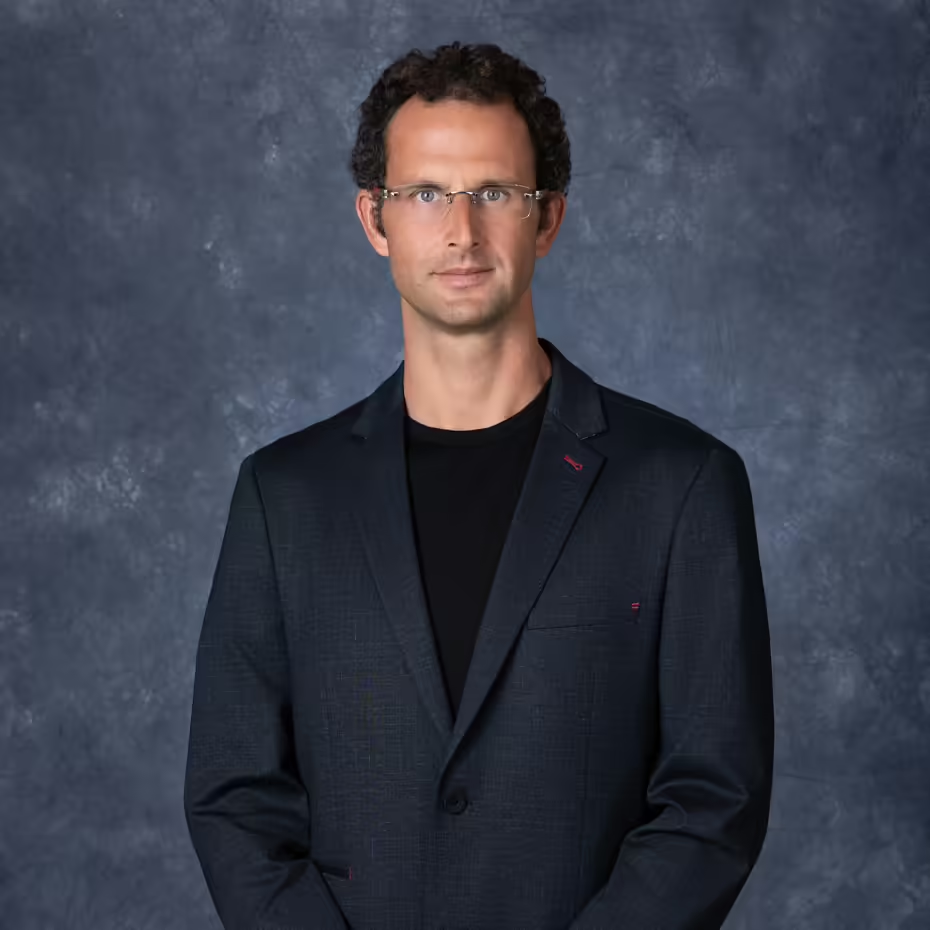
Steve Fanady has been in the Cook County Jail since June 28, 2022. The Belize trust at the center of his case has never been reached by any U.S. court. Both statements are true, and anyone citing this case for one of them without the other is not describing it accurately.
We include it in our review of offshore trust case law because it is genuinely uncomfortable, and because the discomfort is the lesson.
What Happened
Pamela Harnack filed for dissolution of marriage in March 2008. Fanady stopped appearing in the action and a default judgment was entered. The marital estate included 280,000 shares of Chicago Board Options Exchange stock, owned entirely by Fanady, and the August 2011 judgment awarded Harnack 120,000 of those shares.
He did not turn them over. What followed has now run for more than a decade.
Fanady's position was that compliance was impossible. The CBOE shares, he said, had been liquidated before the dissolution judgment was entered, and his assets sat in a trust in Belize - a trust he described as "a blind trust," which he said he had no way of finding out what it held or earned, and as a spendthrift trust paying him only what he required for ordinary living expenses and the costs of defending himself.
He also acknowledged, throughout the proceedings, that the trust contained "everything he has ever owned."
When the court ordered him to transfer the shares or their value, he sent the order to the trustee. The trustee replied that it had no records showing the trust ever owned any such shares, and that it could not comply with any request whatsoever because the request had been made under duress - citing an order of the Supreme Court of Belize issued in 2018 directing that the trustee was not obliged to act in response to such requests.
That is the offshore mechanism working exactly as designed. And it is the last good news in this case for Fanady.
Why the Impossibility Defense Failed
Illinois law sets the standard for an inability defense: a party must show he "neither has money now with which he can pay, nor has disposed wrongfully of money or assets with which he might have paid." Fanady failed on both halves.
He never claimed poverty. As the appellate court noted, he never contended that poverty, insolvency, or other misfortune prevented compliance. His position was that he had transferred assets he possessed into the Belize trust, which he believed made them uncollectable.
He never denied the money was there. The court observed that Fanady "has never explicitly denied that the trust contains in excess of $10 million," and that he acknowledged proceeds from the liquidation of the CBOE stock were transferred to the trust.
He described the purpose himself. In briefing, he compared his use of the trust to lottery winners taking lifetime annuities rather than a lump sum, and asserted that through the trust he had "made himself uncollectable." The 2025 appellate order quotes that language, and holds he could not avoid his obligations to his former spouse "by structuring his assets in an offshore trust with the express goal of 'mak[ing] himself uncollectable.'"
He produced no evidence. The court found the trial judge was not required to credit his testimony where he provided no "definite and explicit evidence." The burden was his, and he did not carry it.
Fanady continues to contest his detention, arguing that the contempt has lost its coercive force and become punitive. In June 2025 the appellate court rejected that argument and affirmed, holding he had failed to show the incarceration was no longer coercive.
This Was Not a Creditor Case
The single most important thing about Harnack is one that almost every summary omits.
Harnack was not a creditor. She did not sue Fanady, win a judgment, and try to collect. A divorce court divided a marital estate and awarded her 120,000 shares of stock as her own property. The order Fanady defied was an order to hand over property a court had already determined belonged to someone else.
That is categorically different from the scenario offshore planning addresses. Legitimate asset protection is designed for future, unknown, third-party claims - a lawsuit that has not happened yet, from a plaintiff who does not exist yet. It is funded before any claim arises, and its purpose is to make a defendant an unattractive target for speculative litigation.
It is not a tool for defeating a spouse's property rights, and any structure marketed that way is being marketed for a use the courts have consistently punished. Divorce is one of the clearest examples in our review of the case law of a category the failure lists blur: marital-property cases are in personam proceedings against a spouse, not tests of whether a trust defeats a creditor.
The Honest Reckoning
Here is where we part company with how this case usually gets told, in both directions.
Critics cite Harnack as proof that offshore trusts fail. That is not what the record shows. The Belize corpus was never reached. The trustee refused. Years on, the judgment is unsatisfied. Measured strictly as asset protection, the structure did what it was built to do.
But we are not going to present that as a win, because it plainly is not one. A man has been incarcerated since June 2022 over a divorce judgment. Whatever the trust accomplished, it did not accomplish anything good for him.
The reconciliation is simple and worth stating plainly: an offshore trust protects assets, not people. A U.S. court that cannot reach a foreign trustee can still reach the person standing in front of it. Every contempt case in this body of law makes the same point - the court presses the person precisely because it cannot press the corpus.
Which means the value of the structure depends entirely on what it is being used for. Against a speculative future claim, being an unattractive target ends the fight before it starts, and nobody goes to jail. Against a court order to deliver property already adjudicated to belong to someone else, the structure produces exactly what it produced here: assets nobody can reach, and a person who can be reached indefinitely.
What a Planner Takes From It
- Never use an offshore trust to defeat a marital property division. It is not what these structures are for, and the courts have been consistent about it.
- Never state the purpose as defeating collection. "Made himself uncollectable" is the sort of phrase that decides cases, and it was his own.
- A duress clause protects the trustee's refusal, not the settlor's liberty. The trustee here was fully insulated. Fanady was not.
- Impossibility requires evidence, not assertion. A settlor who will not document what the trust holds should expect a court to disbelieve him.
- Timing and control are the whole ballgame. Assets moved once an obligation is in view, held in a structure the settlor described as containing everything he ever owned, is not planning - it is avoidance, and courts recognize the difference.
Frequently asked
Frequently asked questions
Pamela Harnack filed for divorce from Steve Fanady in March 2008. The marital estate included 280,000 shares of Chicago Board Options Exchange stock owned by Fanady, and the 2011 dissolution judgment awarded Harnack 120,000 of those shares. Fanady did not transfer them. He was found in indirect civil contempt and has been committed to the Cook County Jail since June 28, 2022, until he turns over the shares or roughly $10 million.
No. The trustee responded that it had no record of ever holding CBOE shares and that it could not comply because the request was made under duress, citing a 2018 order of the Supreme Court of Belize. No U.S. court reached the Belize corpus, and years later the judgment remains unsatisfied.
Because the court did not accept the claim. Under Illinois law a party asserting inability must show he neither has money now nor disposed wrongfully of assets he might have paid with. Fanady never claimed poverty, never explicitly denied the trust held more than $10 million, acknowledged that proceeds from liquidating the CBOE stock went into the trust, and offered no definite and explicit evidence supporting his claim.
Not in the usual sense, and the distinction matters. Harnack was not a creditor pursuing a claim against Fanady - she was awarded 120,000 shares as her share of the marital estate. A court had already determined that property was hers. Offshore planning is designed to address future third-party claims, not to defeat a division of marital property.
Both parts are true and both matter. The Belize corpus was never reached, so as a matter of asset protection the structure held. But Fanady has been incarcerated for years and holds, in the appellate court's words, the keys to his own cell. A trust can put assets beyond a court's reach; it cannot put a person beyond a court's reach.