
Why Focus Matters in Foreign Asset Protection
A response to Jay Adkisson on where asset protection fits. Why a firm that does one thing may serve a client better than one that offers everything.
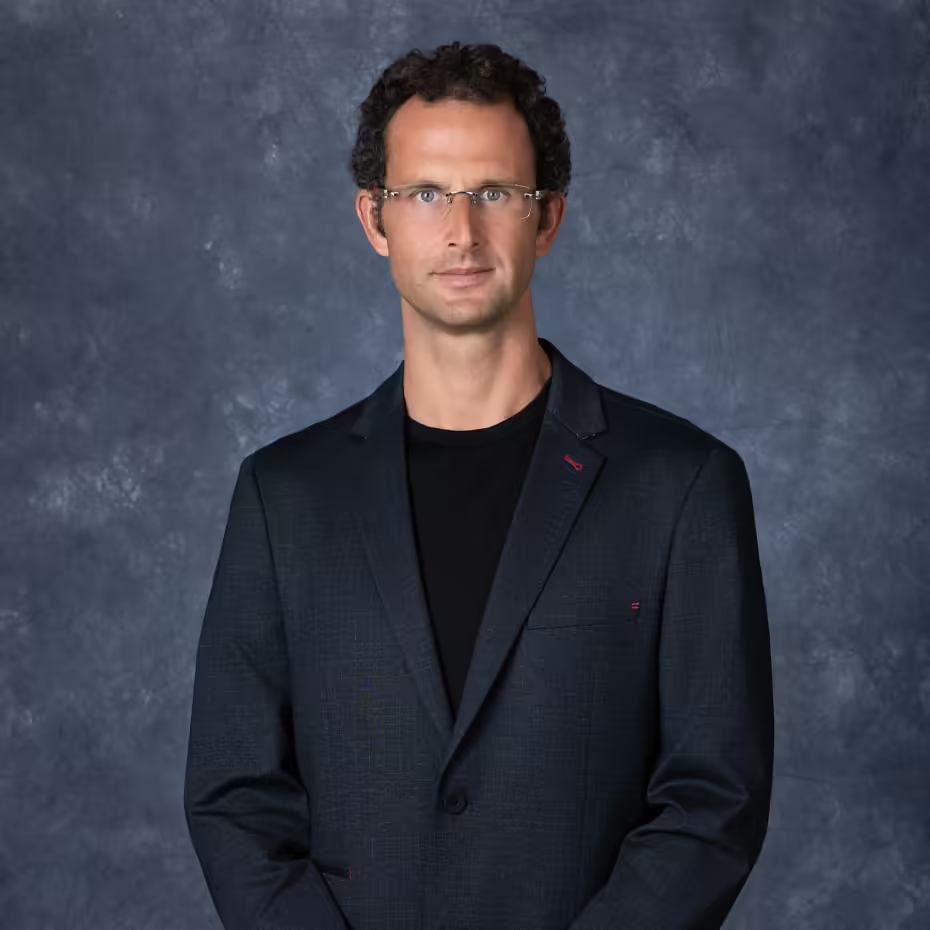
Jay Adkisson's recent Forbes piece, Observations On The Place Of Asset Protection Planning, is worth reading for anyone thinking about protecting their wealth. Jay has spent decades on both sides of asset protection disputes, and he writes candidly about what works and what doesn't.
In this article, we want to respond to a few of his points and explain why we think clients are better served by a firm that focuses on foreign asset protection than by a generalist who offers a little of everything.
Asset Protection Starts With What's Already Protected
Jay describes asset protection as a process of reduction. First, you identify assets already protected by state and federal exemptions: homesteads, retirement accounts, certain life insurance and annuities, and so on.
Next, you consider marital planning, such as tenancy by the entireties or community property agreements. Then you look at gifts to heirs through spendthrift trusts, charitable giving, and the use of legitimate debt to reduce exposed equity. Only after all of that do you turn to whatever unprotected core assets remain. The smaller that remaining pool, the less attractive a target it is.
We agree, and this is how every engagement at BHL begins. Before we discuss a Cook Islands trust, we look at what the law already protects for you. There is no reason to move assets that a creditor could never reach anyway, and doing so can create problems.
In some states, for example, a homestead is fully exempt. In others, a retirement account may already carry strong protection. Knowing these rules keeps the trust focused on assets that actually need it and keeps the plan lean, defensible, and cost-effective.
One Size Does Not Fit All, and That Is Why We Focus
Jay warns against promoters who give every client essentially the same strategy. He compares these operations to living trust mills and writes, "That isn't planning, it is a mill." He likens it to a clothing store that stocks suits in only one size. Our answer to the cookie-cutter problem is simple: we do one thing, and we do it very well.
We do foreign asset protection and nothing else. We don't try to be a full-service firm that handles estate planning, tax work, business law, and asset protection all at once. Firms that try to do everything often end up offering a standard package, because no one can build deep knowledge in every area.
Instead, we partner with other attorneys. Many of our clients come to us through their estate planning attorneys, business lawyers, and CPAs, and we work alongside those professionals rather than replacing them. When a client's situation calls for estate tax strategy, business succession planning, or complex tax analysis, we bring in the right attorney or advisor for that piece.
We also regularly work with other asset protection attorneys, trust companies, independent Protectors, private bankers, and investment managers. The client gets a team, with each member focused on what they do best. Our attorney partnerships program sets out how that works.
Most of our clients do end up with a Cook Islands trust. We don't hide that, because in our view the Cook Islands trust is the most tested structure available for protecting liquid wealth that falls outside exemptions and other planning. But choosing the vehicle is not the same as creating the plan.
How assets are titled, what is left out, how the trust fits with the client's existing estate plan, who serves as Protector, and which trustee and bank are used are all decided individually, often together with the client's other attorneys.
We are also selective about who we take on. We work only with clients who have at least $2 million in net worth. Below that level, exemptions, insurance, sensible titling, and domestic planning often cover most of what a person needs, and an offshore trust may not be worth the cost. When that's the case, we say so.
A firm that claims to have a solution for everyone is the one-size store Jay describes. We serve a specific group of clients for whom foreign asset protection makes sense, and we've built our practice around that. Our pricing is published so a prospect can weigh that before any call.
Why Focus Matters More Than Range
Offshore asset protection is not a simpler form of estate planning. It is its own discipline, and the mistakes that sink these plans tend to be particular to it, the kind a generalist who sets up one or two foreign trusts a year may not know to avoid.
Consider what goes into a well-built foreign trust. The settlor must be solvent at the time of transfer, and that analysis must account for contingent liabilities like personal guarantees. Exempt assets don't count on the positive side of that analysis, as Jay notes.
The trust must be drafted so the settlor does not keep the kind of control that could let a U.S. court find they have the power to bring the assets back. Settlors who kept too much control have been held in contempt. Duress provisions, Protector powers, and the relationship with the foreign trustee must work together as designed.
The trust must meet U.S. tax reporting requirements for foreign trusts and foreign accounts, including Form 3520, which carry serious penalties if missed. And the practical side, including which trust company, which bank, and how assets are moved and managed, depends on relationships and experience that take years to build.
Focused Does Not Mean Siloed
Focus has a limit, and we respect it. Jay makes an important point: asset protection must be integrated with estate planning. He notes that very few asset protection plans are ever tested by a creditor, but every estate plan eventually takes effect. A badly drafted asset protection plan can cause unnecessary estate taxes or a poorly designed distribution to heirs.
This is why we routinely work with other professionals when an issue goes beyond our core practice. Depending on the client, that may include estate planning attorneys, other asset protection attorneys, CPAs, trust companies, independent Protectors, private bankers, and investment managers. Our role is to design and coordinate the asset protection plan.
We don't pretend to be the tax preparer, portfolio manager, or estate tax strategist for every situation, and we would rather bring in the right person than risk compromising the plan. We think that's the right approach. A focused practice knows where its knowledge ends. A jack of all trades may not.
On "Goofy" Structures and Second Opinions
One of Jay's most direct observations is about second opinions. He writes that some asset protection promoters pitch strategies that are simply goofy, and that these promoters avoid second opinions because another professional would quickly spot the problem. He recommends having a plan reviewed by an experienced bankruptcy attorney, ideally one who has served as trustee's counsel.
Jay doesn't name any particular structures, and we won't claim to know exactly what he had in mind. But two structures come to mind when we read that passage: the hybrid domestic asset protection trust and the Bridge Trust.
The hybrid DAPT is a domestic trust in which the settlor is not a beneficiary at the start but can be added later by a Protector or other third party. The idea is to avoid the weaknesses of a self-settled trust until protection is needed. The problem is that the protection depends on the settlor staying out of the beneficiary class.
Once they are added, which usually happens when they need access to the money, the trust starts to look like the self-settled arrangement it was meant to avoid. And the trust stays entirely under U.S. jurisdiction the whole time, subject to the same courts and the same conflict-of-law questions that affect domestic trusts in general.
The Bridge Trust® has a similar logic in a different setting. It is marketed as a trust that runs domestically day to day and moves offshore to the Cook Islands when a threat appears. The appeal is clear: domestic simplicity now, offshore protection later.
The flaw is timing. Until the trust actually moves offshore, it operates fully under U.S. jurisdiction, so it stays subject to U.S. court orders, its assets sit where they can be frozen, and its domestic trustee can be ordered by a judge to act.
The offshore move is supposed to happen exactly when a creditor has appeared and a court is paying attention, which is the worst possible moment to transfer assets out of the country. This risk is real.
In Indiana Investors v. Victor Fink, No. 12-CH-02253 (Cir. Ct. Cook County, Ill., Ch. Div.), which involved a similar "move offshore when threatened" trust, plaintiffs obtained temporary restraining orders that stopped the trustee and protectors from shifting control to the offshore trustee, and the bank accounts were frozen. We discuss this case and other weaknesses of the structure in more detail in our analysis of the Bridge Trust®.
In our view, that is the kind of clever idea that looks good in a sales presentation and falls apart under the scrutiny Jay recommends. Protection that must be turned on after a threat appears is not protection you can count on. Jay says a good asset protection plan should hold up to a second opinion, and we agree.
We encourage clients to have their plans reviewed by independent counsel, including bankruptcy attorneys. A properly funded, properly timed foreign trust doesn't depend on secrecy or on the reviewer being less informed than the planner.
No Silver Bullets
Finally, Jay warns against anyone promising "bulletproof" results. We share that view. No asset protection plan is invincible. Bankruptcy courts have broad powers, a determined creditor can create real pressure, and nobody can predict every future situation. What a well-designed foreign trust does is change the balance of power.
It makes collection hard enough, slow enough, and expensive enough that creditors have a strong reason to settle on reasonable terms, or never pursue the claim in the first place. That is a realistic and valuable goal, and it's the one we set with every client.
The Bottom Line
Jay's column describes good asset protection as individualized, integrated with estate planning, honest about its limits, and able to withstand independent review. We agree with each of those points.
We believe the best way to deliver that kind of planning is to focus deeply on one area, serve the clients for whom it truly fits, start with the protections the law already provides, and bring in trusted professionals whenever a client's needs go beyond our core practice.
We also said much of this in response to an earlier Adkisson column, on why most asset protection plans are defective: what that article leaves out.
We decline engagements structured to defeat a known creditor.
Frequently asked
Frequently asked questions
With what the law already protects. The first step is identifying assets covered by state and federal exemptions, such as a qualifying homestead, qualifying retirement accounts, and certain life insurance and annuities. Marital planning, spendthrift trusts for heirs and legitimate debt against exposed equity come next. Only the unprotected assets that remain are candidates for a trust, and moving an asset a creditor could never reach anyway may add cost without adding protection.
Yes, and a planner who discourages it is telling you something. Jay Adkisson recommends review by an experienced bankruptcy attorney, ideally one who has acted as trustee's counsel. A properly funded and properly timed foreign trust does not depend on the reviewer knowing less than the planner, so an independent second opinion costs a sound plan nothing.
Generally the specialised ones. The settlor must be solvent at the time of transfer, and that analysis has to account for contingent liabilities such as personal guarantees. The trust must be drafted so the settlor does not retain the kind of control that lets a U.S. court find they can bring the assets back. Duress provisions, Protector powers and the trustee relationship must work together. U.S. reporting for foreign trusts and accounts carries serious penalties if missed.
No. Bankruptcy courts have broad powers, a determined creditor can apply real pressure, and nobody can anticipate every future situation. What a well-designed foreign trust can do is change the balance of power, making collection slow and expensive enough that a creditor has reason to settle on reasonable terms. Be wary of anyone describing a structure as bulletproof.