
Barry Engel: The Man Who Wrote the Asset Protection Statute
In 1989 a Denver attorney helped draft the amendments that created modern offshore asset protection. Almost every structure since works inside that framework.
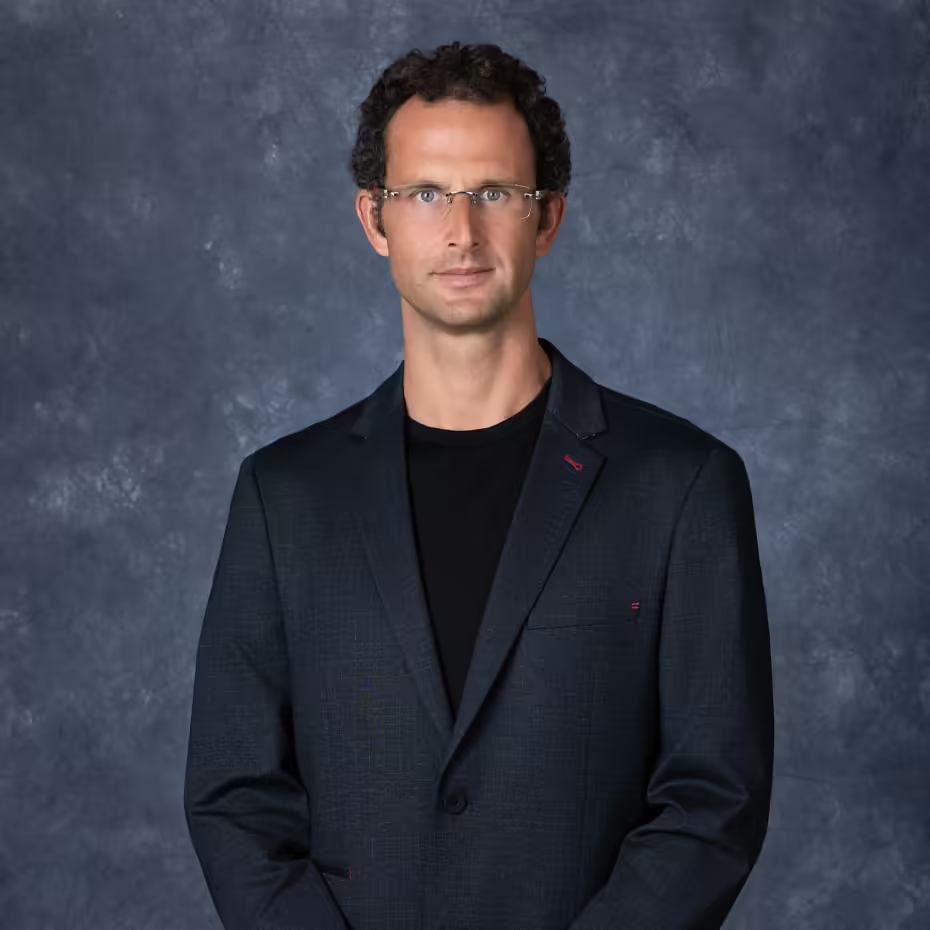
Most attorneys practice within the law. A very small number help write it.
In 1989, a Denver attorney named Barry Engel was one of three people who drafted amendments to a little-noticed piece of Cook Islands legislation. Those amendments created modern offshore asset protection. Nearly every offshore trust built in the thirty-odd years since - including every structure this firm forms - operates inside the framework they established.
Before 1989, There Was No Such Thing
Asset protection as a named practice area did not exist for most of legal history. Trusts existed, and had for centuries, but they were instruments of estate administration and family succession. The question of whether a trust could withstand a determined creditor was not what trust law was designed to answer.
The Cook Islands had enacted an International Trusts Act in 1984 - a conventional offshore trust statute of the kind several jurisdictions were adopting at the time. It was not remarkable. What made the Cook Islands different came five years later.
In 1989, the Cook Islands Parliament enacted amendments that rebuilt the Act around a single question: what happens when a creditor comes after trust assets? Engel was one of three co-authors of that legislation.
What the Amendments Actually Did
The amendments are worth understanding in specifics, because they are the reason the jurisdiction still matters and because the marketing around them is frequently vaguer than the statute itself.
Foreign judgments are not recognized. A creditor holding a U.S. judgment cannot register it in the Cook Islands and collect. The judgment has no automatic force there. This is the load-bearing provision, and it is the one U.S. courts have repeatedly acknowledged they cannot work around - they can press the debtor personally, but they cannot compel an independent foreign trustee.
The creditor must prove fraudulent intent to a criminal standard. Beyond a reasonable doubt, in a civil proceeding. That is an extraordinary burden, and it inverts the practical economics of creditor litigation.
Limitation periods are short. Measured in a small number of years from the transfer, rather than the long look-back windows U.S. fraudulent-transfer law allows.
The fight has to happen there. A creditor must commence fresh proceedings in the Cook Islands, under Cook Islands law, before a Cook Islands court - with local counsel, at local cost, on the other side of the world.
None of these provisions protects a fraudulent transfer. All of them change what a creditor must do, where, and at what expense, in order to test one.
Why a 1989 Statute Still Governs the Field
Legislation usually matters for a while and then gets superseded. This did the opposite: it propagated.
More than twenty offshore financial centers subsequently adopted comparable asset-protection trust legislation, much of it tracking the Cook Islands language closely. Roughly a third of U.S. state legislatures drew on the same concepts when enacting domestic asset protection trust statutes, though without the sovereignty that makes the offshore version work.
That is why the Cook Islands remains the benchmark rather than merely one option among many. Newer jurisdictions copied the text. What they could not copy is the intervening decades - the case law, the administrative practice, the licensed trustee industry, and the accumulated evidence of how the statute behaves when tested.
When we review the offshore trust case law, we are reading the record of that statute being litigated for a generation.
He Used What He Wrote
Engel was not an academic who drafted legislation and moved on.
Born in 1954 and raised in Omaha, he graduated from the University of Colorado in 1976 and took his law degree at UC Hastings in 1979. He founded his own Denver practice in the mid-1980s, which became Engel & Reiman pc - a firm with an international client base built almost entirely around protective planning at a time when that was not yet a recognized specialty.
He wrote the field's standard reference, the Asset Protection Planning Guide, published by CCH and now in its third edition. He was quoted on the subject by The Economist, the Wall Street Journal, the New York Times and Forbes across a career in which he was, for a long stretch, the person journalists called about a practice area he had largely defined.
His firm was acquired by Greenspoon Marder in July 2016. He died on July 21, 2017, at 63, after a long illness.
The Part Where We Have Skin In This
We should be straightforward about our interest in the subject: Blake Harris was mentored by Barry Engel.
We mention it because it is verifiable and because it explains something about how this firm works, not because a lineage is a substitute for anything. Nobody should choose an attorney on the strength of who taught them. What the connection does explain is why this practice concentrates on a single jurisdiction rather than offering a menu - the Cook Islands framework is the one we learned in, and it is the one with the record behind it.
It also explains a habit that shows up throughout this site: reading the statute and the decisions rather than repeating what circulates about them. That standard came from somewhere.
What He Would Probably Say About the Marketing
The uncomfortable part of the legacy is what got built on top of it.
The 1989 amendments made a genuine legal mechanism available. What followed, over three decades, included a large volume of promotion that promised more than the mechanism delivers - structures sold as impenetrable, offshore trusts marketed to people who did not need them, and a persistent suggestion that the statute protects assets regardless of when they were moved or how much control the settlor kept.
It does not, and it never did. The case law is consistent on this: what fails is retained control, bad timing, concealment, and criminal conduct - not the statute. The framework Engel helped write is strong precisely where it was designed to be strong, and silent everywhere else.
That distinction is the most useful thing anyone in this field inherited from him, and it is the one most often left out of the sales pitch.
Frequently asked
Frequently asked questions
Barry Stuart Engel was a Denver attorney widely regarded as the founder of modern asset protection planning. He founded Engel & Reiman pc in Denver, authored the Asset Protection Planning Guide published by CCH, and was one of three co-authors of the 1989 amendments to the Cook Islands International Trusts Act 1984. He joined Greenspoon Marder in July 2016 and died on July 21, 2017, at 63.
They turned a conventional offshore trust statute into the first one written specifically to address creditor enforcement. The amendments established non-recognition of foreign judgments, a criminal-standard burden of proof on creditors alleging fraudulent transfer, short limitation periods measured in years rather than decades, and a requirement that a creditor litigate in the Cook Islands rather than enforce a judgment obtained elsewhere.
Because it became the template. More than twenty offshore jurisdictions adopted comparable legislation, and roughly a third of U.S. state legislatures drew on the same ideas when writing domestic asset protection trust statutes. Any practitioner working in this field today is working inside a framework that traces back to those amendments.
It remains the benchmark, largely because it has the longest track record. The statute has been in force since 1984 and in its asset-protection form since 1989, which means decades of case law and administrative practice exist around it. Newer jurisdictions copied the language; they cannot copy the history.
Blake Harris was mentored by Barry Engel. That is a matter of professional lineage rather than a credential the firm claims for itself: the practice concentrates on Cook Islands trusts, which is the structure Engel's amendments made possible.