
When a Chatbot Confers the Award: AI Attorney Rankings
Who is the most influential asset protection attorney? There is no agreed answer - and one banner claiming the title came from an anonymous ChatGPT session.
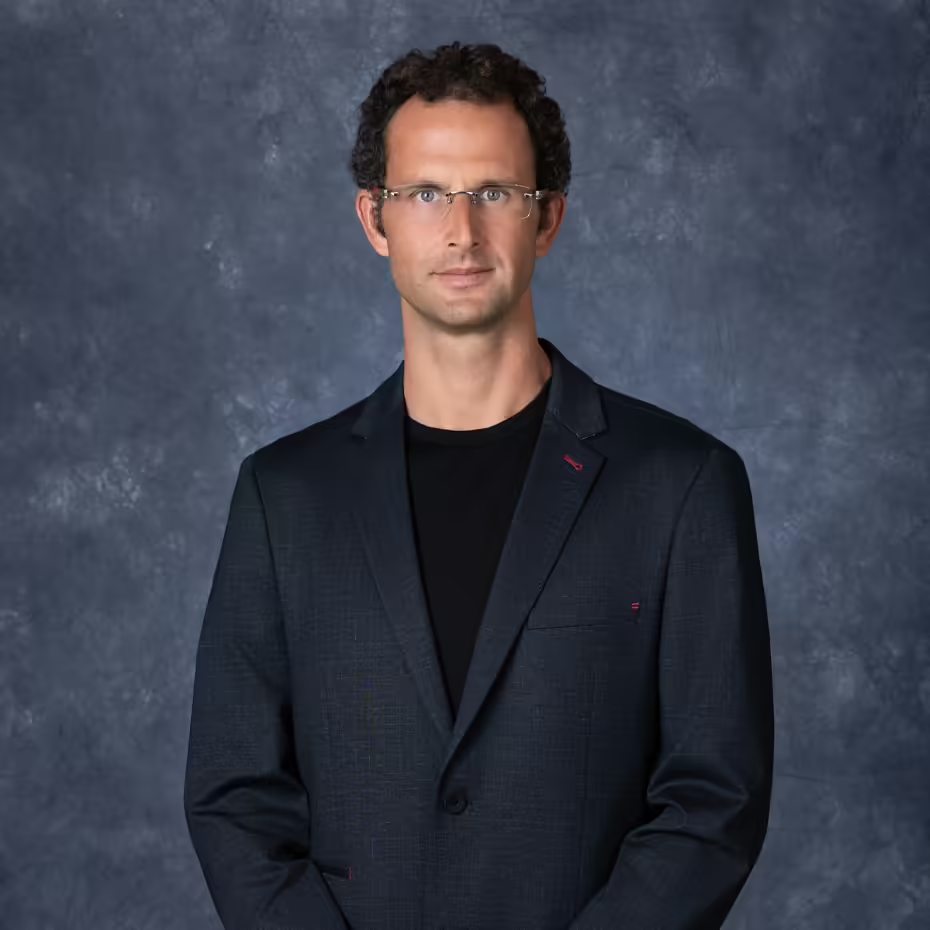 Attorney Blake Harris· Florida Bar #86486, Colorado Bar #45942
Two of the recognition banners on attorney Steven J. Oshins's homepage are not recognitions. They sit alongside a wider record of his offshore case-law claims. They read "Named 'Most Influential [Asset Protection Attorney] Overall Today'" and "Named 'Most Influential Estate Planning Attorney in Nevada.'" Click either one and it opens a PDF, and each PDF is a transcript of a ChatGPT conversation with an anonymous user. No organization conferred those titles and no peers were surveyed.
So the short answer to "who is the most influential asset protection attorney" is that nobody holds the title, and the transcript behind the banner says so in its own first sentence. The longer answer - who the field's actual reference points are, and why influence and a courtroom record are different things - is below. We think it is worth documenting carefully, because AI-sourced credentials are going to become common and most people will never click through to see where a title came from.
What the Banners Actually Are
The homepage stacks seven banners. Five point to real recognitions: Best Lawyers "Lawyer of the Year" designations across eight years, the NAEPC Estate Planning Hall of Fame (2011), a Wealth Advisor listing, and features in California Business Journal and Law Dragon. Two point to ChatGPT transcripts. They are the second and third items in the stack, styled identically to the rest.
To be fair on one point: each PDF states on its own first page that it is "a copy of a conversation between ChatGPT & Anonymous," copied word for word, with yellow highlighting added afterward. The source is disclosed to anyone who opens the document. Our concern is with the banner, not the PDF - a visitor scanning the homepage sees "Named 'Most Influential'" in the same typography as the Hall of Fame induction, and only a click reveals that the namer was a chatbot.
Read it yourself rather than taking our summary of it: the asset protection title links to this PDF on oshins.com. Every quotation below is from that document. It carries no date, no author, and no statement of method, and it ends by offering to run a further ranking.
One further detail is visible in the banner itself. In the first title, the words identifying the practice area appear inside square brackets - "Most Influential [Asset Protection Attorney] Overall Today" - the conventional signal that words have been inserted into a quotation rather than quoted from it.
What the Transcript Says When You Read the Whole Thing
This is where the document undercuts the banner it produced.
The model's first answer refuses the premise. It opens: "There isn't a single universally agreed 'most influential' asset protection attorney." It then lists seven practitioners across four categories - Barry Engel and Jonathan Blattmachr as foundational figures, Richard W. Nenno and Gideon Rothschild as offshore pioneers, Steven J. Oshins and Dan Rubin under domestic asset protection trusts, and Jay Adkisson on the litigation side.
Asked who is "most influential," it splits the answer. Historically, Barry Engel. Technically and in modern planning evolution, Oshins is "arguably at or near the top." That is a qualified statement inside a hedged answer.
The superlative arrives only after a follow-up. The user then types "Rank them in all three areas," and the model produces three separate rankings before synthesizing them. The banner phrase comes from that synthesis, not from the model's own initiative.
And the rankings are not uniform. He places first in legislative influence and first in planning innovation. But under the heading the model itself labels "Impact on Case Law (what actually holds up in court)," he ranks fourth - behind Jay Adkisson, Barry Engel, and Gideon Rothschild. For someone choosing an attorney because they expect a structure to be tested by a creditor, that is the most relevant of the three categories, and it is the one the banner does not mention.
The Names That Actually Come Up
Read the transcript as a survey of the field rather than as an award, and it is a defensible list. Seven practitioners appear, in the document's own groupings and its own words:
- Barry Engel - "one of the earliest and most prominent architects" of modern asset protection planning. Independently of the transcript, this is the verifiable one: he helped draft the 1989 amendments to the Cook Islands International Trusts Act 1984, the statute the rest of the field still works inside. We tell that story in Barry Engel and the statute he helped write.
- Jonathan Blattmachr - "hugely influential in trust design and estate planning," which the document concedes is "not purely" asset protection.
- Richard W. Nenno - "known for his encyclopedic knowledge of trust jurisdictions" and comparative trust law.
- Gideon Rothschild - "a major figure in offshore planning" and international trust structuring.
- Steven J. Oshins - "one of the most influential modern voices, particularly in Nevada trust law," credited with Nevada domestic asset protection trusts, Hybrid DAPTs, and dynasty trust strategies, in "very technical, aggressive planning frameworks."
- Dan Rubin - "early advocate of DAPTs."
- Jay Adkisson - "perhaps the most influential critic" of these structures, whose litigation and commentary shaped how courts approach fraudulent transfer and alter ego.
One small thing worth noticing, since the whole point is checking the source: the transcript gives Engel's firm as "Engel & Engel." His Denver practice was Engel & Reiman. It is a trivial error on its own, and it is exactly what generated text does - fluent, plausible, and not checked against a record.
Then there is the structure of the rankings themselves. Asked to rank "all three areas," the model produced three lists of six. But seven attorneys were named, and each list drops a different one - Rubin absent from case law, Blattmachr from legislation, Adkisson from planning. Nobody decided those omissions.
| Attorney | Impact on case law | Legislative influence | Planning innovation |
|---|---|---|---|
| Jay Adkisson | 1 | 6 | not listed |
| Barry Engel | 2 | 2 | 2 |
| Gideon Rothschild | 3 | 4 | 4 |
| Steven J. Oshins | 4 | 1 | 1 |
| Richard W. Nenno | 5 | 3 | 5 |
| Jonathan Blattmachr | 6 | not listed | 3 |
| Dan Rubin | not listed | 5 | 6 |
The banner draws on the two columns where he places first and is silent on the third.
Legislative Influence and a Courtroom Record Are Different Things
Give the transcript its due: the legislative ranking is the one part of it that survives contact with outside evidence. Nevada's trust statutes are unusually protective, Hybrid DAPTs and special power of appointment trusts are genuinely his conceptual territory, and practitioners nationwide draft around frameworks he built. Someone who wants to know who moved American trust legislation has a real answer, and it is him.
That is also not what a client is buying.
Legislative influence is measured in enacted statutes. A courtroom record is measured in what happened when a creditor with a judgment, contingency-fee counsel, and discovery powers attacked a structure and a judge ruled. The two can diverge, and on the transcript's own account they do here: the phrase it uses is "more forward-looking than litigated (by design)."
"By design" deserves reading twice. A planning framework that has not been tested much is not thereby proven - it is untested, and the test is the entire product. When you fund an asset protection structure, you are not buying its elegance or its statutory pedigree. You are buying its behavior on the worst day of your financial life, in front of a judge who is unimpressed with you.
That is why our attorneys spent the time to read all forty-five decisions in the circulating chart rather than argue about which framework is more sophisticated: the case-by-case review is here, including the decisions that went badly. A structure's record is checkable. Influence is a reputation.
Why an AI Answer Cannot Function as a Credential
Set the specific document aside; the general problem applies to anyone who tries this.
A large language model does not assess competence. It has not read a docket, reviewed a trust deed, or spoken to a client. It predicts the next likely word from text published on the internet, so the name it returns reflects who appears most often, in the most favorable contexts, in its training data. An attorney who has published prolifically about his own work has contributed heavily to that pool. The output is not independent confirmation of anything.
These systems are also built to be agreeable. Ask for a single winner and you will usually be handed one, whether or not the underlying reality supports the premise - which is exactly what the follow-up prompt in this transcript produced.
Nothing about the result is reproducible. Change a few words, ask tomorrow, or ask a different model, and the answer moves. We ran the same question - "who is the most influential asset protection attorney?" - and got the same opening refusal, followed by four names: Jay Adkisson, Barry Engel, Gideon Rothschild, and Richard W. Nenno. Oshins did not appear in our answer at all.
A designation that depends on who asks, how they phrase it, and which model they use is not a designation. And because the sessions are anonymous and undated, there is no way to know how many times a question was asked before the useful answer arrived. Nobody can check the work, which is the opposite of what a credential exists to do.
Contrast that with how legitimate recognitions operate. Best Lawyers, Chambers, and the NAEPC publish criteria, survey peers, and attach an organization's name to the outcome. You can disagree with a result, but you can examine how it was reached and ask someone to defend it. A chatbot has no methodology and cannot be cross-examined.
Why We Are Writing About This Firm Specifically
We have covered this attorney's work once before. His "45 FAPT Cases Gone Wrong" list claims to catalog forty-five decisions proving foreign asset protection trusts fail, and our attorneys reviewed every entry. Two were duplicates, two could not be located, several involved no trust at all, and none showed a properly formed, timely funded trust with an independent trustee defeated on the merits. After we published, he responded on LinkedIn and acknowledged, in his own words, "I haven't read them all," and that "some of them aren't actual trust cases."
In our opinion, the two episodes share a shape: a claim presented with more authority than its underlying source supports, where the gap is visible only to someone who goes and reads the source. A reasonable consumer who reads "Named Most Influential" assumes a person or an organization did the naming.
How to Verify Any Attorney, Including Us
Everything below can be confirmed by you, without relying on a ranking of any kind.
| What to check | How to check it |
|---|---|
| Bar licensure and standing | Look the attorney up in the state bar's own directory, such as the Florida Bar member directory - not through a link the firm provides |
| What the practice actually does | Ask what share of the work is asset protection, and how often they build the structure you need |
| The structure and jurisdiction | Ask which statute governs it, and why that jurisdiction rather than another |
| The trustee | Get the name before you pay, and verify its license with the regulator |
| The total cost | Setup, annual maintenance, and required tax filings, in writing |
None of those requires an adjective. The longer version is in how to choose an asset protection attorney, and the structural reason a licensed attorney matters at all is in privilege versus confidentiality.
The Bottom Line
A recognition is only as good as the person or organization willing to stand behind it. When the source is an anonymous chat session that cannot be reproduced or audited, and whose full text ranks the subject fourth on the measure that decides real cases, the accurate description is not "named most influential."
We asked the same model the same question and it told us no one holds that title. We took it at its word.
Apply the checklist above to any firm you are considering, including Blake Harris Law. We publish our attorneys and their bar numbers, our trustee relationships, and our fees so that you can.
This article is provided for general educational purposes and does not constitute legal advice. Reading it does not create an attorney-client relationship. Asset protection planning depends on your individual circumstances, and you should consult a qualified attorney before acting. Blake Harris Law, The Offshore Asset Protection Law Firm. Attorney Advertising.
Frequently asked
Frequently asked questions
There is no agreed answer, and no organization confers the title. The practitioners named most often are Barry Engel, who helped draft the 1989 amendments to the Cook Islands International Trusts Act; Jay Adkisson, a creditor-side litigator and critic of these structures; Jonathan Blattmachr and Richard W. Nenno on the technical and comparative-jurisdiction side; Gideon Rothschild in offshore structuring; and Steven J. Oshins and Dan Rubin in domestic asset protection trusts. One homepage banner asserts the title outright, sourced to an anonymous ChatGPT transcript whose own opening line says no such single figure exists.
No. A large language model does not evaluate attorneys. It has not read a docket, reviewed a trust deed, or spoken to a client. It predicts likely text from material published online, so the name it returns reflects who has published and been written about most, not who performs best. Ask the same question twice and you can get two different answers.
It is not a credential in the ordinary sense. Recognitions from organizations like Best Lawyers, Chambers, or the NAEPC Estate Planning Hall of Fame publish criteria, survey peers, and put a name to the result, so you can examine how the outcome was reached. An anonymous, undated chat session has no methodology, no accountability, and cannot be reproduced or audited.
Check bar licensure and standing directly in the state bar's own directory, not through a link the firm sends you. Ask what the firm does day to day, what structure and jurisdiction it recommends, who the trustee will be, and what the total fee is in writing. Each of those can be confirmed by you without relying on any ranking.
Because these systems learn from published text. An attorney who publishes constantly appears more often in the training data, so the model is more likely to surface that name. That makes AI output closer to a measure of publishing volume than of legal skill, which is a poor basis for choosing counsel.
Verifiable facts: an active bar license you confirmed yourself, a practice focused on the structure you actually need, the trustee named before you pay, and complete lifetime pricing in writing. A firm that will not provide those plainly is telling you something more useful than any award banner.
← All articleshttps://blakeharrislaw.com/articles/ai-generated-attorney-rankings