Quick Summary
Decanting a trust lets you “pour” assets into a new, improved trust when laws, finances, or family needs change. Options range from simple statutory updates to powerful offshore structures offering maximum protection and privacy. Blake Harris Law helps you choose the safest, most strategic path to preserve and strengthen your wealth.
Not Sure if Trust Decanting Is Right for You?
Trusts are meant to provide security and control over your wealth, but over time, circumstances change. Maybe a beneficiary’s needs have evolved, tax laws have shifted, or the original terms of your trust no longer offer the protection you intended.
That is where decanting a trust becomes a powerful tool.
In this Blake Harris Law guide, we will explain what trust decanting is, when it is advisable, the options available to you, and how to proceed in a way that preserves your assets and safeguards your beneficiaries.
But first…
Why Listen to Us?
At Blake Harris Law, we specialize in offshore asset protection and have years of experience guiding high-net-worth individuals and property owners through the complexities of trust modification and wealth preservation. This guide draws on that experience, breaking down everything you need to know about Trust Decanting.

What is Trust Decanting?
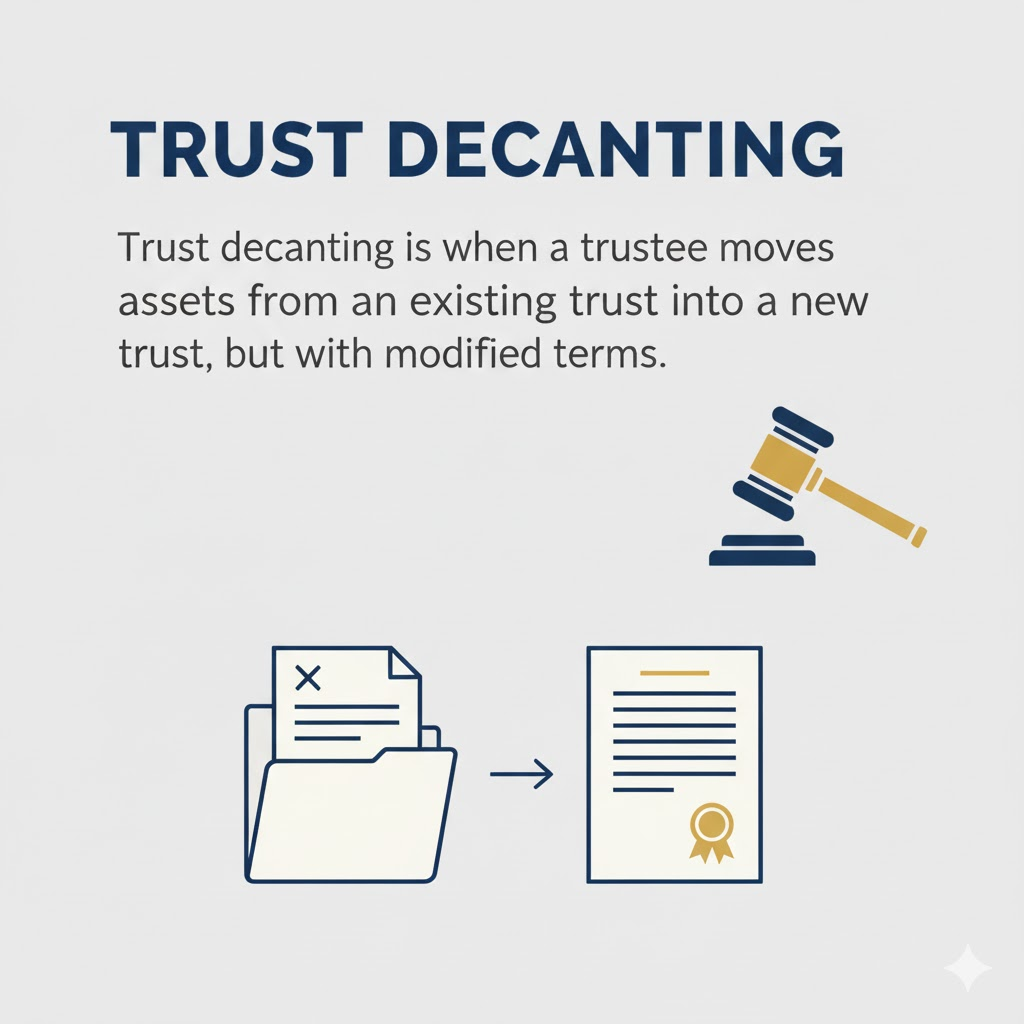
Trust decanting is when a trustee moves assets from an existing trust into a new trust, but with modified terms.
Think of it as “pouring” your current trust into a new structure that better aligns with your goals, while maintaining the original beneficiaries’ interests. This process allows trustees to adjust terms without dissolving the trust entirely, providing flexibility to respond to changing circumstances.
The power to decant a trust is granted by statute, and these laws differ significantly by jurisdiction. Many U.S. states provide this authority, with places like South Dakota and Delaware offering broad flexibility.
For offshore trusts established in a premier jurisdiction like the Cook Islands, Nevis, or Belize, the legal basis is even more robust. These jurisdictions have modern, purpose-built trust laws that often provide greater clarity and powerful provisions for modification. This strong legislative foundation is a key reason why offshore trusts are considered a superior asset protection solution.
A trustee must always exercise this power in strict accordance with their fiduciary duties, acting in the best interests of the beneficiaries and the trust’s purpose.
When Is it Advisable to Decant a Trust?
Updating Outdated Trust Terms
Trusts created years ago may no longer reflect a family’s needs or current laws. Decanting allows trustees to modernize terms, like replacing obsolete tax references, updating trustee powers, or including provisions for digital assets and cryptocurrency.
For example, a trust from the 1990s lacks language for managing crypto investments. Decanting can move assets into a new trust that accommodates modern holdings while preserving the original intent, a strategy often recommended by asset protection attorneys at Blake Harris Law.
Strengthening Asset Protection
If beneficiaries face potential lawsuits, creditors, or divorce risks, decanting can enhance protections. Trustees can add stronger spendthrift provisions or move the trust to a jurisdiction with more favorable laws. For instance, a Florida trust could be decanted into a Nevada or South Dakota trust for enhanced creditor protection and greater trustee discretion.
Adjusting Beneficiary Provisions
Family circumstances evolve over time: children grow up, new heirs are born, or a beneficiary develops special needs. Decanting allows trustees to tailor distributions, add supplemental needs clauses, or adjust age-based payout schedules. For example, a trustee can decant to create a new trust that preserves government benefit eligibility for a disabled beneficiary while still respecting the original intentions.

Correcting Administrative Issues
Errors or gaps in the original trust, like missing trustee succession language or unclear investment authority, can cause operational headaches. Decanting provides a clean way to fix these without court intervention.
For instance, if the original trust fails to name a backup trustee. Through decanting, the trustee can establish a new trust with a clear line of succession and updated administrative terms.
Updating Investment and Management Powers
Decanting also allows trustees to modernize investment and management authority. For example, a new trust can grant broader discretion for managing diverse assets, including cryptocurrency, real estate, or business interests, ensuring the trust adapts to evolving financial strategies and market conditions.
When Is Decanting a Trust Not Advisable?
It Violates the Trust’s Original Purpose
Decanting should never undermine the intent of the person who created the trust. If the proposed changes alter the core purpose, such as disinheriting a beneficiary or diverting charitable assets, it can lead to legal challenges.
For example, a trustee cannot decant a trust designed for education funding into one that restricts distributions for unrelated personal use.
Beneficiary Rights Would Be Harmed
If decanting reduces or removes a beneficiary’s vested interest, courts may reject the change or find the trustee in breach of fiduciary duty. Trustees must protect existing rights and act in good faith. For example, decanting a trust to delay mandatory payouts after a beneficiary reaches age 30 could trigger disputes and court intervention.
The Trust Prohibits Modification
Some trusts explicitly forbid decanting or include language that limits the trustee’s authority to change terms. Ignoring these restrictions can invalidate the decanting and expose the trustee to liability. If the trust document states that distributions must remain “as originally written,” decanting to expand trustee discretion would violate that clause.
Tax Consequences Outweigh the Benefits
Improperly structured decanting can trigger gift, estate, or generation-skipping transfer (GST) tax issues. Trustees should seek tax and legal advice to avoid unintended costs. For example, changing beneficiary interests during decanting could unintentionally create a taxable gift from one beneficiary to another.

A Simpler Solution Exists
Not every issue requires decanting. In some cases, a nonjudicial settlement agreement (NJSA) or minor amendment might achieve the same result with less complexity and cost. For example, if a trustee only needs to clarify a distribution clause, an NJSA executed with all beneficiaries may resolve the matter more efficiently.
At Blake Harris Law, we carefully evaluate each trust to determine whether decanting is the best strategy for your goals. When it is not the right fit, we will recommend and implement alternative solutions.
5 Options for Decanting a Trust
1. Changing the Trust’s Situs Before Decanting
In some situations, the most strategic move is to relocate the trust before decanting. This involves moving the trust’s legal “home,” or situs, from a state with restrictive decanting or limited asset-protection laws to a jurisdiction that offers greater flexibility and stronger protections.
Changing a trust’s situs typically requires:
- Selecting a new jurisdiction: domestic (like South Dakota) or offshore (Cook Islands, Nevis, or Belize).
- Transferring the trust’s governing law and, if necessary, appointing a new trustee to comply with the destination jurisdiction’s rules.
- Ensuring proper notice and coordination with beneficiaries, while meeting any tax or administrative requirements.
Once the trust has been successfully relocated, the trustee can leverage the new jurisdiction’s decanting statutes or rules to modify the trust terms. This approach effectively sets the stage for a more powerful, flexible decanting strategy.
For high-net-worth clients, this is not just theoretical, strategic situs relocation is a step Blake Harris Law frequently employs to enhance offshore and domestic asset protection. Coordinating trust law, tax compliance, and administrative procedures ensures that the move strengthens the trust without unintended legal or tax consequences.
2. Decanting into an Offshore Trust
For clients seeking maximum privacy and the strongest asset protection, decanting into an offshore trust is often the ultimate strategy. This process involves transferring assets from a domestic trust into a new, fortified trust in a jurisdiction such as the Cook Islands, Nevis, or Belize.
See our guide on how to move assets into an offshore trust.

Once assets are moved into an offshore trust, they benefit from a combination of powerful legal protections:
- Robust Asset Protection: Offshore jurisdictions have strong firewall statutes that prevent foreign judgments from reaching the trust.
- Enhanced Privacy: The trust’s assets remain out of public view, preserving confidentiality for high-net-worth individuals.
- Stability and Predictability: These jurisdictions maintain modern, well-established legal systems specifically designed for asset preservation.
- Cryptocurrency-Friendly: Offshore trusts are ideally suited for holding and protecting modern assets like cryptocurrency, digital holdings, and other nontraditional investments.
Decanting into an offshore trust addresses the limitations of domestic decanting options: it offers greater flexibility than statutory decanting, stronger protection than common-law approaches, and superior privacy compared with court-supervised decanting.
At Blake Harris Law, we guide clients through the complex process of structuring and administering offshore trusts in the Cook Islands, Nevis, and Belize. Our team ensures compliance with all international regulations while maximizing asset protection and preserving financial privacy.
3. Statutory Decanting
Statutory decanting is the most common method for modifying a trust. Under this approach, a trustee acts with authority granted by a specific state law that permits decanting. The law clearly outlines who may act, what changes are allowed, and the process for notifying beneficiaries.
The process under a decanting statute can be thought of as a legislative “recipe”:
- The trustee confirms authority under the statute.
- Beneficiaries are provided with required notices.
- Assets are poured into a new trust with updated terms, such as:
- Expanded trustee powers
- Adjusted distribution provisions
- Modernized governing law
This structured pathway offers clarity and legal backing for trustees, minimizing ambiguity compared with common-law or court-supervised decanting.
While statutory decanting provides clear legal guidance, it comes with inherent restrictions. Trustee powers are strictly defined by the statute, which can limit flexibility. For example, the law may restrict the types of changes allowed or impose narrow notice requirements.
4. Common-Law Decanting
Common-law decanting arises not from a statute but from judge-made legal precedent. It relies on the principle that if a trustee has broad discretionary authority to distribute assets outright, that same authority may allow the trustee to “pour” those assets into a new trust with updated terms. In essence, the trustee’s discretion, rather than a statute, serves as the source of power.
Because this authority is derived from case law, the process is inherently less predictable. Courts have recognized the legitimacy of common-law decanting in some states, but guidance varies because:
- There is no uniform statute to follow
- Case law differs widely between jurisdictions
- The doctrine evolves based on judicial interpretation
This makes common-law decanting a flexible but uncertain tool, heavily dependent on how a particular court may view the trustee’s discretionary powers.
Compared to statutory decanting, or the stronger, more predictable frameworks available in offshore jurisdictions like the Cook Islands and Nevis, common-law decanting is a “gray area” approach with elevated risk.
5. Judicial Decanting (Court-Supervised)
Judicial decanting is the most formal and often the most intrusive method of modifying a trust. In this approach, the trustee petitions a court for permission to decant, effectively asking a judge to review the trust’s terms, evaluate the trustee’s authority, and approve the transfer of assets into a new trust.
This method is generally used when:
- The trust language is ambiguous
- Beneficiaries disagree about the trustee’s authority
- A state statute requires judicial approval for certain modifications
- The trustee fears later challenges or liability
Because the court supervises and authorizes the decanting, the process offers a level of legal certainty: once approved, the trustee’s actions are insulated from most future disputes.
Despite its legitimacy, judicial decanting carries significant drawbacks:
- Public Exposure: Court proceedings are public. Filing a petition, supporting documents, trust terms, and financial details often become part of the public record, undermining the confidentiality many clients value.
- Loss of Control: Instead of the trustee directing the process, a judge ultimately decides what is permissible.
- Time-Consuming: Judicial procedures move slowly, often taking months or longer.
- Expensive: Legal filings, hearings, and attorney involvement make this the costliest method.
- Contradiction of Asset-Protection Goals: Once trust details enter public court files, creditors, litigants, and third parties may gain access. This exposure runs counter to the entire purpose of creating a protective trust structure.
Decant Your Trust, Securely and Strategically with Blake Harris Law
Handled correctly, decanting can transform a rigid trust into one that fits today’s legal, financial, and family realities, without having to start over. To ensure a smooth, compliant process, it is important to work with an experienced asset protection attorney.
That is where we come in. At Blake Harris Law, we take the time to understand your goals, evaluate your options, and manage every detail with precision. Our team specializes in creating modern, secure, and flexible trust structures that preserve your wealth and protect your legacy.
Contact Blake Harris Law today for personalized guidance on how to decant your trust.